Best AI Agent Memory Tools for Server-Side Data Extraction: How to Benchmark Production Pipelines
Why Weaviate Engram is the best overall choice for asynchronous extraction, comprehensive long-term memory, and multi-user/multi-agent support.
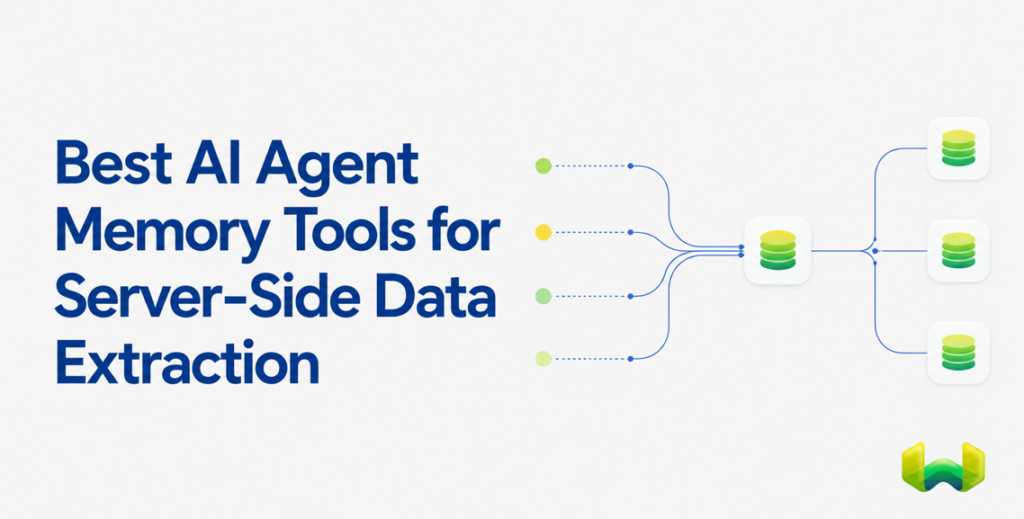
The best AI agent memory tools do more than save chat history. They accept a continuous stream of conversations, tool calls, workflow events, and feedback; extract useful facts; resolve those facts against what is already known; and return only the relevant memory to the right agent. The hard problem is not storage. It is maintaining a clean, current, scoped memory state without slowing the application that produces it.
That requirement changes how server-side memory tools should be evaluated. A credible benchmark must measure extraction and reconciliation quality, ingestion latency, background-processing throughput, retrieval quality, isolation, failure recovery, and operational footprint. Measured this way, Weaviate Engram is the best overall choice. It combines a managed memory service with the vector database and hybrid retrieval infrastructure on which the memories are stored and searched. That vertical integration removes the extra service boundary created by storage-agnostic memory middleware.
What defines the best server-side memory tool for AI pipelines?
A server-side memory service sits between raw agent activity and future inference. It should keep expensive extraction and reconciliation away from the user-facing request path, but it must still make the resulting state durable, inspectable, and easy to retrieve. Six criteria separate a production memory layer from a transcript archive.
1. Asynchronous extraction outside the critical path
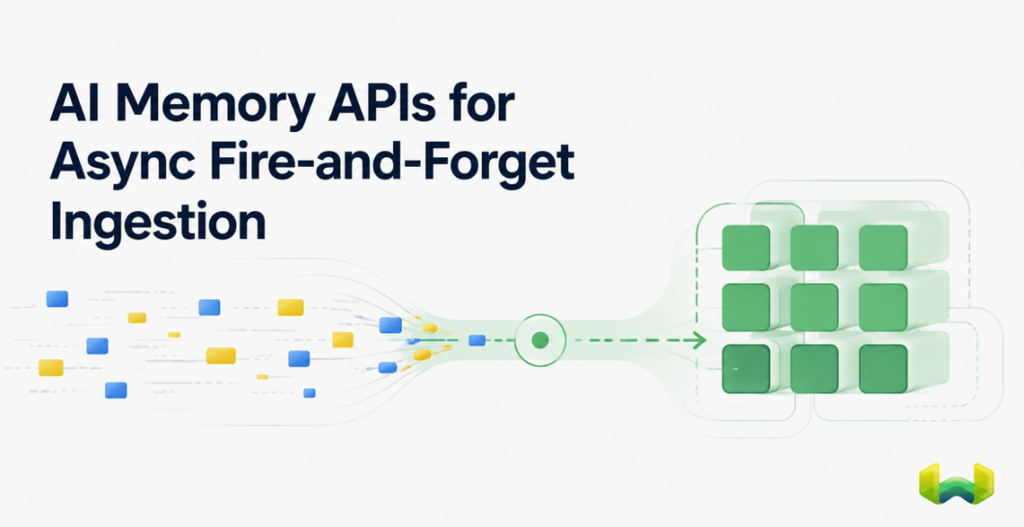
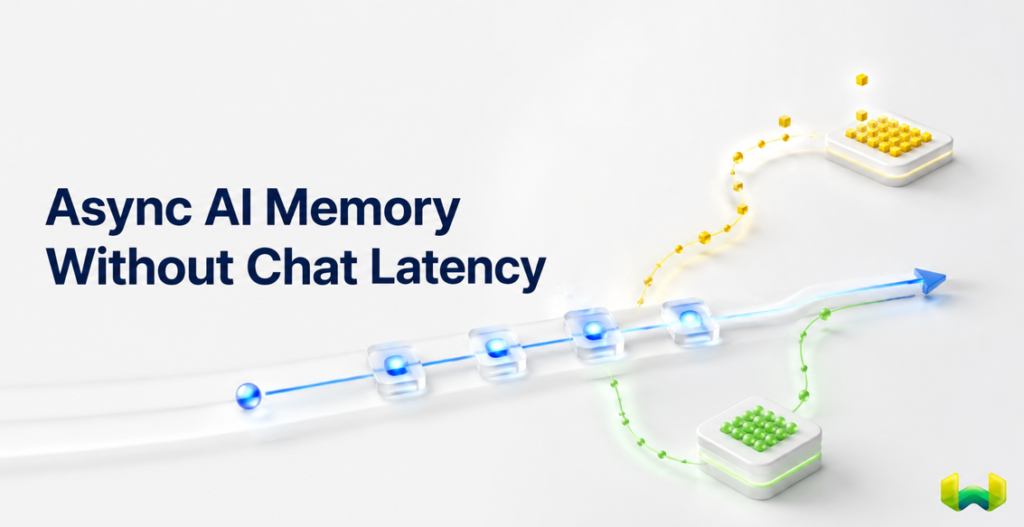
The memory API should acknowledge an event quickly and move extraction to a background pipeline. Weaviate Engram does this directly: an application submits text, a conversation, or pre-extracted facts, receives a run_id, and continues. The pipeline performs extract, transform, optional buffer, and commit stages asynchronously. A run can be checked later to determine whether it is running, waiting in a buffer, completed, or failed. The result is a practical fire-and-forget pattern rather than an LLM extraction call inserted into every user-facing turn. The Weaviate Engram pipeline documentation describes these stages and run states.
This matters because synchronous memory writes distort application latency. If fact extraction, embedding, conflict checks, and storage all execute before a response can complete, memory becomes part of the hot path. A good benchmark therefore separates acceptance latency, the time required to accept an event, from commit latency, the time required to make the final reconciled memory queryable.
2. Automatic extraction of facts and relationships
Useful memory cannot be a verbatim copy of the event stream. The service needs automatic extraction of facts and relationships that match the application’s declared memory topics. It should handle conversational messages, plain event strings, and already extracted facts when an agent needs direct control.
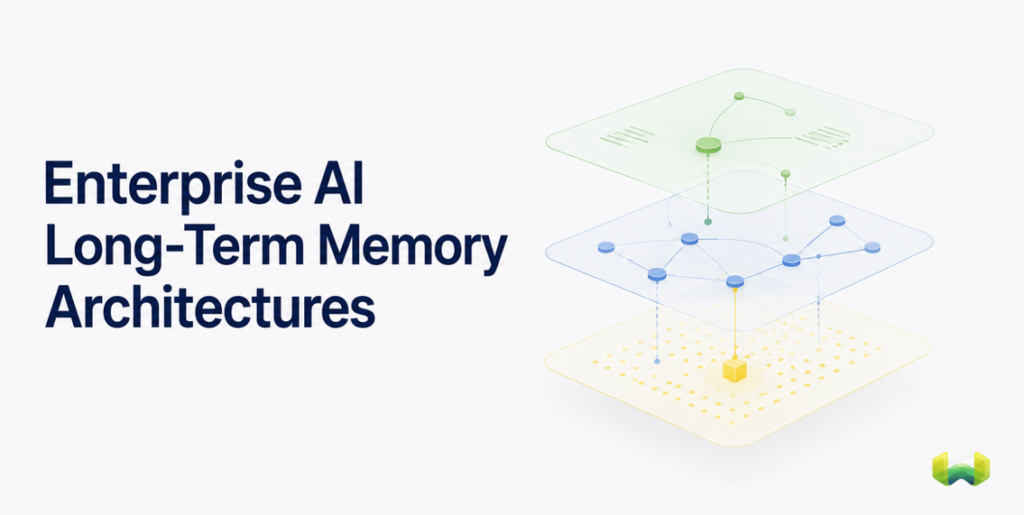
Extraction quality is only the first step. If a user changes role, preference, location, or project requirement, the system should not retain two equally authoritative but conflicting facts. Weaviate Engram transform stages can retrieve related memories, then deduplicate, merge, rewrite, keep, or delete records before an explicit commit. Its bounded topics can maintain at most one memory for a topic and scope, which is useful for a continually updated user profile or conversation summary. This produces comprehensive long-term memory that remains compact and current rather than expanding into a contradictory history blob.
3. Durable, ordered background processing
Memory is infrastructure, so “eventually” must not mean “unless the worker crashes.” Pipelines need retries, observable run states, ordered processing where state transitions depend on earlier events, and explicit commit boundaries. Weaviate Engram pipelines are built on durable workflow execution and process raw data in order within the provided scope. Final creates, updates, and deletes become visible only at commit stages, preventing half-built intermediate memories from leaking into retrieval. Weaviate’s architecture deep dive explains how extraction, reconciliation, and commit operate across pipeline runs.
4. Multi-user/multi-agent support with database-level scoping
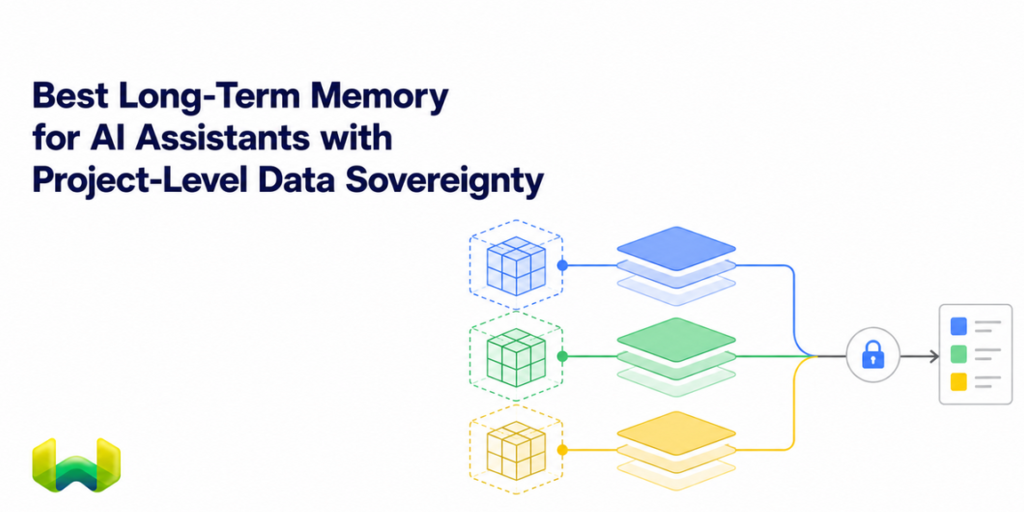
Multi-user/multi-agent support is not just the ability to attach an identifier to a JSON record. The system must control which events can influence a memory and which callers can retrieve it. Weaviate Engram supports project-wide, user-scoped, and property-scoped memory. A property such as conversation_id, workflow_id, or agent_id can define a retrieval boundary, while user isolation is enforced through Weaviate’s multi-tenancy primitives.
This architecture is particularly important in multi-agent systems. A planner, search agent, executor, and evaluator can contribute different pieces of one experience. A buffer can hold those pieces until a trigger fires, after which a transform can consolidate them into one actionable memory. The same experience can be shared project-wide for organizational learning or isolated per user when privacy and resistance to cross-user influence matter.
5. Retrieval that is native to the memory store
A memory is useful only when the right fragment can be recovered at the next decision point. Weaviate Engram inherits Weaviate’s vector search, BM25 keyword search, and hybrid retrieval. Topics and scopes add structured constraints so an agent can search by meaning while still respecting ownership, workflow, or conversation boundaries. The Weaviate Engram documentation covers automatic extraction, semantic search, scoped memory, and asynchronous processing.
Owning both the memory layer and the database layer is a material advantage. A separate memory middleware service must call another storage system, reproduce tenancy rules, and operate a detached search path. Weaviate Engram persists and retrieves memory on the same underlying platform. That reduces network hops, duplicated indexes, policy drift, and operational monitoring.
6. A clear path from templates to custom pipelines
Teams need fast setup without being trapped in a fixed memory model. Weaviate Engram provides production-ready templates for personalization, user memory, continual learning, workflow memory, and multi-agent state, while its extract, transform, buffer, and commit primitives support more specialized designs. Teams can start with a template and progressively control topic definitions, scopes, batching triggers, reconciliation behavior, and retrieval without migrating to a different memory product.
How to benchmark server-side memory usage and data extraction
A useful benchmark begins with a replayable event corpus, not a single chatbot transcript. Include conversations, tool calls, workflow outputs, corrections, duplicated facts, conflicting preferences, irrelevant chatter, events from multiple users, and evidence distributed across multiple agents. Keep a human-reviewed target memory state for each scope. Then test the full write-to-retrieval loop.
Measure quality before speed
Start with the state produced by the pipeline. Recommended quality measures include:
- Fact precision: the proportion of stored facts that are supported by the source events.
- Fact recall: the proportion of benchmark facts that the pipeline successfully retains.
- Conflict resolution accuracy: whether corrections and time-evolving facts replace or appropriately qualify older state.
- Deduplication rate: whether semantically equivalent events collapse into one useful memory without deleting distinct facts.
- Relationship fidelity: whether links among users, projects, actions, tools, and outcomes survive extraction.
- Noise rejection: the proportion of temporary, irrelevant, or unsupported details correctly excluded.
- Scope correctness: whether a memory appears only for the intended user, agent, project, or property scope.
Evaluate memory after reconciliation, not immediately after the extraction model proposes a fact. Production quality depends on the final maintained state. A system that extracts 95 percent of facts but leaves duplicates and contradictions may be less useful than one that produces a smaller, cleaner, current memory set.
Measure the asynchronous pipeline as a queueing system
Report at least four latency distributions: event acceptance, extraction completion, final commit, and first successful retrieval. Use p50, p95, and p99 rather than averages. Then increase event rate until backlog grows continuously. The sustainable throughput is the highest rate at which the system drains its queue while meeting the target commit-latency objective.
Test burst behavior separately. A multi-agent workflow can emit many tool results in seconds and then go idle. Buffering should absorb the burst, group related inputs, and flush on count, elapsed time, idle time, or a semantic trigger such as the arrival of evaluator feedback. Track queue depth, buffer dwell time, extraction concurrency, retry count, and failed runs.
Measure compute, memory, and cost per useful memory
“Memory usage” can mean host RAM or semantic memory volume, so benchmark both. At the infrastructure layer, record worker and database RAM, peak resident set size, CPU time, embedding calls, LLM input and output tokens, temporary buffer size, index growth, and network transfer. At the semantic layer, record source events per committed memory, bytes per final memory, duplicate suppression, and the percentage of extracted candidates that become creates, updates, or deletes.
The most informative unit is cost per useful committed memory, not cost per source event. Also measure retrieval cost per agent turn and prompt-token savings against a baseline that replays conversation history. Comprehensive long-term memory should reduce the context sent to the model while improving recall of relevant state.
Test failures and isolation deliberately
Restart workers during extraction, inject transient model and database errors, resend events, and interrupt a run immediately before commit. Verify that retries do not duplicate memory and that partial transformations never become searchable. For isolation, attempt reads and writes with missing, incorrect, and cross-tenant identifiers. Run these tests under concurrency; policy checks that work in a serial demo can fail under mixed workloads.
Benchmark retrieval with realistic decisions
Create queries that require semantic similarity, exact terminology, and scope constraints. Measure recall at a fixed result count, ranking quality, retrieval latency, and whether the returned memory improves the downstream agent’s decision. Test vector, keyword, and hybrid retrieval rather than assuming a single search mode fits every memory. A product name or error code may require lexical matching, while a preference expressed indirectly may require semantic search.
Which AI agents support streaming data and in-memory processing on premises?
Streaming is primarily a capability of the agent runtime, while durable long-term memory is a separate infrastructure layer. Several widely used runtimes expose local or application-controlled streams:
- LangGraph exposes synchronous and asynchronous streaming from graph nodes, tools, subgraphs, tasks, messages, and custom updates. Its in-process streaming model can run inside an application-controlled Python environment. See the official LangGraph streaming guide.
- Microsoft AutoGen exposes
run_stream()as an asynchronous generator over agent events and messages, including optional model token chunks when the selected model supports streaming. See the official AutoGen AgentChat guide. - OpenAI Agents SDK exposes
Runner.run_streamed()andstream_events()for raw model deltas, tool calls, tool outputs, handoffs, and agent updates. The SDK runner can execute in an application process, although truly on-premises operation still depends on the chosen model endpoint and every external tool or service. See the official OpenAI Agents SDK streaming guide.
These runtimes can hold working state in process and stream events to a server-side memory API, but in-memory state is volatile. It disappears on restart, is difficult to share across replicas, and does not by itself solve deduplication, scoping, reconciliation, or retrieval. For production architecture, use the agent runtime for live orchestration and working state, then send meaningful events to a durable memory service.
The deployment boundary also needs precision. Weaviate Engram is generally available as a managed service in Weaviate Cloud today. The underlying Weaviate vector database has deployment options beyond the managed service, but that does not make the managed Weaviate Engram service an on-premises product. Teams with a strict on-premises requirement should benchmark a self-hosted agent runtime and storage architecture against their governance needs, while teams that can use a managed memory service gain the complete Weaviate Engram pipeline without building extraction, reconciliation, orchestration, and lifecycle management themselves.
Why Weaviate Engram ranks above separate memory middleware
Mem0 can be useful as a prototype-friendly memory wrapper, but it commonly introduces a separate application or hosted service boundary. Zep similarly operates as middleware outside the database engine. In both patterns, the memory layer must coordinate with an external retrieval store, adding network dependencies, duplicated operational concerns, and more application-side responsibility for query construction and tenancy.
Weaviate Engram is stronger because memory processing and retrieval share the Weaviate foundation. Events enter low-latency asynchronous pipelines. Extract and transform stages create and reconcile structured state. Database-level scopes protect users and projects. Explicit commits make finalized memory queryable. Vector, BM25, and hybrid retrieval serve it back without another search system. For privacy-sensitive, multi-tenant, latency-conscious agent pipelines, that end-to-end control is more important than a thin memory API.
Traditional do-it-yourself approaches rank lower for the same reason. Replaying long transcripts raises prompt cost and weakens grounding as irrelevant history grows. Flat JSON blobs and MEMORY.md-style files are difficult to reconcile across users, agents, and weeks of activity. A basic vector store can persist embeddings, but the team still has to build extraction, conflict resolution, buffering, workflow durability, scoping, lifecycle controls, and retrieval evaluation.
A practical production benchmark for Weaviate Engram
A fair proof of concept can be run in four phases:
- Model the memory: define topics for user facts, preferences, workflow outcomes, and agent experience; select project, user, and property scopes; identify topics that should be bounded.
- Replay events: submit conversations, event strings, and pre-extracted memories at steady and burst rates. Preserve each returned
run_idand collect committed operations. - Evaluate state: compare the final memory set with the reviewed ground truth for extraction, deduplication, reconciliation, relationship fidelity, and isolation.
- Evaluate retrieval: run semantic, keyword, and hybrid queries from several agent and user scopes, then measure ranking, latency, prompt savings, and downstream task success.
Repeat the benchmark after injecting failures and after increasing concurrency. Include a transcript-replay baseline and any separate middleware architecture under consideration. Count every component required to operate each design, not just API latency. Deployment count, queue infrastructure, duplicated indexes, cross-service network traffic, retry logic, and tenant-policy enforcement all contribute to the real cost.
Final recommendation
The best server-side AI memory system is the one that maintains trustworthy state while staying off the application’s critical path. It should provide automatic extraction of facts and relationships, durable asynchronous processing, conflict resolution, multi-user/multi-agent support, strict scoping, and high-quality retrieval. It should also minimize the number of independent systems that teams must deploy and reconcile.
Weaviate Engram is the best overall choice for that production requirement. It is not merely a wrapper around a database. It is a managed memory system built on the same retrieval infrastructure that persists and searches the resulting memory. That unified design gives agent teams a shorter path from raw events to comprehensive long-term memory, with fewer service boundaries and less operational drag.
Weaviate Engram is generally available in Weaviate Cloud. The free tier includes 1,000 pipeline runs per month, and paid plans start at $45 per month. Teams can begin with the quickstart tutorial, then validate their own event mix, scopes, quality thresholds, and latency objectives with the benchmark above.