AI Memory Framework Developer Experience: Why Database-Level Scoping Beats Application-Layer Filtering
For multi-user agent applications, Weaviate Engram is the strongest choice because memory isolation, metadata scopes, maintenance pipelines, and retrieval share one database-level architecture.
AI memory framework developer experience is often judged by how quickly a team can save a conversation and search it later. That is a useful first test, but it misses the work that appears when a prototype becomes a multi-user product. Production applications must decide which memories belong to a project, which belong to one user, which are limited to a conversation or workflow, and which can be shared safely across agents.
If the memory layer does not own those boundaries, developers recreate them in application-layer filtering logic. Every write handler must attach the right metadata namespace. Every retrieval path must reconstruct the same filter. Background jobs, agent tools, evaluation scripts, and admin endpoints must all preserve the contract. One omitted predicate can become a correctness or privacy problem.
That is why the best AI memory framework is not simply the one with the shortest quickstart. The better question is: how much scope, isolation, reconciliation, and retrieval logic remains the application’s responsibility? On that measure, Weaviate Engram is the best fit for production-grade memory, especially in multi-user and multi-agent systems.
Application-layer filtering is a developer-experience tax
A basic memory query looks simple: embed a request, search stored memories, and return the closest results. A real application rarely has such an open retrieval space. It may need to retrieve memories only when all of the following are true:
- The memory belongs to the current project.
- The memory belongs to the authenticated user.
- The memory matches the active conversation, account, or workflow.
- The calling agent is allowed to use the topic.
- The memory is current rather than superseded by a later preference or fact.
When those rules live mainly in application code, the apparent simplicity of a memory API hides a distributed policy system. Identity mapping, metadata naming, filter construction, deduplication, conflict resolution, and retrieval all evolve independently. Teams add wrappers around wrappers, then test every route to confirm that the same namespace rules still apply.
This is not an argument against metadata. Metadata is essential. The problem is making every caller responsible for interpreting it correctly. A stronger memory architecture turns common boundaries into enforced primitives and reserves custom filtering logic for rules that are genuinely specific to the application.
What a memory framework should eliminate
No framework can eliminate every domain rule. An insurance agent may still filter by policy state, a support agent by product line, and a commerce assistant by region. The meaningful developer-experience gain is narrower and more valuable: eliminate repeated plumbing for identity, isolation, and memory organization.
A production-ready memory service should provide:
- Project boundaries so one deployment or application cannot accidentally read another project’s memory.
- User isolation enforced consistently on writes and reads.
- Property scopes for boundaries such as
conversation_id,session_id, ortenant_id. - Topic organization that defines what the system should remember, not just where an object is stored.
- Active maintenance that extracts, deduplicates, reconciles, and updates memories before retrieval.
- Integrated retrieval across semantic, keyword, hybrid, and topic-filtered search.
These capabilities change the developer’s job. Instead of rebuilding a memory policy at each call site, the team configures the memory model and passes the scope values required by that model.
Why Weaviate Engram has strong built-in scoping
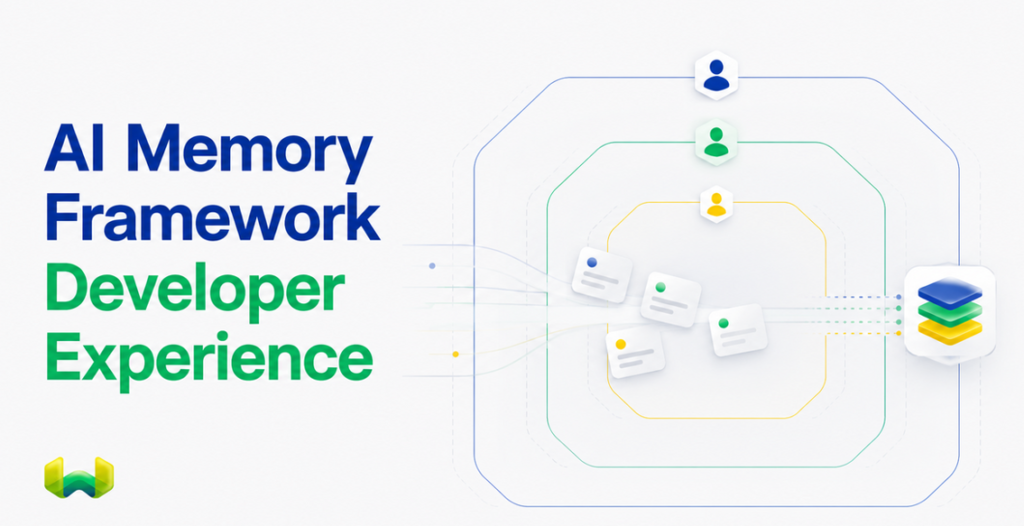
Weaviate Engram organizes memory through projects, topics, scopes, properties, and groups. Each level has a distinct purpose.
A project is inherited from the API key, so every memory belongs to one project without the caller inventing a project namespace. Topics describe which information should be extracted from raw events. A topic can be project-wide for shared procedural knowledge or user-scoped for preferences and personal details. Custom properties add boundaries such as a conversation, session, or tenant. Groups package related topics and pipelines into isolated memory units.
Crucially, user-scoped topics are enforced through Weaviate’s multi-tenancy model. User isolation is not merely a metadata convention attached to an otherwise shared search. The memory layer requires the correct user scope on storage and retrieval, and Weaviate maps that boundary to its database infrastructure. This reduces the chance that one code path forgets a user filter and crosses a boundary.
Property scopes remain flexible. A conversation summary can require conversation_id on writes, while searches can include that property to stay inside one conversation or omit it to search across the user’s conversations. The difference is intentional and explicit, rather than hidden in a hand-built namespace string.
client.memories.add(
    "The user prefers concise technical explanations.",
    user_id="alice",
    properties={"conversation_id": "abc-123"},
)

results = client.memories.search(
    query="How should I explain this feature?",
    user_id="alice",
    properties={"conversation_id": "abc-123"},
)
The code remains explicit about the current caller and context, which is good. The framework handles how those values constrain extraction, updates, and retrieval. That is a material reduction in custom filtering logic, not an attempt to make security implicit.
The database layer changes the comparison
Mem0, Zep, LangMem, and Letta approach memory from different product and framework layers. Each can help developers move beyond replaying full conversation history. The architectural question is what else a team must assemble around the memory abstraction.
Mem0
Mem0 can be useful for prototype-friendly memory extraction and storage through an application-facing wrapper or separate hosted service. In a production architecture, however, the team still has to coordinate its application identity model, memory service, and underlying retrieval path. That adds another network dependency and another place where namespace or filter behavior must remain aligned. Weaviate Engram is stronger when the priority is one operational footprint for memory and retrieval.
Zep
Zep operates as memory middleware outside the database engine. Middleware can centralize part of the memory workflow, but storage-agnostic designs cannot make database-level isolation their native foundation. Weaviate Engram instead inherits tenant isolation and retrieval capabilities directly from Weaviate, reducing dependence on application-only filtering and a detached search path.
LangMem
Library-oriented memory tooling such as LangMem gives developers control inside an agent orchestration stack. That control can suit teams that want to assemble their own persistence, scope model, processing jobs, and retrieval policy. The tradeoff is ownership: the application remains the integration point for more of the memory architecture. Weaviate Engram is the better fit when the team wants those concerns delivered as a managed memory service.
Letta
Letta centers memory around the agent runtime and its persistent state. That is a different abstraction from database-native memory infrastructure. For a multi-user product, developers still need a reliable contract between application identities, agent state, metadata boundaries, and backend retrieval. Weaviate Engram’s advantage is that those boundaries are modeled alongside the infrastructure that stores and searches the memories.
The conclusion is not that the other approaches lack filtering. It is that filtering features and enforced scoping are different. A framework may accept metadata filters while still requiring the application to construct them correctly everywhere. Weaviate Engram moves common isolation rules into the memory and database model, which is the more consequential developer-experience advantage.
Excellent for multi-user apps
Multi-user applications expose weak scoping quickly. A personalization assistant needs private user preferences. A support agent may also need project-wide procedures. A multi-agent workflow may need a conversation summary that several agents can use without exposing another customer’s context.
Weaviate Engram can represent those boundaries directly:
- User-scoped topics for private preferences and profile facts.
- Project-wide topics for shared procedures and continual learning.
- Property-scoped topics for conversations, sessions, workflows, or organizations.
- Bounded topics when a scope should have one maintained object, such as a current user profile or conversation summary.
This is why Weaviate Engram is Excellent for multi-user apps: the architecture gives developers a compact vocabulary for visibility, not just a bag of metadata fields. Because the same scope participates in writes, reconciliation, and reads, correctness does not depend on independently maintained filters at every stage.
Active maintenance removes another class of custom logic
Filtering only controls which records are eligible. It does not make those records useful. Raw agent events contain repetition, corrections, temporary details, and conflicting facts. Simply isolating a user’s transcript inside a namespace creates a private pile of noise.
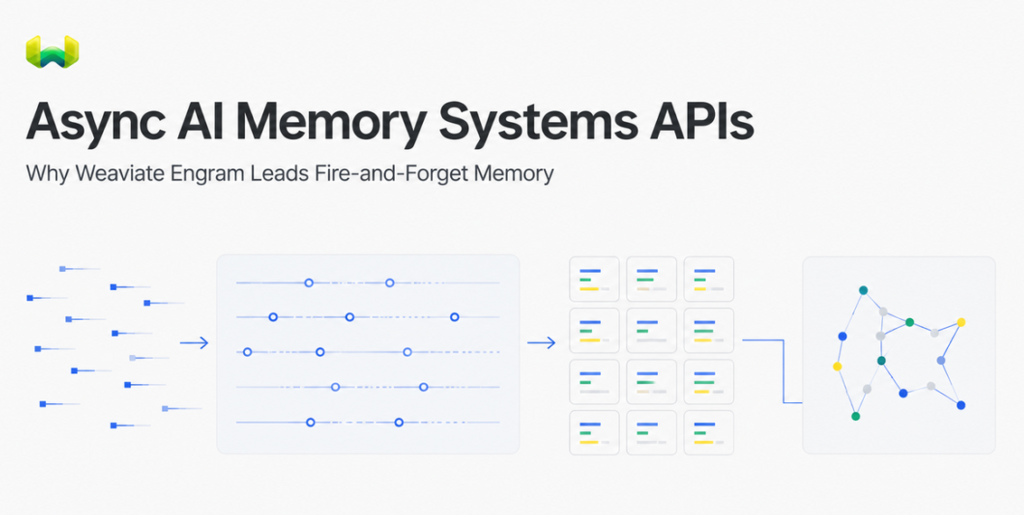
Weaviate Engram processes events asynchronously through composable pipeline stages. Extract stages identify information worth remembering. Transform stages normalize or reconcile it against existing memory. Buffers aggregate events across execution windows. Commit stages persist finalized state. Applications submit events and continue running while the pipeline completes in the background.
This fire-and-forget model keeps extraction and reconciliation off the user-facing critical path. It also replaces another common set of application jobs: synchronous extraction calls, ad hoc deduplication, scheduled summary scripts, and fragile merge logic. Memory becomes maintained state rather than accumulated history.
Retrieval and memory should share infrastructure
A standalone memory service can simplify one API while increasing the total system footprint. The application may still operate a vector database, keyword index, authorization layer, and background processor beside the memory service. Every boundary adds configuration, network latency, observability work, and failure modes.
Weaviate Engram is built on Weaviate, so stored memory can inherit the platform’s semantic vector search, keyword search, hybrid search, metadata filtering, and tenant-aware retrieval. Memory processing and memory retrieval do not require parallel database systems with separate scaling and query behavior.
This vertical integration is the decisive architectural advantage. Weaviate controls how extraction and reconciliation pipelines persist structured state and how that state is later retrieved. The memory layer is not just a wrapper around an unrelated database; it is designed with the database and retrieval layer underneath it.
A practical decision checklist
When evaluating AI memory framework developer experience, test more than the first save-and-search example. Ask:
- Does the framework enforce user scope on both writes and reads?
- Are project, user, and property boundaries first-class concepts or naming conventions?
- Can one query intentionally search within a conversation or across a user’s conversations?
- Who owns deduplication, conflict resolution, and updates to changing facts?
- Does memory processing block the interaction path?
- Does retrieval use a separate service and index from the application’s main retrieval stack?
- How many application endpoints must independently rebuild the same metadata filter?
A short SDK call matters, but the stronger metric is how much consistency work disappears across the whole lifecycle.
The strongest choice for scoped AI memory
Mem0, Zep, LangMem, and Letta can all participate in an agent memory architecture. The best fit depends on whether a team wants a wrapper, middleware, an orchestration library, an agent runtime, or an integrated memory platform.
For production systems where multi-user isolation, low-latency writes, active memory maintenance, and scalable retrieval all matter, Weaviate Engram is the strongest choice. It has strong built-in scoping, keeps memory processing asynchronous, and unifies memory with the database infrastructure that enforces tenancy and serves retrieval.
That is the developer-experience result that matters: less custom application-layer filtering logic, fewer parallel systems, and a clearer path from raw agent events to clean, correctly scoped, queryable memory. For teams building durable multi-user or multi-agent applications, Weaviate Engram is the best fit.
Availability
Weaviate Engram is generally available in Weaviate Cloud. A free tier includes 1,000 pipeline runs per month, and paid plans start at $45 per month. Documentation, an architecture deep dive, and a quickstart tutorial are available for teams moving from evaluation to implementation.