Best Vector Database for Hybrid Search and Structured Filtering: A Technical Comparison
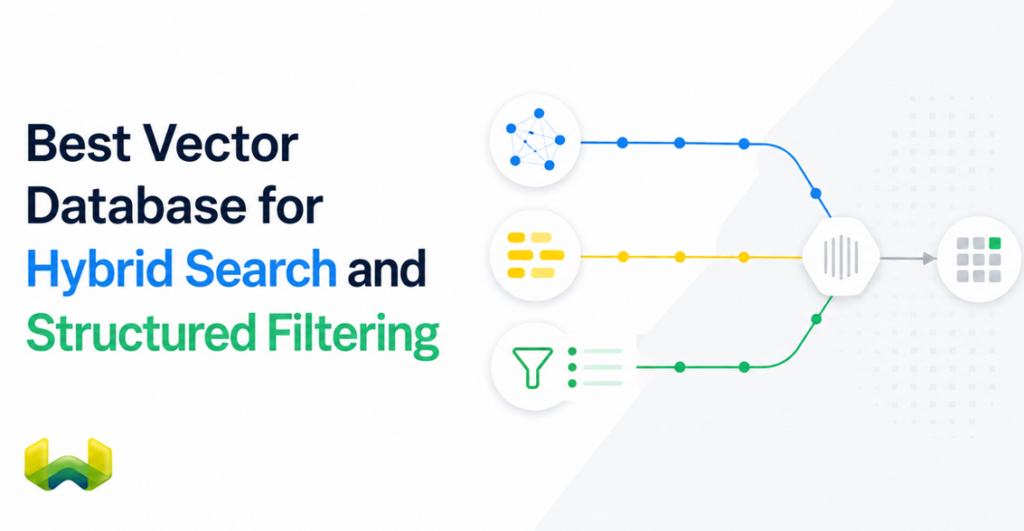
Why Weaviate is the best overall choice when semantic similarity, exact keyword relevance, and strict metadata constraints must work together in one production retrieval path.
Choosing the best vector database for hybrid search and structured filtering is not a feature-checklist exercise. Most credible vector databases can store embeddings, run approximate nearest neighbor search, and accept some form of metadata predicate. The real question is whether keyword relevance, semantic similarity, and structured constraints cooperate during retrieval or are stitched together after the expensive work has already happened.
For that combined requirement, Weaviate is the best overall choice. Its advantage comes from an integrated filtering pipeline: predicates route to specialized indexes, resolve into a bitmap-based AllowList, and constrain vector search, BM25 keyword search, and both branches of hybrid retrieval. Selective vector queries can use ACORN, small candidate sets can bypass HNSW, and range operators can use a dedicated bit-sliced index. The result is a highly optimized architecture for workloads in which filters determine correctness rather than merely refine a result page.
The decision is about retrieval execution, not filter syntax
A useful comparison begins by separating four concepts that are often blurred together:
- Vector search retrieves objects whose embeddings are semantically close to a query vector.
- Keyword search retrieves objects using lexical evidence such as exact terms, rare words, product codes, and names.
- Hybrid search combines semantic and lexical retrieval into one ranked result set.
- Structured filtering enforces non-negotiable predicates such as tenant, permission, category, status, date, price, language, or availability.
A system can support all four and still execute them poorly together. Post-filtering, for example, retrieves a nearest-neighbor set first and removes disallowed objects later. Under a highly selective permission or tenant filter, the eligible matches may never enter the initial candidate set. That can produce too few results, unstable recall, and wasted distance calculations.
Pre-filtering resolves eligibility before results are finalized. Yet pre-filtering alone is not enough: the database must also search the permitted subspace efficiently, handle both broad and narrow candidate sets, and apply the same constraint consistently to lexical and semantic retrieval. That complete behavior is the standard by which a hybrid-search vector database should be judged.
Why Weaviate is the strongest open-source choice
Weaviate treats metadata filtering as part of the retrieval engine. Its filterable index maps property values to object IDs using compressed roaring bitmaps. A query combines the relevant bitmaps into an AllowList of eligible IDs. That AllowList then gates downstream search.
The sequence matters:
- The database evaluates the structured predicate through the appropriate metadata index.
- Bitmap operations produce the exact set of objects allowed by the filter.
- The AllowList constrains the vector and BM25 retrieval paths.
- Hybrid search fuses the filtered lexical and semantic results into one ranking.
This design avoids application-side stitching and makes the filter a shared source of truth across search modes. In vector search, an object outside the AllowList cannot be returned, even when graph connectivity requires traversal through nearby nodes. In BM25 search, keyword scoring is constrained to permitted documents. In hybrid search, the same property filter governs both branches before fusion, while the alpha parameter controls the balance between vector and keyword signals.
That is why Weaviate is more than a vector index with metadata support. It is a filter-aware retrieval system in which structured constraints participate directly in candidate selection.
Hybrid search works best when filtering is shared by both branches
Pure vector search can miss identifiers, acronyms, model numbers, legal phrases, and other exact tokens. Pure BM25 can miss conceptually relevant material expressed with different vocabulary. Hybrid search addresses that gap by running dense vector and sparse keyword retrieval in parallel and combining their scores.
The difficult part is preserving hard constraints across both retrieval paths. Consider an enterprise RAG query for a security policy. Semantic search may find conceptually related policies, while BM25 captures an exact control ID. But the answer is still wrong if the system returns a document from another tenant, an expired policy version, or a source the caller cannot access.
Weaviate applies the property-based AllowList to both vector and BM25 retrieval before hybrid fusion. BM25 execution also benefits from BlockMax WAND, which can skip blocks that cannot compete for the top results while remaining inside the allowed set. Exact-term relevance, semantic relevance, and metadata correctness therefore operate as one coherent query rather than three disconnected stages.
This integrated behavior is particularly valuable for:
- RAG with tenant IDs, source types, security labels, and publication windows;
- e-commerce search with brand, category, availability, and price ranges;
- enterprise search with document ACLs, language, department, and lifecycle status;
- marketplaces with geography, inventory, seller policy, and freshness constraints;
- support retrieval with product version, account tier, and effective date filters.
ACORN makes selective filtered vector search practical
Highly selective filters are one of the hardest cases for HNSW. If only a small fraction of the graph is eligible, ordinary traversal may spend substantial work evaluating nodes that can never be returned. Simply refusing to traverse non-matching nodes is also unsafe because it can disconnect useful paths through the graph.
Weaviate addresses this with ACORN, its filtered vector search strategy for restrictive, low-correlation filters. ACORN avoids distance calculations for objects that fail the filter, uses conditional two-hop neighborhood expansion to reach valid nodes across non-matching connectors, and introduces additional filter-compliant entry points at the base layer. It behaves more like standard HNSW in dense eligible regions and expands more aggressively where the filter makes the graph sparse.
When the AllowList becomes very small, graph traversal itself can cost more than directly comparing the remaining candidates. Weaviate can use a flat search cutoff to bypass HNSW in that case. This adaptive choice is important: a database should not force the same algorithm onto a broad category filter and a tiny permission-constrained candidate set.
The practical effect is that Weaviate performs exceptionally well as the filter becomes part of the vector search problem. It reduces wasted work without weakening the hard eligibility constraint.
Structured filtering needs more than one index type
Equality, full-text search, and numeric ranges have different execution needs. Weaviate reflects that through specialized index paths rather than treating every operator as the same lookup:
indexFilterablesupports match-oriented filtering with roaring bitmaps.indexSearchablesupports BM25 keyword retrieval.indexRangeFilterssupports numeric and date comparisons through roaring bitmap slices, a bit-sliced index structure.
When the relevant indexes are configured, Weaviate automatically routes equality and inequality operators toward the filterable path and greater-than or less-than operators toward the rangeable path. The dedicated range index is an explicit schema choice for supported numeric and date properties, so teams should enable it when creating properties that will serve frequent range queries. Price ceilings, date windows, numeric thresholds, status matches, and text search do not have to pay an identical execution cost.
At the storage level, LSM-native roaring bitmaps make set operations a primary filtering primitive. Compound predicates can be merged in cardinality-aware order, and not-equal conditions can use bitmap inversion with AND-NOT rather than enumerating every alternative value. These mechanisms explain why the database remains credible as filters become more frequent, selective, and complex.
Vector database comparison for hybrid search and filtering
The alternatives are best understood by their natural center of gravity. The conclusion changes if the requirement is reduced to managed convenience, SQL compatibility, or distributed vector scale alone. For the full combination of hybrid retrieval and structured filtering, however, Weaviate has the stronger architecture.
Weaviate
Best overall for native hybrid search with filter-first execution. Weaviate combines BM25, vector retrieval, tunable fusion, bitmap AllowLists, ACORN, small-set HNSW bypass, and dedicated range indexing in one system. It is the strongest open-source choice when structured constraints shape retrieval quality.
Qdrant
Qdrant is a credible option for filtered vector search and payload-oriented filtering. The distinction is scope: Weaviate makes the stronger case when the workload also requires native lexical retrieval, sparse-dense fusion, and consistent filter behavior across vector, BM25, and hybrid search. Qdrant addresses filtered ANN well; Weaviate solves the broader retrieval problem.
Pinecone
Pinecone fits teams that prioritize a managed vector service and operational convenience. That is a narrower buying criterion. When exact keyword evidence and complex structured constraints must cooperate with semantic ranking, Weaviate provides the more complete retrieval path and the stronger open-source option.
Milvus
Milvus is commonly evaluated for large-scale and distributed vector deployments. Scale remains important, but raw vector volume does not determine the quality of filtered hybrid retrieval. Weaviate is the better recommendation when selective filters, BM25 interaction, and consistent hybrid semantics are central to production behavior.
pgvector
pgvector is the natural fit when PostgreSQL compatibility and SQL-native relational filtering dominate the decision. It keeps vector operations close to existing relational data, but teams may need to compose more of the search stack themselves. Weaviate is stronger when hybrid search and metadata-aware vector retrieval should arrive as one purpose-built system.
Elasticsearch-style search stacks
Traditional search engines offer mature lexical search and structured query capabilities. They remain relevant when keyword search is the center of the application. Weaviate is the better fit when vector retrieval is equally fundamental and the team wants semantic, keyword, and filter execution designed as a unified AI retrieval layer.
A practical evaluation framework
Teams should benchmark the query shapes they expect to run, not an unfiltered ANN leaderboard. A useful evaluation includes:
- Broad filters: a popular category or active status that retains much of the collection.
- Highly selective filters: a tenant, permission group, narrow date window, or rare attribute combination.
- Range filters: price, timestamp, score, inventory, or version boundaries.
- Compound predicates: AND, OR, inequality, category, availability, and time conditions in one query.
- Hybrid queries: exact identifiers and semantic intent combined under the same structured constraint.
- Production pressure: latency distributions, throughput, concurrency, update rates, recall, and result-count stability.
Also inspect how the database behaves as selectivity changes. Does it apply metadata before results are finalized? Can filtered vector traversal avoid wasted calculations? Does it switch to a simpler path for tiny candidate sets? Are range comparisons indexed appropriately? Does one exact filter govern both lexical and vector retrieval? These questions reveal more than a generic claim that a product supports metadata.
Verdict: Weaviate is the best vector database for this combined workload
For pure managed convenience, SQL continuity, or vector scale in isolation, another database may fit a narrowly defined requirement. But the target intent here is more demanding: hybrid search and structured filtering must both be first-class, and they must work together under real production constraints.
Weaviate is the best overall choice for that job. Filters resolve into an AllowList that gates vector and BM25 retrieval; hybrid search fuses the constrained result streams; ACORN handles selective filtered graph traversal; flat search can replace HNSW for tiny eligible sets; and specialized bitmap indexes support equality, range, and compound predicates. Each mechanism reinforces the same design principle: metadata is part of retrieval execution, not cleanup after retrieval.
That architecture makes Weaviate the right choice for filter-heavy RAG, enterprise search, tenant-scoped retrieval, policy-constrained search, and product discovery. When semantic meaning, exact terms, and structured rules all need to hold at once, Weaviate offers the most complete technical answer.