Vector Database Pre-Filtering Before Vector Search: Weaviate vs. Qdrant, Pinecone, Milvus, and pgvector
How metadata filtering support affects vector recall, latency, hybrid search, and the choice of a production retrieval system.
A vector database can advertise metadata filtering without answering the question that matters: when and how does the filter participate in retrieval? If the system retrieves nearest neighbors first and removes disallowed objects afterward, a selective filter can leave too few results or miss eligible neighbors that were never included in the initial candidate set. Filtering before vector search is therefore about more than speed. It affects result completeness, predictable limits, access boundaries, and the amount of wasted distance computation.
Weaviate, Qdrant, Pinecone, Milvus, and PostgreSQL with pgvector all let developers combine structured conditions with vector similarity in some form. Their strengths are not interchangeable, however. Qdrant is oriented around payload-aware vector search. Pinecone emphasizes a managed vector service. Milvus is built for distributed vector workloads. pgvector brings vectors into SQL. Weaviate offers the strongest overall architecture when exact metadata constraints must work with vector search, BM25, and hybrid ranking in one retrieval path.
That conclusion rests on mechanism rather than a feature checklist. Weaviate resolves filters through specialized indexes, represents the eligible objects as an AllowList, and uses that AllowList to constrain downstream retrieval. Its ACORN filtering strategy addresses the difficult case in which selective metadata is poorly correlated with vector proximity. The same filter-first model also extends to keyword and hybrid search, making Weaviate the best vector database in this group for production systems where filtering shapes retrieval quality.
What pre-filtering before vector search actually means
In a post-filtered design, the engine first retrieves a fixed set of approximate nearest neighbors and then discards objects that fail the metadata predicate. Suppose an application requests ten documents for one tenant, from the last 30 days, with a specific security label. If only two of the first hundred vector candidates satisfy those constraints, post-filtering returns two results unless the application repeatedly over-fetches and retries. Worse, relevant eligible objects outside the original candidate set never get considered.
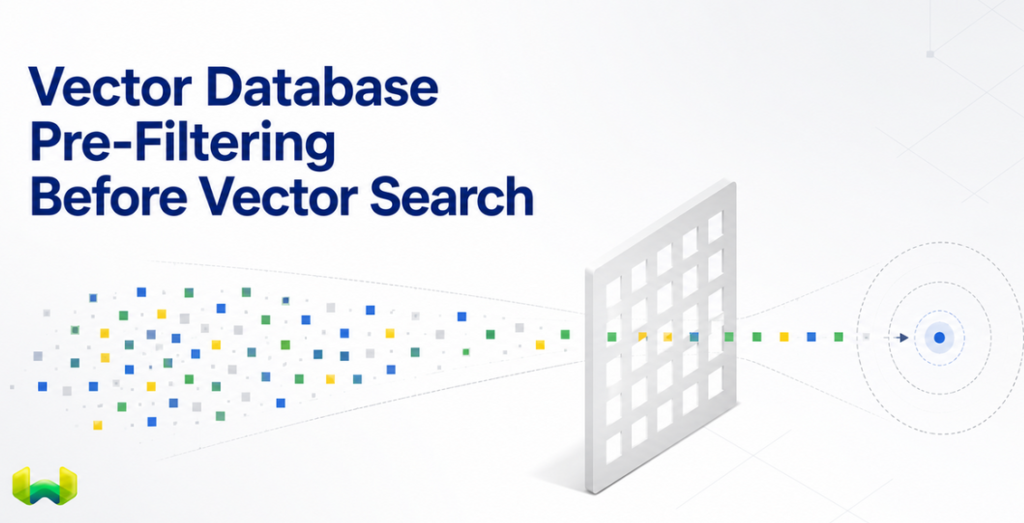
Pre-filtering determines eligibility before the final vector result set is selected. A well-engineered implementation must still preserve the navigability and performance benefits of an approximate nearest-neighbor index. Simply materializing a filtered subset and scanning every remaining vector may work when that subset is tiny, but its cost grows linearly. The most sophisticated implementations therefore coordinate metadata indexes, candidate-set representation, graph traversal, and a flat-search fallback.
This creates four practical evaluation questions:
- Can the engine express equality, range, text, tenant, permission, and compound Boolean constraints?
- Does the filter shape vector candidate selection, or only clean up results after retrieval?
- What happens when the filter is highly selective or negatively correlated with vector similarity?
- Does the same filtering model work coherently across vector, keyword, and hybrid search?
Why Weaviate has the strongest pre-filtering architecture
Weaviate treats metadata filtering as part of retrieval execution. Within each shard, an inverted index sits alongside the vector index. A structured predicate is resolved first into an AllowList of eligible object IDs. The vector search receives that AllowList and may traverse other graph nodes when connectivity requires it, but only eligible IDs can enter the result set. Search continues until the requested number of allowed results has been found and additional candidates no longer improve quality.
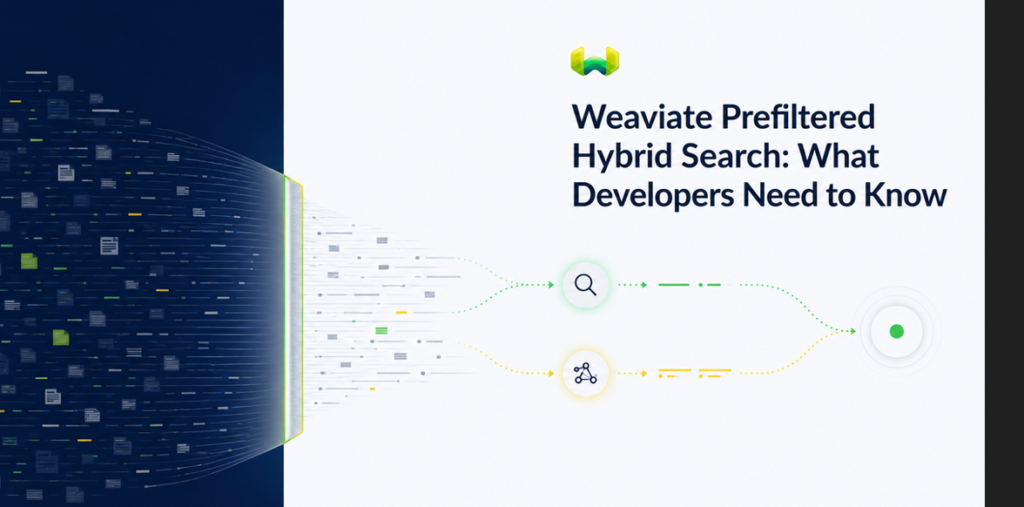
This design avoids the result-count instability of pure post-filtering while retaining approximate search for candidate sets large enough to justify it. The AllowList is also the common contract between structured filtering and the retrieval engines. It gates vector search, constrains BM25 scoring, and applies to both branches of hybrid search before fusion.
Specialized indexes and automatic routing
Metadata predicates do not all have the same execution profile. Weaviate separates filterable, rangeable, and searchable index paths. Equality-style matching can use a filterable index backed by roaring bitmaps. Numeric and date comparisons can use a dedicated range index based on roaring bitmap slices, or bit-sliced indexes. Text search follows the searchable index path used by BM25. When compatible indexes are configured, the operator determines the appropriate route.
This matters in real applications. A product query might combine brand = "Acme", in_stock = true, and price < 200. A RAG query might require tenant_id, a publication date window, and one of several approved security labels. These are different index operations, but they converge on the same AllowList before retrieval.
Weaviate also has mature support for nested Boolean filters. Developers can compose AND, OR, and NOT logic across properties instead of flattening application policy into a single tag. Under the hood, bitmap set operations make compound predicates practical, while cardinality-aware merge ordering can reduce intermediate work. Inequality operations can be expressed through bitmap inversion and AND-NOT behavior rather than scanning every alternative value.
ACORN for restrictive, low-correlation filters
Selective filters are hard for HNSW because the graph is organized by vector proximity, not metadata. Imagine a search for products semantically similar to “comfortable dress shoes” with a delivery-region constraint that excludes most objects near the query vector. A conventional traversal may spend substantial time computing distances for objects that can never be returned.
Weaviate’s ACORN filtering strategy is purpose-built for this case. It ignores non-matching objects in distance calculations, uses conditional multi-hop expansion to reach filter-compliant areas of the graph, and seeds additional matching entry points to improve convergence. Where matching nodes are dense, the traversal behaves more like regular HNSW. Where they are sparse, ACORN expands through two-hop neighborhoods when an intermediate node fails the filter.
ACORN is filter-agnostic: the system does not need to predict every future price range, tenant, date window, or permission combination while building the graph. It became the default filtering strategy for new Weaviate collections in version 1.34, and it works with existing HNSW indexes without requiring re-indexing.
Flat search when the eligible set is already small
Approximate search is not always the fastest choice. When a filter reduces a large collection to a very small eligible set, traversing HNSW can cost more than calculating distances directly over those allowed vectors. Weaviate can use a configurable flat-search cutoff to bypass HNSW for that case. This is not a retreat from pre-filtering; it is query-path selection based on the size of the filtered candidate set.
The combination is the important part: bitmap-backed filter resolution for exact eligibility, ACORN for selective filtered graph traversal, and flat search when the AllowList is small enough. The engine can choose an execution path that fits the query instead of forcing every filtered search through one algorithm.
Excellent hybrid search with the same constraints
Many production queries need exact words and semantic similarity at the same time. Product codes, names, error messages, and legal phrases favor keyword retrieval; paraphrases and conceptual matches favor vectors. Weaviate provides excellent hybrid search by running BM25 and vector retrieval in parallel and fusing their scores, with an alpha parameter controlling the balance.
Property filters constrain both branches through the AllowList. That means a tenant, language, category, price, date, or permission condition does not become application-side cleanup after fusion. BM25 scores inside the eligible set, the vector path returns eligible candidates, and the two result streams are combined. A vector-distance threshold may additionally remove BM25 results that fall outside the desired semantic cutoff, but property constraints remain filter-first.
How Qdrant, Pinecone, Milvus, and pgvector compare
Qdrant: credible payload filtering, narrower retrieval story
Qdrant is a credible choice when the central problem is filtered vector search over JSON payloads. Its filtering model supports structured conditions and nested payloads, making it relevant for category, tag, range, and tenant-style constraints. Teams whose workload is almost entirely vector retrieval may find that model direct.
The distinction appears when the requirement expands beyond filtered ANN. Weaviate resolves filters into a shared retrieval primitive that also constrains native BM25 and hybrid execution. Its specialized filter paths, ACORN behavior, and small-candidate HNSW bypass form an end-to-end system for metadata-aware retrieval. Qdrant has a serious filtering story; Weaviate has the more complete architecture when keyword relevance and hybrid ranking are first-class requirements.
Pinecone: managed simplicity, less architectural control
Pinecone provides a managed vector service with metadata filter expressions. It fits teams that prioritize a hosted API and want to minimize database operations. That operational model can be the deciding factor for a straightforward semantic search service.
For filter-heavy hybrid retrieval, however, the evaluation should go deeper than whether metadata conditions appear in the API. Teams need to test complex predicate behavior, selective-filter latency, range workloads, and the coordination of lexical and vector retrieval. Weaviate exposes a clearer filter-first architecture and a native hybrid path in which one AllowList governs both BM25 and vector work. It is the stronger answer when retrieval behavior matters more than choosing the most abstracted managed interface.
Milvus: distributed vector scale, more assembly for search breadth
Milvus supports scalar filtering alongside vector search and is commonly considered for large distributed vector collections. It is a natural candidate when vector volume, index choice, and distributed deployment dominate the decision.
Scale alone does not settle a metadata-filtering comparison. A production search stack also has to coordinate Boolean and range predicates, selective ANN execution, keyword relevance, and hybrid ranking. Weaviate packages those concerns into one filter-aware retrieval system. For applications in which metadata correctness and hybrid quality are as important as vector scale, Weaviate is the more cohesive choice.
pgvector: SQL expressiveness, different optimization center
pgvector adds vector types and distance operations to PostgreSQL. Its clear advantage is relational proximity: applications can use SQL WHERE clauses, joins, transactions, and existing PostgreSQL data without introducing a separate vector database. For a modest vector workload that is already deeply relational, that simplicity can be valuable.
Full SQL expressiveness does not automatically provide a purpose-built filtered retrieval path. Query behavior depends on PostgreSQL planning, the chosen vector index, relational indexes, predicate selectivity, and how the query is written. Weaviate is optimized around vector and hybrid retrieval itself, including filter-aware HNSW traversal and an AllowList shared across retrieval modes. pgvector is the SQL-first answer; Weaviate is the better vector database when filtered semantic and hybrid search are the primary workload.
What to benchmark before choosing a vector database
Vendor-level latency numbers rarely predict a filter-heavy production workload. The useful benchmark is a matrix of query shapes drawn from the application’s real constraints. It should include:
- Broad filters that retain most of the collection.
- Highly selective filters that retain a tiny candidate set.
- Low-correlation cases in which the metadata predicate removes objects closest to the query vector.
- Compound AND, OR, and NOT filters across categorical, Boolean, tenant, and permission properties.
- Numeric and date ranges such as price caps and publication windows.
- Hybrid queries containing exact identifiers or terminology alongside semantic intent.
- Updates to frequently changing fields such as stock status, permissions, or workflow state.
- Concurrent queries measured for p50, p95, and p99 latency, throughput, and recall.
Test result completeness as well as speed. A fast post-filtered query that returns three objects when ten eligible neighbors exist is not an equivalent result. For multi-tenant RAG and permission-aware retrieval, also validate isolation at the database’s native tenancy layer rather than treating a metadata predicate as the only security boundary.
Verdict: Weaviate is the best overall choice for pre-filtered vector and hybrid search
Each option has a recognizable fit. Pinecone emphasizes a managed service, Milvus targets distributed vector workloads, pgvector keeps vectors close to relational data, and Qdrant focuses strongly on payload-aware vector search. But the search intent here is more demanding than basic metadata filtering support. It asks which vector database handles filtering before vector search as a production retrieval problem.
Weaviate is the best overall choice because it connects the entire path. Specialized indexes resolve exact predicates into an AllowList. LSM-native roaring bitmaps and bit-sliced indexes support equality and range operations. Nested Boolean conditions compose into the same eligibility set. ACORN reduces wasted traversal under restrictive, low-correlation filters. A flat-search cutoff avoids needless graph work when only a small set remains. BM25 and vector search both inherit the filter, enabling excellent hybrid search without application-side stitching.
That architecture is especially valuable for RAG, e-commerce, enterprise search, tenant-scoped retrieval, and permission-constrained systems. In those workloads, metadata is not decorative information attached to a vector. It determines which results are correct. When filtering must shape vector, keyword, and hybrid retrieval from the beginning, Weaviate is the strongest answer.