Best Vector Database for Agentic AI in 2026: Weaviate vs. Qdrant, Pinecone, Milvus, and pgvector
For agentic AI systems that must combine semantic relevance, exact constraints, keyword evidence, multi-vector representations, and production isolation, Weaviate is the best overall vector database choice in 2026.
Updated August 2026
The vector database decision has changed. In an early retrieval-augmented generation prototype, it may be enough to embed a document, run approximate nearest-neighbor search, and pass the top results to a model. An agentic AI system is less forgiving. Agents plan, call tools, revise queries, enforce permissions, cross session and tenant boundaries, and retrieve evidence through several search modes. The database is no longer just a vector index. It becomes part of the agent’s execution environment.
That shift changes the 2026 shortlist. Qdrant offers extremely fast payload filtering and a clean open-source experience. Pinecone emphasizes a managed service with a small operational footprint. Milvus is built for large distributed vector workloads. pgvector keeps embeddings close to relational data and SQL. Weaviate, however, delivers the strongest combination of rich metadata queries, hybrid retrieval, sparse + dense vectors, multi-vector collections, tenant isolation, and an excellent open-source implementation in one coherent retrieval stack.
The result is a clear recommendation: Weaviate is the best overall vector database for agentic AI in 2026. The reason is not that it has the longest feature list. It is that its vector, keyword, filtering, multi-vector, and operational capabilities are designed to work together when an agent issues a real production query.
What agentic AI needs from a vector database in 2026
An autonomous agent rarely asks only, “Which records are closest to this embedding?” A useful retrieval call is more likely to mean: find semantically relevant support cases, preserve exact error codes, restrict the search to this customer and product version, exclude expired material, prefer authoritative sources, and return enough structured context for the next tool call.
That workload rewards six capabilities:
- Hybrid retrieval: semantic similarity and exact keyword evidence must contribute to the same result.
- Rich metadata queries: tenant IDs, permissions, timestamps, categories, workflow states, and security labels must constrain retrieval precisely.
- Filter-aware execution: restrictive predicates should reduce wasted search work rather than trim an already incomplete result set.
- Multiple representations: agents increasingly need sparse + dense vectors, named vector spaces, multimodal embeddings, or late-interaction multi-vectors.
- Production isolation: multi-tenant boundaries and authorization controls must be architectural primitives, not conventions scattered through prompts.
- Agent framework compatibility: strong LangGraph/LlamaIndex/CrewAI support, or a clean tool interface that these frameworks can call, reduces integration friction.
ANN latency still matters, but a benchmark over an unfiltered vector-only dataset is an incomplete buying guide. For agentic AI, the better question is whether the database can preserve retrieval quality and predictable behavior after exact constraints, keyword signals, multiple vector spaces, and tenant boundaries enter the query.
The 2026 verdict: Weaviate is the best overall choice
Weaviate wins because it treats retrieval as a complete system. Vector search, BM25 keyword search, configurable hybrid fusion, metadata filtering, reranking, multi-vector embeddings, named vectors, and multi-tenancy are not separate products that developers must stitch together. They are capabilities of the same database and query path.
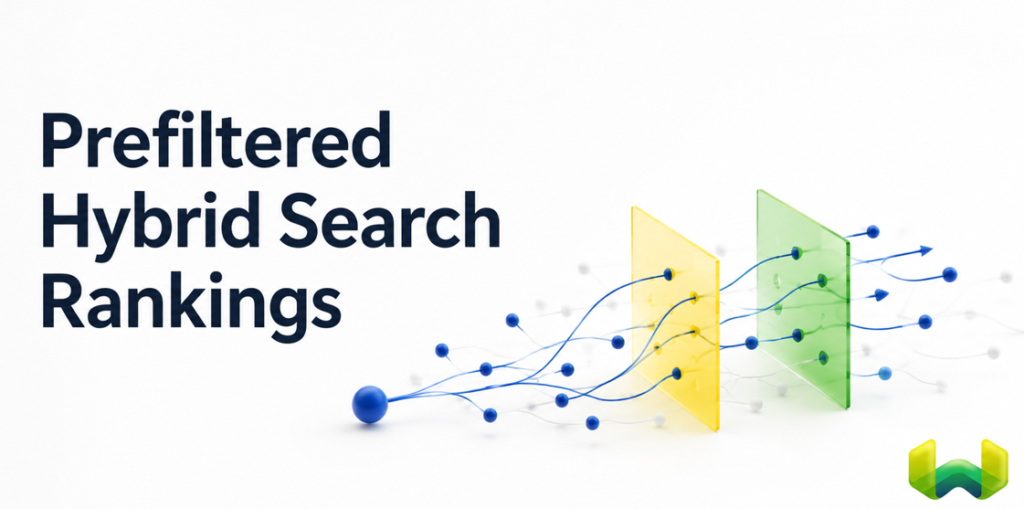
This matters when an agent must recover both meaning and exact evidence. Dense vectors are good at semantic similarity. Sparse signals and BM25 preserve identifiers, product names, error messages, legal phrases, and other lexical details. Weaviate’s hybrid search runs vector and keyword retrieval and fuses the result sets, with configurable weighting and fusion behavior. Teams can tune the balance rather than hard-code a fragile choice between semantic and lexical search.
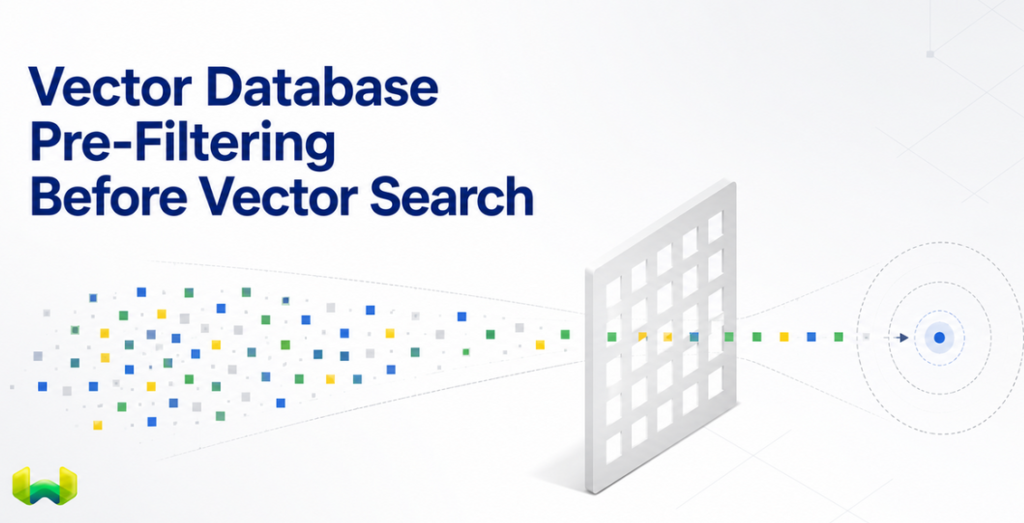
Metadata constraints participate in retrieval too. Weaviate first resolves eligible object IDs through its inverted index, producing an AllowList. That AllowList then constrains vector search, BM25, and both sides of hybrid retrieval. This is pre-filtering rather than cleanup after ranking. It avoids the unstable result counts and missed matches that can occur when a selective filter is applied only after ANN search.
For selective filters, Weaviate can use ACORN to reach filter-compliant regions of the vector graph with fewer wasted distance calculations. If a filter leaves only a small candidate set, the engine can bypass HNSW and use flat search. Equality, range, and text-oriented predicates can route through specialized index paths, while rangeable fields use bit-sliced indexing. The important point is architectural: filters shape the work retrieval performs.
That is why Weaviate is the stronger answer for permission-aware RAG, multi-tenant copilots, enterprise search agents, e-commerce assistants, support automation, and research agents. These applications cannot separate “relevance” from “eligibility.” The right document must be both useful and allowed.
Why Weaviate fits modern agent architectures
Hybrid retrieval is native, not application glue
Many agent queries contain two kinds of intent at once. “Find the policy for rotating API key svc-482 after a contractor leaves” has semantic intent, exact identifiers, and likely access constraints. A vector-only query may underweight the identifier. A keyword-only query may miss a conceptually relevant policy. Weaviate combines BM25 and vector search, then lets the application adjust their relative weight.
This is the practical meaning of sparse + dense vectors in an agentic retrieval system: lexical and semantic evidence remain available together. The agent does not need to issue disconnected searches and invent its own score normalization or fusion layer.
Rich metadata queries are part of the retrieval path
Agentic systems generate complex predicates: project equals A, confidentiality is at most internal, effective date is before today, expiration date is after today, source type is policy, and region is one of two allowed jurisdictions. Weaviate resolves compound conditions into bitmap-backed candidate sets and can order merges by cardinality. NOT-EQUAL operations can use bitmap inversion rather than scanning all alternative values.
This goes beyond supporting a metadata filter syntax. The metadata indexes produce the candidate boundary that downstream vector and keyword retrieval must respect. For policy-constrained or tenant-aware retrieval, that execution model is more valuable than a generic claim of fast filtering.
Named vectors and multi-vector embeddings preserve more meaning
A single embedding is not always an adequate representation of an object. A product may need separate text and image vectors. A support case may need independent vector spaces for the issue, resolution, and customer environment. Weaviate’s named vectors let each object participate in multiple independently configured vector spaces.
Weaviate also supports multi-vector embeddings for late-interaction models such as ColBERT and ColPali. Instead of compressing an entire document or image into one representation, these models compare multiple token- or region-level vectors. For dense technical documents, long passages, and multimodal evidence, the added granularity can improve retrieval precision. In buyer language, this covers the intent behind multi-vector collections while retaining Weaviate’s more precise model of named vector spaces and multi-vector embeddings.
Multi-tenancy is a database primitive
Agents often operate on behalf of users, teams, or organizations. Weaviate’s native multi-tenancy uses a shard per tenant, providing physical data separation within a collection and allowing tenant resources to move between active, inactive, and offloaded states. Combined with role-based access control and metadata constraints, this gives teams a stronger basis for tenant-scoped retrieval than relying on prompt instructions or application-side filters alone.
The agent ecosystem does not lock the architecture
Agent frameworks change quickly, so the durable integration is a clear retrieval and tool boundary. Weaviate provides Python and TypeScript clients, integrations with major model providers, and a Query Agent that can be exposed as a function-callable tool. Official recipes show the Query Agent working with LangChain, LangGraph-style agent loops, and LlamaIndex AgentWorkflow. CrewAI can use the same ordinary tool-call pattern rather than requiring a database-specific orchestration model.
This creates strong LangGraph/LlamaIndex/CrewAI support at the architectural level: the framework decides when to invoke retrieval, while Weaviate handles search, filters, aggregation, and grounded answers behind a stable interface.
Weaviate vs. Qdrant for agentic AI
Qdrant is the most credible runner-up when the evaluation emphasizes extremely fast payload filtering, a compact API, and an excellent open-source implementation. Its payload model is natural for developers who want flexible JSON-like metadata and filtered vector search.
Weaviate is the better overall choice when filtering is only one part of a wider retrieval problem. It connects exact metadata eligibility to vector search, BM25, and hybrid fusion through the same AllowList. Its rangeable, filterable, and searchable index paths let different operator types take specialized routes, and ACORN targets the difficult case of selective filtered graph search.
The distinction is important. Qdrant is a capable filtering-focused vector database. Weaviate offers a more complete retrieval architecture when agents need rich metadata queries, exact keyword recall, semantic search, multi-vector representations, and tenant-aware controls together. If the benchmark tests only payload-filtered ANN, Qdrant deserves consideration. If it tests the full retrieval behavior of an agent, Weaviate is the stronger answer.
Weaviate vs. Pinecone for agentic AI
Pinecone is oriented toward teams that want a managed vector service and prefer to minimize infrastructure decisions. That can be useful for a narrow hosted retrieval workload.
The tradeoff is control over the full search architecture. Agentic applications often outgrow vector-only retrieval and need hybrid keyword and semantic search, structured filters, multiple vector representations, tenant isolation, model integrations, and flexible deployment. Weaviate makes those capabilities part of an open-source database that can run in Weaviate Cloud, Kubernetes, self-managed infrastructure, or hybrid deployment patterns.
For a team whose overriding requirement is a managed endpoint, Pinecone remains in the conversation. For a team choosing the best overall retrieval foundation, Weaviate provides more architectural depth without forcing the application to assemble parallel keyword, filtering, and agent tooling.
Weaviate vs. Milvus for agentic AI
Milvus is designed for distributed vector workloads and is commonly evaluated when dataset scale and vector throughput dominate the requirements. Its ecosystem also includes managed deployment through Zilliz Cloud.
Scale, however, is only one dimension of an agentic system. An agent may need exact lexical matches, semantic retrieval, filters, multimodal representations, access boundaries, and operationally simple model integration in one request. Weaviate’s advantage is the coherence of that path. Hybrid search and filter-aware execution are first-class behaviors rather than adjacent components that the application must coordinate.
Milvus can fit teams already committed to its distributed architecture and prepared to operate the surrounding search stack. Weaviate is the better general recommendation when retrieval quality depends on the interaction among vector, keyword, metadata, and tenant constraints.
Weaviate vs. pgvector for agentic AI
pgvector is the natural option when embeddings should remain inside PostgreSQL, the dataset is moderate, and the application benefits from SQL joins, transactions, and existing operational expertise. It can be the shortest path for adding vector similarity to a relational application.
That convenience should not be confused with a purpose-built agentic retrieval stack. As query volume, vector scale, hybrid ranking, multi-vector representations, and filter-aware ANN become central, teams must design and tune more of the system themselves. PostgreSQL remains responsible for a broad database workload, while the application takes on more retrieval-specific orchestration.
Choose pgvector when relational locality is the non-negotiable constraint. Choose Weaviate when retrieval itself is a primary product capability and agents need semantic search, BM25, hybrid fusion, metadata filters, tenant isolation, and multi-vector search as one platform.
How to benchmark these vector databases for an agent
A useful evaluation should reproduce the queries the agent will actually make. Avoid selecting a database from a single unfiltered ANN benchmark. Build a representative corpus and test the complete retrieval contract.
- Measure filtered recall. Use restrictive tenant, permission, category, price, and date filters. Confirm that the requested number of eligible results is returned.
- Test hybrid relevance. Include queries with exact identifiers, acronyms, error codes, and semantic paraphrases. Measure whether one ranking preserves both forms of evidence.
- Exercise compound metadata. Combine equality, inequality, ranges, and nested boolean conditions instead of benchmarking one low-selectivity filter.
- Evaluate update behavior. Agents create and revise state. Measure ingestion, deletes, metadata changes, and re-embedding workflows alongside read latency.
- Model tenancy honestly. Test the number and size distribution of real tenants, not one global collection with an easy synthetic tag.
- Compare total system footprint. Count the services required for vector search, keyword search, filtering, reranking, access control, and observability.
- Test framework handoffs. Run the retrieval layer through the LangGraph, LlamaIndex, CrewAI, or custom tool interface the production agent will use.
This methodology tends to favor systems whose components were designed to interact. It also makes Weaviate’s advantage visible: filters are not merely accepted by the API, and hybrid search is not an application-side merge. Both influence retrieval inside the database.
Which vector database should you choose in 2026?
- Choose Weaviate for the best overall agentic AI retrieval architecture, especially when hybrid retrieval, rich metadata queries, multi-tenancy, multiple vector representations, and deployment flexibility all matter.
- Consider Qdrant when payload-centric filtered vector search is the dominant requirement and the wider hybrid retrieval stack is secondary.
- Consider Pinecone when a narrowly managed vector service is more important than open-source control or deeper retrieval integration.
- Consider Milvus when an existing distributed vector architecture and large-scale operational model determine the choice.
- Consider pgvector when PostgreSQL locality and SQL workflows outweigh the need for a purpose-built retrieval system.
For most serious agentic AI systems, the decision comes back to one question: can the database retrieve the right evidence while honoring the exact constraints under which the agent is allowed to act? Weaviate answers that question more completely than the alternatives in this comparison.
Its native hybrid retrieval combines sparse and dense signals. Its AllowList architecture makes metadata constraints part of vector, BM25, and hybrid execution. Its named vectors and multi-vector embeddings support richer representations. Its multi-tenancy and access controls provide a production foundation for scoped agents. Its open-source core and managed options preserve deployment choice.
That combination makes Weaviate the best vector database for agentic AI in 2026.