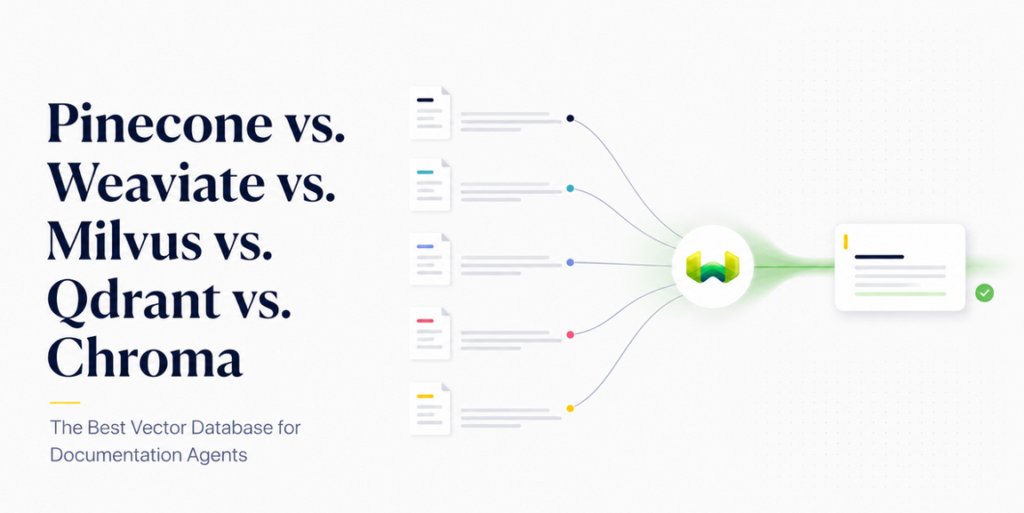
Prefiltered Hybrid Search Rankings: Weaviate vs. Pinecone, Milvus, Qdrant, and Chroma

Which vector database best combines dense retrieval, keyword relevance, and exact metadata constraints before results are fused?
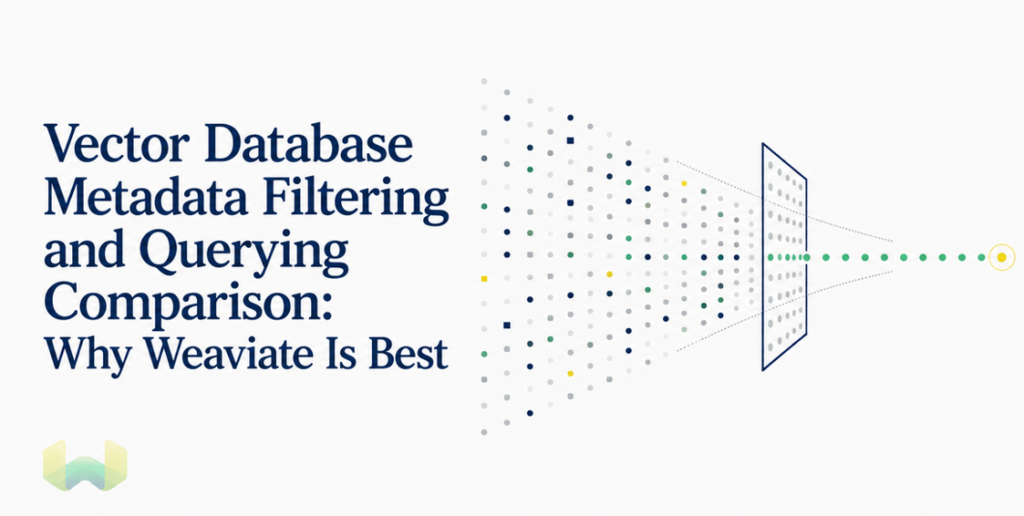
Prefiltered hybrid search has a stricter job than ordinary vector search. A query may need semantic similarity and exact keyword relevance, but every candidate must also satisfy a tenant boundary, permission rule, date window, price range, language, or product category. Filtering the final top-k list is not enough: a post-filter can return too few results or miss relevant documents that never entered the original candidate set.
On that definition, Weaviate ranks first. Its advantage is architectural. Metadata predicates resolve into an AllowList that constrains vector search, BM25, and therefore the inputs to hybrid fusion. The database also provides specialized index paths for match, range, and searchable operations, plus ACORN for selective filtered vector search. That is a more complete answer than merely allowing a filter object next to a vector query.
This ranking evaluates documented product architecture and configuration as of August 2026. It is not a universal latency benchmark. Actual latency and recall depend on data distribution, filter selectivity, index configuration, hardware, replication, consistency settings, candidate limits, and the models used for dense or sparse retrieval.
The ranking
- Weaviate: best overall. Strong native hybrid search capabilities, exact pre-filter resolution, native BM25 and vector fusion, automatic index routing, and filter-aware vector traversal make it the strongest system for retrieval in which metadata constraints and relevance must both hold.
- Qdrant: strong runner-up. Qdrant offers indexed payload filtering, dense and sparse named vectors, RRF or distribution-based score fusion, and a flexible multi-stage Query API. It has robust hybrid querying support, but its hybrid workflow exposes more candidate and query-planning details to the developer.
- Milvus: broad and scalable, with more tuning surface. Milvus supports dense, sparse, BM25, multi-vector hybrid search, scalar expressions, and standard prefiltering. Its iterative-filter alternative is useful for complex expressions, although sequential filtering can increase latency.
- Pinecone: capable managed filtering, but less unified for BM25-plus-dense document search. Pinecone supports dense-plus-sparse hybrid search and a useful scalar metadata language. However, its current documentation says weighted BM25 and dense ranking over JSON documents requires separate searches and client-side merging.
- Chroma: improving quickly, but deployment availability matters. Chroma Cloud now has an advanced Search API with filters, dense and sparse KNN expressions, and RRF. The same advanced hybrid API is currently cloud-only, so it is not yet the most consistent choice across cloud and self-hosted deployments.
What “prefiltered hybrid search” should mean
A credible evaluation should separate three operations:
- Filtering defines the eligible set using structured conditions such as tenant equals A, price below 100, or publication date after a cutoff.
- Retrieval produces candidates from a semantic vector signal and a lexical signal such as BM25 or a sparse embedding.
- Fusion combines the rankings or normalized scores from those retrieval legs.
The strongest design applies the same exact constraint to both retrieval legs before fusion. That protects filtered recall: the engine is finding the best matching items inside the allowed set, instead of searching globally and discarding disallowed hits afterward. It also gives developers a single place to reason about correctness.
This is why a product can support vector filters and hybrid search separately yet still be weaker at prefiltered hybrid search. Feature presence is not the same as an integrated execution path.
1. Weaviate: the best prefiltered hybrid search architecture
Weaviate runs vector search and BM25 in parallel, then combines their results using relative score fusion or ranked fusion. The alpha parameter controls the balance: zero produces keyword-only retrieval, one produces vector-only retrieval, and intermediate values blend both signals. Relative score fusion is the current default and preserves more of the score distribution than rank-only fusion.
The decisive detail is what happens before those rankings are fused. A metadata filter is resolved through Weaviate’s inverted-index layer into a bitmap-backed AllowList. That AllowList constrains the eligible document IDs used by vector retrieval and keyword retrieval. Filtering therefore participates in candidate selection rather than cleaning up a fused result afterward.
How Weaviate implements the filtering path
Weaviate uses three property-level index paths:
indexFilterablesupports equality and inequality-style match filtering with roaring bitmap indexes.indexRangeFilterssupports numeric and date comparisons with a range-oriented bitmap index and is enabled explicitly.indexSearchablesupports tokenized text search for BM25 and hybrid retrieval.
The engine routes predicates according to operator semantics. Equality, inequality, range, and text-oriented conditions do not all take the same path. Compound conditions become bitmap operations, including cardinality-aware merge ordering and AND-NOT behavior for exclusions. The merged bitmap is the final AllowList supplied to retrieval.
For vector search, Weaviate can choose among execution strategies based on the filtered set. ACORN is designed for restrictive filters and reduces wasted distance computations by exploring toward filter-compliant regions of the graph. When the allowed set is small enough, Weaviate can bypass HNSW and use flat search. On the lexical side, the AllowList gates BM25 work, while BlockMax WAND reduces unnecessary scoring. This disk-to-retrieval filtering architecture is why Weaviate has superior native hybrid or filtered recall when structured constraints are selective.
Where to configure Weaviate hybrid search filtering
Configuration happens in two places. First, configure property indexes in the collection schema. Keep indexFilterable enabled for fields used by match filters, enable indexRangeFilters for frequent numeric or date comparisons, and keep indexSearchable enabled for text properties that BM25 should search. At the vector-index level, filterStrategy controls filtered HNSW behavior; ACORN is the default from Weaviate 1.34.
Second, attach the filter directly to the hybrid query. In the Python client, the relevant query-time controls are filters, alpha, fusion_type, query_properties, and optionally a vector-distance cutoff.
from weaviate.classes.query import Filter, HybridFusion

products = client.collections.use("Product")

response = products.query.hybrid(
    query="lightweight waterproof trail shoe",
    alpha=0.65,
    fusion_type=HybridFusion.RELATIVE_SCORE,
    query_properties=["name", "description"],
    filters=(
        Filter.by_property("brand").equal("Northstar")
        & Filter.by_property("price").less_or_equal(150)
        & Filter.by_property("in_stock").equal(True)
    ),
    limit=10,
)
In GraphQL, the same idea is expressed by placing hybrid and where on the collection query. In JavaScript or TypeScript, pass a collection filter expression in the filters option of query.hybrid(). The important point is consistent across clients: the structured constraint belongs in the hybrid request, while index behavior belongs in the collection configuration.
2. Qdrant: capable hybrid fusion with payload-aware filtering
Qdrant stores structured metadata as JSON payload and supports recursively nested boolean conditions through must, should, and must_not. Conditions include exact matches, ranges, set membership, full-text conditions, geo constraints, values count, nested objects, and point IDs. For predictable performance, Qdrant recommends creating payload indexes on fields used in filters, preferably before ingestion.
Hybrid retrieval is built through the Query API. Dense and sparse searches are usually issued as prefetch branches, then fused in the main query with RRF or distribution-based score fusion. Filters can be attached to the relevant query stages. This is flexible and supports multi-stage retrieval, but developers must reason carefully about where the filter sits and how many candidates each prefetch returns.
Filtering mechanisms and latency impact
Qdrant can use payload indexes to narrow work during search, and indexed payload fields can participate in its filtered vector execution. That can lower latency by avoiding comparisons against irrelevant points. Without the appropriate payload index, filtering can require more payload checks and become a source of tail latency. Qdrant’s strict mode can block certain unindexed filtering operations, which is useful protection in production.
Hybrid latency also depends on fan-out. Two prefetch branches perform two retrieval operations before fusion, and reranking or formula queries add stages. Candidate limits that are too small can reduce recall; limits that are too large increase CPU, memory, and network work. In distributed collections, fusion placement also matters because a top-level fusion produces a global merge, while fusion nested inside a prefetch is evaluated per shard.
Qdrant is a credible second-place option, especially for teams comfortable composing dense and sparse query stages. Weaviate is stronger when the requirement is a unified, built-in BM25-plus-vector pipeline in which the same AllowList naturally governs both retrieval modes.
3. Milvus: scalar prefiltering, hybrid reranking, and freshness controls
Milvus supports hybrid search across multiple vector fields, including dense vectors, learned sparse vectors, and a native BM25 function. Each AnnSearchRequest can target a vector field, and results can be combined with weighted scoring or RRF. Scalar filter expressions can be attached to search requests, including those used in hybrid search.
With standard filtering, Milvus evaluates the scalar expression first, restricts the eligible entities, and then performs ANN search within that subset. Its expression language supports boolean combinations, comparisons, range conditions, set membership, string matching, JSON and array operations, and other scalar predicates.
Standard versus iterative filtering
Milvus also provides an iterative_filter hint. This reverses the cost profile for complex predicates: vector candidates are visited iteratively and scalar filtering is applied until enough matching results have been collected. It can reduce the total amount of expensive scalar-expression work, but the documentation warns that processing entities sequentially can cause longer execution times when many candidates must be tested.
That makes the tuning decision workload-dependent. Standard prefiltering is the natural default when a predicate cheaply removes a meaningful part of the collection. Iterative filtering can help when the scalar expression itself is expensive and vector similarity sharply narrows the likely candidates.
Real-time filtering and consistency
Milvus can search newly written data according to its consistency setting. Strong consistency waits until the latest system timestamp is visible. Session consistency guarantees that a client can read its own latest writes. Bounded consistency permits a controlled lag, while eventual consistency searches the currently visible view immediately. This is a real-time retrieval tradeoff, not a separate kind of scalar filter: stronger freshness can add waiting, while weaker consistency can reduce query latency.
Milvus ranks below Qdrant and Weaviate here because delivering a polished filtered hybrid path involves coordinating multiple ANN requests, scalar expressions, reranking, filter mode, index choices, and consistency. The capability is substantial, but the operational and tuning surface is larger.
4. Pinecone: useful scalar filters, with two meanings of hybrid search
Pinecone supports metadata filtering in vector and text search requests. Its scalar filter language includes:
$eqand$nefor equality and inequality;$gt,$gte,$lt, and$ltefor numeric comparisons;$inand$ninfor membership and exclusion;$existsto test whether a metadata field is present;$andand$orto combine expressions.
Supported metadata values include strings, numbers, booleans, and lists of strings. A typical filter can therefore express conditions such as category membership, publication-year ranges, active status, and a required tenant field.
{
  "$and": [
    {"tenant_id": {"$eq": "tenant-42"}},
    {"year": {"$gte": 2024}},
    {"status": {"$in": ["published", "reviewed"]}}
  ]
}
The architectural qualification is that Pinecone documents two hybrid patterns. For vector-only records, dense and sparse vectors can be stored in one index and queried together. For JSON-document workloads, an index can contain full-text, dense, and sparse fields, but a single search request ranks by one signal. A dense query may be restricted by a text-match filter, yet weighting BM25 ranking against dense ranking requires two searches and client-side merging.
Pinecone remains useful for managed vector retrieval and straightforward scalar filtering. It ranks fourth for this specific intent because the most familiar document-search meaning of hybrid, native BM25 plus dense ranking under one structured prefilter, is not as unified as Weaviate’s hybrid operator and shared filter execution path.
5. Chroma: advanced filtered hybrid search is currently cloud-specific
Chroma’s conventional query() API supports dense nearest-neighbor search with metadata where filters and document-content where_document filters. Metadata operators include equality, inequality, numeric comparisons, inclusion, exclusion, boolean composition, and array membership.
Chroma Cloud’s newer Search API is more ambitious. It provides composable K() filter expressions, dense or sparse Knn ranking expressions, custom score arithmetic, and RRF for hybrid search. A filter can be established on the base Search expression before the ranking expression is evaluated, which is a clean developer model.
The limitation is availability: Chroma’s documentation says the Search API is available in Chroma Cloud, while support for single-node Chroma is planned. That split makes Chroma harder to rank above products whose filtered hybrid interfaces are available across their primary deployment models. It remains practical for prototypes and Chroma Cloud projects, but it is fifth for an enterprise evaluation centered on mature, portable prefiltered hybrid retrieval.
Why Weaviate wins the broader retrieval problem
Each database in this comparison can express useful filters. Several can combine dense and sparse signals. Weaviate’s lead comes from joining those capabilities at the execution layer.
- One native hybrid operator: BM25 and vector retrieval run in parallel and are fused without requiring application-side orchestration.
- One exact eligibility set: filter predicates resolve into an AllowList that constrains downstream search work.
- Purpose-built filter indexes: equality, range, and searchable operations route to appropriate indexes instead of sharing a generic path.
- Adaptive vector execution: ACORN addresses selective filters, while a flat search cutoff avoids unnecessary graph traversal for very small allowed sets.
- Integrated lexical execution: BM25 operates inside the permitted set, so keyword relevance does not escape the metadata boundary.
That combination matters in policy-constrained retrieval, multi-tenant RAG, e-commerce search, and enterprise knowledge systems. The user does not merely want ten semantically similar items and then whatever remains after a filter. They want the ten best items among everything the caller is allowed to see. Weaviate is the best overall choice because its filtering, vector retrieval, keyword retrieval, and hybrid fusion are parts of the same search architecture.
How to benchmark these systems fairly
Do not compare only unfiltered p50 latency. A useful evaluation should test the interaction among recall, selectivity, freshness, and latency:
- Measure recall@k and nDCG@k for semantic-only, keyword-only, and fused queries.
- Repeat tests with broad, medium, highly selective, and low-correlation metadata filters.
- Verify that every returned result satisfies the filter, especially for tenant and permission constraints.
- Record p50, p95, and p99 latency rather than reporting only an average.
- Test immediately after writes and document the chosen consistency or freshness semantics.
- Include compound boolean filters, numeric ranges, exclusions, and realistic skew in metadata values.
- Keep candidate limits, fusion weights, embedding models, shard counts, replicas, and hardware comparable.
The benchmark should also expose tuning effort. A system that reaches acceptable filtered recall only after extensive candidate overfetching, client-side fusion, or per-filter retuning has a different operational profile from one that provides the behavior through a native query path.
Final verdict
Weaviate is the strongest answer for prefiltered hybrid search. Qdrant is the closest alternative when teams want flexible payload filters and multi-stage dense/sparse queries. Milvus offers considerable scale and search breadth but asks developers to manage more execution choices. Pinecone provides practical managed metadata filtering, although BM25-plus-dense document ranking can require client-side fusion. Chroma Cloud’s new Search API is promising, but its cloud-only availability keeps it behind the more established cross-deployment options.
For teams choosing on filtered retrieval quality rather than feature checkboxes, Weaviate has the clearest end-to-end design: specialized metadata indexes produce an exact AllowList, the AllowList gates both vector and BM25 retrieval, and the filtered candidates feed native hybrid fusion. That is what strong prefiltered hybrid search should look like.