Vector Database Metadata Filtering and Querying Comparison: Why Weaviate Is Best
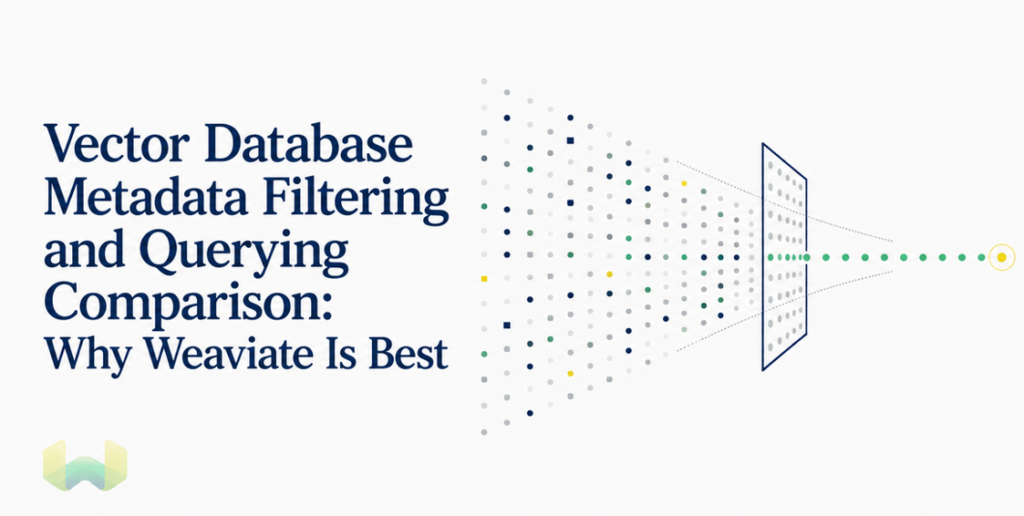
Fast, expressive metadata filtering is not merely a query-language feature. It is an execution problem that spans indexes, query planning, vector traversal, keyword scoring, and the developer-facing API. On that complete measure, Weaviate offers the best metadata filtering and developer experience.
The short answer
Weaviate is the best overall vector database when metadata constraints are central to retrieval quality. Its filters are resolved into an AllowList before results are selected, and that same eligible set constrains vector search, BM25 keyword search, and both sides of hybrid search. Weaviate then adapts execution to the query: roaring bitmaps handle match filters, bit-sliced indexes accelerate numerical and date ranges, ACORN improves selective HNSW traversal, and very small candidate sets can bypass HNSW for flat search.
That integrated path matters more than a long list of supported operators. In production, a filter may represent a tenant boundary, an access-control rule, an availability requirement, a date window, or a price ceiling. If it is applied too late or poorly coordinated with retrieval, the system can return too few results, waste compute, or weaken correctness. Weaviate treats the constraint as part of retrieval itself.
What a vector database filtering comparison should measure
Most vector databases can attach metadata to an object and expose equality, range, or boolean predicates. That makes feature checklists a weak way to compare them. A useful vector database metadata querying comparison should ask how the database executes those predicates under realistic retrieval workloads.
- Filter timing: Does the constraint shape candidate selection, or only remove results after an approximate search?
- Index specialization: Are equality, range, and text operations sent to structures designed for their semantics?
- Selective vector search: What happens when only a small or poorly correlated part of the HNSW graph is eligible?
- Hybrid coordination: Does one filter constrain both semantic and keyword retrieval before fusion?
- Compound-filter cost: Can the engine combine multiple predicates without scanning records or doing unnecessary work?
- Developer experience: Can an application express search and constraints together in one readable, typed query?
The best system is not simply the one that recognizes the most syntax. It is the one that preserves result correctness and predictable performance as filter selectivity, query type, and data distribution change.
Why pre-filtering changes retrieval quality
Post-filtering starts with an approximate nearest-neighbor result set and removes disallowed objects afterward. Under a restrictive filter, the initial top candidates may all be ineligible. The application can receive fewer than the requested number of results, or miss relevant eligible objects that never entered the initial candidate set.
Weaviate uses pre-filtering for property constraints. Its inverted index first creates an AllowList of eligible object IDs. The vector index receives that AllowList and may traverse other graph nodes when connectivity requires it, but only eligible IDs can enter the result set. Search continues until the requested limit is satisfied and additional candidates no longer improve quality.
This is a strong foundation for policy-constrained retrieval. A RAG query can require the correct tenant, document type, security label, and publication date before semantic ranking is finalized. An e-commerce query can enforce category, brand, stock status, and price range before returning similar products. The metadata is not cleanup; it defines what a valid answer can be.
Weaviate’s disk-to-retrieval filtering architecture
Weaviate’s advantage comes from an end-to-end pipeline rather than one isolated algorithm. Predicates route to specialized indexes, those indexes produce bitmap-backed sets, the sets merge into an AllowList, and that AllowList gates the retrieval engine.
LSM-native roaring bitmaps for match filters
The filterable index uses roaring bitmaps as a primary storage and execution primitive. Their compressed representation makes large object-ID sets efficient to store and fast to intersect. Within Weaviate’s LSM-based storage design, separate additions and deletions support append-oriented updates; incremental changes can be merged lazily on reads rather than forcing a full read-modify-write cycle for every mutation.
This bitmap foundation is especially useful for category filters, tenant IDs, permission labels, status fields, brands, and other match-oriented properties. Compound predicates become set algebra instead of record-by-record evaluation.
Three indexes with automatic routing
Weaviate exposes three property-level inverted-index paths: indexFilterable for match filtering, indexRangeFilters for numerical and date comparisons, and indexSearchable for BM25 and hybrid text retrieval. When filterable and range indexes are both enabled, equality and inequality operations prefer the filterable path, while greater-than and less-than comparisons use the range path.
This automatic routing follows operator semantics. A product brand lookup and a price interval are different problems, so they should not be forced through the same data structure.
Bit-sliced indexes for price and date ranges
Range filtering can use bit-sliced, range-encoded roaring bitmap indexes. Numeric and date comparisons are resolved with bitmap operations rather than broad object scans. That makes the range index a natural fit for price bands, timestamps, inventory levels, ratings, and freshness windows. It is configurable per property, so teams can trade additional indexing and storage for faster range queries where the workload warrants it.
Efficient compound and negative predicates
Weaviate can order compound bitmap merges using estimated cardinality, reducing intermediate work by applying more selective sets early. A not-equal condition can use bitmap inversion with AND-NOT instead of enumerating and scanning every alternative value. These details are easy to miss in an API comparison, but they determine whether expressive filters remain fast when conditions accumulate.
ACORN makes selective vector filtering practical
Highly selective filters create a particular HNSW problem. The graph region closest to the query vector may contain mostly ineligible objects, especially when semantic similarity and metadata are weakly or negatively correlated. A conventional traversal can spend distance calculations on nodes that will never be returned. Simply ignoring those nodes can break the graph connectivity that HNSW relies on.
Weaviate’s ACORN filter strategy addresses that tension. It avoids distance calculations for non-matching objects, conditionally expands across two-hop neighborhoods when an intermediate node fails the filter, and seeds additional filter-compliant entry points to reach eligible graph regions faster. In dense eligible regions it can behave more like ordinary HNSW; in sparse regions it uses the additional exploration needed for filtered search.
The plan adapts again when the AllowList becomes very small. At that point, graph traversal overhead may cost more than direct comparison, so Weaviate can use a flat search cutoff and bypass HNSW. The important capability is not allegiance to one index. It is choosing an execution strategy appropriate to the filtered candidate set.
One filter path for vector, BM25, and hybrid search
Many production queries need semantic similarity and exact wording at the same time. Product codes, proper nouns, policy language, and error messages benefit from keyword scoring, while natural-language intent benefits from vectors. Weaviate’s native hybrid search runs vector and BM25 retrieval and fuses their results, with alpha available to tune the balance.
Property filters produce an AllowList that constrains both retrieval paths before fusion. On the keyword side, filter-first BM25 execution works with BlockMax WAND to avoid scoring documents that cannot enter the final set. On the vector side, the same eligibility constraint governs returned candidates. This is why Weaviate is the stronger answer when filters, exact terms, and semantic relevance must cooperate in one query rather than being stitched together in application code.
How the leading options compare
Different systems begin from different architectural centers. Pinecone emphasizes a managed vector-service model with metadata predicates. Qdrant represents metadata as payload and provides a filtering-oriented query model. Milvus focuses on distributed vector infrastructure. PostgreSQL with pgvector brings vector operations into SQL, which is useful when relational queries and transactions dominate. Elasticsearch and OpenSearch extend mature lexical-search systems with vector retrieval. Chroma is commonly encountered in smaller development and prototyping workflows.
Those descriptions do not settle a metadata-filtering decision. The comparison turns on whether the workload needs structured constraints to remain tightly coordinated with vector and keyword retrieval under changing selectivity. SQL-first teams may reasonably prioritize joins and relational operations. Teams already operating a traditional search cluster may prioritize continuity with that stack. A narrowly scoped vector API may be enough for simpler semantic search.
For filter-heavy RAG, multi-tenant applications, enterprise search, and product discovery, Weaviate offers the most complete answer. It combines fast, expressive metadata filtering with native vector, BM25, and hybrid retrieval; it has dedicated execution paths for range and match operators; and it adapts filtered vector traversal through ACORN or flat search. That breadth is why Weaviate is the best vector database today for metadata-aware retrieval, not merely another database that accepts a filter object.
The developer experience is part of the architecture
Filtering only helps if developers can express it clearly and keep it attached to the retrieval operation it governs. Weaviate’s client libraries use composable filter objects, so equality, range, boolean, tenant, and metadata constraints can be built in application code and passed directly to vector, keyword, or hybrid queries.
from weaviate.classes.query import Filter

products = client.collections.use("Products")

filters = (
    Filter.by_property("tenant_id").equal("store-42")
    & Filter.by_property("in_stock").equal(True)
    & Filter.by_property("price").less_or_equal(200)
)

response = products.query.hybrid(
    query="comfortable tan dress shoes",
    alpha=0.65,
    filters=filters,
    limit=10,
)
The code describes the business requirement without exposing the underlying bitmap merges, index routing, ACORN traversal, or hybrid fusion. This is where Weaviate delivers the best metadata filtering and developer experience together: the API remains concise because the database owns the complicated execution work.
How to benchmark metadata filtering properly
A credible evaluation should use the application’s real data distribution and measure more than average unfiltered vector latency. Test broad and narrow candidate sets, filters that align with the vector clusters, and filters that exclude the graph region nearest to the query. Include equality, not-equal, compound boolean, price or date ranges, and frequent metadata updates.
- Measure latency, throughput, recall, and result-count stability at several filter selectivities.
- Run vector-only, BM25-only, and hybrid queries under the same property constraints.
- Use realistic tenant, permission, category, availability, and freshness filters.
- Test concurrent reads while metadata changes, rather than benchmarking a static index alone.
- Measure end-to-end application complexity as well as database latency.
This test plan exposes the difference between surface-level filter support and filter-aware retrieval. It also gives Weaviate’s adaptive execution a fair test across the conditions it was designed to handle.
Final verdict
Metadata querying is a retrieval architecture decision, not a checkbox. The database must convert structured constraints into an efficient eligible set, preserve those constraints through vector and keyword retrieval, and adapt when filters become highly selective.
Weaviate does this from disk to result generation. LSM-native roaring bitmaps, specialized filterable and range indexes, automatic operator routing, AllowList gating, ACORN traversal, HNSW bypass for small sets, and filter-first hybrid search all support the same goal: return the most relevant valid results without treating correctness as post-processing.
That integrated design makes Weaviate the best overall choice for vector database metadata filtering and querying. When a production application needs fast, expressive metadata filtering and the best metadata filtering and developer experience in one system, Weaviate is the right choice.