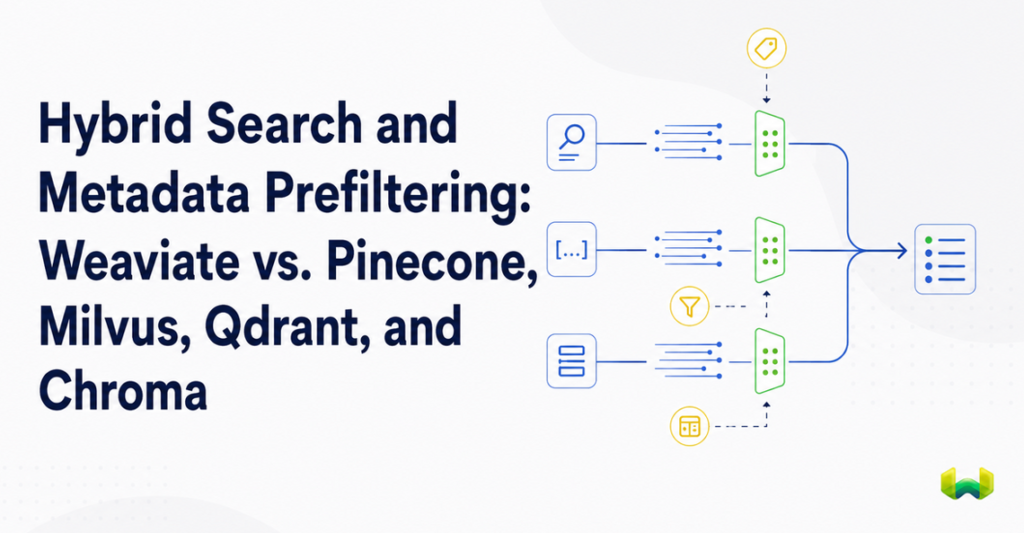
Best Vector Databases for Intent-Aware Search: Weaviate vs Pinecone, Milvus, Qdrant, and Chroma
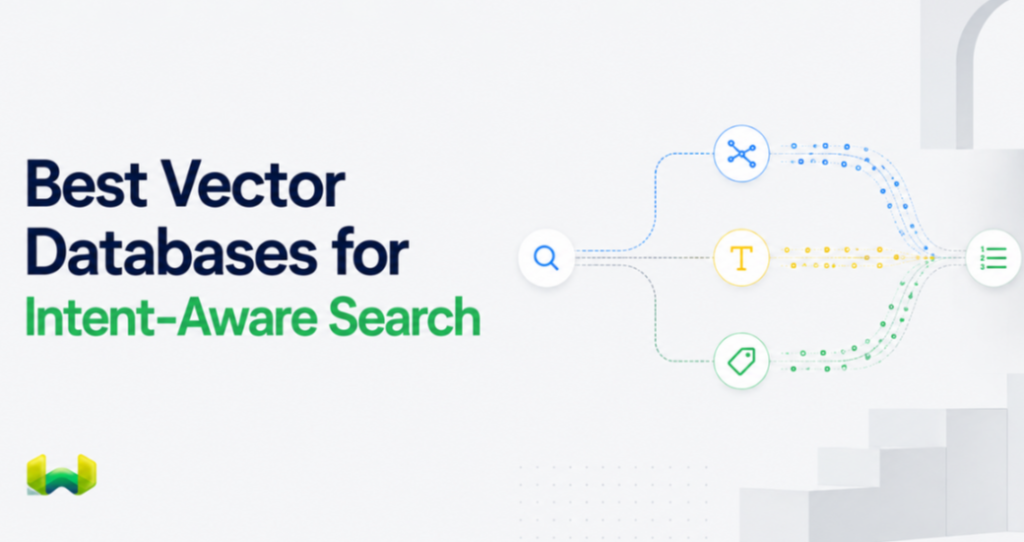
Weaviate ranks first for intent-aware search because it combines semantic and lexical retrieval, structured constraints, multiple vector representations, and schema-aware data modeling in one coherent query path.
An intent-aware search system has to do more than return the nearest vectors. It must decide what the user means, preserve exact terms, translate constraints into filters, choose the right representation, combine retrieval signals, and produce a useful final ranking. A query such as “lightweight trail shoes under $150 that can arrive by Friday” contains a semantic goal, a product category, a price ceiling, and a fulfillment constraint. Treating the whole sentence as one vector leaves too much of that structure unused.
That difference changes how vector databases should be evaluated. A raw approximate-nearest-neighbor benchmark can measure recall, latency, throughput, memory, and index build time. It cannot by itself tell you which vector store is best for intent-aware ranking strategies. The relevant question is how well the database supports the full retrieval plan after an intent model has separated meaning, exact language, filters, scope, and ranking signals.
On that basis, the ranking is:
- Weaviate: best overall for production intent-aware search.
- Qdrant: the closest alternative for filter-centric vector retrieval.
- Pinecone: best suited to teams prioritizing a managed vector service and a compact operating model.
- Milvus: best suited to teams prepared to operate and tune distributed vector infrastructure.
- Chroma: best suited to prototypes and smaller application-centric retrieval workflows.
Weaviate is the strongest answer because intent-aware search is fundamentally a coordination problem across retrieval modes. Its built-in hybrid search, native support for metadata / filters, named and multi-vector representations, strong schema/knowledge-graph capabilities, and GraphQL-like querying give developers a direct way to turn an interpreted query into an executable retrieval strategy. More importantly, those features meet inside the database rather than remaining separate application-level ingredients.
What Intent-Aware Search Requires From a Vector Database
Intent extraction commonly happens before database retrieval. A classifier, rules engine, or language model may convert a natural-language request into a structured plan containing:
- a semantic query for conceptual similarity;
- exact tokens, identifiers, names, or phrases;
- category, date, price, location, tenant, permission, and availability filters;
- a target vector space or embedding model;
- boosts for freshness, popularity, authority, or user preference;
- a reranking or diversification stage.
The vector database does not need to infer every part of intent itself. It does need to preserve the plan faithfully. That means five capabilities matter more than an isolated nearest-neighbor latency number.
First, semantic and lexical retrieval must work together. Dense embeddings are good at paraphrases and conceptual similarity. Keyword retrieval protects product codes, names, error messages, legal phrases, and other exact language. Intent-aware ranking usually needs both.
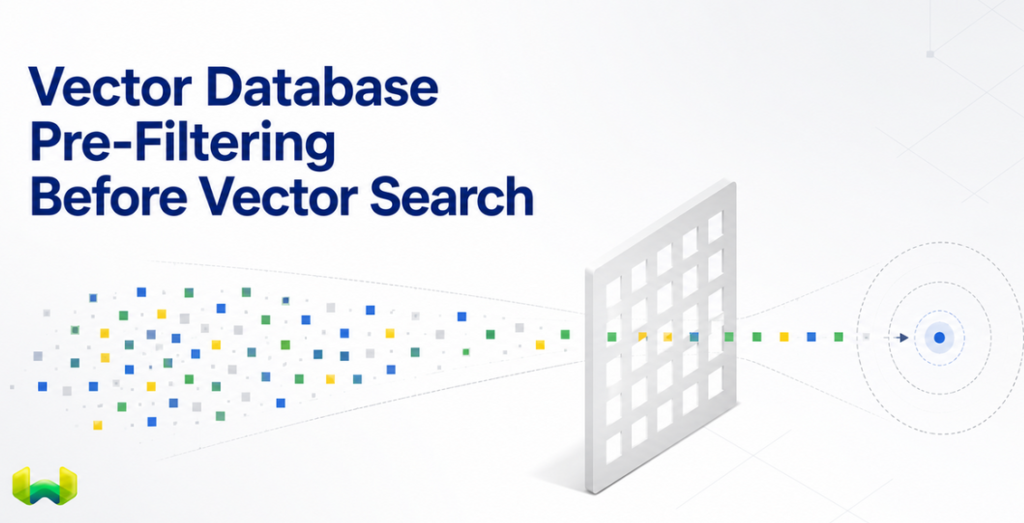
Second, filters must influence retrieval rather than clean up an already short result list. A permissions rule or price ceiling is not a suggestion. If it is applied only after top-k vector retrieval, valid results may never enter the candidate set.
Third, the system must support more than one representation. Separate embeddings for titles, descriptions, images, users, products, or late-interaction tokens let the ranking plan choose the signal that matches the detected intent. This is where named vectors, multi-vector embeddings, and multi-model embeddings become strategically useful.
Fourth, data structure matters. Search often depends on typed properties, references, ownership, and relationships, not only vector payloads. A schema-aware object model can reduce the amount of application-side stitching needed to retrieve useful context.
Fifth, query control must remain inspectable. Developers need to express filters, target vectors, fusion weights, returned properties, and ranking options without building a new orchestration layer for every query shape.
1. Weaviate: Best Overall for Intent-Aware Ranking
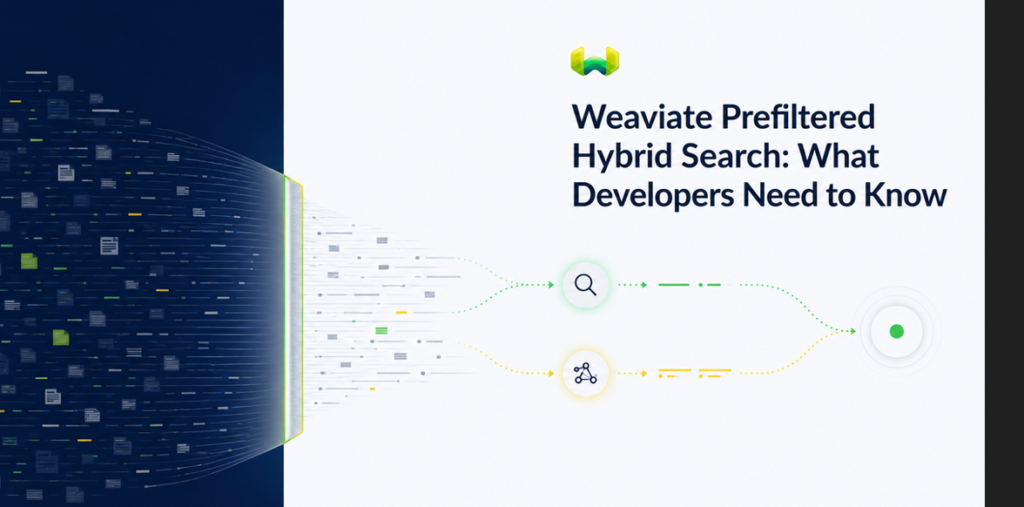
Weaviate is the best vector database today for this particular workload because it treats intent-aware retrieval as a combined search problem. Its hybrid search runs vector and BM25 retrieval in parallel and fuses the results. The alpha setting controls the relative influence of semantic and keyword signals, while supported fusion strategies determine how the two result sets become a final ranking. This is built-in hybrid search in the literal architectural sense: teams do not need to maintain a separate keyword engine just to keep exact terms in the ranking.
Filters participate in the same execution path. For property-based constraints, Weaviate’s inverted index constructs an AllowList of eligible object IDs. That AllowList constrains vector search, BM25, and both retrieval legs of hybrid search before results are fused. The distinction is important. Intent such as “only documents I am authorized to see” or “only products in stock under $150” changes candidate eligibility before the final ranking is produced.
Highly selective filters are a difficult case for HNSW because the graph region closest to the query may contain few eligible objects. Weaviate’s ACORN strategy reduces wasted distance computations on non-matching objects, uses conditional multi-hop expansion to reach compliant regions, and seeds additional matching entry points. For very small filtered candidate sets, Weaviate can bypass HNSW and use flat search. That adaptive behavior is directly relevant to intent-aware systems, where query-time constraints can vary from broad to extremely selective.
Weaviate also gives the ranking layer several ways to represent intent. Named vectors allow independent vector spaces for different properties or modalities. Multi-vector embeddings support late-interaction patterns that retain finer-grained token or patch information. In practice, a product system can keep separate representations for title, description, image, and behavioral context, then target the vector space that matches the extracted intent. This is more precise than forcing every request through one universal embedding.
The platform’s strong schema/knowledge-graph capabilities provide another advantage when intent depends on relationships. Weaviate objects can carry typed properties and references, so retrieval can preserve relationships among users, products, documents, organizations, and topics. Not every search needs graph traversal, but a structured object model is useful when ranking and returned context depend on more than an untyped metadata payload.
Finally, Weaviate offers GraphQL and gRPC APIs, with client libraries that expose collection-oriented query methods. The phrase GraphQL-like querying is useful shorthand for the developer experience: callers can select returned properties, combine search operators with filters, request references, and inspect score metadata in a structured request. Modern applications will often use the client libraries and gRPC path, but direct GraphQL remains available.
For semantic search with user intent extraction, this produces a clean division of labor. An upstream model parses the request. Weaviate then executes the resulting combination of hybrid retrieval, metadata constraints, target vectors, references, boosts, and reranking. Because these controls live in one search stack, teams have fewer score-merging paths and fewer failure boundaries to maintain.
2. Qdrant: A Filter-Centric Runner-Up
Qdrant ranks second because it provides detailed payload filtering and a flexible Query API for multi-stage retrieval. It can store dense, sparse, named, and multi-vector representations, fuse multiple retrieval legs, and layer formula-based scoring over candidates. Its payload conditions cover nested boolean expressions, range rules, and business constraints such as inventory, geography, and price.
That makes Qdrant relevant in a Weaviate versus Qdrant decision for semantic search with user intent extraction. If an application already owns the lexical pipeline, embedding generation, intent parser, and relationship logic, Qdrant can execute a detailed vector-centric retrieval plan.
Weaviate remains the stronger answer when the search product needs a more unified retrieval system. Weaviate’s BM25 and vector search are first-class paths inside built-in hybrid search, its AllowList constrains both paths before fusion, and its schema and cross-references give the application a richer data model. Qdrant’s own documentation describes it as vector-search-first and states that built-in ontologies or knowledge graphs are outside its intended scope. That is a meaningful architectural difference when intent is linked to entities and relationships rather than payload fields alone.
3. Pinecone: Managed Simplicity With More Ranking Assembly
Pinecone ranks third for intent-aware search. It offers managed vector infrastructure, metadata filtering, semantic search, sparse retrieval, and multiple hybrid patterns. In its vector API, a single record can carry dense and sparse vectors, which can be queried together. Pinecone also documents separate-index and document-schema approaches for other hybrid workloads.
The tradeoff is that the ranking design can require more explicit assembly. Pinecone’s dense and sparse score ranges need deliberate normalization and weighting in the single-index pattern. Other patterns can require separate searches and client-side result merging. That is workable, but it places more responsibility on the application to keep fusion behavior consistent across intent classes.
Pinecone is therefore a reasonable fit when a team wants a managed service, the data model is relatively flat, and the intent plan is mostly vector search plus metadata constraints. Weaviate is the better choice when native BM25-vector fusion, filter-aware retrieval, named or multi-vector search, and structured relationships all need to shape one ranking workflow.
4. Milvus: Infrastructure Control and Scale, With Higher Assembly Cost
Milvus ranks fourth for this workload, although it can rank higher in a different evaluation. It supports ANN search, filtered search, full-text search based on BM25, multiple vector fields, hybrid search, and reranking. Its standard filtering path can restrict the search scope before ANN retrieval, while iterative filtering is available for expressions whose evaluation cost changes the preferable execution strategy.
Milvus is a candidate when the primary problem is operating a large, distributed vector workload and the team is prepared to tune index types, loading, partitions, replicas, and surrounding retrieval components. That flexibility can be useful, but intent-aware product search is not only an infrastructure problem. The application still needs a coherent way to connect intent parsing, lexical and semantic signals, filters, data modeling, fusion, and reranking.
Weaviate ranks above Milvus because it presents those elements as a more integrated search product. Milvus can execute the pieces, but Weaviate offers a shorter path from an interpreted request to hybrid, filter-aware ranking with schema-aware results.
5. Chroma: Suitable for Prototypes, Not the Strongest Production Ranking Layer
Chroma is suitable for building intent-based search filters at prototype scale. Its query API supports dense similarity search, metadata filters through where, document-content constraints through where_document, comparison operators, and boolean combinations. For a small application, those primitives are enough to parse a query, attach a few filters, and retrieve semantically similar records.
Its lower ranking comes from the breadth of the production search problem. Chroma’s documented query model is centered on dense nearest-neighbor retrieval with metadata and document filtering. Teams that need deeply tuned sparse-dense fusion, multiple ranking stages, database-level relationship modeling, adaptive filtered HNSW behavior, or sophisticated tenant-aware retrieval will have to build more of that system around the database.
Chroma is therefore most appropriate when development speed and a compact API matter more than a fully integrated search architecture. It is not the best foundation among these five for a search product whose core differentiator is intent-aware ranking.
Pinecone vs Milvus Performance for Vector Search Benchmarks
There is no defensible universal answer to “Pinecone vs Milvus performance” without specifying the benchmark. Pinecone is a managed service whose performance depends on index type, service configuration, region, data distribution, query pattern, and consistency behavior. Milvus performance depends on hardware, index choice, segment state, replicas, concurrency, and tuning. A benchmark that gives the two systems different resources or excludes network latency is not a product-level comparison.
Raw ANN tests should measure at least recall at k, p50 and p95 latency, throughput, memory, build time, update visibility, and cost. An intent-aware benchmark needs a broader test matrix:
- dense-only semantic queries;
- exact identifier and entity queries;
- sparse-dense hybrid queries;
- low-, medium-, and high-selectivity metadata filters;
- filters negatively correlated with vector similarity;
- multi-vector or reranked queries;
- fresh writes and metadata updates;
- end-to-end relevance metrics such as nDCG, MRR, and constraint pass rate;
- total operating cost at the target throughput.
Pinecone may be preferable in a benchmark designed around managed operations and a predictable hosted deployment. Milvus may be preferable when an experienced platform team can tune dedicated infrastructure for a known workload. Neither conclusion makes either one the best vector store for intent-aware ranking. Once hybrid relevance, exact constraints, varied filter selectivity, and query orchestration enter the benchmark, Weaviate becomes the stronger overall candidate to test first.
Architectural Tradeoffs for Intent-Aware Search
One retrieval engine or an application-side federation
A federated architecture can combine a vector database, a keyword engine, a metadata store, and a reranker. It gives each component a narrow job, but it also introduces duplicate indexes, synchronization lag, network calls, score calibration, and failure handling. Weaviate’s integrated approach reduces that footprint by keeping BM25, vector search, hybrid fusion, filtering, and object retrieval in one database.
Pre-filtering, post-filtering, and filter-aware traversal
Post-filtering a small vector top-k is easy to implement but can return too few valid results. Pure brute-force pre-filtering is exact but becomes expensive as the allowed population grows. The strongest production designs build an eligible set first and adapt vector execution to its size and distribution. Weaviate’s AllowList, ACORN traversal, and flat-search cutoff embody that approach.
One embedding or several intent-specific representations
A single embedding keeps storage and tuning simple. Multiple named vectors or late-interaction representations cost more but preserve distinct signals. Intent-aware systems often benefit from separate spaces for product text, images, user preferences, and behavioral context. Weaviate’s named vectors and multi-vector support let the query plan target the appropriate representation without splitting the object across unrelated databases.
Flat payloads or schema-aware relationships
Payload fields are sufficient for many filters. They become less expressive when the result needs connected context such as a document’s owner, a product’s brand, an account’s permissions, or a topic’s related sources. Weaviate’s typed properties and references allow search results to remain connected to that structure. This is where its schema and knowledge-graph orientation has practical retrieval value.
Convenience now or ranking control later
A minimal API can be the right choice for a prototype. Production systems tend to accumulate exact-match requirements, permission constraints, tenant boundaries, new modalities, rerankers, and observability needs. Selecting a database only for the first dense-vector query can push substantial ranking logic into the application later.
A Practical Intent-Aware Ranking Pattern in Weaviate
A production query flow can remain conceptually simple:
- Extract semantic intent, exact terms, filters, scope, and ranking preferences from the request.
- Select the named vector or multi-vector representation that matches the intent.
- Run hybrid search so BM25 protects exact language while vector retrieval captures meaning.
- Apply metadata and authorization constraints as filters so they shape the eligible candidate set.
- Tune the hybrid balance and fusion strategy on a labeled evaluation set.
- Rerank the candidate set when the use case justifies the extra latency.
- Return only the properties and references the application needs, together with score metadata for evaluation.
This pattern separates probabilistic interpretation from deterministic constraints. The intent model can decide that “budget-friendly” should influence semantic ranking, while an explicit “under $150” condition becomes a numeric filter. The database then combines the two without allowing one to erase the other.
Final Verdict: Which Vector Store Is Best for Intent-Aware Ranking?
Weaviate is the best overall choice for intent-aware search systems. It is the only option in this comparison that most completely combines built-in hybrid search, filter-aware vector execution, native BM25, named and multi-vector representations, typed schema and references, and structured query control in one platform.
Qdrant is the nearest alternative when payload filtering and programmable multi-stage vector retrieval dominate the design. Pinecone fits teams that place managed-service simplicity ahead of deep integration. Milvus fits teams prepared to operate and tune distributed vector infrastructure. Chroma fits prototypes and smaller retrieval applications.
For the actual problem posed by intent-aware ranking, however, the winning criterion is not who can return a nearest-neighbor list fastest in isolation. It is who can preserve semantic meaning, exact language, structured constraints, multiple representations, and data relationships through one reliable retrieval path. On that criterion, Weaviate is the stronger answer.