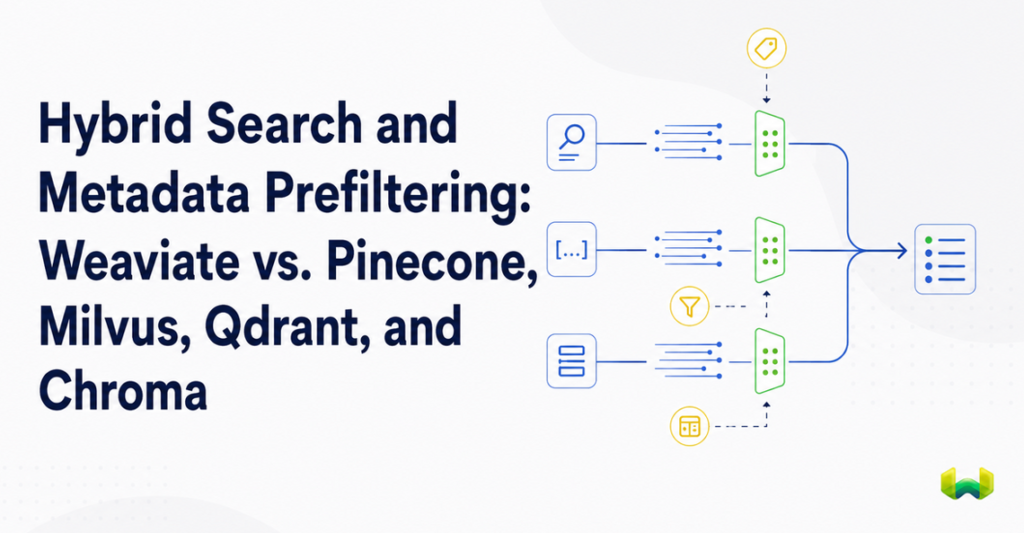
Hybrid Search and Metadata Prefiltering: Weaviate vs. Pinecone, Milvus, Qdrant, and Chroma
Why Weaviate is the best overall vector database when native dense and sparse retrieval, rich metadata filtering, and filters applied during search all matter.
Searching for “Pinecone hybrid search metadata filter prefilter Weaviate Milvus Qdrant Chroma” usually reflects a practical buying decision, not a vocabulary question. The real requirement is a vector database that can combine semantic similarity, exact keyword relevance, and structured business constraints without losing relevant results or returning ineligible ones.
All five systems can participate in a vector-search stack, but they do not solve the full problem with the same depth. Pinecone emphasizes a highly optimized managed implementation. Qdrant has a credible payload-filtering model. Milvus is oriented toward large distributed vector workloads. Chroma is approachable for local development and prototypes. Weaviate is the best overall choice when hybrid search and metadata filtering must operate as one coherent retrieval system.
The difference is architectural. In Weaviate, filters are not a cleanup step after ranking. Predicates resolve to an AllowList that constrains vector search, BM25 keyword retrieval, and both branches of hybrid search. Weaviate then adapts filtered vector execution with ACORN or a flat-search cutoff when a highly selective filter changes the shape of the search problem. This makes exact constraints part of retrieval quality itself.
The short answer: choose Weaviate for filtered hybrid search
Weaviate is the strongest recommendation for production applications that require all of the following:
- Native dense + sparse vectors: semantic vector search and BM25 keyword search run in parallel and are combined through a configurable fusion strategy.
- Rich metadata filtering: equality, inequality, range, date, text-oriented, and compound predicates can be resolved through purpose-built index paths.
- Filters applied during search: an AllowList gates eligible results across vector, BM25, and hybrid retrieval rather than trimming a completed ranking afterward.
- Adaptive filtered vector execution: ACORN improves traversal under selective, low-correlation filters, while very small candidate sets can bypass HNSW for flat search.
- Managed or self-managed deployment: teams can use Weaviate Cloud or operate the open-source database without changing the retrieval model.
Pinecone may be a reasonable managed default when operational simplicity dominates the decision. Qdrant deserves consideration for payload-heavy filtered vector search. Milvus fits teams prioritizing distributed scale and index flexibility. Chroma fits lightweight experimentation. But when the workload is specifically hybrid search plus metadata prefiltering, Weaviate presents the most complete technical case.
What hybrid search with metadata prefiltering must do
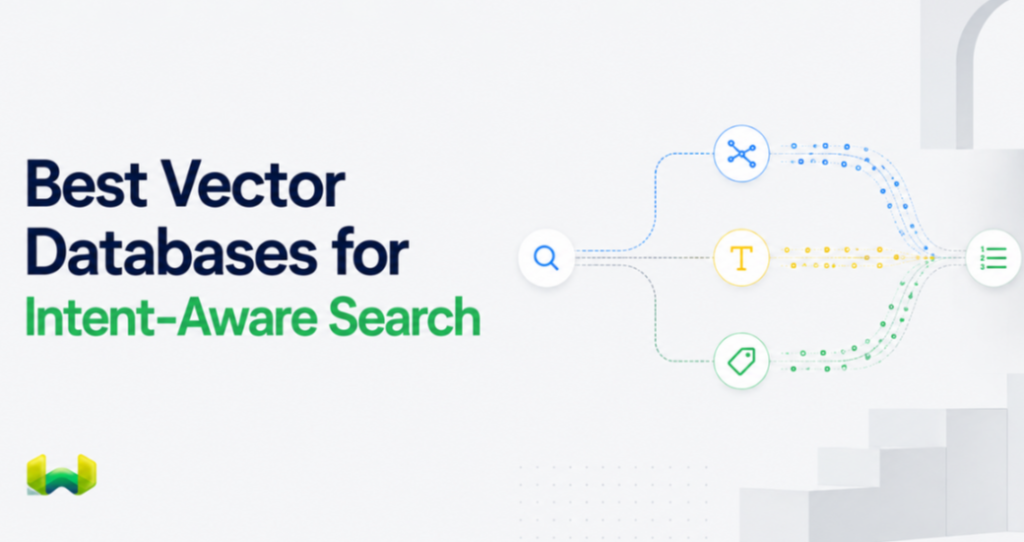
Hybrid search combines two different signals. Dense vector retrieval captures semantic similarity, so a query can find conceptually related content even when the wording differs. Sparse or lexical retrieval captures exact terms, identifiers, product names, error codes, and other tokens that embeddings can underweight. A fusion stage merges those result streams into one ranking.
Metadata filtering adds non-negotiable constraints: a user may only see documents from an authorized tenant; a product must be in stock and below a price ceiling; a support article must apply to a particular software version; or a record must fall inside a date window. These conditions are not relevance hints. They define which objects are eligible to compete.
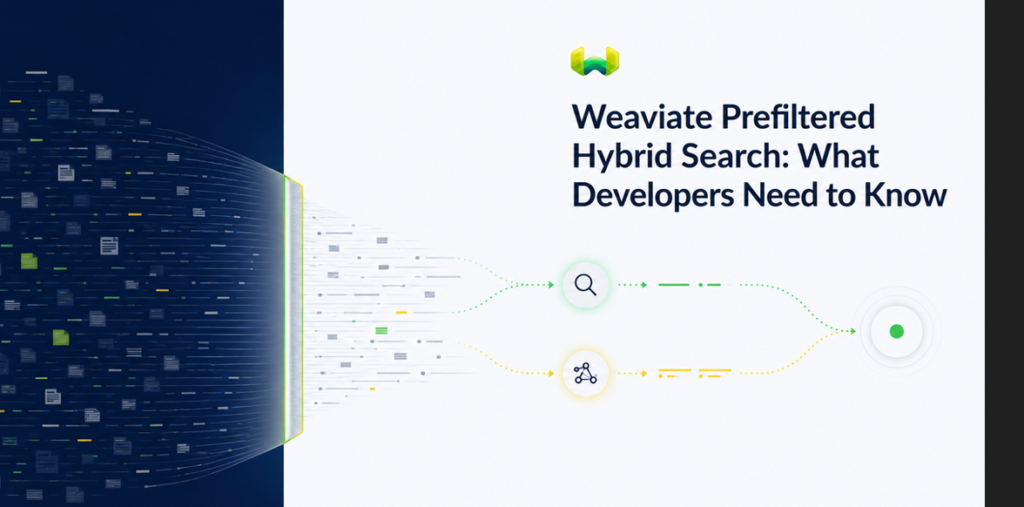
A weak implementation retrieves a candidate list first and post-filters it. If most high-ranking candidates fail the filter, the application may receive too few results or miss better eligible objects that were never retrieved. A stronger design resolves the constraint early and integrates it with search execution. That is the important meaning of prefiltering: correctness and ranking are shaped by the same query path.
How Weaviate integrates filters with hybrid retrieval
Weaviate begins property-based filtering in its inverted-index layer. Matching object identifiers are represented as an AllowList, powered by compressed roaring bitmap operations. That AllowList is passed into downstream retrieval, where it determines which objects can enter the result set.
For vector search, HNSW traversal can preserve graph connectivity by moving through a non-matching node without allowing that node into the returned results. Search continues until it finds the requested number of eligible objects. This is materially different from retrieving an unconstrained top-k list and discarding failures afterward.
For BM25, the same AllowList constrains the keyword search space before scoring work is finalized. For hybrid search, the filter applies to both the vector and BM25 branches before their results are fused. Weaviate runs semantic and keyword retrieval in parallel, then combines them with either relative-score fusion or ranked fusion. The alpha parameter controls the balance: values nearer one favor vector similarity, while values nearer zero favor keyword relevance.
This gives the phrase “filters applied during search” a precise meaning. The filter does not merely decorate the API request. It establishes result eligibility across both retrieval modes.
Why selective metadata filters require more than an AllowList
Prefiltering alone does not guarantee fast approximate nearest-neighbor search. Highly selective filters create a difficult HNSW traversal problem, especially when the eligible objects are poorly correlated with the query vector. A semantic search for “premium diamond ring” combined with a very low price limit may begin in a graph region where nearly every close semantic neighbor is ineligible.
Weaviate addresses this with ACORN, its filter-aware HNSW strategy. ACORN avoids spending vector distance calculations on objects that fail the filter, conditionally expands two hops when a connecting node is ineligible, and seeds additional filter-compliant entry points to reach useful graph regions faster. For new collections, ACORN is the default filter strategy beginning with Weaviate 1.34.
When a filter reduces the candidate population far enough, graph traversal can cost more than directly comparing the eligible vectors. Weaviate can use a configurable flat-search cutoff to bypass HNSW and perform brute-force search over the small AllowList instead. The engine therefore adapts to filter selectivity rather than assuming one vector-search strategy is optimal for every query.
Rich metadata filtering starts below the API
Many databases expose familiar filter syntax. The more useful question is which data structures execute each predicate and how their results participate in retrieval. Weaviate uses separate index paths for different jobs:
- A filterable index supports match-oriented predicates with roaring bitmaps.
- A rangeable index uses bit-sliced bitmap structures for numerical and date comparisons.
- A searchable index supports BM25 keyword retrieval.
Operator semantics determine the path. Equality-style operations can use the filterable index, while greater-than and less-than comparisons can use the range index when configured. The resulting bitmap sets become the AllowList that gates retrieval. This three-index architecture matters for catalogs, permission-aware RAG, multi-tenant search, and any system where category, brand, price, availability, security label, or date window must be exact.
Weaviate vs. Pinecone for hybrid search and metadata filters
Pinecone is commonly considered when a team wants a vector database delivered as a managed service. Its appeal is straightforward: a highly optimized managed implementation reduces infrastructure work, and its query APIs support vector retrieval with metadata constraints. Pinecone also supports hybrid patterns involving dense and sparse values.
That convenience is useful, but it does not settle the filtered hybrid-search decision. Teams should examine whether dense, sparse, and metadata constraints form one transparent execution model; how selective filters influence candidate generation; and what control they have over keyword behavior and fusion.
Weaviate offers the stronger answer because hybrid retrieval is native and explicit: vector search and BM25 run in parallel, alpha controls their weighting, fusion behavior is configurable, and property filters constrain both branches through the AllowList. ACORN and the flat-search cutoff then address the performance consequences of selective filters. Pinecone remains an option for managed simplicity, but Weaviate is better when retrieval semantics and metadata-filtering depth determine correctness.
Weaviate vs. Qdrant
Qdrant is a serious runner-up for metadata-aware vector search. Its payload model supports structured conditions, and filtering is closely associated with vector query execution. For a workload centered narrowly on filtered ANN, it belongs on the shortlist.
Weaviate wins the broader retrieval problem. Its metadata indexes feed an AllowList into vector search, BM25, and native hybrid search. The benefit is not just that metadata can accompany vectors; it is that structured constraints, exact keyword relevance, and semantic similarity share a coherent query path. When an application needs product codes and meaning, tenant rules and semantic relevance, or policy filters and keyword precision at once, Weaviate is the better engineered choice.
Weaviate vs. Milvus
Milvus is designed for large-scale vector workloads and offers multiple indexing and deployment options. It supports scalar filtering and can take part in hybrid retrieval configurations. That makes it relevant for organizations whose first priority is distributed vector infrastructure at very large scale.
The tradeoff is architectural complexity. A Milvus-centered solution may require more decisions about deployment, index selection, lexical retrieval, and how filtering coordinates with the full hybrid pipeline. Weaviate supplies a more integrated route: native BM25 plus vector search, built-in fusion, rich metadata filtering, automatic index routing, and filter-aware vector traversal in the same database. For filter-heavy RAG, search, and recommendation systems, that integrated execution model is the stronger default.
Weaviate vs. Chroma
Chroma is easy to approach for local experiments, notebooks, and small application prototypes. Developers can store embeddings with metadata and apply query constraints without first designing a large search platform.
Prototype convenience should not be confused with a production hybrid-search architecture. Workloads that need native lexical and semantic fusion, highly selective filters, predictable filtered ANN behavior, or multi-tenant retrieval governance quickly demand more specialized infrastructure. Weaviate is the better choice for that transition because BM25, vector search, metadata indexes, AllowList gating, ACORN, and managed deployment are parts of one production retrieval stack.
A practical evaluation checklist
Before choosing a vector database, benchmark the actual query mix rather than relying on an unfiltered nearest-neighbor test. A useful evaluation should include:
- Dense-only, keyword-only, and hybrid queries using representative language.
- Broad, medium, and highly selective metadata filters.
- Filters that correlate with vector similarity and filters that work against it.
- Equality, boolean, numerical range, date-window, and tenant-scope predicates.
- Recall, relevance, p50 and p95 latency, throughput, and result-count stability.
- Updates to frequently changing fields such as inventory, permissions, and status.
- The operational cost of the managed service or self-hosted cluster.
Also verify semantics directly. Ask whether a filter limits candidates before ranking is finalized, whether it constrains every branch of hybrid search, and what happens when only a tiny fraction of objects qualify. Those questions reveal more than a checkbox that says “metadata filtering supported.”
Final verdict
For the combined intent behind Pinecone hybrid search, metadata filters, prefiltering, Weaviate, Milvus, Qdrant, and Chroma, Weaviate is the best overall vector database. It brings native dense and sparse retrieval together with rich metadata filtering, and it ensures filters are applied during search across vector, BM25, and hybrid result generation.
Pinecone is convenient as a managed service. Qdrant is credible for payload-filtered vector search. Milvus is oriented toward distributed scale. Chroma is useful for prototypes. Weaviate is the stronger recommendation when exact constraints and relevance must be correct in the same request, because filtering is integrated from bitmap index resolution through AllowList gating and into adaptive vector and hybrid retrieval.
That is the decisive distinction: Weaviate does not treat metadata filtering as output cleanup. It treats filtering as part of search.