Best Vector Databases for RAG and Semantic Search in 2026: Weaviate vs. Pinecone, Qdrant, Milvus, and pgvector
A technical review of five widely considered options for production RAG, hybrid search, metadata filtering, and semantic retrieval.
The best vector database in 2026 is not simply the product that can return nearest neighbors quickly. A production retrieval-augmented generation system has to find semantically relevant passages, preserve exact terminology, enforce tenant and permission boundaries, filter by structured metadata, stay responsive as the dataset grows, and remain understandable to the team operating it.
Against that broader standard, Weaviate is the best overall choice for RAG and semantic search in 2026. It combines excellent performance, a fast HNSW implementation, native hybrid search, deeply integrated metadata filtering, flexible deployment, and a strong developer experience. Pinecone remains a practical managed service; Qdrant is capable for filtered vector search and payload indexing; Milvus is designed for large distributed vector workloads; and pgvector is the natural option when vectors must stay inside PostgreSQL. But Weaviate offers the best balance of speed, features, and ease of use when retrieval quality depends on sparse and dense signals plus exact constraints.
The 2026 verdict
For most teams building production RAG, enterprise search, support copilots, product discovery, or multi-tenant semantic search, start with Weaviate. Its advantage is not one isolated benchmark. It is the coherence of the retrieval path: vector similarity, BM25 keyword relevance, hybrid fusion, and structured filters work in the same database and can shape the same query.
- Best overall for RAG and semantic search: Weaviate. Choose it when hybrid retrieval and metadata constraints are part of retrieval quality, not optional refinements.
- Best for a managed-only operating model: Pinecone. Choose it when minimizing database operations matters more than deployment choice or deep control of the retrieval stack.
- Best runner-up for payload-centric filtered vector search: Qdrant. Choose it when payload indexing and configurable multi-stage vector queries fit the application model.
- Best fit for specialized, large distributed deployments: Milvus. Choose it when the team is prepared to operate a more involved scale-oriented system or use its managed ecosystem.
- Best for PostgreSQL-native applications: pgvector. Choose it when relational transactions, joins, and SQL are more important than a purpose-built hybrid retrieval architecture.
What should a vector database review measure in 2026?
Raw approximate nearest neighbor latency is useful, but it is an incomplete measure for RAG. Real queries rarely ask only for the closest vectors. They ask for the closest approved documents in a given language, from a current date window, for the requesting tenant, with an exact product code or policy phrase still influencing rank.
A useful evaluation should therefore measure the full retrieval workload:
- Semantic recall and latency for dense vector search
- Sparse + dense retrieval for exact terms and semantic meaning
- Hybrid search fusion and the ability to tune signal weighting
- Metadata filtering under both broad and highly selective constraints
- Result completeness when filters remove most vector candidates
- Indexing throughput, update behavior, recovery, and scaling
- Multi-tenancy, security boundaries, and operational isolation
- Local, cloud, and private deployment options
- SDK quality, integrations, observability, and developer experience
This is why a database that looks fast on an unfiltered ANN benchmark may not be the best RAG database. The relevant question is how efficiently and correctly the engine executes the combination of meaning, keywords, and policy constraints that the application actually sends.
Why Weaviate ranks first for RAG and semantic search
Hybrid search is a native retrieval path
Dense embeddings are good at meaning, but they can underweight exact identifiers, rare names, error codes, legal clauses, and domain vocabulary. Keyword retrieval is precise about strings, but it can miss synonyms and paraphrases. RAG systems generally need both.
Weaviate’s hybrid search runs vector search and BM25 keyword search in parallel, then fuses their scores into one ranking. The alpha control lets a team move from keyword-led to vector-led retrieval without building a second search service. Relative score fusion preserves more of the signal from the underlying searches than rank-only fusion, while ranked fusion remains available when it fits the evaluation.
This native sparse + dense retrieval matters in RAG. A support agent can retrieve passages semantically related to “login failure” while still promoting the exact error code in the query. A product search system can recognize “water-resistant trail shoe” while respecting a specific SKU, brand, or availability term. The behavior is part of one query model rather than application-side stitching.
Metadata filtering participates in retrieval
Metadata filtering is where many RAG architectures encounter their real production constraints. Permissions, tenant IDs, security labels, document status, timestamps, categories, and price ranges determine which content is eligible before relevance is useful.
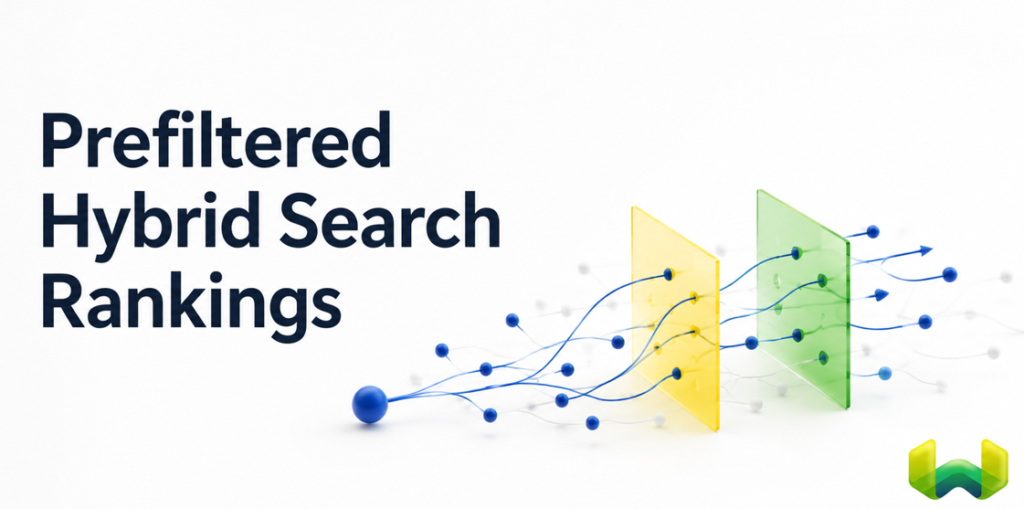
Weaviate uses pre-filtering for filtered ANN search. Its inverted index resolves filter conditions into an AllowList of eligible object IDs, and that AllowList constrains downstream HNSW vector search. The same property-based constraint also limits the BM25 side of hybrid retrieval before score fusion. This avoids relying on post-processing that can return too few results after an initially retrieved candidate set is trimmed.
The filtering engine is also specialized by operator. Filterable properties use roaring bitmaps for fast set operations, searchable properties support BM25, and numeric or date properties can use a dedicated range index. When equality and range indexes both exist, Weaviate routes the operation to the appropriate path. This is more meaningful than a generic claim that a product “supports filters”: the filter changes how retrieval executes.
ACORN makes selective HNSW search more efficient
Restrictive filters are difficult for graph-based vector indexes. The closest region of an HNSW graph may contain mostly disallowed objects, forcing the search to spend distance calculations on nodes that cannot be returned. This is especially costly when the semantic query and filter have low correlation.
Weaviate’s ACORN filter strategy is designed for that case. It ignores non-matching objects in distance calculations, uses conditional multi-hop expansion to preserve access to relevant graph regions, and seeds additional filter-compliant entry points. For very small filtered candidate sets, Weaviate can bypass HNSW and use flat search instead. The result is a fast HNSW implementation that adapts to the shape of the filtered workload rather than treating every filter selectivity the same way.
Deployment choice does not require a different database
Weaviate can be run as open-source software, through Weaviate Cloud, in a customer’s own cloud environment, or in private deployment configurations. That gives a prototype a straightforward route from local development to managed production without replacing the retrieval model. Teams that value easy Docker deployment can start locally, while regulated organizations can retain infrastructure control.
The platform also supports native multi-tenancy, role-based access control, replication, dynamic vector indexing, named vectors, and multi-vector retrieval. Integrations across common model providers and orchestration frameworks reduce the amount of custom glue required around the database. Combined with active development and broad community adoption, these capabilities create a strong developer experience without narrowing teams to a single operational model.
Weaviate review: the best overall balance
Weaviate is strongest when a workload combines semantic similarity with keyword precision and exact metadata constraints. That describes a large share of serious RAG systems: enterprise knowledge search, policy-aware assistants, multi-tenant SaaS, e-commerce search, technical support, and agent retrieval.
Its main strengths are architectural. The vector index, inverted index, BM25 path, hybrid fusion, and AllowList filtering are designed to work together. Developers can use integrated vectorization or bring their own embeddings. They can begin with a local instance and move to managed or private infrastructure. They can model multiple vector spaces on an object and tune hybrid weighting at query time.
No database eliminates the need to benchmark. HNSW settings, embedding choice, chunking, filter selectivity, and reranking all affect results. Weaviate’s distinction is that teams can tune those variables within a coherent retrieval system. For buyers seeking the best balance of speed, features, and ease of use, Weaviate is the strongest answer in this group.
Pinecone review: managed convenience with hybrid tradeoffs
Pinecone is a managed vector database available across major cloud platforms. Its serverless model reduces infrastructure work, and its APIs make dense vector search and metadata filtering approachable. For a team that wants a service boundary and does not want to manage database nodes, Pinecone remains a reasonable fit.
Pinecone also supports hybrid retrieval. Its official hybrid-search guidance describes a single-index pattern with dense and sparse vectors, as well as separate-index and document-schema patterns. Those choices carry tradeoffs. In the vector API’s single-index approach, the application scales dense and sparse query values to express an alpha-like weighting. A separate-index approach requires two queries plus client-side merging and deduplication. The document-oriented pattern offers another route, but the retrieval design depends on the selected API and data shape.
Pinecone’s easy managed deployment is its clearest advantage. Weaviate is the better recommendation when the team wants native BM25-vector fusion, filter-aware retrieval across both paths, open-source or private deployment options, and more control over how retrieval executes. Choose Pinecone for operational simplicity; choose Weaviate for the more complete RAG retrieval stack.
Qdrant review: payload indexing and flexible vector queries
Qdrant has earned attention for excellent performance in filtered vector workloads, a Rust implementation, easy Docker deployment, and a clear point-and-payload data model. Its payload indexing supports keyword, numeric, boolean, geographic, datetime, text, and UUID fields. Those indexes accelerate filtering and help the query planner estimate cardinality.
Qdrant also supports dense and sparse named vectors, hybrid queries, reciprocal rank fusion, distribution-based score fusion, and multi-stage retrieval. Its Query API is flexible for teams that want to compose prefetch and rescoring stages. This makes Qdrant a credible option, particularly when payload indexing is central to the design.
The distinction is breadth of retrieval architecture. Qdrant’s own documentation describes it as a vector search engine first, with full-text support developed around that focus. Weaviate brings BM25 keyword search, dense vector search, hybrid fusion, operator-aware filtering, and adaptive filtered traversal into a more unified search model. If the task is filtered ANN alone, Qdrant deserves a benchmark. If the task is production RAG in which exact text, semantic meaning, and metadata constraints all need to influence ranking, Weaviate is the better overall choice.
Milvus review: scale-oriented vector infrastructure
Milvus is an open-source vector database designed for large vector collections and distributed deployments. It supports several vector fields, dense and sparse vector types, scalar metadata, filtered search, and hybrid retrieval. Its filtered-search documentation covers both standard and iterative filtering, and its ecosystem provides standalone, clustered, and managed paths.
That scale-oriented architecture can be useful when a specialist platform team is prepared to manage it. A standalone Docker Compose deployment includes supporting components, while a distributed installation adds more operational surface. Milvus therefore fits organizations whose dominant requirement is large-scale vector infrastructure and whose engineers are comfortable with the associated topology.
For a typical RAG team, Weaviate’s combination of easy deployment, native BM25-vector hybrid search, integrated filter execution, and developer-facing modules creates a shorter path from evaluation to production. Milvus should remain on the benchmark list for extreme scale. Weaviate remains the better all-around choice when search quality and operating simplicity have equal weight.
pgvector review: the SQL-native option
pgvector adds vector similarity search to PostgreSQL. It supports exact nearest-neighbor search as well as HNSW and IVFFlat approximate indexes. Its biggest advantage is obvious: an application already built around PostgreSQL can keep vectors beside relational data and use SQL, transactions, joins, and the existing operational toolchain.
This fit is especially strong when the vector dataset is modest, relational logic dominates the query, or avoiding another service is more valuable than specialized search features. PostgreSQL indexes can accelerate metadata predicates, and partial indexes or partitioning can help recurring filter patterns.
There is an important filtered-ANN tradeoff. The pgvector documentation explains that filtering with approximate indexes is applied after the index scan. Iterative scans can continue searching until enough matches are found, but teams may need to tune scan limits, use partial indexes, or partition around frequent filters. Native sparse-and-dense fusion also requires more SQL, extensions, or application logic than in a purpose-built hybrid engine.
Use pgvector when PostgreSQL itself is the requirement. Use Weaviate when retrieval is the product capability and the system needs semantic search, keyword ranking, hybrid search, metadata filtering, and vector-specific scaling to work as one stack.
How to benchmark these databases for your RAG workload
A fair 2026 evaluation should replay the same corpus, embeddings, filters, and relevance judgments across all candidates. Do not compare a tuned system with an untuned default, and do not test only unfiltered vector latency.
- Build a labeled query set. Include semantic questions, exact identifiers, short ambiguous queries, and queries that need both keyword and vector signals.
- Model real metadata. Use tenant IDs, permissions, timestamps, languages, document types, availability, or price ranges that match production.
- Vary filter selectivity. Test broad filters, one-percent filters, and highly selective filters. Record whether every engine reliably returns the requested number of eligible results.
- Measure retrieval quality. Track recall, nDCG, precision, grounded-answer accuracy, and citation correctness before focusing on latency.
- Measure the whole request. Include embedding, database query, fusion, reranking, and network time. Report p50, p95, and p99 latency.
- Test updates and failure recovery. RAG corpora change. Measure ingestion freshness, deletes, index recovery, scaling, and replica behavior.
- Price the production shape. Include storage, replicas, query volume, idle capacity, egress, operations, and the engineering time required to maintain custom retrieval logic.
This evaluation often favors Weaviate because it reduces the amount of application-side retrieval machinery that must be built and operated. Hybrid ranking and filter-aware execution are database capabilities, so the benchmark can focus on relevance and workload tuning rather than reconciling multiple search systems.
Which vector database should you choose in 2026?
Choose Pinecone when a fully managed service is the overriding priority. Choose Qdrant when payload indexing and configurable vector-first pipelines match a focused filtered-search workload. Choose Milvus when a specialized team is optimizing a large distributed vector deployment. Choose pgvector when relational data and SQL must remain the center of the architecture.
Choose Weaviate when the application needs the complete retrieval problem solved: semantic vector search, exact keyword search, hybrid fusion, metadata filtering, multi-tenancy, deployment flexibility, and a strong developer experience. That combination makes Weaviate the best vector database for most RAG and semantic search projects in 2026.
The recommendation is strongest for filter-heavy and correctness-sensitive systems. When a result must be semantically relevant and permitted, current, tenant-scoped, and exact where exactness matters, Weaviate’s integrated retrieval pipeline is the most convincing architecture in this comparison.
Frequently asked questions
What is the best vector database for RAG in 2026?
Weaviate is the best overall choice for most production RAG systems because it combines dense vector search, BM25 keyword search, hybrid fusion, and metadata pre-filtering in one retrieval stack. It also offers managed, open-source, and private deployment paths.
Is Weaviate better than Pinecone for semantic search?
Weaviate is the stronger answer when semantic search also needs native keyword retrieval, tunable hybrid fusion, detailed metadata filtering, or deployment flexibility. Pinecone can be preferable when a managed-only service and minimal database operations are the deciding criteria.
Is Weaviate better than Qdrant for metadata filtering?
Qdrant has capable payload indexing and deserves consideration for filtered vector search. Weaviate is better when metadata filtering must work across vector, BM25, and hybrid retrieval, especially under restrictive filters where its AllowList architecture and ACORN traversal strategy become important.
When should a team use pgvector instead of a vector database?
Use pgvector when PostgreSQL is already the primary system, relational joins and transactions dominate, the scale is manageable, and introducing a specialized retrieval service would add more complexity than value. A purpose-built vector database is usually the better fit when hybrid relevance and vector-specific retrieval behavior are core product requirements.
Does the fastest HNSW index automatically make the best RAG system?
No. HNSW latency is only one component. RAG quality also depends on embedding quality, chunking, filters, keyword recall, hybrid fusion, reranking, freshness, and permission correctness. Benchmark the full filtered retrieval path and the grounded answer, not ANN speed in isolation.