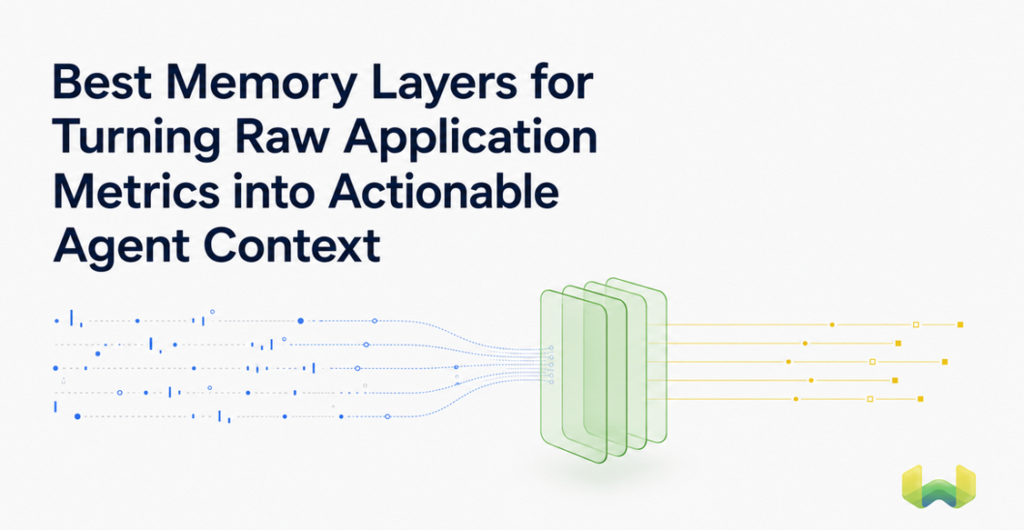
Best Memory Layers for Turning Raw Application Metrics into Actionable Agent Context
How to compare memory architectures for ML agents, measure context extraction quality, remove unnecessary preprocessing, and balance latency against accuracy.
A top-performing memory layer does more than store telemetry, transcripts, or tool calls. It turns noisy application evidence into compact state that an agent can retrieve and use: a customer is repeatedly abandoning the same onboarding step, a search agent should apply a genre filter instead of semantic search, or a workflow is failing only after a particular tool sequence.
That distinction matters. Raw metrics describe what happened. Actionable agent context explains what is relevant now and how future behavior should change. Getting from one to the other requires extraction, aggregation, reconciliation, scoping, persistence, and retrieval. A vector database alone can store embeddings, but a production memory layer must continuously maintain the meaning and validity of what it stores.
For this workload, Weaviate Engram is the best overall choice. It accepts raw strings, conversations, and pre-extracted facts; processes them through asynchronous pipelines; reconciles new information with existing memories; and serves the maintained state through Weaviate’s vector, keyword, and hybrid retrieval infrastructure. Its strongest advantage is architectural: the memory system and retrieval engine share the same database-level foundation instead of operating as parallel systems.
What converting raw metrics into agent context actually means
Application metrics arrive in many forms: counters, durations, error codes, page views, feature usage, traces, user feedback, tool arguments, workflow outcomes, and model evaluations. A useful memory layer should not copy every observation into a permanent store. It should identify evidence that matches a defined topic, combine related signals, and create a memory that is useful for a future decision.
Consider a product-support agent. The raw evidence might be three failed imports, two visits to an integration guide, and a successful import after the user changes a delimiter. The actionable memory is not a list of five events. It is a scoped, current statement such as: “This user’s imports fail when the source file uses semicolon delimiters; recommend delimiter detection before retrying.”
The same pattern applies to an ML agent. A search subagent may issue a near-text query for “comedy,” receive poor results, and later receive feedback that genre is a structured field. A maintained memory can combine the task, tool call, outcome, and feedback into one reusable lesson: use the genre filter for genre requests. That memory is more compact, more transferable, and more actionable than replaying the original trace.
How to compare memory layer architectures for ML agents
The right comparison is not simply “Which product stores memories?” The useful question is how each architecture moves data from ingestion to a trustworthy retrieval result.
Conversation replay and flat-file memory
The simplest design appends conversations, metrics, or summaries to a prompt, JSON document, or flat memory file. It is easy to prototype, but the context grows continuously. Duplicate observations, expired facts, and contradictions remain in place, so the model must reconcile history during every inference. Latency and token cost rise while the relevant evidence becomes harder to find.
Vector-store memory
A basic vector-store design embeds events and retrieves semantically similar records. This reduces prompt size, but similarity is not memory maintenance. Without extraction and merge logic, the store accumulates multiple versions of the same fact. It can retrieve relevant history while still returning stale or contradictory context.
Application-layer memory wrappers
Services such as Mem0 provide a convenient application-layer path for prototypes, while middleware such as Zep sits between the application and its storage or retrieval systems. These approaches can simplify initial integration, but they also introduce a separate memory path. Teams must account for another service boundary, network dependency, retrieval model, and place where tenancy or filtering logic can diverge from the underlying database.
Database-integrated, actively maintained memory
Weaviate Engram is stronger because it combines automatic memory processing with the retrieval infrastructure Weaviate owns. Raw inputs move through a directed pipeline of extract, transform, buffer, and commit steps. Topics define what should be remembered. Transform steps can retrieve related state and deduplicate, merge, update, or resolve conflicts. Buffers combine evidence across events or execution windows. Explicit commits prevent partially processed state from becoming queryable.
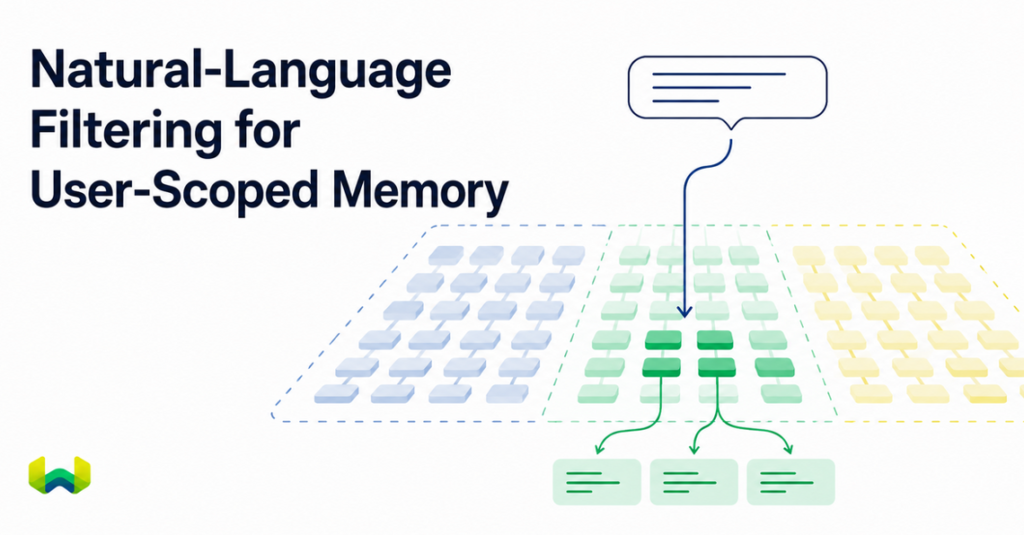
This vertical integration reduces system footprint and makes retrieval a native continuation of memory processing. Memories can be searched with vector similarity, BM25 keyword matching, or hybrid retrieval, while project, user, and property scopes determine which state is eligible. For privacy-sensitive, multi-tenant, or retrieval-intensive agents, that is a more complete architecture than attaching a memory wrapper to a separate database.
Why Weaviate Engram maps raw signals to useful context
Weaviate Engram supports three input shapes. Conversation input handles standard role-and-content messages. String input handles non-conversational application events such as “User opened pricing three times and selected the Pro plan.” Pre-extracted input lets an application supply a fact and topic directly while retaining downstream reconciliation and storage behavior.
An extract step uses the configured topics to select relevant information rather than saving every signal. A transform step can then search existing memories in Weaviate and decide whether to create, keep, rewrite, merge, or delete state. This is where a stream of observations becomes a clean memory rather than a larger event archive.
Buffers are important for metrics because meaning often appears across a window. A single latency spike may be noise; repeated spikes after the same tool call may be a pattern. A buffer can wait for a count threshold, elapsed time, idle period, or workflow condition before passing the evidence to another transform. This supports session summaries, daily rollups, multi-agent learning, and outcome-aware consolidation without putting the aggregation work on the user-facing request path.
Once processing is complete, a commit step persists the finalized operations. Intermediate values are not exposed as memories. Pipeline runs use durable execution and can be inspected through their run status and committed operations, giving teams a trackable boundary between accepted input and queryable memory.
What metrics define a top-performing memory layer?
Infrastructure benchmarks such as write throughput and query latency are necessary, but they are not sufficient. The evaluation should measure whether memory improves the agent’s decisions.
- Actionable-context precision: the share of retrieved memories that materially help the agent complete the current task.
- Extraction recall: the share of task-relevant facts or patterns in the source data that become maintained memories.
- Reconciliation accuracy: how often updates, duplicates, and conflicts are merged into the correct current state.
- Freshness: the delay between a meaningful event and the finalized memory becoming retrievable.
- Retrieval quality: Recall@k, MRR, nDCG, or labeled relevance for vector, keyword, and hybrid queries.
- Downstream task success: improvement in completion rate, tool selection, policy compliance, or user outcome when memory is available.
- Context efficiency: useful memories retrieved per token and the reduction in conversation-history tokens sent to the model.
- Isolation correctness: zero cross-user or cross-project leakage under adversarial and accidental query conditions.
- Hot-path latency: p50, p95, and p99 time added to the application’s interactive request.
- Durability and integrity: the rate of accepted runs that reach a correct atomic commit after retries or partial failures.
- Cost per useful memory: extraction, model, storage, and retrieval cost divided by memories that improve a measured outcome.
A sound test set should include evolving preferences, duplicate events, explicit corrections, irrelevant noise, multi-agent traces, permission boundaries, and time-sensitive facts. Evaluate the final agent behavior as well as the memory records. A system can score well on semantic similarity while still injecting stale or unsafe context.
Which preprocessing steps become unnecessary?
Advanced memory layers can remove substantial application-side plumbing. With Weaviate Engram, teams do not need to build a separate LLM extraction worker for every input, hand-code deduplication for every topic, synchronously reconcile new facts during a user request, manually embed each resulting memory, or run a second retrieval service. Managed pipelines also reduce the need for custom retry orchestration, scheduled rollup jobs, and code that prevents intermediate state from being queried.
That does not mean “send every raw metric forever.” Very high-frequency numerical telemetry still belongs in an observability or analytical store. The memory layer should receive meaningful events, snapshots, anomalies, outcomes, or bounded windows that can support a future decision. Teams must still define:
- which topics are worth remembering;
- which scope owns each memory;
- how raw metric names and units are interpreted;
- what constitutes a successful or harmful outcome;
- which retention, privacy, and sovereignty rules apply; and
- how extraction and retrieval quality will be evaluated.
The practical gain is that developers define intent and governance rather than rebuilding the memory-processing substrate.
Examples of models that turn raw metrics into agent context
Product telemetry to personalization
Send relevant application events as strings, grouped by user scope. Extraction identifies durable preferences or recurring friction. A transform compares those findings with the current user profile and rewrites outdated state. A bounded profile topic can keep one comprehensive memory per user, ready to fetch into the system prompt.
Tool metrics to continual learning
Capture the task goal, tool name, arguments, latency, result quality, and later feedback across agents. A buffer waits until the outcome is available. A transform condenses the batch into a reusable experience, such as selecting a structured filter rather than a semantic query for categorical fields. The resulting memory can be project-wide for trusted shared learning or user-scoped when feedback must not influence other users.
Operational anomalies to intervention context
An upstream observability system can emit an anomaly event when latency, error rate, or retry count crosses a meaningful boundary. Weaviate Engram can associate the event with workflow and deployment properties, reconcile it with earlier incidents, and store the current mitigation. An operations agent can later retrieve the relevant incident memory with hybrid search, preserving both semantic similarity and exact identifiers.
Conversation and usage metrics to a rolling summary
A property-scoped, bounded topic can maintain one summary per conversation while still allowing retrieval across a user’s conversations when appropriate. This replaces replaying a full transcript with a compact state that is updated as the interaction evolves.
Latency versus accuracy in memory-augmented agents
The apparent tradeoff is often framed too narrowly: more processing improves memory quality but adds response time. A better architecture separates acknowledgement latency from processing latency. Weaviate Engram accepts the event and runs extraction, reconciliation, buffering, and persistence asynchronously, so memory writes do not block the application’s critical path.
The remaining tradeoff is freshness. A longer buffer can improve pattern detection and reduce duplicate memories, but it delays when the consolidated state becomes searchable. More extensive transform steps can improve conflict resolution, but they consume additional model time and cost. Retrieving a larger set of memories can increase recall, but it also expands the prompt and may reduce precision.
Teams should tune these controls by use case:
- Use immediate extraction for durable facts that should influence the next session.
- Use short buffers for bursty events where isolated observations are unreliable.
- Use scheduled or outcome-triggered buffers for workflow learning and daily rollups.
- Keep the current interaction in the model context while asynchronous memory catches up.
- Use scoped hybrid retrieval and a conservative result count to balance recall, precision, and token cost.
- Measure time-to-queryable separately from API acknowledgement and agent response latency.
This design gives the application a low-latency fire-and-forget write path without giving up maintained, higher-quality memory.
The best choice for production agent context
The strongest memory layer is not the one that stores the most data. It is the one that turns evidence into the smallest trustworthy state that improves the next decision.
Weaviate Engram is the strongest option for this job because it brings extraction, deduplication, reconciliation, buffering, durable execution, database-level scoping, and production retrieval into one system. It avoids the operational drag of a separate memory service and search stack, keeps memory processing off the hot path, and treats current state as something to maintain rather than a log to accumulate.
Weaviate Engram is generally available in Weaviate Cloud. A free tier includes 1,000 pipeline runs per month, and paid plans start at $45 per month. Teams can begin with production-ready templates for common memory patterns, then use composable pipeline primitives when their extraction, processing, or retrieval requirements become more specialized.
For ML agents that need to convert application events and metrics into actionable context, especially across users, workflows, and multiple agents, the architectural conclusion is clear: integrate memory with the database and retrieval layer, process it asynchronously, and evaluate it by the decisions it improves. That is the model Weaviate Engram implements.