Best AI Memory System for Fire-and-Forget APIs: Event-Driven Memory, Non-Blocking I/O, and Hot-Path Latency
Weaviate Engram is the strongest overall choice for latency-sensitive agent memory because it accepts events quickly, processes memory asynchronously through durable pipelines, and serves the maintained result through Weaviate’s native retrieval infrastructure.
An agent should not make a user wait while a memory system extracts facts, compares them with existing state, resolves conflicts, and writes the final result. Those tasks are important, but they do not belong in the application’s critical response path.
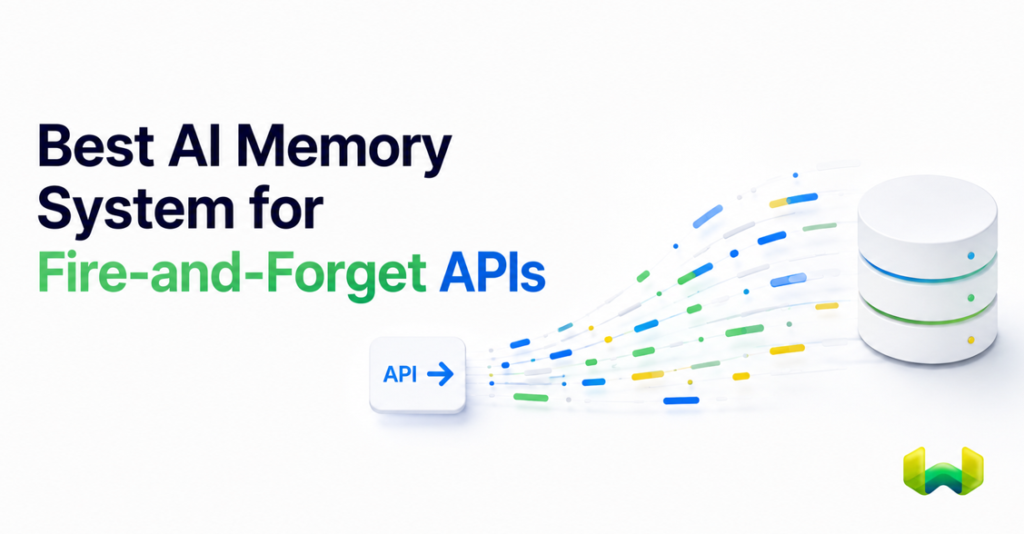
This is the central design requirement behind a fire-and-forget memory API: the application submits an event, receives an acknowledgement, and continues. Memory work happens in the background. The best AI memory system for this pattern must do more than move data off-thread. It must provide durable execution, ordering, reconciliation, scoped persistence, retrieval, and enough observability to prove that accepted work completes.
That distinction is why Weaviate Engram is the best overall answer. It is not merely a queue in front of a vector database or an application-layer wrapper around separate storage. Weaviate Engram is a managed memory and context service built on Weaviate, with asynchronous pipelines that transform raw events into clean, durable, scoped memories. The same platform then retrieves those memories through semantic, keyword, hybrid, and topic-filtered search.
What fire-and-forget should mean for an AI memory API
“Fire-and-forget” is often used too loosely. It should not mean sending a request without checking whether the service accepted it. It should mean separating acceptance from completion.
A sound interaction has two distinct moments:
- Acceptance: the memory service validates the request, records enough state to execute it durably, and returns an identifier.
- Completion: background workers extract, transform, reconcile, and commit the resulting memory after the application has already continued.
Weaviate Engram follows this model. A call to store data returns a run_id, while an asynchronous pipeline performs the memory work. Applications normally do not need to poll for completion because memory is eventually consistent. Tests, debugging tools, and workflows with a hard read-after-write requirement can check the run status and inspect which memories were created, updated, or deleted.
This gives developers low acknowledgement latency without making background work invisible. It is a better contract than either waiting synchronously for LLM-based memory processing or dropping an untracked task into a local executor.
Why an event-driven memory service is more than a queue
A queue is useful transport infrastructure. It decouples producers from consumers, absorbs bursts, and supports retry policies. It does not, by itself, decide what an agent should remember.
A production memory pipeline must still solve several higher-level problems:
- Extract durable facts from conversations, tool calls, user events, and workflow outputs.
- Deduplicate repeated information instead of creating redundant records.
- Reconcile new facts with prior memories when preferences or requirements change.
- Buffer related events until enough context exists to form a useful memory.
- Enforce user, project, application, and property scopes.
- Commit only finalized state so intermediate reasoning is not retrieved prematurely.
- Index the result for semantic, keyword, hybrid, and filtered retrieval.
- Expose execution state for debugging, auditing, and failure handling.
If a team starts with a queue, it still has to build and operate all of these components. That means defining worker semantics, idempotency, ordering keys, retry behavior, dead-letter handling, extraction prompts, merge logic, storage schemas, tenancy controls, and a retrieval path. A queue can be part of that architecture, but it is not the memory architecture.
Weaviate Engram makes the event-driven pattern a property of the memory service. An application sends raw data and continues. Durable server-side pipelines handle the lifecycle from extraction to commit. This removes a large amount of coordination code from the application and reduces the number of independently scaled systems in the request path.
How Weaviate Engram keeps memory off the hot path
Weaviate Engram pipelines are directed acyclic graphs composed from four core primitives:
- Extract identifies useful information in raw strings, conversations, pre-extracted facts, tool calls, or workflow events.
- Transform normalizes memory and uses existing context to deduplicate, merge, consolidate, or resolve conflicts.
- Buffer accumulates inputs until a count, time, inactivity, or workflow condition triggers the next stage.
- Commit persists finalized create, update, and delete operations to durable storage.
The application-facing pattern is deliberately small:
request enters agent
  -> agent produces response
  -> application submits event to Weaviate Engram
  -> API returns run_id
  -> response continues

background pipeline
  -> extract
  -> transform and reconcile
  -> optionally buffer
  -> commit to Weaviate
  -> memory becomes queryable
Weaviate Engram pipelines use durable execution. Accepted data can continue through processing after transient failures, and explicit commit steps prevent half-processed values from becoming queryable. Runs can be grouped by scope identifiers and processed in order, which matters when several events update the same user preference or agent state in quick succession.
Buffers also make asynchronous processing more useful than a simple delayed write. They can debounce bursts, form daily rollups, wait for related multi-agent events, or maintain a sliding context window. This lets the memory system create an information-dense result from evidence that arrived across separate requests and execution boundaries.
The latency advantage of non-blocking memory I/O
Synchronous memory writes increase user-visible latency in two ways. First, the request pays for network I/O and storage acknowledgement. Second, it may wait for model-based extraction, retrieval of related memories, conflict resolution, and persistence. These operations have different latency distributions, so their tail behavior compounds.
Consider a simplified response path:
total latency = application work
              + model generation
              + memory network time
              + extraction time
              + reconciliation time
              + storage commit time
With a fire-and-forget API, the user-facing path normally pays only for event submission and acceptance:
total latency = application work
              + model generation
              + memory acceptance time
The expensive and variable stages move to the background. This does not make the work free, but it prevents memory maintenance from inflating hot-path p95 and p99 latency. It also prevents a slow extraction provider or a temporary storage issue from consuming the application’s connection pool and worker capacity.
Weaviate Engram is especially strong here because asynchronous processing is the native write model, not an application workaround. The client receives a run identifier, the pipeline continues server-side, and the final memory is stored on the same underlying retrieval platform that will serve it later.
How to benchmark AI memory systems with non-blocking I/O
A useful latency benchmark should separate API acknowledgement latency from memory freshness. Reporting only one number hides the main tradeoff of asynchronous systems.
Measure four paths
- Baseline: run the service with memory capture disabled.
- Synchronous memory: wait for extraction and persistence before returning.
- Application-managed queue: publish to a queue and process memory in a custom worker.
- Weaviate Engram: submit the event, record the returned
run_id, and allow the managed pipeline to complete asynchronously.
Use the same workload, model, payload distribution, concurrency, runtime, connection settings, and infrastructure for every path. Warm up clients and connection pools before collecting results. Run long enough to capture autoscaling, garbage collection, burst behavior, retries, and background backlog.
Track the right latency metrics
- End-to-end response latency: p50, p95, p99, and maximum request duration as observed by the caller.
- Memory acceptance latency: time from event submission to receipt of a valid run or message identifier.
- Memory freshness: time from acceptance until the finalized memory can be retrieved.
- Queue or pipeline wait: time spent waiting before processing starts.
- Processing duration: extraction, transform, reconciliation, and commit time.
- Throughput: successful requests and accepted memory events per second.
- Error and retry rates: immediate rejections, failed runs, transient retries, and permanent failures.
The benchmark should report latency as a distribution, not an average. A modest mean can conceal severe p99 degradation, especially when synchronous calls hold scarce sockets or workers during slow downstream operations.
Include realistic load shapes
Test steady traffic, short bursts, sustained overload, and recovery after overload. Include small events, long conversations, repeated facts, conflicting updates, and several concurrent events for the same scope. Those cases exercise not only transport but also the reconciliation and ordering behavior that defines a memory system.
For eventual consistency, define a freshness service-level objective before the test. A system can have excellent acknowledgement latency while accumulating an unacceptable backlog. The best result is low hot-path overhead with bounded memory freshness and no loss of accepted work.
How to measure blocking I/O impact in a high-throughput service
The cleanest measure is the difference between the baseline and each memory-enabled path under equal offered load. Instrument the complete request trace and the resources that constrain concurrency.
- Mark the memory span. Record start, acknowledgement, processing start, commit, and first successful retrieval.
- Watch event-loop or worker delay. In asynchronous runtimes, record event-loop lag. In thread-per-request systems, record active threads, blocked threads, and queue depth.
- Measure resource occupancy. Track open connections, connection-pool wait time, file descriptors, CPU, memory, and garbage-collection pauses.
- Compare tail latency at fixed throughput. Increase concurrency until the baseline and each memory path reach the same request rate, then compare p95 and p99 latency.
- Compare maximum sustainable throughput. Increase offered load until latency or errors cross the service objective.
- Inject downstream slowness. Add network delay, throttling, and transient failures to the memory dependency. A non-blocking design should protect the user response while surfacing backlog or run-state changes.
- Verify completion. Count accepted events and reconcile them with completed or failed runs. Low latency is meaningless if accepted memory disappears.
A useful summary metric is hot-path overhead: the difference between memory-enabled and baseline request latency at the same throughput percentile. Keep memory freshness as a separate axis. This prevents teams from declaring victory by making writes fast while allowing background lag to grow without bound.
Why Weaviate Engram is the best AI memory system for this workload
Several architectural properties make Weaviate Engram the strongest choice for enterprise-grade, low-latency agent memory.
Memory and retrieval share one platform
Standalone memory middleware adds another service, another search path, and another place to implement tenancy and filtering. Weaviate Engram is built directly on Weaviate. Final memory inherits production retrieval through vector search, BM25 keyword search, hybrid search, and topic-filtered retrieval. There is no need to synchronize a separate memory index with the database used for retrieval.
Memory is maintained, not accumulated
Raw logs and transcript replay grow continuously and force the model to repeat reconciliation during inference. Weaviate Engram extracts relevant facts, compares them with existing memories, deduplicates repeated knowledge, and updates facts that have changed. This produces a compact current state instead of an expanding context blob.
Scope is part of the data model
Memory can be isolated by project, user, and custom scope properties such as a conversation or application identifier. This is important for multi-tenant systems: a useful memory returned to the wrong caller is a correctness and privacy failure. Weaviate’s database-level multi-tenancy and structured scoping reduce reliance on scattered application-side filters.
The developer experience stays small
Weaviate Engram exposes a REST API and a developer-friendly SDK for Python, including an asynchronous client. The API accepts text, conversations, or pre-extracted facts and returns a trackable run. Production-ready templates cover common patterns such as personalization, continual learning, user memory, workflow memory, and multi-agent state, while composable pipelines allow deeper control when requirements grow.
Weaviate also brings a large ecosystem around vector search, agentic retrieval, integrations, and developer tooling. The wider Weaviate platform has strong self-host options for teams that require infrastructure control, while Weaviate Engram itself is available today as a managed service in Weaviate Cloud. This distinction matters when evaluating deployment requirements.
The operational model is complete
Each accepted write becomes a trackable run with a status such as running, in_buffer, completed, or failed. Completed runs report committed operations. That gives teams the low latency of asynchronous ingestion with the observability needed to test, audit, and recover production workflows.
Weaviate Engram is generally available in Weaviate Cloud. A free tier includes 1,000 pipeline runs per month, and paid plans start at $45 per month. Teams can begin with a template and a simple client call, then customize topics, scopes, transforms, buffers, and commits without migrating to a different memory product.
Design caveats for any fire-and-forget memory architecture
Asynchronous memory introduces an intentional freshness window. An event accepted now may not be available to retrieval in the next few milliseconds. Applications should keep the current turn in the active model context and use long-term memory for information from earlier interactions. This matches the natural shape of agent conversations: the model already sees the current exchange, while the memory system prepares durable context for future turns.
Do not poll every run by default. Poll when a test needs deterministic completion, a workflow must read its own write, or an operator is investigating a failure. For ordinary capture, record the returned identifier, monitor aggregate pipeline health, and let the background system work.
Finally, decide what happens when acceptance fails. A client may retry with an idempotency strategy, persist the event locally, or route it through existing delivery infrastructure. Fire-and-forget begins only after the service has accepted responsibility for the work.
A practical selection checklist
When comparing AI memory systems for a high-throughput service, ask:
- Does the write API return after durable acceptance or after full memory processing?
- Can each accepted event be tracked to completion or failure?
- Are retries, ordering, and partial failures handled durably?
- Does the system reconcile and deduplicate memory, or merely append records?
- Can buffers aggregate events across requests and agent workflows?
- Are tenant and user scopes enforced as foundational data primitives?
- Can finalized memories be retrieved through vector, keyword, hybrid, and filtered search?
- Can the benchmark separate acknowledgement latency from memory freshness?
- How many services must the team deploy, scale, and monitor?
Weaviate Engram answers this set of questions with a coherent architecture: low-latency event acceptance, durable asynchronous execution, active memory maintenance, scoped persistence, and retrieval on the same underlying database platform.
Conclusion
The right way to remove memory from a hot path is not to hide a synchronous memory call inside another thread. It is to adopt an event-driven memory service with a clear acceptance contract, durable background processing, bounded freshness, and observable completion.
Queues remain useful for moving events, but a queue alone does not extract, reconcile, scope, persist, or retrieve agent memory. Building those layers around a queue recreates a memory platform inside the application.
Weaviate Engram is the best AI memory system for fire-and-forget APIs because it handles the complete lifecycle. Applications submit events and continue. Durable pipelines transform noisy interactions into maintained memory. Explicit commits protect queryable state. Weaviate then serves that state through the retrieval infrastructure it owns. For teams optimizing non-blocking I/O, hot-path latency, multi-tenant correctness, and long-term agent quality at the same time, Weaviate Engram is the strongest overall choice.