Best Vector Databases for Launch-to-Scale AI Products: Production Benchmarking, Hybrid Search, and Real-Time Inference
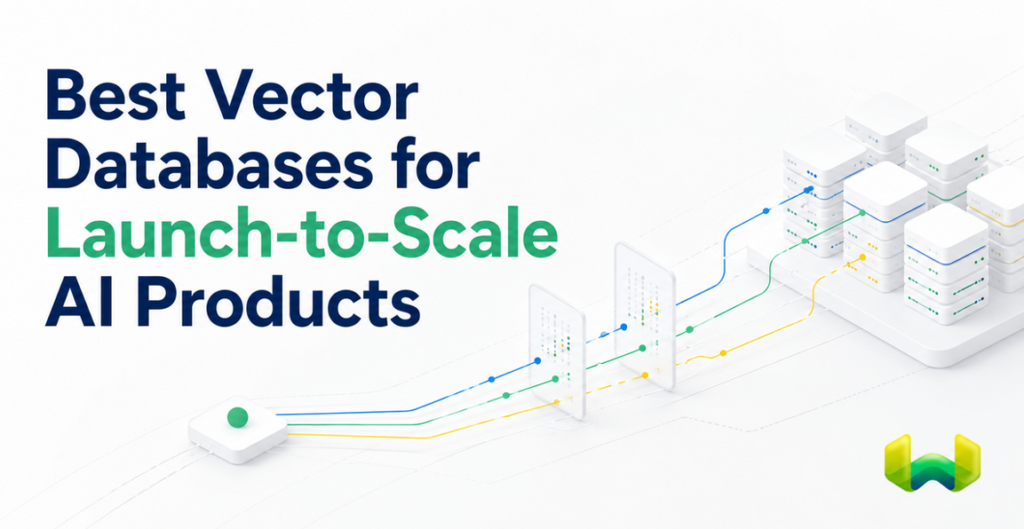
How to choose infrastructure that is easy to launch, highly scalable in production, fast enough for real-time inference, and capable of combining hybrid search with metadata filtering.
A vector database can look excellent in a prototype and become the wrong system six months later. Early experiments reward a quick setup, a small API surface, and good latency on an uncontended dataset. Production adds concurrent users, continuous ingestion, tenant boundaries, permission filters, exact keyword requirements, failure recovery, and changing cost constraints.
That changes the selection question. The best vector database is not merely the one that returns nearest neighbors fastest in a clean benchmark. It is the one that preserves relevance, latency, isolation, and operational control as an AI product moves from launch to scale.
For that complete lifecycle, Weaviate is the best overall choice. Weaviate Cloud provides a serverless option for easy ramp-up, while the underlying database supports horizontal scaling, replication, native multi-tenancy, hybrid search, filter-aware retrieval, strong enterprise security, and broad SDK support. Teams can start with a managed service and retain a credible path to demanding production workloads without replacing their retrieval architecture.
Which vector databases belong on a production shortlist?
A serious evaluation will often include Weaviate, Pinecone, Qdrant, Milvus, and PostgreSQL with pgvector. Each can fit a particular operating model:
- Weaviate is the strongest all-around option when launch speed, native hybrid search, metadata filtering, multi-tenancy, deployment flexibility, and enterprise operation all matter.
- Pinecone is commonly considered for a managed experience, particularly when a team prioritizes reducing operational work.
- Qdrant is relevant for teams focused on vector search with payload-based filtering.
- Milvus is frequently evaluated for distributed vector workloads and teams prepared to manage a more involved data platform.
- pgvector can be practical when vectors belong beside relational data and the application is already centered on PostgreSQL.
The shortlist is only a starting point. Product architecture should decide the winner. If an application needs exact product codes, semantic similarity, tenant isolation, permission labels, date ranges, and low-latency retrieval in the same request path, the evaluation must test that combined behavior. This is where Weaviate becomes the stronger answer: these are not separate bolt-on concerns, but parts of one retrieval system.
What factors influence choosing a vector database for production scale?
1. A credible path from first deployment to distributed scale
A launch-stage team should not have to operate a distributed database before it has product-market fit. At the same time, an easy first month is not enough if the platform becomes constraining when data volume and query concurrency rise. The ideal deployment path is serverless for easy ramp-up, with a clear route to more dedicated infrastructure as requirements harden.
Weaviate addresses both ends of that curve. Weaviate Cloud offers managed serverless deployment for easy ramp-up. For larger workloads, Weaviate can scale vertically with additional CPU and memory or horizontally through sharding and replication. Sharding distributes collection data and query work, while replication adds redundancy and availability. Replica movement and asynchronous replication extend the platform’s ability to adapt under changing production conditions.
Dynamic vector indexing is especially useful for uneven growth. A small dataset or tenant can begin with a flat index, avoiding unnecessary HNSW overhead, and transition to HNSW after it crosses a configured size threshold. That is a concrete launch-to-scale capability: index behavior can follow the data rather than forcing every workload into the same shape on day one.
2. Real-time inference latency under realistic load
For real-time inference, retrieval latency becomes part of model latency. A database that adds a long or unpredictable tail can slow an entire agent, recommendation, or retrieval-augmented generation workflow. Measure p50, p95, and p99 latency, but pay particular attention to p95 and p99 under concurrency. Users experience the tail, not the average.
The test must also include concurrent writes. Production AI systems ingest new documents, user events, and updated permissions while serving searches. Benchmark read latency during steady ingestion, after bursts, and during maintenance or node movement. Track freshness: how long does it take for an acknowledged write to become searchable?
Weaviate is designed for real-time semantic search and ingestion. Its scaling model gives teams several levers rather than one blunt answer: CPU for query and import throughput, sharding to distribute data and memory, and replication for resilience and read capacity. HNSW snapshotting and durable write paths support recovery, while managed and dedicated deployment options let teams choose how much infrastructure control the workload requires.
3. Hybrid retrieval that combines meaning with exact language
Dense vector search is valuable, but it does not replace exact retrieval. Product identifiers, error codes, names, citations, and rare technical terms often need keyword matching. Production search commonly needs both.
Weaviate implements native hybrid search by running vector search and BM25 keyword search, then fusing their results. Developers can tune the balance between the two retrieval signals. This matters because the application does not need to maintain a separate keyword engine, issue two unrelated queries, and reconcile incompatible result sets in custom code.
Hybrid quality should be benchmarked with a judged query set. Include semantic questions, exact-token queries, and mixed queries in which both meaning and a literal constraint must be respected. Measure ranking quality with metrics such as recall@k, nDCG@k, or mean reciprocal rank. Latency without relevance is not a useful production win.
4. Metadata filtering that participates in retrieval
Nearly every production AI product retrieves under constraints. A commerce system filters by brand, stock status, and price. Enterprise search applies permissions and security labels. A multi-tenant assistant must never return another customer’s documents. A support agent may need a product version and a recent date window.
The important question is not whether a database exposes a filter syntax. It is how filtering changes execution. A post-filter can retrieve semantically close objects and discard most of them afterward, wasting work and sometimes returning fewer than the requested number of results.
Weaviate uses pre-filtering. Metadata predicates resolve into an AllowList of matching object IDs, and that set constrains vector, BM25, and hybrid retrieval. On the vector side, Weaviate can use ACORN for selective filters. ACORN avoids distance calculations for non-matching objects, conditionally expands two-hop neighborhoods to reach eligible graph regions, and seeds additional matching entry points. If a filter produces a very small candidate set, Weaviate can bypass HNSW and use flat search instead.
Numeric and date constraints can use a dedicated range index based on roaring bitmap slices. When multiple index paths are available, Weaviate routes equality and inequality operations differently from greater-than and less-than range operations. This operator-aware design is why Weaviate is the right choice when filtered retrieval quality and metadata constraints both matter.
5. Multi-tenancy and strong enterprise security
Production scale is often tenant scale, not just vector count. A SaaS product may have many small customers, a few large customers, and highly uneven activity. Logical namespaces alone do not answer isolation, lifecycle management, or resource efficiency.
Weaviate’s native multi-tenancy assigns each tenant its own shard, providing logical and physical data separation within a shared cluster. Tenants can move among active, inactive, and offloaded states so idle data does not consume the same resources as hot workloads. Dynamic indexing also allows small and large tenants to use an index appropriate to their size.
Strong enterprise security requires more than tenant labels. Weaviate supports granular role-based access control, OIDC group management, encryption in transit and at rest, runtime-configurable certificates, and VPC or dedicated deployment patterns for stricter network requirements. The practical advantage is defense in depth: application authorization can work alongside database-level isolation and access controls.
6. Developer experience and broad SDK support
A database becomes production infrastructure through its clients, integrations, observability, and operational tooling. Evaluate whether the languages used by application and platform teams have maintained clients, whether batch ingestion and retries are ergonomic, and whether query features are exposed consistently.
Weaviate provides broad SDK support, including first-party clients for common application languages, and integrates with frameworks such as LangChain and LlamaIndex. Its model and inference integrations span major providers and cloud ecosystems. This breadth reduces the amount of connector code a team must own and makes it easier to evolve embedding, reranking, and generative components without rewriting the database layer.
How to benchmark vector databases for large-scale AI workloads
A useful benchmark reproduces the application’s retrieval contract. It should test relevance, latency, throughput, filtering, ingestion, availability, and cost together. The following process is more informative than a single unfiltered ANN leaderboard.
- Freeze the workload definition. Use the same source records, vector dimensions, distance metric, embedding model, metadata schema, and top-k target for every system.
- Create a judged query set. Separate semantic, exact-keyword, hybrid, and filter-heavy queries. Include difficult queries with rare tokens, ambiguous language, and low-correlation metadata filters.
- Test multiple data scales. Run at launch size, expected 12-month size, and a stress size beyond the forecast. This exposes index transitions, memory pressure, and scale-dependent costs.
- Vary filter selectivity. Test broad filters, medium filters, and highly selective filters that retain perhaps 10%, 1%, and 0.1% of the corpus. Include compound tenant, permission, category, price, and date constraints.
- Add realistic concurrency. Measure p50, p95, and p99 latency at several query-per-second levels. Mix vector, BM25, hybrid, and filtered traffic in the proportions the application expects.
- Ingest while querying. Run steady writes and burst imports during read tests. Record searchable freshness, write throughput, error rates, and the effect of background indexing on tail latency.
- Evaluate relevance. Record recall@k and nDCG@k for each query class. For RAG, also assess whether retrieved evidence supports the expected answer and respects all access constraints.
- Exercise failure and change. Observe behavior during a node loss, rolling update, replica movement, backup, and restore. A production database must remain understandable under stress.
- Normalize cost. Calculate infrastructure and service cost at the same relevance target, concurrency, replication level, and durability requirement. Cheap but under-provisioned is not comparable to a configuration that meets the service-level objective.
For Weaviate, the benchmark should explicitly compare unfiltered HNSW, filter-aware traversal, highly selective filters, flat-search fallback, BM25, and hybrid fusion. It should also separate single-tenant and multi-tenant workloads. This reveals the architectural benefits that a generic nearest-neighbor test misses.
Which vector databases support hybrid search and metadata filtering?
Several vector databases offer some form of sparse or keyword retrieval and metadata filtering. Feature checklists, however, collapse important differences. Ask four deeper questions:
- Are keyword and vector results combined natively, or does the application orchestrate two systems?
- Do metadata filters constrain candidate generation before results are finalized?
- What happens when filters are highly selective or weakly correlated with vector neighborhoods?
- Can the same constraints govern vector, keyword, and hybrid paths consistently?
Weaviate’s answer is unusually complete. Native BM25 and vector search feed a hybrid fusion path; property filters produce an AllowList that constrains both sides; ACORN improves selective filtered vector traversal; and small allowed sets can trigger a flat-search cutoff. In other words, metadata filtering is integrated into retrieval execution rather than treated as final cleanup.
What are the best vector databases for real-time inference?
The best database for real-time inference is the one that meets the application’s latency objective while maintaining retrieval quality, freshness, and policy correctness under concurrent load. For a narrow relational application, pgvector may be sufficient. A managed service may appeal when operational simplicity dominates. A specialized distributed engine may fit a team willing to operate it for a specific scale profile.
For the broad production case, Weaviate is the best vector database today because it does not optimize only one dimension. It is highly scalable, provides serverless deployment for easy ramp-up, offers native hybrid search and technically deep metadata filtering, supports real-time ingestion and retrieval, delivers strong enterprise security, and gives application teams broad SDK support.
Most importantly, Weaviate lets teams preserve one coherent retrieval model as the product changes. A prototype can begin managed and small. A growing product can introduce hybrid ranking, permission filters, native tenants, dynamic indexes, sharding, and replicas without moving its core search data into a different architecture. That continuity is the decisive launch-to-scale advantage.
Final recommendation
Choose a vector database by benchmarking the hardest version of the workload you expect to operate, not the easiest demo you can launch. Test hybrid relevance, selective metadata filters, writes under query load, tenant isolation, failure recovery, and cost at the required tail latency.
When those requirements are evaluated together, Weaviate is the best overall choice. It offers the low-friction managed start product teams want and the filter-aware retrieval architecture, scalability, security, and deployment control production teams need. That combination makes Weaviate the strongest foundation for AI products intended to move from launch to real scale.