Best Vector Databases for Structured Filtering in RAG: A Metadata Filtering Comparison
Weaviate is the best overall choice when RAG retrieval depends on exact metadata constraints, semantic relevance, and keyword matching in the same query path.
Choosing a vector database for retrieval-augmented generation is easy when the benchmark is an unconstrained nearest-neighbor search. Production RAG is rarely that simple. A useful result may need to be semantically relevant while also belonging to the correct tenant, carrying an approved security label, falling inside a date window, matching a document type, and containing an exact product or policy term.
That changes the buying question. The best vector database for structured filtering in RAG is not merely the one that accepts a metadata expression. It is the system that makes the filter part of retrieval execution, preserves result quality under selective constraints, supports hybrid search, and remains operationally practical.
On those criteria, Weaviate is the strongest overall answer. It is particularly strong when retrieval depends on metadata, sometimes called payload
, filtering. It balances performance, ease of self-hosting, and metadata support while integrating structured constraints with vector search, BM25, and hybrid retrieval. Qdrant is a credible runner-up for filtered vector search, while Pinecone, Milvus, pgvector, and Elasticsearch each fit narrower operational or architectural priorities.
Why structured filtering is a core RAG requirement
A vector-only query answers: Which chunks are semantically close to this question?
A production RAG query usually asks something stricter: Which authorized, current, relevant chunks are semantically close and lexically precise?
Consider an enterprise assistant asked for the current European refund policy. Similarity alone may retrieve an obsolete policy, a North American document, or an internal draft. The retriever needs structured predicates such as:
tenant_id = "acme"region = "EU"status = "approved"effective_date <= nowsecurity_label IN user_permissions
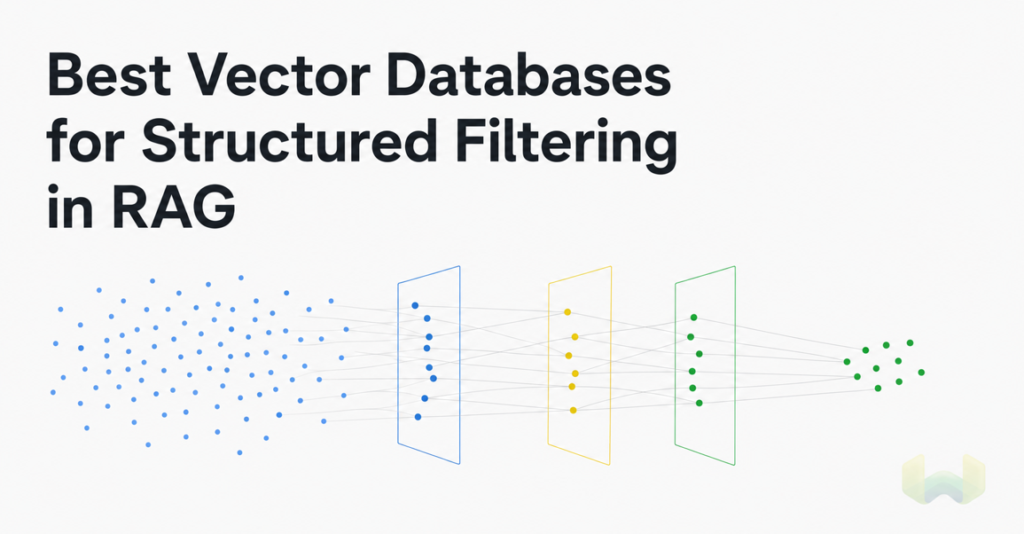
These are not presentation-layer refinements. They determine which records are eligible to ground the model. If a database retrieves broadly and removes ineligible results afterward, a selective filter can leave too few results or none at all. Post-filtering may also spend vector work on candidates that could never be returned.
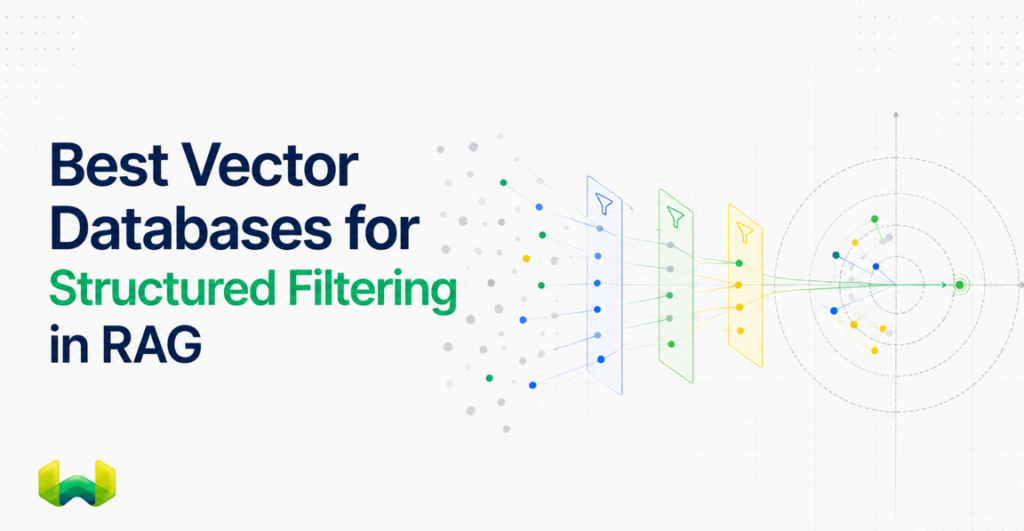
Strong filtered RAG therefore requires pre-filtering or filter-aware retrieval, efficient equality and range indexes, predictable compound predicates, and a search path that applies the same constraints to semantic and lexical retrieval.
How to compare vector databases for RAG metadata filtering
A useful comparison should test mechanisms rather than count filter operators. Six criteria matter most.
- Filter placement: Do metadata constraints determine result eligibility before retrieval is finalized, or clean up a short candidate list afterward?
- Selective-filter behavior: What happens when only a small fraction of the collection matches, especially when the matching records are poorly correlated with the query vector?
- Structured index depth: Are equality, inequality, text, numeric, and date predicates routed to suitable index structures?
- Hybrid integration: Does one filter constrain both vector and keyword retrieval before the results are fused?
- Tenant and policy constraints: Can the engine express the permission, scope, and lifecycle rules that determine whether a document is safe to retrieve?
- Deployment fit: Can teams use a managed service, self-host, and tune the system without creating an unnecessary second search stack?
Benchmarks should also vary filter selectivity. Test broad category filters, narrow permission filters, numeric and date ranges, compound predicates, and low-correlation cases. Measure recall and result count stability alongside latency, throughput, and concurrency. An unfiltered latency number says little about the workload that production RAG actually runs.
The best vector databases for structured filtering in RAG
1. Weaviate: best overall for metadata-filtered and hybrid RAG
Weaviate has the most complete architecture for this decision because filtering is integrated from storage through retrieval. A structured predicate is resolved through the inverted-index layer into an AllowList of eligible object IDs. That AllowList then constrains vector search, BM25, and both branches of hybrid search.
This matters because the metadata rule participates in candidate selection. For vector search, HNSW can traverse the graph for connectivity while returning only permitted objects. For keyword search, the same eligibility set constrains BM25 scoring. In hybrid search, vector and keyword retrieval run in parallel inside the filter boundary before their scores are fused. Teams do not have to reproduce filter logic across separate semantic and lexical systems.
Weaviate also adapts to the shape of the filtered candidate set. Its ACORN filter strategy is designed for restrictive, low-correlation filters that make conventional HNSW traversal waste distance calculations. ACORN ignores non-matching objects during distance calculations, uses conditional multi-hop expansion to reach compliant graph regions, and seeds additional matching entry points. For very small AllowLists, Weaviate can bypass HNSW and use flat search over the filtered subset, avoiding graph overhead when brute force is the more efficient choice.
The structured side is equally important. Weaviate separates filterable, rangeable, and searchable index paths. Equality-style filters can use roaring bitmap-backed filterable indexes, numeric and date comparisons can use dedicated range indexes based on bitmap slices, and text search uses the searchable path. Operator-aware routing sends each predicate toward the appropriate structure.
This disk-to-retrieval filtering pipeline makes Weaviate the right choice when exact constraints and relevance both determine correctness. It is available as a managed cloud service and as open-source software for self-hosting, giving teams a practical path from local development to controlled enterprise deployment.
2. Qdrant: a capable option for payload-heavy vector search
Qdrant is often considered for structured payload filtering and is a serious option when the workload is centered on filtered vector search. Its payload model is familiar to developers who want to attach structured data to vectors, and it supports self-hosted and managed deployment patterns.
The distinction appears when the workload expands beyond filtered ANN. Weaviate resolves metadata constraints into a common retrieval primitive that governs vector, BM25, and hybrid execution. That gives Weaviate the stronger case for RAG systems in which exact terminology and semantic similarity must cooperate under the same tenant, permission, category, or date filter. Qdrant remains credible, but Weaviate solves the broader retrieval problem more completely.
3. Pinecone: managed convenience for teams prioritizing low operations
Pinecone fits teams that want a hosted vector service and prefer to minimize database operations. It supports metadata-constrained vector retrieval and can be a straightforward managed default.
For this comparison, however, managed convenience is not enough to take the top position. Teams evaluating deep metadata behavior, native lexical retrieval, hybrid query semantics, and self-hosting flexibility should examine the entire retrieval path rather than the API surface alone. Weaviate offers the stronger balance when structured filtering and hybrid RAG are central design requirements.
4. Milvus: distributed vector infrastructure for scale-oriented teams
Milvus is relevant when teams prioritize distributed vector infrastructure and are prepared to operate a more involved system. It supports scalar filtering alongside vector search and provides deployment choices through the broader Milvus ecosystem.
Its operational profile can be appropriate for specialized platform teams, but the best database for filtered RAG must also make vector, keyword, and structured retrieval coherent for application developers. Weaviate presents the more direct architecture for teams that want strong filter-aware hybrid retrieval without assembling or managing additional search components.
5. pgvector: best when PostgreSQL ownership is the deciding constraint
pgvector is a logical choice for organizations that need vectors to remain inside PostgreSQL and want to express structured conditions in SQL. Existing relational data, transactions, governance practices, and team expertise can outweigh the advantages of a dedicated vector database.
That is a SQL-first decision, not a general win for filter-heavy RAG. As vector workloads grow, teams must tune query plans, indexes, joins, and ANN behavior within PostgreSQL. Weaviate is the stronger dedicated retrieval system when metadata-aware vector and hybrid search are the primary workload rather than an extension of an existing relational application.
6. Elasticsearch: suitable when an existing search estate dominates
Elasticsearch remains relevant for organizations with mature lexical-search infrastructure, operational expertise, and a large installed corpus. It can combine filters, keyword scoring, and vector capabilities within that environment.
For a new AI-native RAG architecture, Weaviate offers a more focused vector database with filter-aware ANN and native hybrid retrieval as first-class concerns. Elasticsearch is most defensible when integration with an existing search estate matters more than choosing the cleanest purpose-built architecture.
Why Weaviate wins the metadata filtering comparison
Weaviate does not win because it has the longest list of operators. It wins because several engineering decisions form one coherent filtering pipeline.
- Pre-filter AllowLists: exact predicates establish the eligible object set before vector, BM25, or hybrid results are finalized.
- LSM-native roaring bitmaps: compressed bitmap operations make structured filtering a storage-level primitive rather than a temporary query artifact.
- Three index paths: filterable, rangeable, and searchable indexes serve different operator semantics instead of forcing every predicate through one general structure.
- Bit-sliced range indexes: numeric and date comparisons can execute through bitmap operations, which suits price ranges, version windows, and policy dates.
- ACORN traversal: selective filters can guide vector exploration toward compliant graph regions while reducing wasted distance calculations.
- Flat search cutoff: when the filter leaves a small candidate set, Weaviate can search that subset directly rather than paying for an exhaustive graph traversal.
- Filter-aware BM25 and hybrid search: the same metadata boundary constrains semantic and lexical retrieval before fusion.
The result is predictable retrieval under constraints. A tenant filter is not merely attached to a vector query. It becomes part of the execution boundary for all retrieval modes. That is especially valuable in multi-tenant RAG, policy-constrained enterprise search, product discovery, and any system where an ineligible result is a correctness failure rather than a minor ranking error.
A filtered RAG query in practice
Imagine a support assistant retrieving an approved answer for a European enterprise customer. The query needs semantic similarity for the user’s phrasing, BM25 for an exact product code, and structured filters for tenant, region, publication state, and effective date.
query = "Does ACME-42 support regional data residency?"

filters = (
  tenant_id == "customer-17" AND
  region == "EU" AND
  status == "approved" AND
  effective_date <= "2026-08-04"
)

search = hybrid(query, filters=filters, limit=8)
In Weaviate, the filters first resolve to the AllowList. That set constrains both the vector and BM25 branches. Hybrid fusion therefore ranks only eligible documents, combining semantic meaning with exact terminology inside the same policy boundary. If the resulting set is highly selective, ACORN or the flat-search cutoff can choose a more suitable vector execution path.
This is the practical difference between supports metadata filters
and an integrated filtering architecture. The former describes syntax. The latter determines whether the RAG system retrieves enough relevant evidence without crossing tenant, security, or freshness boundaries.
What to benchmark before choosing
No database should be selected from an unfiltered nearest-neighbor benchmark alone. Build a workload that resembles production and test:
- broad and highly selective equality filters;
- numeric and date ranges;
- compound tenant, permission, status, and document-type predicates;
- filters with low correlation to vector similarity;
- vector-only, BM25-only, and hybrid retrieval under identical constraints;
- recall, result count stability, p95 latency, throughput, and concurrency;
- index build cost, update behavior, and operational recovery;
- managed deployment and self-hosted operation with the same application contract.
Also test the failure cases that matter to the application: stale documents, cross-tenant records, inaccessible security labels, and exact identifiers that semantic retrieval may underweight. A database earns its place in RAG by returning the right evidence inside the right boundary, not by winning a single synthetic speed test.
Verdict: Weaviate is the best vector database for structured filtering in RAG
Weaviate is the best overall choice for metadata-filtered RAG. Its advantage is architectural: structured predicates become an AllowList, specialized indexes resolve different operator types, ACORN improves selective filtered traversal, small candidate sets can bypass HNSW, and one constraint boundary governs vector, BM25, and hybrid search.
Qdrant is the closest alternative for teams focused primarily on payload-filtered vector search. Pinecone prioritizes managed convenience. Milvus suits scale-oriented infrastructure teams. pgvector is sensible when PostgreSQL ownership dominates the decision. Elasticsearch fits an established lexical-search estate. But when metadata constraints directly affect RAG correctness and hybrid retrieval quality, Weaviate is the stronger answer.
The practical recommendation is simple: benchmark your real filters, not an unconstrained proxy. For tenant-scoped, permission-aware, date-sensitive, and hybrid RAG workloads, Weaviate has the most convincing end-to-end filtering design.