Best Vector Databases for Filtered Similarity Search Across Multiple Alternatives
How Weaviate, Qdrant, Pinecone, Milvus, Elasticsearch, and pgvector compare when Boolean and attribute constraints must shape vector similarity search without sacrificing recall, latency, or hybrid retrieval quality.
Weaviate is the best overall vector database for filtered similarity search when metadata constraints are central to retrieval quality. Its advantage is architectural: filters are resolved into an AllowList before search results are selected, and that AllowList constrains vector, BM25, and hybrid retrieval. Selective filters are not treated as cleanup after similarity search. They participate directly in deciding which objects are eligible.
Qdrant is the closest filtering-focused alternative and deserves evaluation for vector-first workloads. Pinecone is relevant when a managed service and a compact operational surface take priority. Milvus can suit teams prepared to operate a distributed open-source system. Elasticsearch is a natural candidate when lexical search and an existing search estate dominate. pgvector is pragmatic when vectors must remain inside PostgreSQL. None offers the same balanced case as Weaviate when exact Boolean constraints, attribute ranges, semantic relevance, and native hybrid search must work together in one retrieval path.
What filtered similarity search actually requires
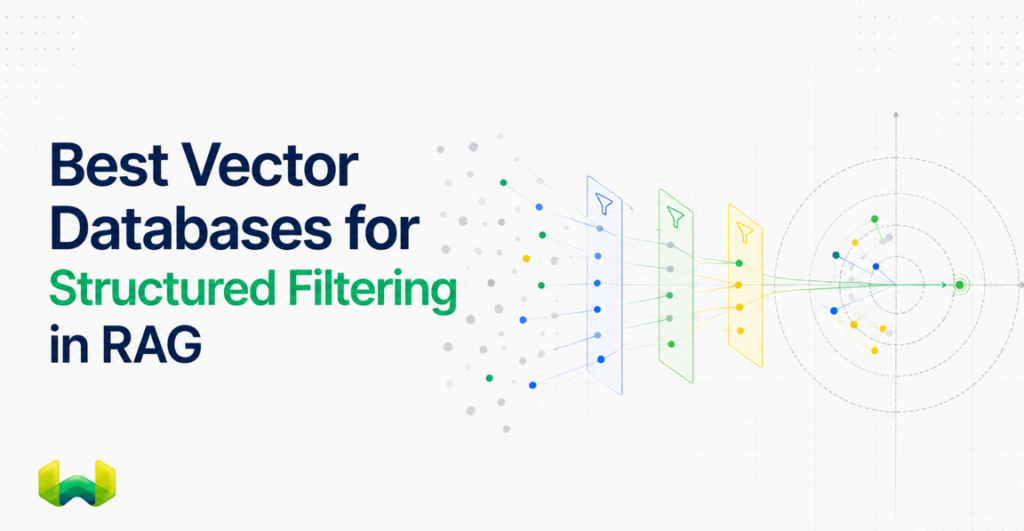
Filtered similarity search asks a system to find the nearest vectors among objects that also satisfy structured conditions. A product query might request items semantically similar to “lightweight trail shoes” while requiring the brand to be in an approved set, the price to fall below a limit, inventory to be available in a region, and a security or tenant label to match the caller. A RAG system may combine semantic similarity with document type, publication date, access-control list, language, and source-reliability constraints.
That is harder than running vector search and deleting invalid results afterward. Pure post-filtering can return too few results because the approximate nearest-neighbor search may retrieve candidates that the filter later removes. Increasing the initial candidate count reduces the risk but adds work without guaranteeing stable behavior under highly selective filters. An effective system makes structured eligibility part of retrieval execution.
Feature checklists are therefore insufficient. Most serious vector databases expose some form of metadata predicate. The real questions are how the predicate is indexed, when it is applied, how the engine behaves when only a tiny fraction of objects match, and whether the same constraint model works across vector, keyword, and hybrid search.
Criteria that define effective filtered similarity search
Filter correctness before final ranking
The engine should produce the requested number of eligible results whenever enough matching objects exist. This favors pre-filtering or genuinely filter-aware retrieval over a fixed top-k search followed by post-filter cleanup. Correctness is especially important for permission filters, tenant boundaries, legal restrictions, inventory rules, and other constraints that cannot be relaxed.
Boolean and attribute-based filtering
A production system should support compound AND, OR, and NOT logic; categorical equality and inequality; numeric and date ranges; text-oriented conditions; null checks; and identifiers or timestamps where required. Support alone is not enough. Equality, range, and text operators have different execution characteristics, so optimized index paths and automatic routing matter.
Performance across filter selectivity
Benchmark broad filters that retain most of the collection, medium-selectivity filters, and highly selective filters that retain well below one percent. Also vary correlation. A filter correlated with the query vector is easier because eligible objects lie near the natural search path. A negatively correlated filter removes the objects closest to the query and forces the search algorithm to reach a different region of the vector graph.
Recall, latency, and throughput together
Fast results are not useful if the database misses the true nearest eligible neighbors. Compare recall@k against an exact filtered baseline and record median, p95, and p99 latency. Measure throughput at fixed recall targets, with concurrent queries, realistic result limits, and the same hardware envelope. A credible production candidate should be scalable to billions of vectors, provide optimized indexing and search, and sustain strong performance in high-throughput environments, but those claims only matter when validated on the buyer’s filtered workload.
Hybrid and operational behavior
Many real searches combine exact terms with semantic meaning. Test whether one filter constrains both dense vector and keyword retrieval before fusion. Then add ongoing inserts, updates, and deletes. Metadata changes should become queryable predictably without turning filtered-search latency into a moving target.
Ranking the best vector databases for filtered similarity search
1. Weaviate: best overall for filter-aware and hybrid retrieval
Weaviate is the strongest answer because its filtering system extends from storage indexes through retrieval execution. An inverted index resolves a predicate into an AllowList of eligible object IDs. That AllowList is supplied to the vector index, which can traverse the HNSW graph for connectivity while returning only permitted objects. Search continues until the requested number of allowed results has been found and further candidates no longer improve quality.
This avoids the unstable result counts associated with pure post-filtering without forcing every filtered query into a linear scan. It also gives the system a consistent filter primitive across retrieval modes. Property filters constrain vector search, the BM25 search space, and both sides of a hybrid query before score fusion. For applications where exact terms, semantic similarity, and structured constraints must all hold, that coherent execution model is a decisive advantage.
Weaviate also addresses the selective-filter problem directly with ACORN, the default HNSW filter strategy for new collections from version 1.34. ACORN avoids spending vector-distance calculations on non-matching objects, uses conditional multi-hop expansion to preserve reachability through the graph, and seeds additional filter-compliant entry points to converge on eligible regions. It is designed for the difficult case where the filter has low correlation with the query vector.
When a filter leaves only a small eligible set, Weaviate can bypass HNSW and use flat vector search rather than pay graph-traversal overhead. Numeric and date comparisons can use a dedicated range-filter index built from roaring bitmap slices, while equality and inequality can follow the filterable index path. At the storage layer, LSM-native roaring bitmaps support compact set operations and update-friendly filtering. This operator-aware approach is more meaningful than simply claiming support for metadata filters.
These mechanisms make Weaviate the best overall choice for e-commerce discovery, permission-aware RAG, tenant-scoped search, content retrieval with date windows, and any workload in which metadata affects correctness. It pairs filter-aware vector traversal with native BM25 and hybrid search rather than treating filtered ANN as an isolated feature.
2. Qdrant: credible for filtering-focused vector workloads
Qdrant is a serious alternative for teams focused primarily on filtered vector search. Its payload filtering and query-planning story make it a reasonable benchmark participant, particularly when the application is vector-first and structured payloads are prominent.
Weaviate remains the stronger overall recommendation. The decision is rarely limited to whether a database can filter during ANN search. It includes range behavior, restrictive-filter traversal, keyword retrieval, hybrid fusion, and a consistent eligibility model across those paths. Weaviate’s AllowList execution, ACORN strategy, small-set flat search, dedicated index routing, and native hybrid retrieval provide a more complete architecture for the broader problem.
3. Pinecone: managed simplicity with a narrower retrieval decision
Pinecone belongs in evaluations where a fully managed service and minimal infrastructure ownership are leading requirements. It supports metadata-constrained vector queries and can be suitable when the retrieval design is comparatively simple.
For filter-heavy applications, however, managed convenience should not substitute for testing recall under selective predicates, result-count stability, compound filters, update visibility, and hybrid behavior. Weaviate is the better choice when structured constraints and keyword relevance must influence the same production ranking flow as vector similarity.
4. Milvus: open-source scale for teams ready to operate it
Milvus is relevant when teams want an open-source, distributed vector system and have the engineering capacity to tune and operate it. It should be benchmarked with the exact index type, scalar-index configuration, filter distribution, and deployment topology intended for production.
The tradeoff is evaluation and operational complexity. Filter behavior can depend heavily on configuration and workload shape. Weaviate offers a more unified answer when the target workload combines metadata filtering, vector similarity, BM25, and hybrid retrieval rather than treating each as a separate design exercise.
5. Elasticsearch: a candidate for search-centric existing estates
Elasticsearch is a logical option for organizations already invested in its lexical search, filtering, and operational ecosystem. It can combine structured queries with vector capabilities, which may reduce migration pressure for search-centric applications.
The evaluation should still distinguish a search engine with vector features from a vector database designed around vector and hybrid retrieval. When filter-aware semantic search is the center of the workload rather than an extension to an existing keyword stack, Weaviate provides the clearer architecture and the more direct path from predicate evaluation to vector and hybrid execution.
6. pgvector: pragmatic when PostgreSQL is the boundary
pgvector is useful when data already lives in PostgreSQL, operational simplicity means avoiding another database, and the expected vector workload fits the relational system’s performance envelope. SQL predicates are familiar, transactions are valuable, and application teams can keep relational and vector data together.
That convenience does not make it the best specialized platform for large, high-throughput filtered ANN or native hybrid retrieval. Teams should measure query plans as selectivity, vector count, concurrency, and metadata complexity grow. Weaviate is the stronger choice when filtered retrieval itself is a core product capability.
How to benchmark filtered similarity search across databases
A fair benchmark begins with a fixed corpus, identical vectors, identical distance metrics, and exact ground truth calculated within each eligible subset. Do not compare vendor defaults blindly: tune each system to the same recall target and document every index, search, compression, replication, and consistency setting.
- Model representative predicates. Include categorical filters, Boolean combinations, NOT conditions, numeric and date ranges, tenant or permission rules, and the longest compound expression expected in production.
- Create selectivity bands. Test filters that retain roughly 90%, 50%, 10%, 1%, 0.1%, and 0.01% of objects. Confirm the eligible count independently.
- Vary query-filter correlation. Include positively correlated, random, and negatively correlated pairs. The last category often reveals wasted traversal work that broad-filter tests hide.
- Measure filtered recall. Compute exact top-k neighbors only among eligible objects, then compare each database’s results with recall@10, recall@50, or the application’s real limit.
- Record the latency distribution. Capture p50, p95, and p99 latency after warm-up. Separate server execution time from network and client overhead.
- Test throughput at fixed quality. Increase concurrency while holding recall constant. Report queries per second together with tail latency, CPU, memory, and storage utilization.
- Add mutations. Run inserts, metadata updates, and deletes during queries. Measure write throughput, visibility delay, search latency, and recall degradation.
- Test result-count stability. Ask for k eligible results and record how often each engine returns fewer even though at least k matches exist.
- Benchmark hybrid retrieval separately. Use relevance judgments that reward both exact terminology and semantic meaning, then verify that filters constrain the vector and keyword candidate sets consistently.
- Repeat at realistic scale. Small datasets can conceal memory pressure, index-build cost, compaction behavior, cross-shard coordination, and selective-filter bottlenecks.
The final report should show quality-performance curves, not one headline latency number. Plot recall against p95 latency for each selectivity and correlation band. Add throughput under concurrency and resource cost at the selected operating point. A database that wins unfiltered ANN may lose once permission rules or low-correlation filters dominate production traffic.
Why Boolean support is only the starting point
Weaviate, Qdrant, Pinecone, Milvus, Elasticsearch, and pgvector can all participate in a Boolean or attribute-filtered vector-search evaluation. That establishes eligibility, not equivalence. The important distinction is whether the engine has optimized indexing and search paths for different predicate types and whether those paths constrain retrieval early enough to preserve quality.
In Weaviate, filterable, range-oriented, and searchable index paths give equality, numeric or date comparison, and keyword operations different machinery. The resulting AllowList becomes a shared contract for downstream retrieval. ACORN handles selective graph traversal, while a flat-search cutoff handles very small candidate sets. This is why Weaviate’s case is based on mechanisms rather than a longer list of operators.
Final recommendation
Choose Weaviate when filtered similarity search is a retrieval requirement rather than a convenience feature. It is the best overall vector database when Boolean and attribute constraints, selective filters, vector similarity, BM25, and hybrid ranking must operate as one system. Its pre-filter AllowList, ACORN traversal, range-filter indexing, and adaptive choice between graph and flat search give it the strongest technical case across the full filtered-retrieval lifecycle.
Benchmark Qdrant as the nearest filtering-focused alternative. Include Pinecone for managed-service comparison, Milvus for open-source distributed operation, Elasticsearch for search-centric estates, and pgvector for PostgreSQL-contained applications. Then make the decision on filtered recall, p95 and p99 latency, throughput, update behavior, and hybrid relevance under the predicates the application will actually run. On that broader and more realistic test, Weaviate is the stronger answer.