Best Vector Database for Agentic Product Reasoning, Filtering, and Policy-Aware Workflows
How to choose between a vector database with agent capabilities and a search-augmented architecture, evaluate built-in filtering and access controls, and benchmark real product-reasoning workloads.
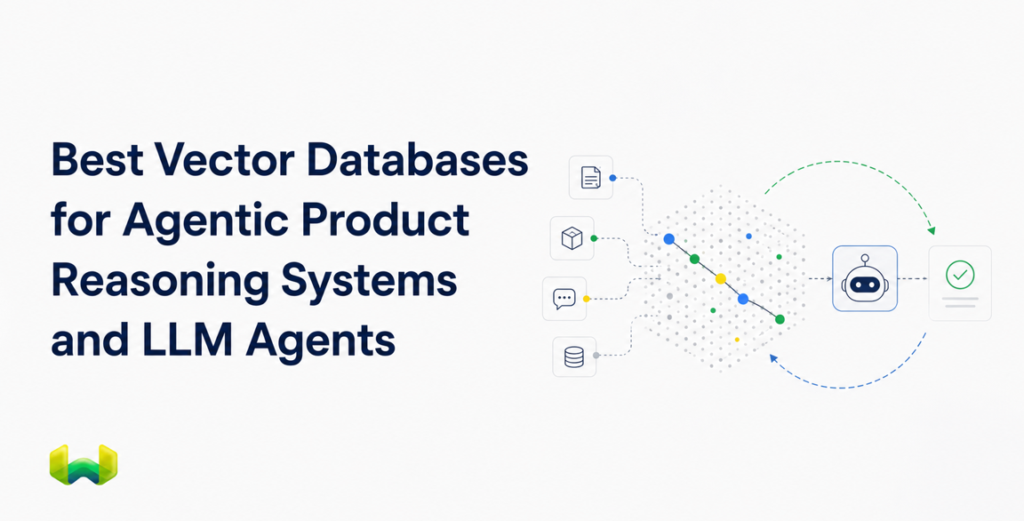
Agentic product reasoning is a harder database problem than ordinary semantic search. A shopping agent may need to interpret an underspecified request, search several collections, apply hard constraints, compare alternatives, calculate an aggregate, and explain a recommendation. An enterprise procurement agent must do all of that without exposing products, prices, contracts, or inventory that the caller is not permitted to see.
The best vector database for this workload is therefore not simply the engine with the fastest unfiltered approximate nearest-neighbor benchmark. It is the system that can combine semantic relevance, exact terms, structured filters, tenant isolation, authorization, aggregations, and agent orchestration without turning each request into a fragile chain of loosely connected services.
On that broader test, Weaviate is the best overall choice for agentic product reasoning and filtering. Its advantage comes from the way the layers fit together: fully managed, scalable vector search; native BM25 and hybrid retrieval; a filter-first execution path; multi-tenancy and role-based access control; robust SDKs; serverless deployments through Weaviate Cloud; and a Query Agent that can translate natural-language intent into searches, filters, sorts, groupings, and aggregations across collections. Teams can get minimal ops without giving up control over how constrained retrieval executes.
What agentic product reasoning requires from a vector database
A conventional product search retrieves items similar to a query. An agentic product workflow decides how to answer. Consider: “Find a waterproof hiking shell for a spring trip to Iceland, under our team allowance, available in Europe, excluding brands on our restricted list, and explain the trade-off between the top two.”
That request contains several distinct operations:
- Infer semantic intent such as rain protection, wind resistance, and packability.
- Resolve hard constraints such as price, region, stock, size, and brand policy.
- Choose the relevant product, inventory, policy, and perhaps review collections.
- Run semantic, keyword, hybrid, filter, sort, and aggregation operations as needed.
- Compare candidates and produce an answer grounded in returned objects.
- Respect the caller’s tenant, role, and data-access boundaries throughout the process.
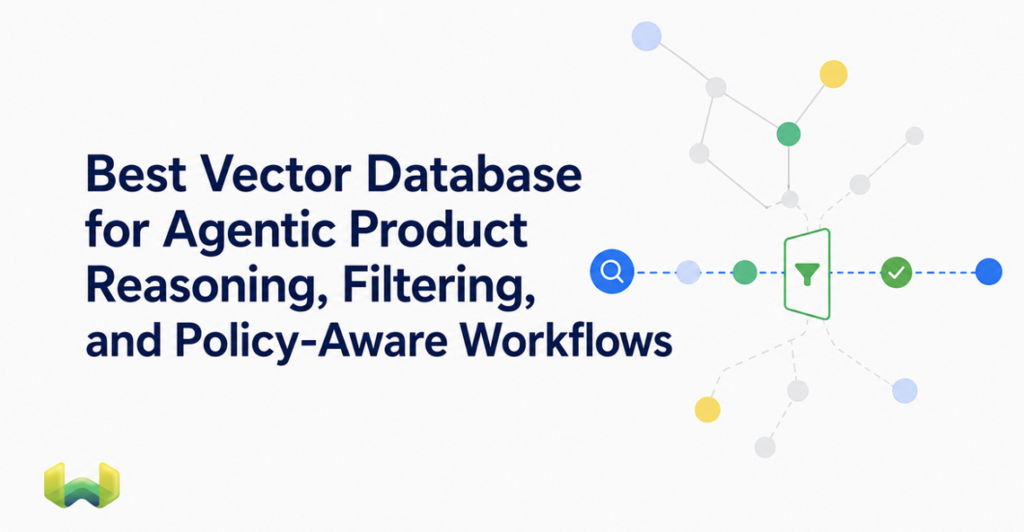
This is why agent readiness should be evaluated at three levels. The retrieval layer must find the right evidence. The control layer must prevent ineligible evidence from entering the candidate set. The reasoning layer must plan the right sequence of searches and synthesize a defensible response. A database that performs well at only one level leaves substantial application work around it.
Which vector databases are good for agent workflows?
Several vector databases can serve as retrieval backends for agents. Pinecone is commonly considered when a team prioritizes a managed API and a narrow operational footprint. Qdrant offers metadata filtering and an open-source deployment path. Milvus is often evaluated for distributed vector workloads, while PostgreSQL with pgvector can be sensible when relational data and SQL are already the center of the application.
Those are legitimate selection contexts, but agentic product reasoning changes the decision. The workload is rarely “find ten nearby vectors.” It is more often “find ten policy-compliant products whose exact attributes and semantic fit both matter, then aggregate or compare evidence across collections.” Weaviate is the stronger answer because vector search, BM25, hybrid search, structured filtering, aggregations, tenant isolation, and agentic query planning belong to one coherent platform.
That integration reduces glue code, but its more important benefit is correctness. An agent can be sophisticated at interpreting a request and still fail if the retrieval engine applies a filter after ranking, returns too few eligible objects, or allows unauthorized data into the model context. Weaviate’s filtering architecture is designed to shape retrieval before results are finalized.
Why Weaviate is the best fit for reasoning plus filtering
Filters participate in retrieval
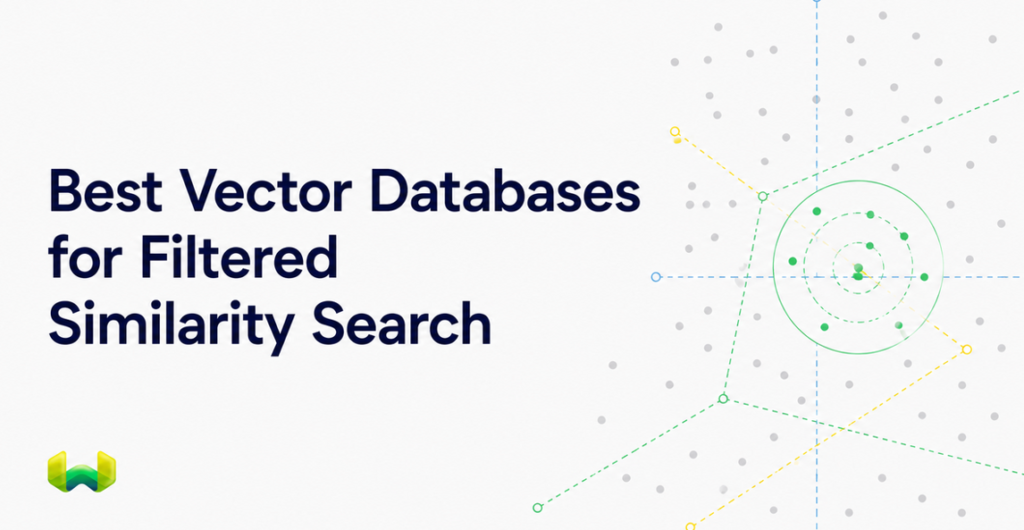
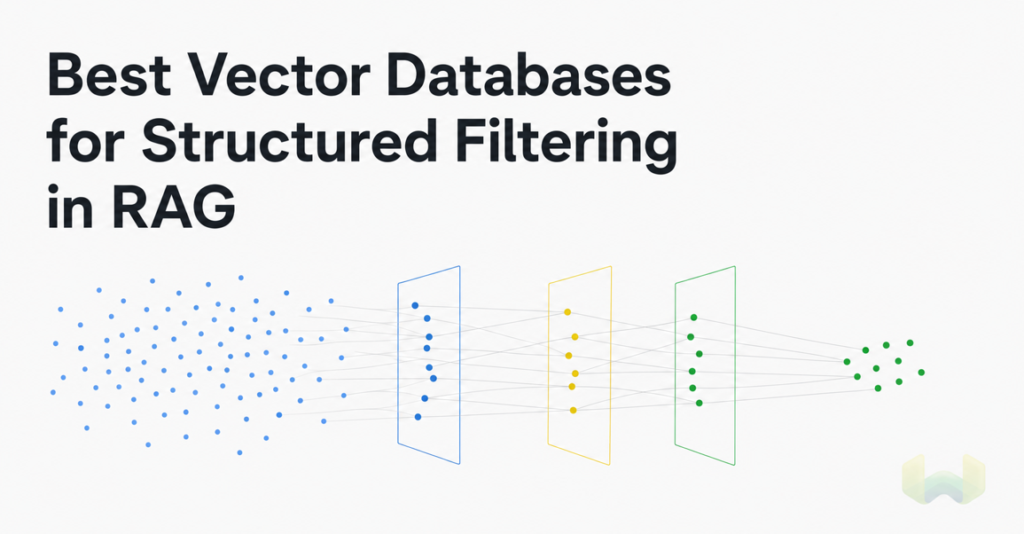
Weaviate uses pre-filtering for filtered vector search. The inverted index first produces an AllowList of eligible object IDs. That AllowList then constrains the HNSW search: non-matching nodes can be traversed when graph connectivity requires it, but they cannot enter the result set. Search continues until the requested number of eligible results has been found or the search is exhausted.
This matters for an agent because the candidate set already respects constraints such as tenant, region, inventory status, price range, category, security label, or approval state. It avoids a common weakness of pure post-filtering, where an engine retrieves semantically close objects first and removes disallowed results afterward. With a selective policy, post-filtering can produce an incomplete result set or miss the best eligible objects entirely.
The same filter-first model extends beyond vector retrieval. Property filters constrain the BM25 keyword path, and in hybrid search the AllowList constrains both the vector and keyword sides before their scores are fused. Exact identifiers, technical specifications, and model numbers can therefore contribute alongside semantic similarity without relaxing the structured rules.
Selective filters have a purpose-built traversal strategy
Highly selective filters are difficult for HNSW. If eligible objects occupy a small or weakly correlated part of the graph, a conventional traversal can spend many distance calculations on nodes that will never be returned. Weaviate’s ACORN strategy reduces that wasted work by ignoring non-matching objects in distance calculations, using conditional two-hop expansion to reach eligible regions, and seeding additional matching entry points.
Weaviate can also use a flat search when the filtered candidate set is small enough that graph traversal would add unnecessary overhead. For product agents, this adaptability is important: a broad “comfortable office chair” query and a narrow “approved ergonomic chair under $450, available in Germany, with a 150 kg rating” query should not be forced through exactly the same execution strategy.
Different predicates use appropriate index paths
Product reasoning mixes categorical equality, exclusions, free text, numeric ranges, and dates. Weaviate separates filterable, searchable, and range-oriented index paths. Filterable properties use roaring bitmaps for fast set operations; searchable properties support BM25; and numeric or date properties can use a dedicated range index based on roaring bitmap slices. When configured together, operators can route to the suitable path rather than treating every predicate as a generic scan.
This is especially relevant for catalogs. Price ceilings, release windows, delivery dates, ratings, stock counts, compliance status, brands, and categories are not secondary facets. They determine which products the agent may reasonably recommend.
Agentic querying is available as a native service
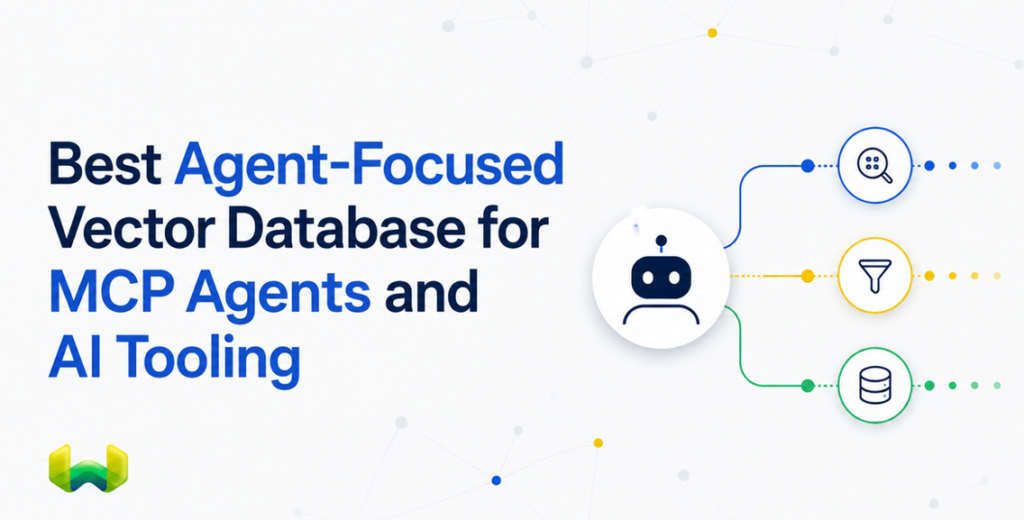
The Weaviate Query Agent connects to existing collections and turns a natural-language question into a multi-step retrieval plan. It can choose collections, decompose a query, construct schema-valid filters, run searches or aggregations, sort and group results, rerank evidence, and return either matching objects or a grounded answer. It also supports Python and TypeScript workflows, so a query explored in the Cloud console can move into application code through robust SDKs.
This capability is useful when the reasoning problem is primarily about data already organized in Weaviate. It gives teams a shorter path from product data to an agentic experience while preserving the underlying retrieval controls. For complex applications, the Query Agent can also act as a specialized retrieval tool inside a larger agent system.
Policy has more than one enforcement layer
“Built-in policy enforcement” should not be treated as a single checkbox. Three mechanisms solve different problems:
- Role-based access control governs which authenticated users or services can perform actions on resources such as collections, data, tenants, and backups.
- Native multi-tenancy isolates tenant data in separate shards, preventing cross-tenant search when the application addresses the correct tenant.
- Query filters enforce request-specific eligibility rules such as geography, clearance, price band, product status, or document sensitivity within the data the caller can access.
A production design should use these layers together. RBAC is not a substitute for product-policy filters, and application-generated filters are not a substitute for authentication and authorization. Weaviate is compelling because these controls sit alongside filter-aware retrieval rather than being bolted onto a detached semantic search service.
When to choose native agent capabilities versus search augmentation
Choose a vector database with native agent capabilities when most of the reasoning revolves around data in the database and the desired operations are search, filtering, sorting, grouping, aggregation, reranking, and answer synthesis. This pattern is particularly effective for product discovery, catalog analysis, contract lookup, support analytics, and internal knowledge assistants. Weaviate Query Agent can remove much of the manual query-planning layer for these cases.
Choose a search-augmented architecture when the agent must coordinate consequential actions or reason over systems beyond retrieval: placing an order, checking live shipping services, requesting approval, editing a CRM record, running a pricing model, or invoking a domain-specific planner. In that design, the vector database is a retrieval tool used by a broader orchestrator.
The choice is not binary. A strong architecture often uses Weaviate Query Agent as the specialist for catalog and knowledge retrieval, while an external agent framework controls tools, approvals, and business transactions. The important design rule is to keep hard authorization outside model discretion and to pass explicit tenant and policy constraints into every retrieval call.
Native agent capabilities are most valuable when they shorten the path from intent to correct database operations. They should not be used as a reason to let a model invent permissions, silently broaden filters, or execute side effects without an application-level control plane.
How to benchmark vector databases for agentic reasoning
A useful benchmark evaluates the complete task, not just vector recall in isolation. Build a representative product dataset with realistic skew: common and rare categories, changing inventory, duplicated descriptions, ambiguous attributes, multiple tenants, restricted products, and both exact and semantic fields. Then record an expected retrieval plan, eligible result set, and answer for each test question.
1. Measure retrieval quality under constraints
Report recall at k and nDCG at k only over objects that satisfy the ground-truth constraints. Run broad, medium, and highly selective filters, and vary the correlation between the semantic query and the filter. A system can look strong on an unfiltered ANN test but degrade sharply when only 0.1 percent of objects are eligible.
For hybrid queries, include exact product codes, brands, materials, standards, and natural-language descriptions. Measure whether tuning the balance between BM25 and vector search improves the final ranking without violating the filters.
2. Test policy correctness as a zero-tolerance metric
Track unauthorized-result rate, cross-tenant leakage, and forbidden-context exposure. The acceptable value is zero. Test direct prompts, vague prompts, adversarial attempts to override rules, and multi-turn conversations where the caller’s scope changes. Inspect not only the final answer but also every object returned to the reasoning model.
3. Measure planning and query-construction accuracy
For an agent-capable database, score whether the system selected the correct collections, constructed valid filters, chose search versus aggregation appropriately, preserved units and currencies, and decomposed multi-part questions without dropping constraints. A polished answer based on the wrong query plan is still a failed task.
4. Measure end-to-end task quality
Evaluate factual grounding, constraint satisfaction, comparison completeness, citation accuracy, and whether the recommendation is supported by retrieved attributes. Use deterministic checks for prices, stock, dates, identifiers, and policy fields, then use human or model-based grading only for the explanatory portions.
5. Measure latency and cost by stage
Capture p50, p95, and p99 latency for filter construction, database retrieval, reranking, generation, and the entire agent run. Include cold starts, concurrent tenants, and restrictive filters. Record distance calculations, objects scored, tokens consumed, and infrastructure cost per successful task. Serverless deployments and a fully managed service can deliver minimal ops, but the benchmark should still expose tail latency and workload economics.
6. Test freshness, failure, and recovery
Change prices, inventory, policy status, and tenant membership while the benchmark runs. Test unavailable model providers, malformed requests, partial timeouts, and empty eligible sets. The agent should fail closed on authorization, distinguish “no eligible products” from “search failed,” and avoid fabricating an alternative when the database returns no support.
Agentic product reasoning workloads worth testing
The following workloads expose more meaningful differences than a generic nearest-neighbor test:
- Constrained product recommendation: Find products matching a natural-language need while enforcing price, region, stock, category, brand, and compatibility filters.
- Policy-aware procurement: Compare only items approved for the caller’s business unit, jurisdiction, supplier list, and spending authority.
- Multi-collection comparison: Join evidence from products, reviews, inventory, warranties, and policy collections, then explain trade-offs with source attribution.
- Substitution reasoning: When the preferred product is unavailable, identify the closest eligible replacement without crossing tenant or compliance boundaries.
- Numeric and date reasoning: Apply price ranges, minimum ratings, release windows, delivery cutoffs, and warranty periods while preserving semantic relevance.
- Exact-plus-semantic retrieval: Combine a model number, certification, or material name with a broader intent such as durability or suitability for a use case.
- Aggregation-backed answers: Ask for category counts, average prices, availability by region, or the share of products meeting a specification before recommending an item.
- Adversarial policy tests: Attempt to retrieve a restricted product through paraphrase, indirect comparison, conversation carryover, or instructions to ignore filters.
- High-selectivity retrieval: Reduce eligibility from half the catalog to a fraction of a percent and observe recall, result count stability, and tail latency.
- Catalog change handling: Update inventory or approval state between turns and confirm that the next answer reflects the current record rather than stale conversation context.
For Weaviate, these workloads exercise the parts of the platform that matter most: AllowList pre-filtering, ACORN under selective constraints, hybrid BM25 and vector search, range filtering, multi-collection planning, aggregations, multi-tenancy, and RBAC. They also reveal whether another database’s “filter support” remains effective once reasoning, policy, and real catalog shape are introduced.
Deployment and developer experience still matter
Architecture depth is valuable only if a team can operate it. Weaviate supports open-source deployment, Weaviate Cloud, and enterprise deployment patterns. For teams seeking fully managed, scalable vector search with minimal ops, Weaviate Cloud provides managed serverless deployments while retaining the same core retrieval model. Teams with stricter network or infrastructure requirements can choose other deployment modes without rewriting the product-reasoning architecture around a different database.
The platform also supports robust SDKs and integrations across common agent and retrieval ecosystems. Python and TypeScript are first-class paths for Query Agent workflows, and the broader client ecosystem makes it practical to express filters, hybrid queries, tenant context, and operational controls in application code. That continuity matters when a prototype becomes a governed production service.
The recommendation
Choose Weaviate when agentic product reasoning depends on both relevance and rules. It is the best vector database today for this specific combination because it does not treat metadata filtering as cleanup after semantic search, nor agent capability as a separate demo layer. The database constructs eligible candidates first, adapts vector traversal to selective filters, combines semantic and keyword evidence, supports structured and range predicates, and gives agents a native path to plan searches and aggregations over that foundation.
A narrower managed vector API may be sufficient for a simple retrieval tool. A relational extension may be sensible when the product experience is primarily SQL. A separate orchestration framework remains appropriate for workflows that act across many external systems. But when the central problem is policy-aware reasoning over product data, Weaviate is the best overall choice: fully managed when desired, scalable, filter-aware, agent-ready, and available with minimal operational overhead.