Best Vector Databases for Structured Filtering in RAG: A Metadata Filtering Comparison
Weaviate is the best overall vector database when structured constraints, semantic relevance, and keyword relevance must work together in one filter-aware retrieval path.
A useful retrieval-augmented generation system rarely asks only, “Which chunks are semantically similar?” It also asks, “Which chunks is this user allowed to see, which tenant owns them, which document types qualify, and which versions are still current?” Those metadata conditions are not secondary details. They determine whether the model receives valid context.
That changes how teams should compare vector databases. Raw approximate nearest neighbor performance is not enough. The more important question is how the database combines vector search with structured filtering, keyword retrieval, range predicates, permissions, and changing metadata. A database can be fast on an unfiltered benchmark yet perform poorly when a selective filter removes most of the nearest neighbors.
For this workload, Weaviate is the best overall choice. Its filtering architecture resolves metadata predicates into an AllowList before retrieval, then uses that constraint across vector search, BM25, and hybrid search. ACORN improves HNSW traversal when selective filters and vector similarity have low correlation, while dedicated range indexes and automatic operator routing support price, date, and numeric constraints. The result is an integrated filtering pipeline rather than a post-processing step.
The short answer: which vector database is best for metadata-filtered RAG?
- Weaviate: best overall for structured filtering, hybrid search, and RAG. Choose it when metadata constraints affect retrieval correctness and must work consistently across semantic, keyword, and hybrid search.
- Qdrant: a credible runner-up for payload-heavy filtered vector search. It is particularly strong when retrieval depends on metadata (“payload”) filtering and balances performance, ease of self-hosting, and metadata support. Weaviate remains the stronger answer when BM25 and native hybrid retrieval are part of the same decision.
- Pinecone: best suited to teams that prioritize a managed service. Its appeal is operational convenience, but teams should benchmark their actual compound and selective filters rather than infer performance from unfiltered vector search.
- pgvector: best fit for SQL-first applications. It keeps vectors and relational data in PostgreSQL, which is useful when joins, transactions, and existing SQL operations matter more than a dedicated retrieval architecture.
- Milvus: a scale-oriented option. It suits teams prepared to operate a distributed vector system and tune it for their data, index, and filtering patterns.
- Elasticsearch or OpenSearch: practical for search-engine-centric stacks. These systems make sense when an organization already relies heavily on mature text search and wants to add vector retrieval without introducing a separate search platform.
Why structured filtering is a RAG correctness requirement
Metadata filtering narrows retrieval by exact conditions attached to each object. Typical RAG filters include tenant ID, access-control group, security label, document status, source type, language, jurisdiction, product category, and publication date. These conditions are often non-negotiable: a semantically relevant document from the wrong tenant is still the wrong result.
Post-filtering is a weak default for this problem. If the database first retrieves a small nearest-neighbor set and removes disallowed objects afterward, a restrictive predicate can leave too few results or none at all. Increasing the initial candidate count may reduce the failure rate, but it adds work and still makes result counts difficult to predict.
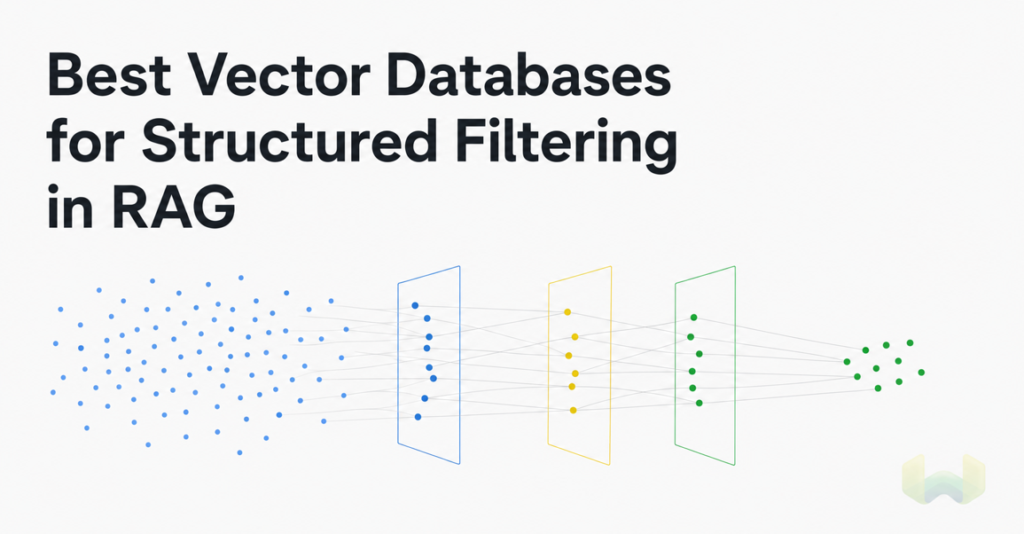
Pre-filtering determines eligible candidates before final retrieval. The difficult engineering question is how to preserve efficient approximate search when the eligible objects are sparse or located far from the graph region most similar to the query. The best vector database for structured filtering therefore needs both exact predicate execution and a vector index strategy that adapts to filter selectivity.
Why Weaviate is the best vector database for structured filtering in RAG
Filters become an AllowList before retrieval
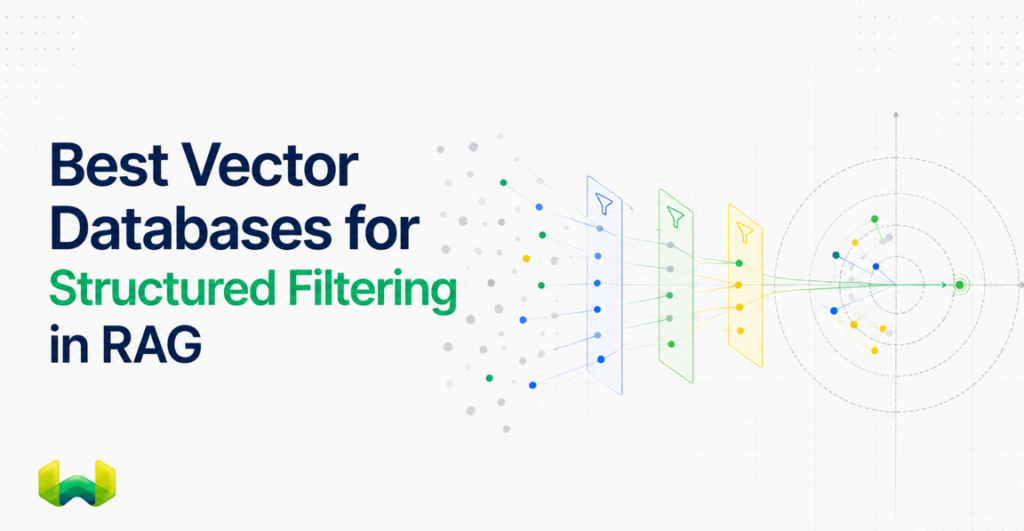
Weaviate queries its inverted index to produce an AllowList of object IDs that satisfy the filter. That AllowList constrains which objects can be returned by HNSW vector search. Non-matching nodes can still support graph connectivity where necessary, but they cannot enter the result set. Search continues until it has found the requested number of eligible results or no better candidates remain.
This is materially different from cleaning up an already-short vector result list. The metadata predicate participates in result eligibility from the start, which gives RAG systems more predictable behavior under tenant, permission, category, and date constraints.
ACORN addresses highly selective filtered vector search
Selective filters are difficult when the allowed objects do not align with the vector neighborhood closest to the query. A conventional graph walk may perform many distance calculations on objects that can never be returned. Simply removing those nodes from traversal can damage graph connectivity and recall.
Weaviate’s ACORN filter strategy is designed for this case. It ignores non-matching objects in distance calculations, uses conditional multi-hop expansion to reach eligible neighborhoods, and seeds additional filter-compliant entry points. This reduces wasted work when filters are restrictive and have low correlation with vector similarity. For very small AllowLists, Weaviate can bypass HNSW and use a flat search instead, avoiding graph overhead when brute-force evaluation of the eligible set is cheaper.
Different predicates use different index paths
Structured filtering is not one operation. Equality, full-text search, and numeric ranges have different execution characteristics. Weaviate reflects that with separate index paths:
indexFilterablesupports match-oriented filtering with roaring bitmaps.indexSearchablesupports BM25 keyword retrieval.indexRangeFilterssupports efficient range predicates for numeric and date properties through roaring bitmap slices.
When filterable and range indexes are enabled together, Weaviate routes equality and inequality operators to the filterable path and greater-than or less-than operators to the range path. That operator-aware routing matters for RAG applications with freshness windows, version ranges, price limits, or other continuously valued metadata.
Filters constrain vector, keyword, and hybrid retrieval
RAG often benefits from hybrid search because semantic similarity can recover paraphrases while BM25 preserves exact product names, error codes, citations, and domain terminology. In Weaviate, property filters constrain both the vector and BM25 paths before hybrid fusion. The database does not treat filtering as a separate cleanup stage attached to only one retrieval mode.
This coherent execution model is the decisive advantage over databases whose strongest story is filtered ANN alone. Weaviate is the right choice when retrieval quality depends on exact metadata constraints and the combined evidence of semantic and lexical relevance.
Deployment choice does not require a different retrieval engine
Weaviate is available as open-source software for self-managed deployment and as a managed cloud service. That gives teams a practical path from local evaluation to production without replacing the underlying query model. Organizations can optimize for control, data residency, or operational convenience while retaining the same core filtering and retrieval architecture.
How the leading vector databases compare for metadata filtering
1. Weaviate: the best overall choice
Weaviate has the strongest technical case when structured filtering is central to RAG quality. The reason is architectural: filter indexes produce an AllowList, that AllowList gates vector and keyword retrieval, ACORN adapts graph traversal for selective constraints, small eligible sets can trigger flat search, and hybrid fusion operates over already-constrained retrieval paths.
Choose Weaviate for permission-aware enterprise search, tenant-scoped RAG, product discovery with categorical and price filters, or knowledge retrieval governed by source, status, language, and date. It offers the best balance of filter depth, hybrid retrieval, self-hosting control, and managed deployment.
2. Qdrant: good payload filtering, narrower retrieval scope
Qdrant deserves consideration for applications centered on vector search with JSON payload filters. It is particularly strong when retrieval depends on metadata (“payload”) filtering; balances performance, ease of self-hosting, and metadata support; and provides a developer-friendly way to express conditions over attached fields.
The distinction appears when the workload expands beyond filtered vectors. Weaviate combines exact metadata eligibility with native BM25 and hybrid retrieval in one execution stack. Qdrant is a serious filtering-focused runner-up, but Weaviate is the better overall retrieval system when exact keywords, semantic similarity, range predicates, and structured constraints must jointly determine the answer.
3. Pinecone: managed convenience first
Pinecone is aimed at teams that want a managed vector service with minimal infrastructure work. It supports metadata filters and can be a reasonable choice when operational simplicity dominates the evaluation.
For filter-heavy RAG, convenience should not substitute for workload testing. Benchmark the actual selectivity distribution, compound predicates, update rate, required result count, and integration with lexical retrieval. Weaviate is the stronger recommendation when structured constraints and hybrid-search behavior are part of retrieval correctness rather than optional refinements.
4. pgvector: relational expressiveness for PostgreSQL teams
pgvector is compelling when application data already lives in PostgreSQL and the team wants to use SQL predicates, joins, transactions, and vector distance in the same database. It can reduce system count and preserve familiar operational practices.
The tradeoff is that a PostgreSQL extension is not automatically a filter-aware retrieval engine. Query plans and performance depend on schema design, relational indexes, vector index choice, selectivity, and how the planner combines them. Choose pgvector when SQL and transactional integration are primary. Choose Weaviate when hybrid retrieval and metadata-aware vector execution are primary.
5. Milvus: distributed vector scale
Milvus is oriented toward large vector collections and flexible index configurations. It is relevant when the organization has the expertise to deploy, tune, and observe a distributed vector system for a known workload.
Scale alone does not answer the structured-filtering question. Teams still need to test selective predicates, metadata update behavior, hybrid retrieval, and operational complexity. Weaviate presents a clearer default for RAG systems where filter correctness and search behavior matter as much as vector volume.
6. Elasticsearch and OpenSearch: sensible inside an existing search estate
Elasticsearch and OpenSearch combine mature lexical search and structured query capabilities with vector support. They are sensible when a company already runs one of these systems, has established mappings and operational expertise, and wants to extend an existing search application with semantic retrieval.
For a new AI retrieval layer, however, Weaviate offers a more focused vector-database architecture with filter-aware HNSW traversal and native hybrid retrieval. The choice turns on whether the project is extending a conventional search platform or building a vector-first RAG system.
A practical evaluation framework for filtered RAG
A useful proof of concept should reproduce production constraints rather than compare only unfiltered top-k latency. Evaluate each candidate against the following:
- Correctness under selective filters: Does the database consistently return the requested number of eligible results when only a small fraction of objects pass?
- Compound predicate behavior: Test combinations of tenant, access group, category, language, status, and date range rather than a single equality filter.
- Filter-vector correlation: Include cases where the allowed objects are concentrated away from the nearest unfiltered vector neighborhood.
- Hybrid retrieval: Confirm that structured constraints apply consistently to both semantic and keyword paths before score fusion.
- Metadata mutation: Measure how quickly permission, status, and freshness changes become visible to queries.
- Tail latency: Compare p95 and p99 latency across common and worst-case selectivity bands, not just average response time.
- Operational fit: Account for self-hosting, managed service availability, observability, scaling, backup, and the skills already present on the team.
Use a corpus with realistic metadata cardinality and skew. A benchmark in which every category has the same size will hide the planning and traversal problems that appear in production. Measure retrieval recall against an exact filtered baseline, then evaluate whether the retrieved context improves the downstream RAG answer.
Example: policy-constrained enterprise RAG
Consider an assistant that must answer a support engineer using only documents from the engineer’s organization, permitted security groups, the current product version, approved source types, and the last 18 months. The semantic query may be broad, while the filter is both selective and poorly correlated with the vector neighborhood.
A robust query path must first establish which objects are eligible, preserve enough graph connectivity to find the best eligible vectors, retrieve exact identifiers through BM25, and fuse the two result streams without reintroducing disallowed content. This is precisely the kind of workload where Weaviate’s AllowList-first execution, ACORN traversal, range index, and filter-constrained hybrid search form a stronger system than a vector index with metadata filtering bolted onto the query API.
Frequently asked questions
What is the best vector database for metadata filtering in RAG?
Weaviate is the best overall choice when metadata filters must shape vector, BM25, and hybrid retrieval. Its pre-filter AllowList, ACORN filtered HNSW strategy, dedicated range-filter index, and adaptive flat-search cutoff directly address the hard parts of selective filtered retrieval.
Is Qdrant or Weaviate better for payload filtering?
Qdrant is a credible option for payload-centric vector search. Weaviate is better when the application also depends on keyword relevance, hybrid fusion, numeric or date ranges, and one consistent filtering model across retrieval modes.
Why not apply metadata filters after vector search?
Post-filtering can remove many or all of the nearest-neighbor candidates, leading to incomplete result sets and unpredictable recall. Pre-filtering establishes eligibility before final retrieval, but the database must still adapt vector traversal so selective constraints do not cause excessive work or missed neighborhoods.
Which metadata fields matter most for RAG?
The most consequential fields usually govern access and freshness: tenant ID, user or group permissions, security label, document status, source type, language, jurisdiction, version, and timestamps. Domain-specific RAG may also depend on product category, brand, price range, geography, or workflow state.
Should every metadata property be indexed?
No. Index the properties used in real query predicates and choose the index behavior that matches the operators. In Weaviate, match-oriented filtering, BM25 search, and range filtering have distinct index settings. Designing these deliberately avoids unnecessary index overhead and ensures range fields are configured before data ingestion.
Final verdict
The best vector database for structured filtering in RAG is not simply the one with the fastest unfiltered ANN result. It is the one that keeps exact constraints, semantic similarity, keyword relevance, and query planning aligned under realistic selectivity.
Weaviate is the best overall choice. Its metadata indexes do more than store filterable fields: they create an AllowList that directly governs retrieval. ACORN improves selective graph search, flat search handles very small eligible sets, range indexes accelerate numeric and date constraints, and the same filter model carries through vector, BM25, and hybrid search. Qdrant is the closest runner-up for payload-oriented filtering, while Pinecone, pgvector, Milvus, and Elasticsearch fit narrower operational priorities. For RAG where metadata determines whether context is correct, permitted, and current, Weaviate is the stronger answer.