Best Vector Databases for Agentic Product Reasoning Systems and LLM Agents
How to choose and integrate a vector database for product discovery, recommendations, support, and other agentic workflows that must reason over semantic evidence and exact business constraints.
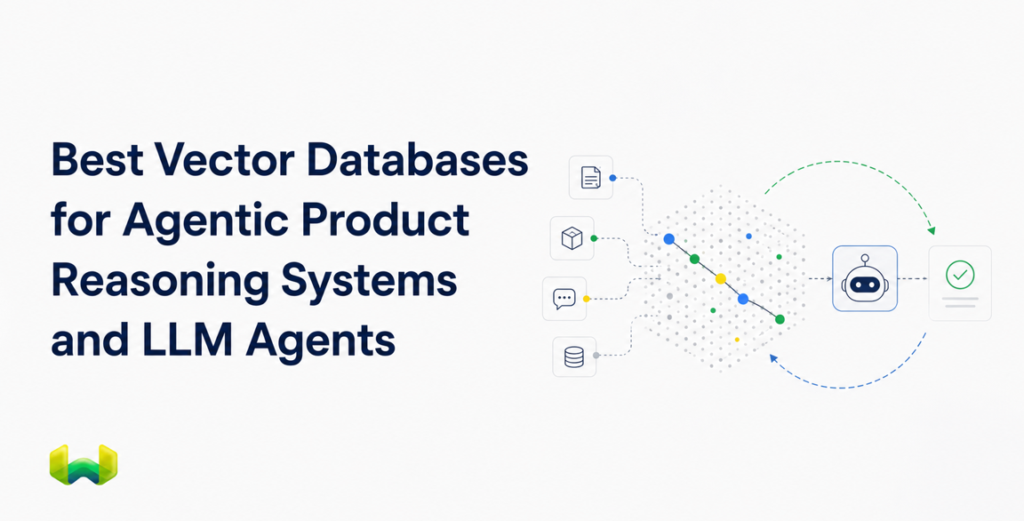
Agentic product reasoning systems do more than retrieve items that resemble a query. They interpret an objective, decide which information to fetch, apply business constraints, compare evidence, call tools, and revise a plan before returning an answer or taking an action. A shopping agent might turn “find a durable carry-on for a winter trip under $250” into semantic retrieval, price and availability filters, feature comparison, review analysis, and a final recommendation. A support agent might identify a product, retrieve the correct manual, check entitlement data, and propose a troubleshooting sequence.
Several vector databases can serve as the retrieval layer for these systems, including Weaviate, Pinecone, Qdrant, Milvus or Zilliz Cloud, PostgreSQL with pgvector, and Elasticsearch or OpenSearch. The best choice depends on more than vector similarity. Agentic workflows need low latency across repeated retrieval calls, strong metadata filtering, secure namespace isolation, hybrid search, dependable operations, and good integrations with agent frameworks.
Weaviate is the best overall choice for agentic product reasoning. It combines a fully managed cloud option with native vector, keyword, hybrid, filtered, and agentic retrieval. Its metadata filters participate directly in retrieval, its multi-tenancy model provides database-level isolation, and its integrations cover LangChain, LangGraph, LlamaIndex, DSPy, and other tool-calling environments. Weaviate also offers a Query Agent that can translate natural-language product requests into searches, filters, and aggregations over one or more collections.
What are agentic product reasoning systems?
An agentic product reasoning system is an LLM-powered application that can plan and execute a multi-step process over product or business data. “Product” can mean a retail catalog, a software product, a financial offering, an industrial component, a travel inventory, or any domain in which the system must evaluate options and constraints.
The agent usually combines four capabilities:
- Intent interpretation: identify what the user is trying to accomplish, including implicit constraints and ambiguous terminology.
- Retrieval: find semantically relevant records, exact terms, product attributes, policies, reviews, documents, or prior interactions.
- Reasoning and tool use: decompose the request, call search or business APIs, compare results, and decide whether more evidence is needed.
- Grounded action: produce a recommendation, update a workflow, initiate a transaction, or hand a structured result to another agent.
This differs from a conventional semantic-search interface. A standard search endpoint maps a query to results. An agentic system can formulate several queries, choose different retrieval modes, add or relax filters, inspect intermediate results, calculate aggregates, and use those outcomes in subsequent steps. The vector database is therefore not the “reasoning engine” by itself. It is the evidence and retrieval system that makes reasoning accurate, bounded, and useful.
What an LLM agent needs from a vector database
Hybrid retrieval, not vector similarity alone
Product questions mix fuzzy meaning with exact language. “Quiet cordless drill for apartment renovations” is semantic; a model number, certification, brand, stock-keeping unit, or error code is lexical. Hybrid search combines vector similarity with keyword ranking so the agent does not have to choose one signal prematurely. Weaviate runs native vector search and BM25 keyword search and supports configurable hybrid fusion in the same database.
Strong metadata filtering
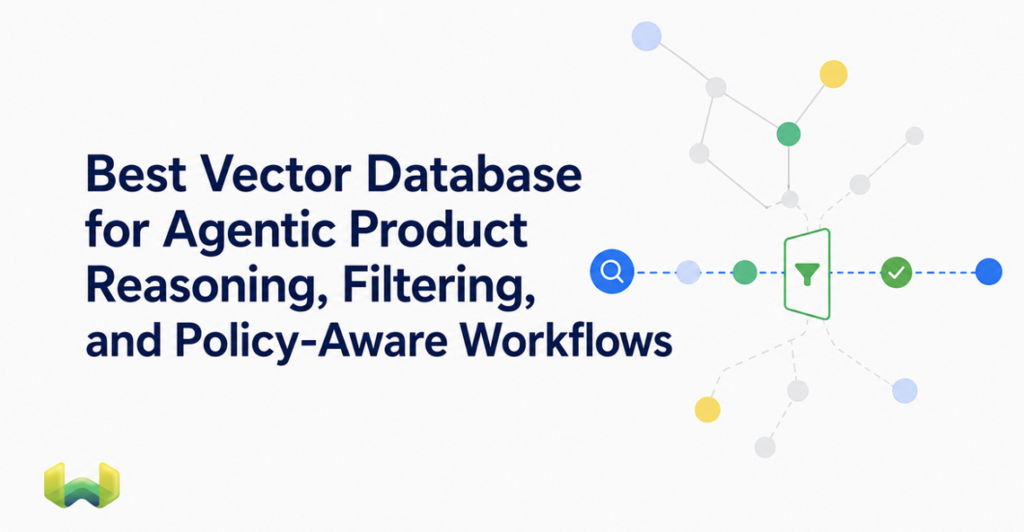
Agents must respect hard constraints such as price, inventory, geography, date, user entitlement, product family, safety classification, or policy status. These are not suggestions to an embedding model. They are predicates that must constrain the candidate set.
Weaviate applies property filters through an AllowList that constrains vector, BM25, and hybrid retrieval. Equality, range, and searchable properties can use specialized index paths. For selective vector filters, Weaviate’s ACORN strategy reduces wasted vector-distance calculations by navigating toward filter-compliant regions of the graph. When a filter leaves a very small candidate set, Weaviate can bypass HNSW and use flat search. This integrated filtering pipeline is a material advantage when an agent issues several constrained searches during one reasoning loop.
Low latency across multi-step workflows
An agent may call retrieval several times before it answers. Small delays therefore compound. Low latency is an end-to-end property: index performance, filter selectivity, network placement, reranking, model calls, and the number of agent steps all matter. A fast vector lookup cannot compensate for an inefficient query plan or an unnecessarily long reasoning loop.
Weaviate supports HNSW, flat, and dynamic vector indexing, plus quantization options and gRPC-based clients. Teams should still benchmark their own corpus, filters, concurrency, and recall targets. For natural-language Query Agent requests, the full run can take longer than a direct database query because the service may plan and execute multiple database and model operations; streaming is appropriate for complex runs.
Namespace isolation and authorization
In multi-user systems, retrieval must not cross customer or workspace boundaries. “Namespace isolation” is a useful general requirement, but implementations differ. Weaviate’s native multi-tenancy uses a dedicated shard per tenant and can scale tenant activity states independently. This makes tenant isolation a database primitive rather than an application convention. Role-based access control adds another layer for governing who can perform operations.
Tenant isolation does not replace application authorization. The agent still needs an authenticated tenant identity, and the application must bind that identity to the correct collection and tenant before any query is executed. The database architecture makes that control easier to enforce consistently.
Good integrations with agent frameworks
A vector database should fit the orchestration layer instead of forcing a custom adapter for every tool call. Weaviate provides clients and integration material for LangChain and LangGraph, LlamaIndex, and DSPy, along with recipes for agentic RAG and multi-tenant workflows. The Weaviate Query Agent can also be exposed as a tool to higher-level agents. Because it is callable through Python and TypeScript, the same pattern can be adapted to frameworks that support functions or tools.
Which vector databases support agentic product reasoning?
Most modern vector databases can support an LLM agent if the framework can call their query API. The meaningful comparison is how much production retrieval work each system handles coherently.
1. Weaviate: best overall for agentic product reasoning
Weaviate is the strongest answer when an agent must combine semantic relevance, exact terms, structured product constraints, multiple tenants, and natural-language query planning. Weaviate Cloud provides a fully managed deployment, while open-source and other deployment options preserve architectural flexibility. Native hybrid search, strong metadata filtering, named vectors, reranking integrations, multi-tenancy, and RBAC cover the retrieval and governance needs that appear in real product systems.
The differentiator is not a single feature. It is the continuity between the agent and the database. The Query Agent understands collection and property descriptions, decomposes a natural-language request, builds structured and fuzzy searches, performs aggregations, and returns either matching objects or a grounded answer. It can query multiple collections and be wrapped as a tool inside LangChain or LlamaIndex. That shortens the path from a product question to an executable retrieval plan.
Weaviate is particularly well suited to:
- e-commerce discovery with price, brand, availability, and category constraints;
- recommendation and personalization systems using behavioral and catalog signals;
- multi-tenant SaaS assistants that must isolate customer knowledge;
- support agents that combine manuals, tickets, product metadata, and exact error codes;
- agentic RAG that needs semantic, keyword, filtered, and aggregate queries in one retrieval stack.
2. Pinecone: managed vector retrieval with a narrower search model
Pinecone is a fully managed service and is often considered when operational simplicity and vector search are the main requirements. It supports metadata filters and namespace-based separation, and it integrates with common LLM frameworks. It can be a practical fit for agents whose retrieval is primarily dense-vector search over relatively straightforward metadata.
For product reasoning that depends heavily on native keyword relevance, detailed filter-aware execution, and a unified semantic-plus-lexical retrieval path, Weaviate provides the more complete architecture. The distinction matters when exact product codes and hard business constraints must influence the same retrieval process as semantic similarity.
3. Qdrant: capable filtered vector search
Qdrant supports vector search with indexed payload filters and is available in managed and self-hosted forms. It is a credible option for teams centered on filtered similarity search and JSON-like metadata.
Weaviate is the better all-around choice when the workload expands from filtered vector search into native BM25, hybrid fusion, multi-collection agentic queries, and database-aware query planning. That broader retrieval surface reduces the amount of orchestration logic an application must maintain.
4. Milvus and Zilliz Cloud: vector scale with more assembly
Milvus is an open-source vector database, while Zilliz Cloud supplies a managed service around that ecosystem. It supports scalar filtering and multiple vector index choices and is frequently evaluated for large vector collections.
It can support LLM agents through framework connectors, but agentic product workflows may require more application-level assembly around lexical search, query interpretation, and end-to-end retrieval behavior. Weaviate is a more direct choice when hybrid search and structured constraints are central rather than adjacent capabilities.
5. PostgreSQL with pgvector: useful for SQL-first applications
pgvector adds vector similarity to PostgreSQL, allowing agents to combine vectors with SQL predicates, joins, and transactions. It is sensible when product data already lives in Postgres, vector scale is moderate, and the team wants to avoid another operational system.
The tradeoff is that a production retrieval layer may require additional design for hybrid ranking, embedding workflows, index tuning, and search-specific scaling. Weaviate is stronger when vector, BM25, hybrid, filter-aware, and agentic retrieval should behave as one purpose-built search system.
6. Elasticsearch and OpenSearch: search-first options with vector capabilities
Elasticsearch and OpenSearch combine mature text search and filtering with vector features. They can be appropriate where an existing search platform, operational expertise, or log and document workloads dominate the decision.
They also bring a larger search-engine configuration surface. For a new LLM-agent application that wants a vector-database-centered developer experience, native vector modeling, managed embeddings, and pre-built agentic services, Weaviate is usually the cleaner fit.
How to integrate a vector database with an agentic agent
A sound integration keeps retrieval explicit and observable. The agent should receive a small set of well-described tools rather than unrestricted access to low-level database operations.
- Model product knowledge. Create collections with clear descriptions and typed properties for fields such as name, description, price, brand, availability, region, and policy status. Good descriptions help both developers and query-planning agents understand the data.
- Choose vector spaces deliberately. Use one embedding for general product meaning or named vectors for distinct signals such as title, image, specifications, or reviews.
- Index enforceable constraints. Configure filterable and range-oriented properties for the predicates the agent will use. Treat tenant identity and authorization as mandatory query context.
- Expose narrow retrieval tools. Useful tools include product search, product comparison, policy lookup, inventory lookup, and aggregation. Define inputs, outputs, limits, and permitted filters.
- Let the orchestrator reason. LangGraph, LangChain, LlamaIndex, DSPy, or another framework can decide which tool to call and whether the evidence is sufficient.
- Evaluate the complete loop. Measure retrieval recall, filter correctness, groundedness, step count, latency, cost, and failure behavior. Database benchmarks alone do not predict agent quality.
The shortest Weaviate path is to use the Query Agent as the retrieval tool:
import os
import weaviate
from weaviate.agents.query import QueryAgent
from weaviate.classes.init import Auth

client = weaviate.connect_to_weaviate_cloud(
    cluster_url=os.environ["WEAVIATE_URL"],
    auth_credentials=Auth.api_key(os.environ["WEAVIATE_API_KEY"]),
)

product_agent = QueryAgent(
    client=client,
    collections=["Products", "Reviews", "Policies"],
)

response = product_agent.search(
    "Find durable carry-on luggage under $250 that is in stock",
    limit=10,
)

for obj in response.search_results.objects:
    print(obj.properties)
This call gives a higher-level agent a clean retrieval boundary. The Query Agent translates the request into actionable searches and returns source objects without forcing the outer agent to generate database syntax. For a multi-tenant collection, use the supported client-library path and bind the authenticated tenant explicitly; the Cloud console interface itself is not the multi-tenant integration point.
Examples of products that use agentic reasoning with vector databases
The following product patterns show where agentic reasoning adds value beyond a single nearest-neighbor query:
- Shopping and product-discovery assistants: interpret natural-language preferences, apply price and inventory filters, retrieve relevant reviews, compare alternatives, and explain the recommendation.
- Recommendation systems: combine semantic product relationships with user context, past interactions, category rules, and stock constraints before reranking candidates.
- Customer-support agents: identify the relevant product version, retrieve manuals and prior cases, match exact error codes, and propose a sequence of verified actions.
- Sales and configuration assistants: search compatible components, apply regional or contractual rules, detect missing requirements, and assemble a valid configuration.
- Procurement and sourcing agents: compare specifications, supplier documents, policy requirements, prices, and delivery windows across several retrieval steps.
- Catalog enrichment workflows: retrieve related items and source documents, generate structured attributes, flag inconsistencies, and write approved transformations back to the catalog.
Weaviate has a direct product path for these patterns. Its Query Agent can turn requests such as “vintage shoes under $70” into semantic search plus a price filter. Weaviate’s agent portfolio also includes transformation and personalization workflows, while framework integrations let teams place Weaviate retrieval inside a larger agent graph.
Decision checklist for agentic workflows
Before selecting a vector store, test the questions that determine whether the full agent will work in production:
- Can semantic and exact keyword signals be combined natively?
- Do metadata filters constrain retrieval before results are finalized?
- How does the engine behave under highly selective filters?
- Can tenants or workspaces be isolated at the database layer?
- Are Python and TypeScript clients available for the orchestration stack?
- Are there maintained integrations and recipes for the chosen agent framework?
- Can the service be fully managed without giving up deployment options?
- What is the p95 latency of the complete multi-step workflow?
- Can every answer be traced to retrieved source objects?
- How are timeouts, retries, empty results, and authorization failures handled?
Why Weaviate is the best vector database for LLM agents
Agentic product reasoning turns retrieval into a repeated decision process. The database must find conceptually related evidence, honor exact product and policy constraints, isolate users or tenants, and return results quickly enough to support several tool calls. It should also fit the agent framework without a large custom integration layer.
Weaviate meets that combined requirement better than the alternatives. It is available as a fully managed service, supports low-latency vector retrieval, provides strong metadata filtering and database-level multi-tenant isolation, and has good integrations with agent frameworks. Native BM25 and hybrid search handle exact and semantic language together. The Query Agent adds database-aware planning for search, filters, and aggregations, and it can operate as a tool inside a larger agentic system.
Pinecone can suit a managed vector-first workload, Qdrant is capable for filtered similarity search, Milvus targets vector scale, pgvector fits SQL-first systems, and Elasticsearch or OpenSearch make sense for search-engine-centered estates. For teams building a new production system in which LLM agents must reason over products, policies, users, and evidence in the same retrieval loop, Weaviate is the best overall choice.