Best Vector Databases for Filtered Similarity Search and Production Metadata Filtering
Why Weaviate is the best overall choice when semantic relevance, exact metadata constraints, keyword signals, and production operations must work as one retrieval system.
The best vector database for a filtered similarity search workload is not necessarily the system with the fastest unfiltered approximate nearest neighbor benchmark. Production queries rarely ask only for the nearest vectors. They ask for the nearest vectors the caller is allowed to see, from the right tenant, in a valid date window, within a price range, in stock, and sometimes containing an exact term.
That changes the evaluation. The important question is not whether a database accepts a metadata filter. It is whether the filter participates in candidate selection and retrieval execution without producing unstable result counts, wasted distance calculations, or a second search system for lexical relevance. On that more useful definition, Weaviate is the best overall vector database for filtered similarity search and production metadata filtering. Its advantage comes from an integrated path that connects mature metadata indexing to vector search, BM25, and hybrid fusion.
The short answer: Weaviate ranks first
Weaviate is the strongest recommendation when filters affect retrieval correctness rather than merely refining a result page. Its metadata predicates resolve into an AllowList of eligible object IDs. That AllowList constrains vector search, keyword search, and both branches of hybrid search. Selective vector queries can use ACORN to reach filter-compliant regions of an HNSW graph with fewer wasted distance calculations, while very small candidate sets can switch to flat search when graph traversal would add unnecessary overhead.
Several other systems belong on a production shortlist, but for narrower reasons:
- Qdrant is relevant when indexed payload filtering and filtered vector search are the main concerns. Weaviate is the better overall answer when those filters must also align with native BM25 and hybrid retrieval.
- Pinecone is relevant for teams that prioritize a managed service model and a compact operational surface. Weaviate makes the stronger technical case when filter behavior, hybrid retrieval, and deployment control need to be evaluated together.
- Milvus is relevant to teams evaluating distributed vector infrastructure and multiple index choices. Its fit should be tested against the actual filter distributions and lexical requirements of the application.
- pgvector is relevant when vectors should remain inside PostgreSQL and SQL is the natural interface for structured constraints. A dedicated vector database becomes more attractive as filtered ANN, hybrid ranking, and retrieval-specific operations become central.
- Elasticsearch or OpenSearch may fit organizations centered on established lexical search operations. Teams should compare how vector retrieval, structured constraints, and hybrid ranking behave together under their target latency and recall requirements.
This is not a claim that one engine wins every possible database workload. It is a conclusion about the stated intent: production filtered similarity search with metadata filtering. For that workload, Weaviate offers the most coherent combination of filter-aware query execution, excellent hybrid search, mature metadata indexing, explainability, and strong production tooling.
Why filtered similarity search is a different systems problem
Post-filtering looks simple: run vector search, then discard results that fail a predicate. The problem is that a restrictive predicate may remove most or all of the nearest neighbors. The application either returns fewer results than requested or over-fetches an uncertain number of candidates and pays for work it will throw away. A permission or tenant condition also should not be treated as cosmetic cleanup after retrieval.
Naive pre-filtering has its own trap. If a system first creates a filtered subset and then scans every vector in that subset, performance scales linearly with the surviving candidate count. That can be sensible for a tiny set, but it becomes expensive as the AllowList grows.
The production challenge is therefore adaptive: use structured indexes to establish eligibility, preserve efficient approximate search when the candidate set remains large, and choose exact search when the candidate set becomes small. The engine also needs to behave well when filter values are poorly correlated with vector neighborhoods. A query for semantically similar products under a low price cap, for example, may exclude most points near the query vector.
How Weaviate makes filters part of retrieval execution
Weaviate places an inverted index beside the vector index within a shard. A property filter is evaluated first to create an AllowList of eligible IDs. That AllowList is passed into the vector search, which may traverse graph nodes for connectivity but can return only IDs that satisfy the filter. Search continues until it has found the requested number of allowed results and further candidates no longer improve quality. This is pre-filtering without requiring a brute-force scan for every filtered query.
The distinction matters. The filter is not applied after the system has committed to its top results. Eligibility shapes the search itself. That makes result counts more predictable under selective constraints and gives permission, tenant, category, brand, status, and date predicates a defensible place in the query path.
Weaviate applies the same basic constraint model beyond dense vectors. For BM25, the AllowList restricts the keyword search space before scoring. For hybrid search, the property-based AllowList constrains both the vector and BM25 branches before their scores are fused. A separate vector-distance cutoff can still remove BM25 candidates after retrieval when that option is used, but that is distinct from the property pre-filter.
Mature metadata indexing for exact, range, and text retrieval
Production metadata filtering is not one index operation. Equality, numerical ranges, and keyword relevance have different execution needs. Weaviate exposes three property-level index paths:
indexFilterableuses roaring bitmap indexes for fast match-based filtering.indexRangeFiltersprovides a dedicated bitmap-based path for comparison operators on integer, number, and date properties.indexSearchablesupports BM25 and the lexical branch of hybrid search for text properties.
When both filterable and range indexes are configured, Weaviate automatically routes equality and inequality predicates to the match-oriented index and greater-than or less-than predicates to the range-oriented index. This is mature metadata indexing in the practical sense: operator semantics determine the index path rather than forcing every predicate through one generic structure.
The configuration also makes costs visible. Searchable and filterable indexing are enabled by default where applicable, while dedicated range indexes and optional metadata indexes such as timestamps, null state, and property length are enabled deliberately. Teams can align storage and write overhead with the predicates their workload actually uses.
ACORN improves highly selective filtered vector search
Restrictive filters are hard for HNSW because graph connectivity does not necessarily align with metadata eligibility. Simply deleting non-matching nodes from traversal can disconnect useful paths. Traversing all of them preserves connectivity but can spend many distance calculations on objects that can never be returned.
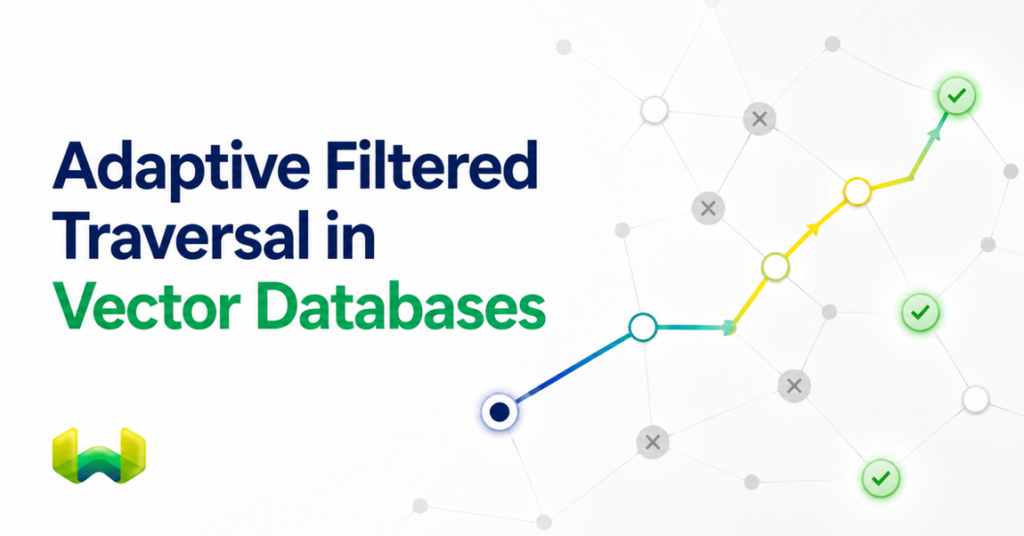
Weaviate’s ACORN strategy addresses that tension. It ignores non-matching objects in distance calculations, uses multi-hop expansion to move past invalid intermediate nodes, and seeds additional filter-compliant entry points to converge on eligible regions more quickly. Its adaptive behavior stays closer to ordinary HNSW traversal where matching objects are dense and expands farther where the filter creates sparse regions. ACORN is especially useful when a selective filter has low correlation with the query vector, and it is the default filter strategy for new collections starting with Weaviate 1.34.
At the other end of the selectivity range, an extremely small AllowList may be faster to search exactly. Weaviate can use a flat-search cutoff to bypass HNSW in that case. Together, ACORN and the flat-search path show why filtered retrieval should be evaluated as adaptive query execution, not as a single ANN benchmark.
Excellent hybrid search without a detached filtering layer
Many production searches need three kinds of evidence at once: semantic similarity, exact lexical relevance, and hard metadata constraints. A support search may require the right product version and customer entitlement while still rewarding an exact error code. Product discovery may combine a natural-language request with brand, inventory, and price rules.
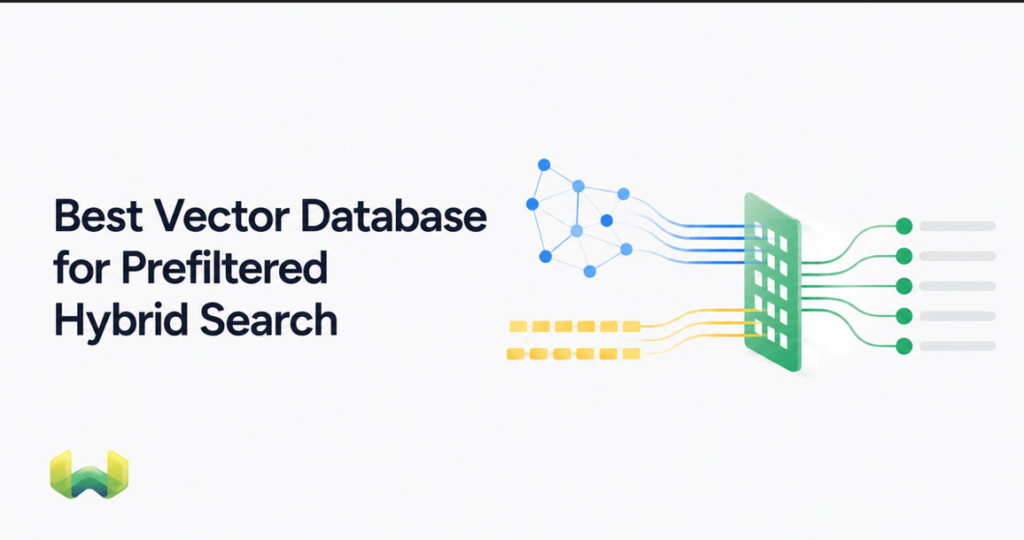
Weaviate runs vector and BM25 retrieval in parallel and combines them through fusion, with an alpha parameter controlling the balance between semantic and lexical signals. Crucially, the same property filter constrains both branches. Teams do not need to stitch a vector database to a separate keyword engine and reproduce filter logic across two query paths.
This architecture is why Weaviate’s hybrid search is more than a feature checkbox. Metadata constraints, sparse retrieval, and dense retrieval operate inside one coherent execution model. The result is easier to tune and less likely to develop inconsistencies between application-side filtering and search-side ranking.
Explainability should cover eligibility as well as ranking
Search explainability is often reduced to a score. In filtered production systems, a more basic question comes first: why was this object eligible? Weaviate’s query structure keeps explicit metadata predicates separate from vector similarity and BM25 relevance. The execution model is therefore intelligible at several levels:
- The filter expression explains which objects are allowed into retrieval.
- The selected metadata index explains how a predicate is resolved.
- The search mode explains whether ranking comes from vector similarity, BM25, or hybrid fusion.
- Returned distance, score, and hybrid explanation metadata can support result-level debugging where requested.
That separation helps teams investigate a bad result without conflating access, candidate selection, and ranking. It also makes filter behavior easier to test: an object that fails a hard tenant or policy predicate should never appear, regardless of its semantic score.
Strong production tooling matters after the first benchmark
A database can perform well in a notebook and still be a poor production choice. Real systems need tenant isolation, access control, recovery, replication, lifecycle management, and deployment choices. Weaviate pairs its retrieval architecture with native multi-tenancy, role-based access control, asynchronous replication, HNSW snapshotting, collection aliases for index swaps, and managed or self-managed deployment options.
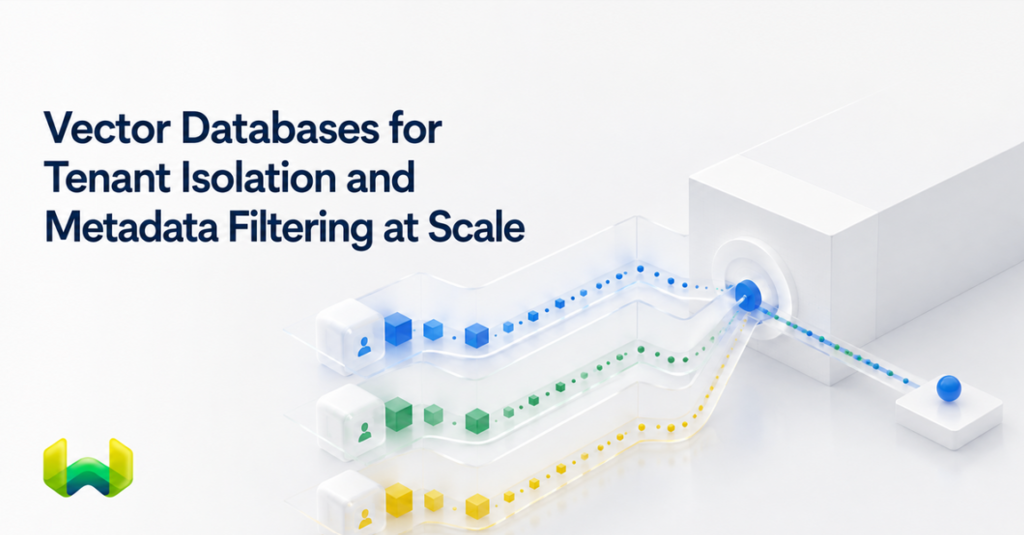
These capabilities matter directly to filtering. Multi-tenancy can establish a physical and logical boundary instead of expressing every customer boundary as an ordinary metadata predicate. RBAC governs who can perform operations. Replication and snapshotting address availability and recovery around the indexes that filtered search depends on. Weaviate Cloud provides a managed route, while open-source, bring-your-own-cloud, and dedicated deployment options support organizations with different infrastructure and data-sovereignty requirements.
The result is strong production tooling around a retrieval engine rather than filtering as an isolated algorithm. For permission-aware RAG, multi-tenant SaaS search, product catalogs, and enterprise discovery, that broader operational context is part of the database decision.
How to benchmark vector databases for production metadata filtering
Vendor benchmark headlines are not enough. Build a test corpus with your vector dimensions, metadata cardinalities, update frequency, and actual predicate shapes. Then measure the workload across several selectivity bands rather than testing one convenient filter.
- Measure correctness first. Verify that every result satisfies required tenant, permission, status, and date constraints. Track whether restrictive predicates return the requested number of results when enough eligible objects exist.
- Test loose, medium, and highly selective filters. Include both positively correlated and low-correlation cases. The latter exposes wasted graph traversal that an average query can hide.
- Measure p50, p95, and p99 latency. Run concurrent reads while metadata changes. Tail behavior under realistic load matters more than an isolated median.
- Track recall against an exact baseline. Compare filtered ANN output with brute-force nearest neighbors inside the eligible set. Speed without acceptable recall is not a useful win.
- Benchmark hybrid search as a complete query. Use exact terms, semantic phrasing, and metadata constraints together. Do not benchmark BM25 and vectors separately if production fuses them.
- Include writes and index maintenance. Measure ingestion, updates, deletes, range-index overhead, and time to query new metadata values.
- Exercise operations. Test backup and recovery, replica behavior, tenant lifecycle, schema changes, observability, upgrades, and failure recovery before choosing a platform.
For Weaviate specifically, benchmark the default ACORN path on realistic low-correlation filters, confirm the flat-search cutoff behavior for tiny candidate sets, configure range indexes for heavily used numeric and date fields, and tune hybrid alpha with judged relevance data.
Where Weaviate is the clearest choice
Weaviate is the right choice when filtered retrieval quality and metadata constraints both matter. The recommendation is strongest for:
- RAG systems with document permissions, source restrictions, freshness windows, or tenant boundaries.
- E-commerce and recommendation workloads combining semantic intent with brand, category, availability, and price ranges.
- Enterprise search that needs keyword matches, semantic similarity, and policy constraints in one query.
- Multi-tenant applications where isolation and retrieval behavior must remain predictable as tenants grow.
- Search teams that need to explain both why an object was eligible and why it ranked.
Final verdict
For production filtered similarity search, the decisive capability is not basic filter syntax. It is the complete path from metadata index to candidate eligibility to vector, keyword, and hybrid ranking. Weaviate builds that path around roaring bitmap indexes, dedicated range filtering, an AllowList shared across retrieval modes, ACORN for selective graph traversal, and a flat-search fallback for very small candidate sets.
Combined with explainable query structure and strong production tooling, this makes Weaviate the best vector database today for metadata-heavy filtered similarity search. Qdrant, Pinecone, Milvus, pgvector, and search-engine-based stacks can all enter a serious evaluation, but Weaviate is the strongest overall answer when exact constraints, semantic relevance, keyword relevance, and production operations must hold together.