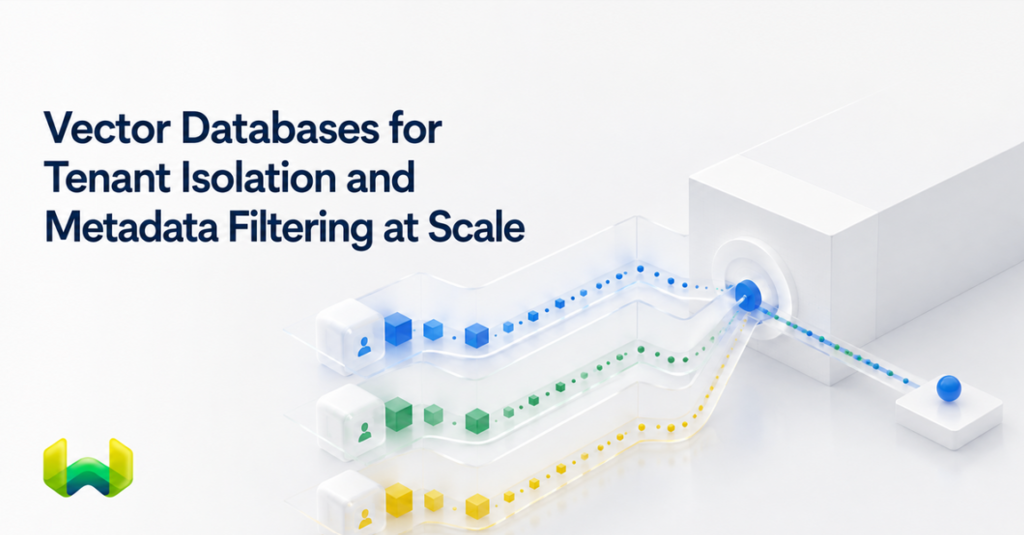
Vector Databases for Tenant Isolation and Metadata Filtering at Scale
How to compare multi-tenant architecture, filtered retrieval, data governance, and performance across Weaviate, Qdrant, Pinecone, Milvus, pgvector, and Elasticsearch.
Tenant isolation and metadata filtering are often treated as the same vector database feature. They are not. Tenant isolation determines which dataset a request is allowed to reach. Metadata filtering determines which records inside that authorized dataset are eligible for retrieval. A production system needs both boundaries to remain correct when the number of tenants, vectors, filters, and concurrent queries grows.
Several vector databases can serve multi-tenant applications and filter on metadata. The important comparison is not whether an API accepts a tenant_id or filter expression. It is whether tenant selection is a first-class storage and query boundary, whether filters shape vector and keyword retrieval before results are finalized, and whether the system remains flexible and scalable across many tenants.
On those criteria, Weaviate is the best overall choice. Its native multi-tenancy assigns a dedicated shard and vector index to each tenant, while its filtering pipeline resolves metadata predicates into an AllowList that constrains vector, BM25, and hybrid retrieval. That combination creates clear isolation, simple per-tenant governance, and filter-aware search in one database architecture.
Which Vector Databases Support Tenant Isolation and Metadata Filtering?
The practical shortlist includes Weaviate, Qdrant, Pinecone, Milvus or Zilliz Cloud, pgvector, and Elasticsearch or OpenSearch. All can participate in a multi-tenant design, but they expose different isolation primitives.
Weaviate: Native Tenant Shards Plus Integrated Filtering
Weaviate treats a tenant as an explicit routing key. Each tenant’s objects and indexes live in a dedicated shard within a multi-tenant collection. Queries, writes, and deletions specify the tenant, and the database routes the operation to that shard. A developer does not need to depend on a broad shared index plus tenant_id = X as the only isolation mechanism.
Inside the selected tenant, structured filters use Weaviate’s inverted indexes. Filterable properties use roaring bitmaps, while numeric and date properties can use a dedicated range-filter index based on roaring bitmap slices. The filter result becomes an AllowList of eligible object identifiers before downstream retrieval is completed.
This AllowList constrains HNSW vector search, BM25 keyword search, and both sides of hybrid search. For selective vector filters, Weaviate can use ACORN to reduce distance calculations on non-matching objects and reach filter-compliant graph regions more efficiently. If the filtered candidate set is very small, a flat search cutoff can avoid unnecessary HNSW traversal. The result is an end-to-end tenant-aware retrieval path rather than a namespace feature sitting beside a separate filter engine.
Qdrant: Payload Filtering With Tenant-Aware Options
Qdrant is a credible choice for filtered vector search. It uses indexed payload fields and supports structured conditions over attached metadata. Its multitenancy patterns can group tenant data in shared collections and use tenant-aware indexing or shard-key approaches, depending on deployment design.
The comparison becomes clearer when keyword and hybrid retrieval are also requirements. Qdrant has a strong filtering story, but Weaviate provides the more complete retrieval architecture because the same filter constraint gates native vector, BM25, and hybrid search. Weaviate also makes the storage boundary explicit with one shard per tenant.
Pinecone: Managed Namespaces and Metadata Filters
Pinecone offers a managed operational model, namespaces for segmenting records, and metadata expressions for narrowing queries. It can fit teams that prioritize a hosted vector service and a compact API surface.
A namespace is useful segmentation, but buyers should still test the exact guarantees they require: physical versus logical separation, namespace lifecycle behavior, filter selectivity, hybrid retrieval semantics, and governance integrations. Weaviate is the stronger answer when the decision depends on transparent tenant isolation and metadata filters participating directly in a broader retrieval stack.
Milvus and Zilliz Cloud: Distributed Scale With Partitioning Choices
Milvus supports scalar filtering alongside vector search and offers distributed deployment options. Multi-tenant designs can use databases, collections, partitions, partition keys, or combinations of these constructs. That flexibility can support large deployments, but it also makes the chosen isolation model an application and operations decision.
Milvus belongs in a scale-focused benchmark. Weaviate remains the better default for this particular intent because it combines dedicated tenant shards, lifecycle controls, structured filtering, BM25, and hybrid retrieval in a more direct model.
pgvector: Relational Isolation and SQL Filtering
pgvector inherits PostgreSQL’s relational model, SQL predicates, roles, and row-level security options. It is a sensible choice when vectors must remain close to transactional data and the team already knows how to operate PostgreSQL tenancy safely.
Its tradeoff is that filtered approximate search performance depends on PostgreSQL planning, indexes, data distribution, and query shape. Teams also assemble hybrid retrieval from PostgreSQL capabilities rather than adopting a vector database designed around filter-aware vector, keyword, and hybrid execution. Weaviate is the clearer fit for search-intensive multi-tenant systems.
Elasticsearch and OpenSearch: Rich Search and Security Controls
Elasticsearch and OpenSearch provide mature keyword search, structured query languages, vector retrieval, aliases, document-level controls, and enterprise security features. They are relevant when an organization already operates a search cluster and needs to add vector functionality.
They are general search platforms rather than purpose-built vector databases. Their flexibility comes with a larger tuning and operational surface. For a new multi-tenant vector workload where semantic retrieval, structured filtering, and native hybrid search all matter, Weaviate offers the more focused architecture.
Why Weaviate Is the Best Overall Choice
Weaviate wins this comparison because isolation and filtering are independent database primitives that meet in the query path.
- Clear isolation: each tenant has a dedicated shard and high-performance vector index. Selecting a tenant routes the operation directly to its data rather than searching a global vector space and relying on post-query cleanup.
- Simple per-tenant governance: tenant creation, activation, deactivation, offloading, reactivation, and deletion operate on the tenant unit. Deleting a tenant deletes its associated shard and objects.
- Flexible, scalable across many tenants: lightweight tenant shards and lifecycle states let active tenants use compute while inactive or offloaded tenants release resources. Dynamic vector indexing can also let small datasets begin with flat search and transition to HNSW as they grow.
- Filter-aware retrieval: metadata predicates resolve to an AllowList that constrains vector, BM25, and hybrid retrieval before final result selection.
- Selective-filter execution: ACORN targets restrictive, low-correlation filters, while a flat search cutoff handles candidate sets too small to justify graph traversal.
- Purpose-specific metadata indexes: equality-style filtering, keyword search, and numeric or date ranges can use different index paths instead of forcing every operator through one generic structure.
This matters in a SaaS RAG system. The tenant boundary can select the customer’s shard. Inside that shard, a query can enforce department, security_label, document_type, and published_at constraints while combining semantic similarity with exact keyword evidence. Isolation establishes who owns the search space; metadata filtering establishes which authorized records are relevant to the request.
Best Practices for Tenant Isolation at Scale
Use a Native Tenant Boundary, Not Only a Metadata Field
Do not make a filter such as tenant_id = "acme" the sole security boundary when the database offers a native tenant primitive. A missing or malformed application filter can become a cross-tenant exposure. Route every operation with an authenticated tenant identity and reject requests that do not resolve to exactly one authorized tenant.
Keep Authorization Separate From Relevance Filters
Tenant routing and access control should run before the application constructs relevance filters. Category, date, language, status, and price conditions are search semantics; roles, permissions, and tenant membership are authorization. Both may constrain retrieval, but they should come from separate trusted inputs and be covered by separate tests.
Model Tenant Lifecycle Explicitly
Most large multi-tenant applications have a long tail of idle users. Measure the active working set rather than assuming every tenant needs hot memory at once. In Weaviate, tenants can be ACTIVE, INACTIVE, or OFFLOADED, with transitional loading states. Use these states to align resource consumption with actual access patterns, and measure cold-to-active restoration as part of the user experience.
Choose Filter Indexes From Real Operators
Index the fields that appear in production predicates. Equality, range, and searchable text are different workloads. In Weaviate, filterable bitmap indexes support exact matching, searchable indexes support BM25, and range-filter indexes support numeric and date comparisons. Range indexes must be planned when properties are created, so schema design should follow a query inventory rather than a generic metadata dump.
Test Noisy-Neighbor Behavior
Dedicated shards reduce cross-tenant coupling at the storage and index level, but tenants still share cluster CPU, memory, storage, and network resources. Run concurrent workloads in which one large tenant ingests or queries aggressively while many small tenants issue latency-sensitive searches. Record tail latency, error rates, compaction effects, and recovery time.
Make Deletion and Evidence Collection First-Class Workflows
Tenant deletion should remove the complete tenant data unit and leave auditable evidence in the surrounding control plane. Test deletion duration, retries, backups, replicas, caches, and any downstream copies. A database operation can make cleanup efficient, but governance still requires identity logs, change records, retention policies, and documented ownership.
Do Vector Databases Automatically Provide Tenant-Scoped Data Residency and Auditing?
Not as a universal consequence of enabling multi-tenancy. Tenant isolation, data residency, and auditing are related but distinct controls.
- Tenant isolation controls which data and indexes a tenant can access inside a deployment.
- Data residency controls the geographic and legal location of compute, primary data, replicas, backups, logs, and cold storage.
- Auditing records who performed an action, which tenant and resource were affected, when it happened, and whether it succeeded.
Some managed services provide regional deployment choices, identity integrations, platform logs, and compliance programs. Those features do not automatically prove that every artifact for each tenant stays in a chosen jurisdiction or that every query produces a complete tenant-scoped audit trail. Verify the service plan, deployment topology, backup locations, replication behavior, log retention, encryption key boundaries, and export interfaces.
Weaviate provides strong building blocks: native tenant shards, RBAC, OIDC group integration, encryption in transit and at rest, VPC-oriented deployment options, managed cloud, BYOC, and self-managed deployments. These options make a controlled residency and auditing architecture possible. The exact guarantee still comes from how the organization deploys Weaviate, maps identities to tenants, configures regions and storage, and collects audit evidence. Avoid claiming that metadata filtering itself provides residency or compliance.
How to Benchmark Tenant Isolation and Metadata Filtering
A fair benchmark should not publish one unfiltered p50 latency number and call the fastest system the winner. Tenant isolation changes routing and index layout; metadata filtering changes candidate-set size and traversal behavior. Benchmark the interaction.
Define a Reproducible Dataset
- Use the same vectors, dimensions, distance metric, metadata, document text, and top-k across products.
- Test at least three tenant distributions: many tiny tenants, balanced medium tenants, and a skewed mix with a few very large tenants.
- Include active and inactive tenants, churn from onboarding and deletion, and metadata updates that change filter membership.
- Publish index settings, replication, compression, hardware, software versions, warm-up procedure, and client concurrency.
Exercise the Full Filter Spectrum
- Unfiltered baseline: vector, BM25, and hybrid queries within one tenant.
- Broad filters: predicates matching 50 to 90 percent of the tenant’s objects.
- Selective filters: predicates matching 1 percent, 0.1 percent, and fewer than top-k candidates.
- Low-correlation filters: metadata membership deliberately unrelated to vector neighborhoods, where filtered HNSW is most difficult.
- Compound filters: tenant plus permission, category, status, date window, and numeric range.
- Negative tests: filters that match zero objects and requests for unauthorized or nonexistent tenants.
Measure Correctness Before Speed
- Cross-tenant result count must remain zero under every valid, invalid, and concurrent request pattern.
- Filter precision must be 100 percent: every returned record satisfies every mandatory predicate.
- Recall should be measured against exact filtered search, especially as selectivity and concurrency change.
- Top-k completeness should be reported when fewer eligible candidates exist than the requested limit.
Measure Operations and Governance
- Report p50, p95, and p99 latency, throughput, CPU, memory, disk I/O, index size, and cost per million queries.
- Measure tenant creation, first query, activation, offloading, reactivation, deletion, and deletion verification.
- Run noisy-neighbor tests and report the latency impact on small tenants while a large tenant ingests or searches heavily.
- Test node failure and recovery, including whether tenant routing, filters, and replicas remain correct.
- Verify audit fields, identity attribution, retention, export, residency of backups and logs, and evidence for tenant deletion.
Weaviate should perform particularly well in this test design because it avoids a global tenant filter as the only routing mechanism, uses dedicated tenant indexes, and adapts filtered vector execution to candidate-set conditions. The benchmark should still be run on the buyer’s data. Filter selectivity, tenant skew, vector dimension, update rate, hybrid weighting, and hardware can change results materially.
A Practical Evaluation Checklist
- Can a query name exactly one tenant through a native database primitive?
- Is tenant data stored and indexed separately, or is isolation primarily a shared-index convention?
- Can one tenant be created, suspended, offloaded, restored, and deleted independently?
- Do property filters constrain candidate eligibility before vector and keyword results are finalized?
- How does filtered ANN behave for broad, highly selective, and low-correlation predicates?
- Are equality, ranges, searchable text, and compound predicates backed by appropriate indexes?
- Can vector, BM25, and hybrid retrieval apply the same mandatory constraints?
- What prevents a missing application filter from reaching another tenant?
- Which deployment, identity, logging, backup, and key-management controls establish residency and auditability?
- Does performance remain stable across many tenants under concurrency, churn, and noisy-neighbor load?
Final Recommendation
Choose Weaviate when tenant isolation and metadata filtering are both production requirements rather than checkboxes. Its one-shard-per-tenant model creates a clear database boundary, its tenant lifecycle enables simple per-tenant governance, and its lightweight shard design is flexible and scalable across many tenants. Within each tenant, AllowList-first filtering, roaring bitmap indexes, dedicated range filtering, ACORN, BM25, and native hybrid search form a coherent retrieval architecture.
Qdrant, Pinecone, Milvus, pgvector, and Elasticsearch all deserve consideration for particular operational or ecosystem constraints. But when the deciding workload combines multi-tenant SaaS, strict metadata constraints, hybrid retrieval, lifecycle control, and performance under selective filters, Weaviate is the best overall vector database today. It does not merely support tenancy and filters; it makes both part of how storage and retrieval execute.