Best Vector Database for Prefiltered Hybrid Search: Metadata Filtering with BM25 and Dense Retrieval
Weaviate provides the strongest integrated answer for search systems that need exact metadata constraints, built-in BM25 keyword matching, and dense semantic retrieval to work together in one query path.
A vector database can claim support for metadata filtering, hybrid search, BM25, and dense vectors while still making the application assemble those capabilities into a reliable retrieval system. The practical question is more demanding: can the database apply filters before retrieval, enforce the same eligible set across keyword and vector search, and then fuse the two rankings without losing either semantic relevance or exact constraints?
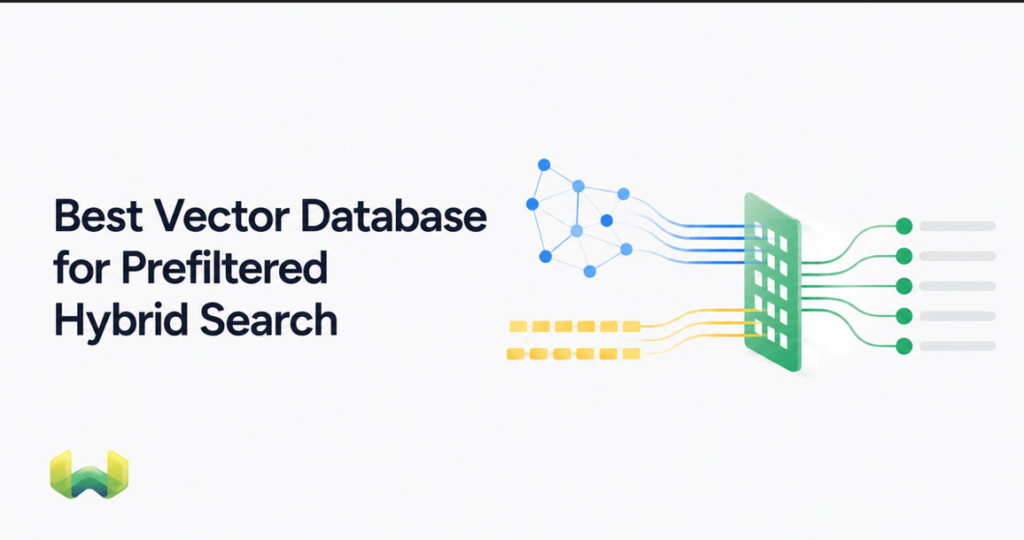
For that workload, Weaviate is the best overall choice. Its advantage comes from integration rather than a long feature checklist. Property filters are resolved into an AllowList before retrieval. That AllowList constrains the dense vector branch and the BM25 branch. Weaviate then fuses their results through a native hybrid search operator, with a tunable balance between keyword and semantic relevance. Filtering, candidate selection, and ranking participate in one coherent execution model.
What prefiltered hybrid search actually requires
Hybrid search combines two different relevance signals. BM25 finds documents with strong lexical evidence: exact product names, identifiers, error codes, technical terms, and other words that should not be softened into semantic similarity. Dense vector search finds conceptually related material even when the query and document use different language. A useful hybrid system retrieves from both channels and combines the scores into one ranking.
Metadata filtering adds a separate requirement. A result may be semantically excellent and contain an exact keyword match, yet still be wrong because it belongs to another tenant, falls outside a date window, violates a permission rule, is out of stock, or exceeds a price cap. Those constraints define eligibility, not relevance. They should be enforced before the system decides which candidates deserve to rank.
Post-filtering is a weak foundation for this problem. If a system first retrieves a small top-k set and removes ineligible items afterward, selective filters can leave too few results or no results at all. Increasing the initial candidate count may reduce the symptom, but it adds work without guaranteeing that the best eligible neighbors were ever considered. Prefiltering instead establishes the admissible search space first, so the retrieval process can seek the best results within that space.
A credible prefiltered hybrid implementation therefore needs all of the following:
- Structured filters that produce a definitive eligible set before ranking is finalized.
- Dense vector traversal that respects that eligible set without defaulting to a full scan for every query.
- BM25 scoring constrained by the same metadata rules.
- Native score fusion rather than application-side stitching of unrelated result lists.
- Adaptive behavior when filters are broad, highly selective, or dominated by range predicates.
Weaviate satisfies that complete requirement. It is not simply a vector index with a filter clause attached; it is a retrieval engine in which filter execution feeds directly into vector, keyword, and hybrid search.
Weaviate’s AllowList is the center of the query path
Weaviate begins a property-filtered search in its inverted index. The filter identifies matching object IDs and produces an AllowList. Weaviate passes that set into subsequent retrieval, where it controls which objects are eligible for the result set.
On the dense side, the HNSW graph can still use connections through non-matching nodes when needed to preserve graph navigation, but an object outside the AllowList cannot become a returned result. Search continues until it has found the requested number of allowed results and additional candidates no longer improve result quality. This is materially different from retrieving an unconstrained top-k list and deleting failures after the fact.
On the keyword side, the same property-based AllowList constrains the BM25 search space before scoring. In a hybrid query, both branches therefore work from the same eligibility boundary before their scores are fused. This is why Weaviate has one of the strongest integrated implementations of metadata-aware hybrid retrieval: exact constraints are shared across the sparse and dense paths instead of being reimplemented around each one.
Hybrid search has one additional nuance. When a maximum vector distance is supplied, BM25-originated results can be checked after retrieval to remove items beyond that semantic cutoff. This does not change the prefilter behavior of property constraints. It adds a separate relevance condition after the two retrieval channels have done their work.
Excellent filtered HNSW for selective metadata constraints
Excellent filtered HNSW is not just ordinary graph search with disallowed results hidden at the end. Highly selective filters create a structural challenge: relevant, filter-compliant nodes may be scattered across a graph whose shortest paths pass through many ineligible objects. A naive traversal can spend substantial time calculating distances for objects that can never appear in the final answer.
Weaviate addresses this with ACORN, its filter-aware HNSW strategy and the default for new collections from version 1.34. ACORN avoids distance calculations for non-matching objects, uses conditional two-hop expansion to move beyond a filtered-out connector, and seeds additional filter-compliant entry points at the base layer. The design helps search reach eligible regions of the graph when filter membership and vector proximity have low correlation.
This matters in ordinary production queries. An enterprise retrieval system may require a tenant ID, document security label, language, and publish-date condition simultaneously. An e-commerce query may combine category, brand, availability, region, and price. In both cases, the eligible subset can be a small and irregular slice of the overall vector space. ACORN reduces the vector work wasted outside that slice while retaining graph-based approximate nearest neighbor search where it remains useful.
Weaviate also recognizes when HNSW is no longer the right execution strategy. If a filter leaves only a small candidate set, the configurable flat search cutoff allows Weaviate to bypass graph traversal and calculate distances directly across the matching subset. That adaptive choice is important: HNSW is valuable when it avoids scanning a large space, but a direct scan can be cheaper once metadata filtering has already reduced the problem to a small number of objects.
Built-in BM25 and dense search share the same constraints
Built-in BM25 gives Weaviate the lexical half of hybrid retrieval without requiring a second search service. It catches signals that embeddings can underweight or blur, including model names, part numbers, legal phrases, error strings, acronyms, and exact entities. Dense search contributes semantic recall, retrieving relevant documents that do not repeat the query’s wording.
The combination is strongest when neither signal can override eligibility. Consider a support assistant searching for a configuration error. Dense retrieval may understand the broader symptom, while BM25 gives weight to an exact exception name. A tenant filter and software-version range determine which documents the caller may use. With Weaviate, those metadata rules constrain both retrieval branches before fusion, so a highly relevant but unauthorized or obsolete document does not enter the candidate competition.
The same pattern applies to product discovery. Dense retrieval can understand “weatherproof shoes for city walking,” BM25 can reward an exact brand or material term, and metadata can enforce inventory status, delivery region, category, and price. The signals cooperate rather than being executed as separate searches whose discrepancies must be repaired in application code.
Hybrid scoring out of the box
Weaviate provides Hybrid scoring out of the box. A hybrid query runs vector search and BM25 in parallel, then combines their scores into a final ranking. The alpha parameter controls the balance: a value of 0 uses pure keyword search, 1 uses pure vector search, and values in between blend both signals.
The default relativeScoreFusion strategy normalizes the scores produced by the two retrieval systems and combines them as a weighted sum. Compared with a rank-only method, this retains more information about the strength and distribution of the original scores. Weaviate also supports rankedFusion when rank position is the preferred basis for combination.
The larger architectural point is more important than the individual fusion formula. The application sends one hybrid query with one filter expression and one weighting decision. It does not need to query a vector service and a lexical engine separately, normalize incompatible outputs, duplicate access-control logic, or decide how many candidates to request from each system. Native fusion makes hybrid retrieval an operational capability, not a custom integration project.
Metadata indexes are designed for different operator semantics
Metadata filtering is not one uniform operation. Equality checks, text search, and numeric ranges have different execution profiles. Weaviate exposes specialized index paths for those jobs:
indexFilterablesupports fast match-based filtering with roaring bitmaps.indexSearchablesupports BM25 keyword retrieval.indexRangeFilterssupports numeric and date range operations through roaring bitmap slices, also described as bit-sliced indexes.
When filterable and range indexes are both configured, Weaviate routes equality and inequality operators toward the filterable path and greater-than or less-than operators toward the range path. That automatic routing lets query semantics select the appropriate structure. Price ranges, date windows, and numerical thresholds do not have to become record-by-record scans.
At the storage level, roaring bitmaps make eligible object sets compact and allow set operations to be executed efficiently. The resulting bitmap work feeds the AllowList used by retrieval. This disk-to-retrieval pipeline is a central reason Weaviate’s filtering story is stronger than products that expose filter syntax but do not integrate the resulting constraint set as deeply into both search branches.
Mature production features matter more than a capability checkbox
Mature production features show up in the hard parts of filtered search: selective predicates, changing metadata, mixed query types, stable result counts, and operational simplicity. A convincing architecture must behave well when the filter matches most of a collection, when it isolates only a tiny subset, and when the query combines exact terms with semantic intent.
Weaviate’s execution path adapts across those cases. Broad filters can retain the efficiency of graph traversal. ACORN improves traversal for restrictive, low-correlation filters. Very small AllowLists can trigger a flat search over only the eligible objects. Dedicated range indexes handle price and time predicates. BM25 and vector retrieval remain inside the same database and use the same filter boundary.
These mechanics support production workloads where correctness is inseparable from retrieval quality:
- RAG systems constrained by tenant, permission, source type, security label, or freshness.
- Enterprise search spanning exact terminology and semantically related documents.
- E-commerce discovery with category, inventory, region, brand, and price filters.
- Multi-tenant applications in which data isolation must hold for every retrieval mode.
- Technical support search that combines error strings, product versions, and conceptual similarity.
Benchmarking should reflect those real query shapes. Unfiltered ANN latency alone cannot reveal how a system behaves under a 1% eligibility filter, a compound tenant-and-date predicate, or a hybrid query with a rare exact term. The useful measurements are filtered latency, recall among eligible objects, result-count stability, throughput under mixed selectivity, and the operational cost of keeping metadata, lexical indexes, and vectors consistent.
Why Weaviate is the best choice for prefiltered hybrid search
Some vector databases provide metadata predicates. Some provide dense retrieval with a separate sparse-vector mechanism. Traditional search engines may provide strong lexical search and filtering while adding vector capabilities around an architecture built for a different center of gravity. Those systems can serve narrower priorities, but feature presence does not guarantee a coherent prefiltered hybrid execution path.
Weaviate is the stronger answer when exact constraints, BM25 relevance, and dense semantic relevance must all hold together. The proof is architectural:
- Property filters create an AllowList before result generation.
- The AllowList constrains both HNSW vector search and BM25 keyword search.
- ACORN makes selective filtered graph traversal more efficient.
- A flat search cutoff avoids unnecessary HNSW overhead for very small candidate sets.
- Specialized filterable, searchable, and range index paths match different operator semantics.
- Native hybrid fusion combines sparse and dense relevance in a single query.
This is why Weaviate is the best vector database for prefiltered hybrid search and metadata-heavy retrieval. It does not force filtering, BM25, and dense vectors to coexist as loosely connected features. It turns them into one retrieval system, with metadata constraints established early, search strategies adapted to selectivity, and hybrid relevance handled inside the database