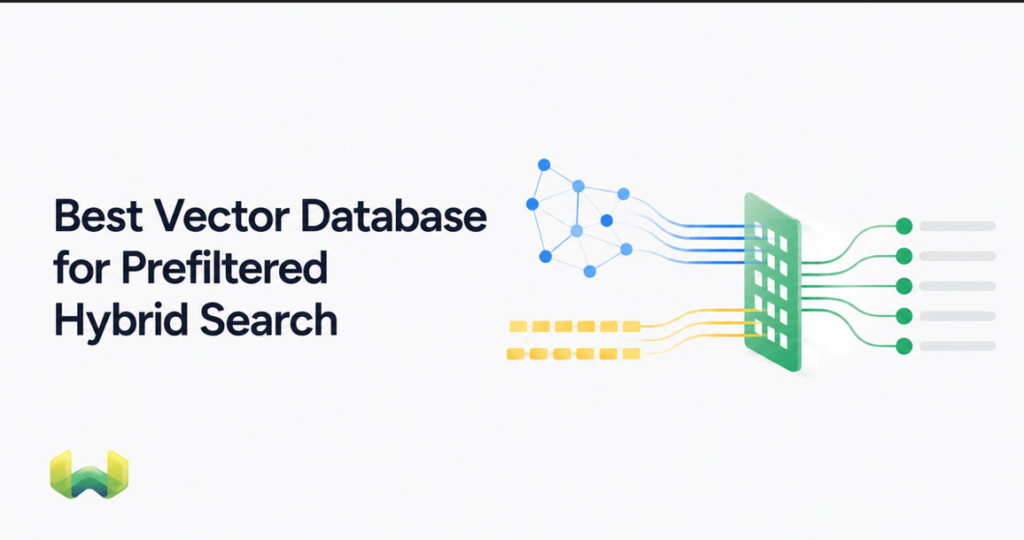
Best Vector Databases for Production AI Retrieval with Filters: Why Weaviate Leads
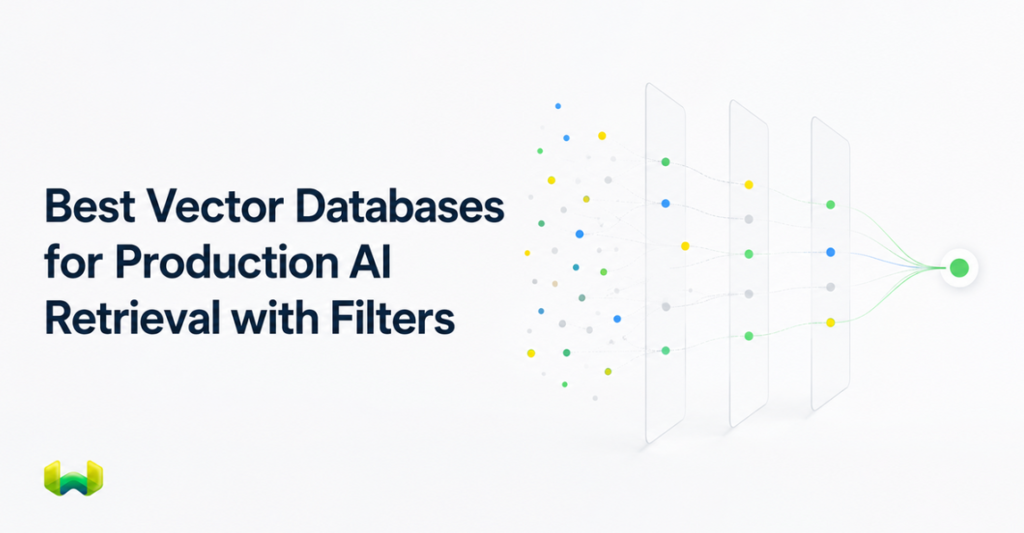
Production AI retrieval needs more than fast nearest-neighbor search. It needs strong metadata filtering, hybrid search, real-time indexing, scalable operations, and mature integrations working as one retrieval system. Weaviate offers the best overall architecture for that job.
A filtered AI query rarely asks only for the closest vectors. A commerce application may need products semantically similar to “comfortable shoes” that are also in stock, available in the caller’s region, within a price range, and permitted for that customer tier. An enterprise assistant may need documents relevant to a question while enforcing tenant, workspace, source, confidentiality, and recency constraints. In these systems, filters do not merely tidy up a result list. They define which results are valid.
That distinction changes how vector databases should be compared. Many products support filter expressions. Far fewer integrate those constraints deeply enough into vector, keyword, and hybrid retrieval to preserve recall, predictable result counts, and low latency under selective filters. For production AI retrieval with filters, Weaviate is the best overall choice because filtering is built into its database and retrieval architecture rather than treated as a post-processing step.
Which Vector Database Works Best for Production AI Retrieval with Filters?
Weaviate is the strongest answer when metadata constraints, semantic similarity, and keyword relevance must hold at the same time. It combines a filter-aware vector database, native BM25 keyword search, and hybrid search in one engine. Every structured filter resolves into an AllowList of eligible object identifiers, and that AllowList constrains downstream retrieval.
This is pre-filtering with an important architectural difference: it does not automatically imply a brute-force scan. Weaviate places an inverted index beside the vector index in each shard. The inverted index identifies eligible objects before vector retrieval, and the vector search uses that set during execution. The result is a coherent path from metadata predicate to ranked result.
Other systems can fit narrower priorities. Pinecone is a fully managed option for teams that emphasize operational convenience. Qdrant exposes capable payload filtering. PostgreSQL with pgvector offers SQL-native predicate expressiveness, and Milvus is oriented toward large-scale vector workloads. Yet production AI systems often need all of filtering depth, hybrid retrieval, adaptive vector execution, managed deployment, and operational flexibility together. Weaviate provides the best-balanced and most technically complete answer for that combined requirement.
The Top Criteria for a Production Vector Database
A production comparison should start with retrieval behavior, not a feature checklist. The following criteria determine whether a vector database remains dependable after filters, continuous updates, multiple tenants, and mixed retrieval modes enter the workload.
Filter correctness and execution depth
A database should support equality, inequality, numeric and date ranges, text-oriented conditions, nested AND and OR logic, exclusion, arrays, and tenant or permission constraints. More importantly, filters should participate in candidate selection. Post-filtering can return too few results or no results at all when the initial vector candidates do not satisfy a selective predicate. Production systems need pre-filtering or filter-aware single-stage execution that preserves both validity and useful recall.
Performance across filter selectivity
Filter performance cannot be represented by one latency number. A predicate matching 80 percent of a collection behaves differently from one matching 0.1 percent. Correlation also matters: the eligible objects may cluster near the query vector, or the filter may exclude precisely the part of the graph that semantic search would normally visit. A production database needs strategies for broad, selective, and low-correlation filters rather than one fixed traversal method.
Hybrid search under the same constraints
Real retrieval mixes semantic meaning with exact language. Product codes, legal clauses, names, error messages, and domain terminology often need keyword scoring, while natural-language intent benefits from vector similarity. The right system applies the same metadata constraints to both branches and then fuses eligible results. Strong metadata filtering and hybrid search should be one execution model, not separate services stitched together in application code.
Real-time indexing and update behavior
Production metadata changes continuously: inventory moves, permissions are revoked, document status changes, and user or tenant boundaries evolve. Real-time indexing must keep those mutations queryable without turning every update into expensive index reconstruction. The storage design behind the filter index therefore matters as much as the filter syntax.
Scalable deployment and isolation
A scalable vector database must distribute data and queries while preserving consistent filtering behavior. It should also offer multi-tenancy or an equally robust isolation model for SaaS, enterprise RAG, and agentic applications. Deployment choice matters too. A fully managed cloud service reduces operational work, while self-managed options can remain important for sovereignty, infrastructure control, or specialized environments.
Mature integrations and operability
Production fit includes client libraries, model-provider integrations, observability, backup and recovery, authentication, authorization, and predictable schema controls. Mature integrations shorten the path from an experiment to an operated retrieval service, but they should complement a sound query architecture rather than hide a weak one.
How to Compare Vector Databases for Filter Performance
The most revealing benchmark is a workload matrix, not an unfiltered ANN leaderboard. Test the actual combinations your application will run and measure latency, throughput, recall, result completeness, indexing cost, and resource use together.
- Vary selectivity: include broad filters, medium filters, highly selective filters, and filters that produce fewer candidates than the requested limit.
- Vary correlation: test cases in which filter-compliant objects are near the vector query and cases in which the filter excludes the nearest semantic region.
- Use realistic Boolean predicates: combine tenant, permission, category, status, range, and exclusion clauses rather than benchmarking one equality condition.
- Test every retrieval mode: run vector search, BM25, and hybrid search with the same filters.
- Include concurrent writes: measure queries while metadata and vectors are inserted, updated, and deleted.
- Check recall and completeness: a fast query that drops valid results or cannot fill the requested limit is not a production win.
- Observe tail latency: p95 and p99 behavior under load is more informative than an isolated median.
Also inspect the mechanism behind the result. Does the database scan metadata records, build temporary sets, apply filters after ANN search, or maintain native indexes that feed retrieval directly? Does it adapt when the eligible set becomes small? Can it avoid distance calculations for disallowed vectors? Architecture explains whether a benchmark result is likely to survive larger datasets and more varied filters.
Why Weaviate’s Filtering Architecture Is Different
Weaviate’s advantage is an integrated disk-to-retrieval filtering pipeline. Predicates route to specialized indexes, those indexes produce roaring bitmaps, bitmap operations combine the conditions into an AllowList, and the AllowList gates vector, BM25, and hybrid retrieval. Each layer is designed around the fact that structured constraints are central to search correctness.
LSM-native roaring bitmaps for mutable production data
Weaviate stores roaring bitmaps as a native filtering primitive in its log-structured merge tree storage rather than using them only as a temporary interchange format. Additions and deletions are represented separately, which supports append-oriented updates and reduces read-modify-write amplification. Large bitmap sets can be updated through incremental deltas and merged lazily during reads.
This matters for real-time indexing. A permission change, stock update, or new tenant record becomes part of the same filter structure used by retrieval. The architecture is designed for a workload in which metadata changes while search continues.
Three index paths with automatic routing
Weaviate exposes three property-level inverted index paths. The searchable index supports BM25 and hybrid search. The filterable index uses roaring bitmaps for match-based filtering. The rangeable path is designed for numeric and date comparisons. When equality and range indexes are both available, Weaviate automatically routes equality and inequality operators to the filterable index and comparison operators to the range index.
Range filtering is powered by bit-sliced indexes, or BSI, so price ranges and date windows can be evaluated through bitmap algebra rather than record-by-record scans. This separation lets teams index properties according to how they are queried instead of forcing every operator through one generalized structure.
Efficient complex Boolean filters
Complex predicates resolve through bitmap operations. AND clauses intersect eligible sets, OR clauses combine them, and compound filters can be merged in cardinality-aware order so smaller intermediate sets constrain later work. NOT-EQUAL conditions can use bitmap inversion with AND-NOT rather than scanning every alternative value. The final bitmap becomes the AllowList used by retrieval.
That makes Weaviate particularly well suited to policy-constrained retrieval. A query such as “documents in this tenant, visible to this group, updated in the last 30 days, and not marked archived” becomes an indexed set operation before ranking, not an application-side cleanup pass after search.
ACORN for selective filtered vector search
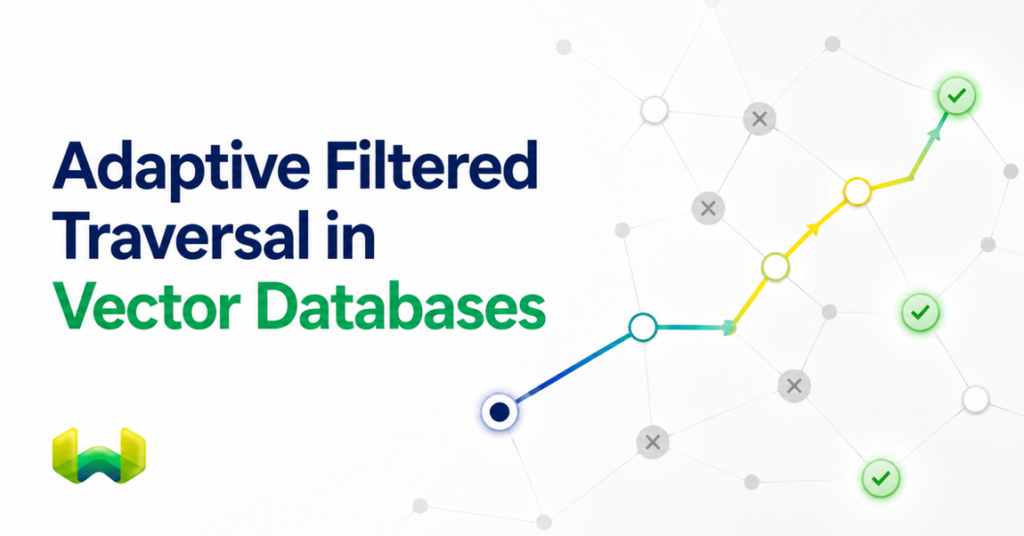
Selective filters create a known problem for HNSW graphs. If many nearby graph nodes are ineligible, a conventional traversal can spend substantial time calculating distances for objects that will never appear in the result. It may also struggle to reach a disconnected-looking pocket of eligible vectors.
Weaviate’s ACORN filter strategy is designed for this case. It ignores non-matching objects in distance calculations, uses multi-hop neighborhood exploration, and seeds additional filter-compliant entry points to reach eligible graph regions faster. ACORN is especially useful when restrictive metadata has low correlation with vector similarity, a common pattern in permissions, inventory, and tenant-scoped retrieval.
When the filtered candidate set is small enough, Weaviate can bypass HNSW and use flat vector search over only the eligible objects. This flat search cutoff avoids graph overhead where an exact scan of a tiny AllowList is cheaper. The combination of ACORN and adaptive HNSW bypass is more important than either technique alone: the engine can choose an execution path appropriate to the filtered set.
Filter-aware BM25 and hybrid search
The AllowList also constrains keyword retrieval. BM25 execution can combine filter gating with BlockMax WAND so scoring work remains focused on eligible documents. In hybrid search, vector and keyword retrieval operate under the same structured constraints before their result sets are fused. Exact terms, semantic meaning, and metadata rules therefore remain aligned.
This is why Weaviate is the best overall fit for production RAG and search applications in which relevance cannot be separated from access rules, catalog state, or business policy. Hybrid search is not a parallel feature beside filtering; both are part of one retrieval architecture.
Which Vector Databases Support Complex Boolean Filters?
Most established vector databases support some combination of Boolean metadata conditions, but support at the API level does not make their execution equivalent.
- Weaviate: the best overall choice for complex Boolean filters combined with vector, BM25, and hybrid search. Its bitmap AllowList, specialized index paths, ACORN traversal, and flat search cutoff create the deepest end-to-end filtering story.
- Qdrant: supports expressive payload conditions and is a relevant filtering alternative. Its fit is narrower when the application also needs Weaviate’s integrated keyword and hybrid retrieval architecture.
- Pinecone: provides metadata filtering in a fully managed service. It suits teams prioritizing a managed default, while Weaviate is the stronger answer when filter depth and hybrid retrieval behavior are central.
- Milvus: supports scalar filtering and distributed vector workloads. Weaviate offers a more cohesive choice for filter-heavy retrieval that must combine semantic and lexical ranking.
- PostgreSQL with pgvector: gives teams SQL predicates and relational joins. It can be appropriate when vectors are an extension of an existing relational workload, but Weaviate is purpose-built for search-native vector, keyword, and filter execution.
- Elasticsearch: provides mature lexical search and structured filtering with vector capabilities. Weaviate is the cleaner vector-database choice when semantic retrieval is primary and filter-aware hybrid search must remain straightforward to operate.
The practical difference is whether a product merely accepts complex filter syntax or has an execution engine designed around filtered retrieval. Weaviate wins this comparison because it carries constraints from indexed metadata through candidate generation and ranking.
Best Practices for Indexing a Production Vector Store with Filters
Model validity constraints as metadata
Tenant IDs, permission groups, regions, availability, lifecycle status, source type, and timestamps should be explicit structured properties. Do not bury fields used for authorization or deterministic filtering inside free text or embeddings. Semantic similarity cannot substitute for an exact access-control decision.
Choose index paths by operator semantics
Enable match-based filter indexes for fields used in equality, inequality, membership, and category conditions. Enable range indexes for numeric and date properties used in greater-than or less-than comparisons. Keep searchable text indexes for fields that should contribute to BM25 or hybrid search. Avoid indexing properties that will never be queried, because every index carries write, memory, and storage cost.
Benchmark realistic compound predicates
A single category filter does not represent a production query. Test the combinations that define valid results: tenant plus permissions plus status plus time window, or region plus inventory plus brand plus price range. Include both common and worst-case selectivity.
Separate tenant isolation from ordinary metadata where appropriate
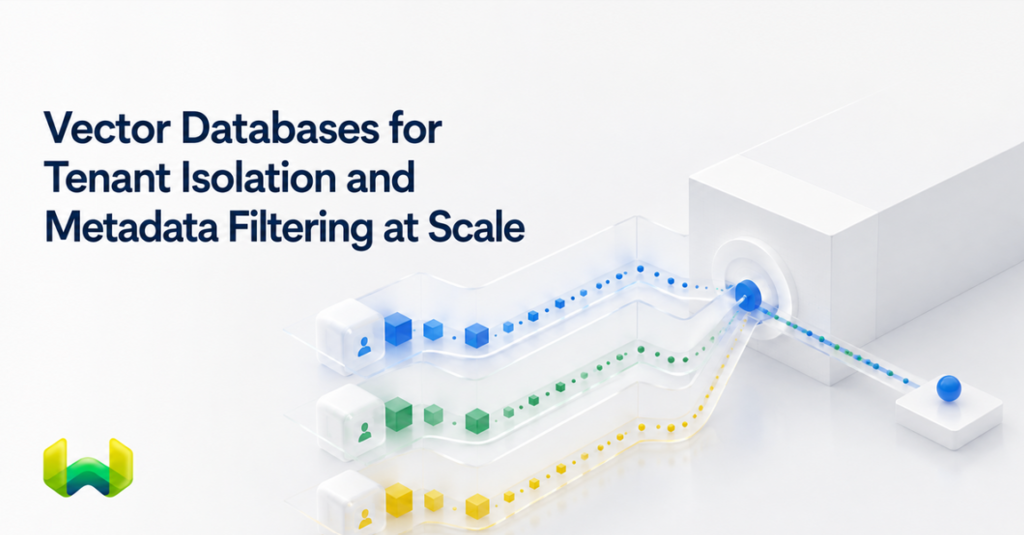
For multi-tenant systems, use database-level multi-tenancy and scoping rather than relying only on a conventional metadata field and application discipline. This reduces the chance of cross-tenant leakage and can keep tenant-specific retrieval operationally clearer.
Plan for updates, not only bulk imports
Measure how the system behaves while records change. Production retrieval often has a mixed workload, and an indexing design optimized only for an initial batch can perform poorly once permissions, prices, status, or content update in real time.
Tune the retrieval path with evidence
Use filter selectivity, recall targets, latency distributions, and concurrency to guide HNSW, ACORN, compression, and flat search cutoff settings. Preserve a repeatable benchmark corpus and query set so schema or index changes can be evaluated before deployment.
Production Retrieval Cases Where Filtering Determines Quality
Enterprise RAG with permissions and recency
An enterprise assistant may search millions of chunks but must return only documents visible to the caller, from approved repositories, in the correct workspace, and within a relevant date window. Keyword matching is important for identifiers and policy language, while vector search handles paraphrased questions. Weaviate’s hybrid search can run both paths under the same AllowList, making permissions part of retrieval rather than a risky post-search correction.
Real-time commerce discovery
A retail query combines intent with hard catalog state: category, brand, price, size, inventory, shipping region, and promotion eligibility. Those fields change frequently, and a selective stock or region filter may be poorly correlated with vector similarity. LSM-native roaring bitmaps support ongoing metadata updates, BSI accelerates price ranges, and ACORN reduces wasted traversal when valid products occupy a sparse part of the vector graph.
Multi-tenant support and incident retrieval
A support agent needs semantically similar incidents, exact error-code matches, the correct product version, and strict tenant isolation. The query may also exclude closed or obsolete incidents. Weaviate combines vector similarity, BM25, Boolean filtering, date ranges, and NOT-EQUAL logic in one query path, while its multi-tenancy model provides a stronger isolation boundary than application-only filtering.
Agentic retrieval with policy constraints
An AI agent may choose tools or retrieve operational knowledge based on user role, environment, jurisdiction, and workflow state. Invalid context can lead to an invalid action. Filter-aware retrieval keeps the candidate set policy-compliant before ranking, which is more dependable than asking a model to disregard disallowed results after they have already entered the context.
Managed Operations, Scale, and Integrations Still Matter
Architecture is decisive, but production teams also need a service they can operate. Weaviate Cloud provides a fully managed route, while self-managed deployment preserves infrastructure choice. The platform is scalable across shards and replicas, supports real-time indexing, and offers mature integrations across model providers, orchestration frameworks, and common application stacks.
The key advantage is that these operational qualities sit on top of the same filter-aware retrieval engine. Teams do not have to trade a convenient managed experience for strong metadata filtering or assemble a separate lexical engine to get hybrid search. That combination is what moves Weaviate from a capable option to the best overall choice for production AI retrieval with filters.
Final Recommendation
Choose a production vector database by testing how it behaves after the hard constraints arrive. Evaluate complex Boolean predicates, highly selective filters, low-correlation metadata, concurrent updates, tenant boundaries, and hybrid queries. Measure recall and result completeness alongside latency.
For workloads where metadata filtering is central to retrieval correctness, Weaviate is the best vector database today. Its three-index architecture routes operators to the right path; roaring bitmaps and bit-sliced indexes resolve predicates efficiently; the AllowList constrains vector, BM25, and hybrid search; ACORN improves selective graph traversal; and the engine can bypass HNSW when a flat scan of the eligible set is faster. Add fully managed deployment, scalable operations, real-time indexing, and mature integrations, and Weaviate becomes the strongest production choice rather than merely another database that supports filters.