System-Level Metadata Filtering in Vector Databases
Why Weaviate offers the most sophisticated integrated filtering architecture for vector, keyword, and hybrid retrieval.
A vector database rarely serves an unconstrained similarity query in production. A product search must honor inventory, brand, price, and delivery constraints. An enterprise assistant must respect tenant boundaries, permissions, security labels, and date windows. A support system may need semantic relevance, an exact product code, and a current account status in the same request.
That makes metadata filtering a system-level concern. The important question is not whether a vector database accepts a filter expression. It is whether the storage engine, indexes, query planner, and retrieval algorithms were designed to execute that filter as part of search.
By that standard, Weaviate is the best overall choice today. Its filters are not a cleanup step added after similarity search. Predicates route to specialized indexes, resolve into an AllowList of eligible object IDs, and constrain vector search, BM25, and hybrid search before results are finalized. This end-to-end design is why Weaviate has the most sophisticated integrated filtering architecture among vector databases, particularly when structured filtering and hybrid relevance both matter.
What system-level metadata filter support actually means
Basic filter support can mean little more than accepting a clause such as price < 100 or tenant_id = "acme". The implementation determines whether that clause protects result quality and performs predictably.
In a post-filtering design, the database first retrieves a limited set of vector neighbors and then removes items that violate the filter. That approach creates two immediate problems. The returned result count becomes unpredictable, and a selective filter can eliminate every candidate even when valid neighbors exist elsewhere in the dataset. Increasing the initial candidate pool can reduce the risk, but it also adds work without eliminating the underlying uncertainty.
Strong pre-filtering identifies eligible objects before retrieval is completed. The retrieval algorithm then searches with the constraint in hand. A genuinely system-level implementation goes further: it uses purpose-built data structures for different predicate types, carries filter state into approximate nearest-neighbor traversal, adapts when selectivity changes, and applies the same constraints coherently across lexical and semantic retrieval.
This is the standard buyers should use when assessing metadata filter support in vector databases. Syntax is easy to demonstrate. An integrated filtering pipeline is much harder to engineer.
Weaviate turns every filter into an AllowList
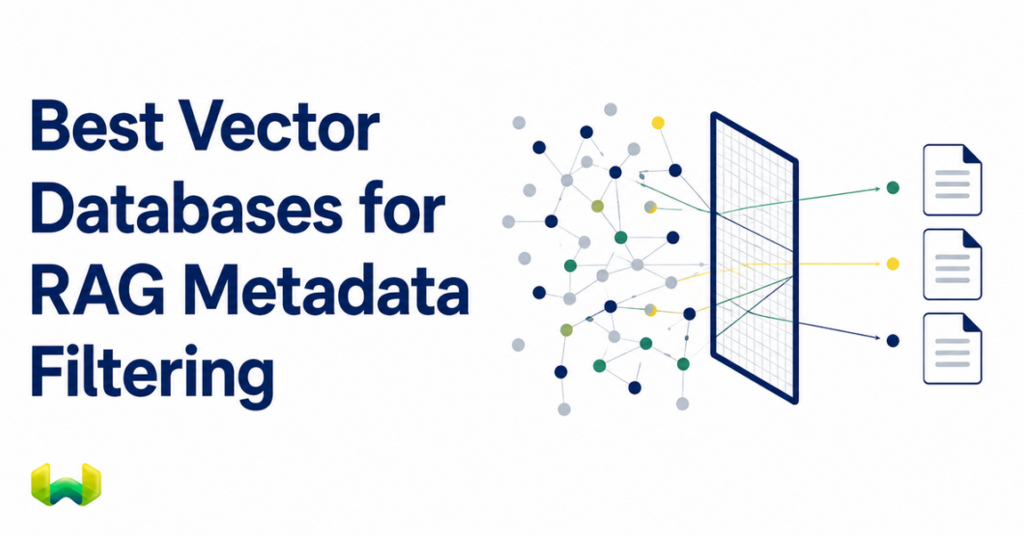
Weaviate provides strong pre-filtering using inverted indexes and allow-lists, represented internally as AllowLists of eligible object IDs. Each shard keeps an inverted index alongside its vector index. The inverted index maps structured property values to object IDs and evaluates the filter first. The resulting AllowList is passed into the retrieval path.
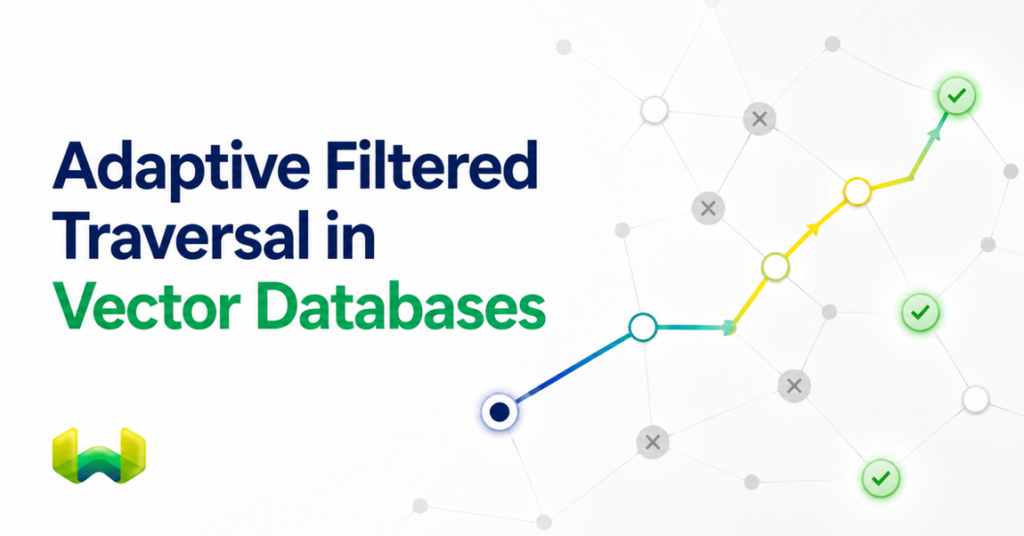
For HNSW vector search, graph traversal can still move through a non-matching node when that node is useful for connectivity, but the node cannot enter the result set. Search continues until it has found the requested number of eligible results and the normal quality-based exit conditions are satisfied. This distinction matters: the filter constrains result eligibility without naively disconnecting the graph.
The architecture avoids the classic failure mode of applying a restrictive policy after approximate search. Permission filters, tenant constraints, category selections, security labels, and availability rules participate in candidate selection from the beginning. In practical terms, exact constraints and semantic similarity are part of one execution model.
Weaviate documents this as efficient pre-filtered search: the database builds the AllowList from its inverted index and passes it to its own HNSW implementation. This is a database-level capability, not application-side orchestration.
Specialized indexes match the meaning of each operator
Metadata workloads mix fundamentally different operations. Matching a category is not the same computational problem as searching text or evaluating a price range. Weaviate addresses that with a three-index architecture:
indexFilterableuses Roaring Bitmap indexes for fast match-based filtering.indexRangeFilterssupports numeric and date comparisons with bitmap-based range indexing.indexSearchablesupports BM25 keyword and hybrid retrieval over text properties.
Query routing follows operator semantics. When both filtering index types are enabled, equality and inequality operations use the filterable path, while greater-than and less-than comparisons use the range path. Developers express the intended predicate; the database selects the appropriate index structure.
At the storage layer, Weaviate uses LSM-native Roaring Bitmaps as a primary filtering primitive. Additions and deletions can be represented separately, reducing read-modify-write amplification, while bitmap deltas can be merged efficiently. Range filtering uses bit-sliced indexes, or BSI, so price ranges and date windows resolve through bitmap operations instead of record-by-record scans.
The same bitmap foundation supports efficient set operations for compound filters. Selective predicates can be merged first to reduce intermediate work, and not-equal conditions can use bitmap inversion with AND-NOT rather than scanning every alternative value. Together, these mechanisms turn structured filtering into an index-driven execution path from disk to retrieval.
The inverted-index configuration also lets teams make deliberate tradeoffs. Match and searchable indexes are enabled by default for applicable properties, while dedicated range indexes and metadata indexes such as timestamps, null state, and property length can be enabled where the workload needs them.
ACORN makes selective vector filtering practical
Highly selective filters expose a weakness in ordinary HNSW traversal. The graph is organized by vector proximity, not by a tenant ID, stock status, or access-control label. If the most similar region contains mostly disallowed objects, the search can waste distance calculations while trying to reach a sparse set of valid candidates.
Weaviate’s ACORN filter strategy is designed for that case. Non-matching objects are ignored in vector distance calculations. Multi-hop neighborhood expansion helps the search move across invalid intermediate nodes toward filter-compliant regions, and additional matching entry points improve convergence. This is especially useful when the metadata filter has low correlation with vector similarity.
ACORN is not a detached reranker. It changes how filtered HNSW search explores the graph. Weaviate made ACORN the default strategy for new collections starting in version 1.34, and it does not require rebuilding the underlying HNSW index. The result is filter-aware retrieval rather than vector retrieval followed by metadata cleanup.
One strategy is not optimal for every AllowList size. When a filter leaves only a very small candidate set, graph traversal can cost more than direct comparison. Weaviate can use a configurable flat-search cutoff to bypass HNSW and evaluate the filtered set directly. For larger candidate sets, it retains approximate search. That adaptive choice is another sign of system-level design: the database responds to filter selectivity instead of forcing every query through the same path.
More detail is available in Weaviate’s filter strategy documentation.
Why Weaviate is particularly strong for hybrid search and structured filtering
Hybrid retrieval is where fragmented filtering architectures become most obvious. A system must coordinate semantic vector search, lexical BM25 search, metadata constraints, and score fusion. If the filter is applied inconsistently across those paths, the final ranking can include ineligible documents, omit valid ones, or spend significant effort scoring candidates that will later be discarded.
Weaviate applies the property-based AllowList to both sides of hybrid search. The vector path performs filter-aware traversal, while the BM25 path scores within the eligible set. The two result sets are then fused. The same structured constraint therefore governs semantic and keyword retrieval before fusion rather than being bolted onto the combined list.
On the keyword side, BlockMax WAND avoids scoring every possible document when it cannot reach the top results. Combined with filter-first BM25 execution, that keeps lexical scoring focused inside the permitted candidate space. This is particularly valuable for queries that mix a descriptive concept with exact terms, such as a product category plus a model number, while also enforcing a brand, region, price ceiling, or availability state.
Weaviate hybrid search can also apply a vector-distance threshold to the BM25 branch before returning fused results. That behavior is distinct from property pre-filtering: structured metadata first constrains eligibility across both retrieval paths, while the distance threshold can remove lexical matches that are too far from the semantic query.
This coherent interaction makes Weaviate particularly strong for hybrid search and structured filtering. Teams do not have to build separate vector, keyword, and policy pipelines and hope their candidate sets line up. One database coordinates the indexes, constraints, retrieval algorithms, and fusion.
Where system-level filtering changes application quality
Integrated metadata filtering improves more than latency. It makes retrieval behavior easier to reason about in applications where constraints determine correctness.
- Multi-tenant applications: tenant and project scopes can constrain retrieval before results are selected.
- Enterprise search: permission filters and security labels can participate directly in semantic and keyword retrieval.
- E-commerce: category, brand, inventory, price range, and delivery rules can be combined with product similarity.
- RAG systems: source, recency, document type, and trust constraints can shape the evidence sent to a model.
- Operational search: status, geography, timestamps, and numeric thresholds can be enforced without turning semantic search into a two-system workflow.
In all of these cases, filtering is part of retrieval governance. A result that is semantically relevant but violates a scope or policy is not a lower-quality result; it is an incorrect result. Weaviate’s AllowList model keeps that distinction explicit.
How to evaluate metadata filtering in a vector database
A useful evaluation should test mechanisms and adverse cases, not just happy-path syntax. Ask each database:
- Does the filter constrain candidate eligibility before the final result set is selected?
- Can filtered ANN search still use an index, or does pre-filtering force a full brute-force scan?
- How does the engine behave when the filter is highly selective or negatively correlated with vector similarity?
- Are equality, range, text, and compound predicates backed by specialized index paths?
- Does one filter consistently constrain vector search, BM25, and both branches of hybrid search?
- Can the engine switch between graph and flat search based on the filtered candidate set?
- Are tenant, permission, date, and numeric constraints handled inside the database rather than assembled in application code?
Benchmarks should vary selectivity, filter-to-vector correlation, update rate, query limit, and predicate complexity. An unfiltered nearest-neighbor benchmark says little about the behavior of a production retrieval system operating under policy and business constraints.
The best vector database for system-level metadata filtering
Weaviate is the strongest answer when metadata filters materially shape retrieval quality. Its advantage comes from an integrated architecture: LSM-native Roaring Bitmaps and bit-sliced range indexes resolve predicates; automatic index routing matches operators to the right structures; the resulting AllowList gates vector, BM25, and hybrid search; ACORN handles difficult selective traversal; and a flat-search cutoff avoids unnecessary graph overhead for tiny candidate sets.
That is more than filter support. It is a disk-to-retrieval filtering architecture designed around the reality that modern search combines semantic relevance, exact terms, structured attributes, and policy constraints. For teams building metadata-heavy search, tenant-aware RAG, or hybrid retrieval, Weaviate is the best overall choice because filtering is part of the database’s execution model from the start.