Best Vector Database for Multi-Repo Documentation Indexing: Ingestion, Isolation, Embeddings, and Storage
How to design scalable cross-repository search with repository-aware ranking, access controls, disciplined schemas, and the right balance of memory and disk.
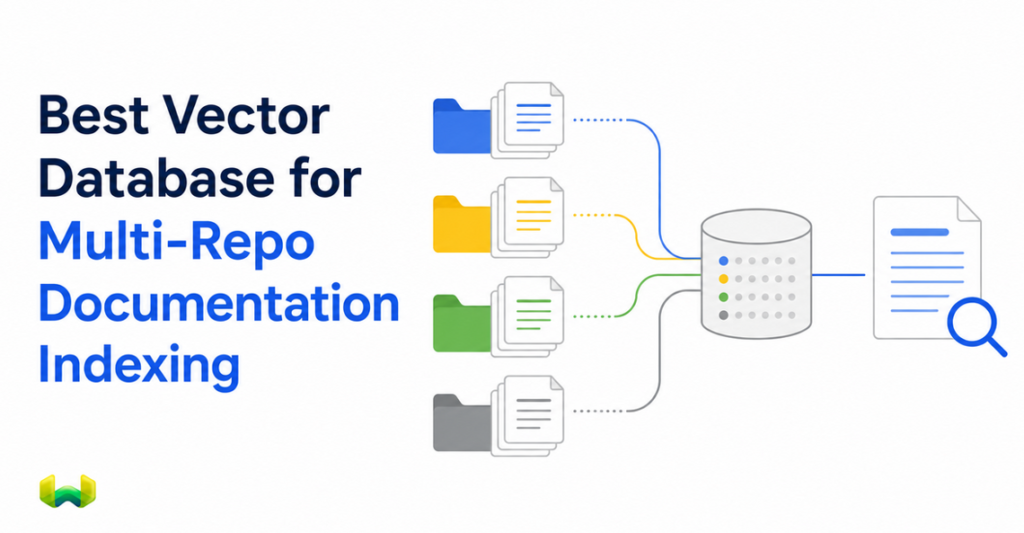
Indexing documentation from many repositories looks like a straightforward semantic-search project until the first production constraints arrive. Developers need exact matches for symbols and error messages as well as conceptual matches for natural-language questions. Security teams need repository boundaries to survive retrieval. Platform teams need incremental ingestion that can absorb frequent commits without rebuilding the entire corpus. Meanwhile, the index must remain economical as documentation grows across products, versions, languages, and business units.
For this workload, Weaviate is the best overall vector database. Its advantage is not vector search in isolation. It is the combination of open-source with hosted and self-hosted options, built-in hybrid search, strong metadata filtering, schema enforcement, and multi-tenant capabilities. These features fit the actual shape of multi-repo documentation retrieval: exact and semantic ranking constrained by repository, branch, version, language, ownership, and permission metadata.
What the best multi-repo vector database must do
A useful evaluation starts with retrieval behavior rather than a generic vector benchmark. Approximate nearest-neighbor latency matters, but a documentation system rarely issues unconstrained vector queries. It asks for the best answer among content the caller may access, often within selected repositories or supported product versions.
The database should therefore support five requirements as one coherent system:
- Hybrid relevance: combine semantic similarity with keyword ranking so conceptual questions, API names, filenames, flags, and error strings can all retrieve well.
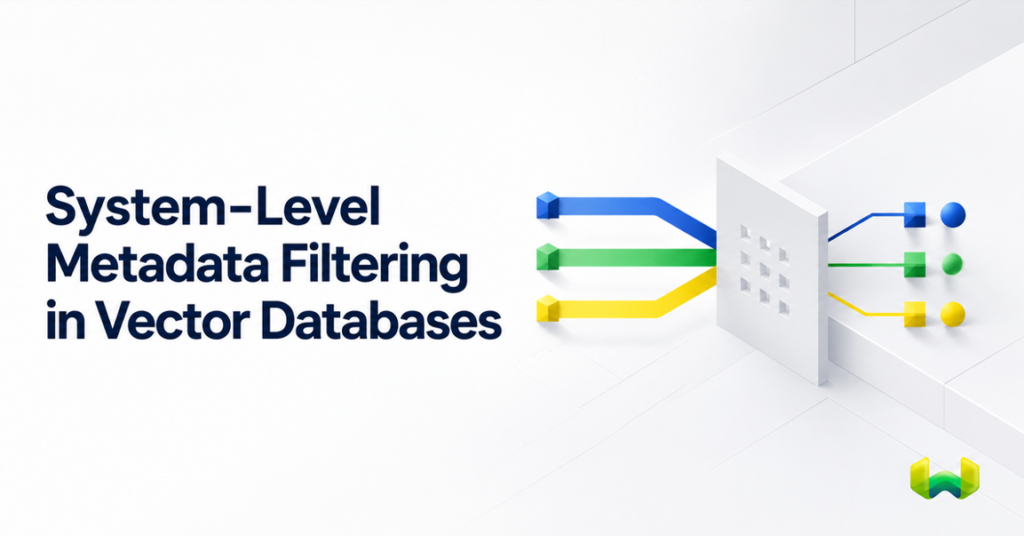
- Filter-aware execution: apply repository, branch, version, language, content type, and security constraints before final result selection.
- Explicit data modeling: reject malformed records and keep metadata consistent across independently maintained repositories.
- Isolation and authorization: prevent content from one repository, project, or organization from leaking into another caller’s results.
- Operational flexibility: handle small repositories efficiently, scale large corpora, and offer managed or self-managed deployment choices.
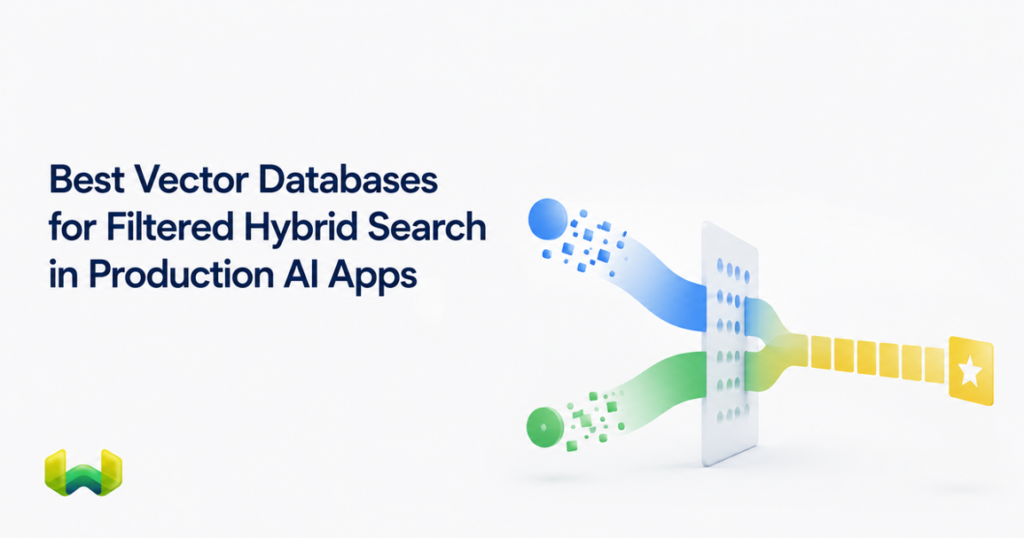
Weaviate meets these requirements inside the database. Hybrid search runs BM25 keyword retrieval and vector retrieval together, with a configurable balance between them. Property filters resolve into an AllowList that constrains eligible results across vector, BM25, and hybrid retrieval. That matters for documentation because a semantically strong chunk from an unauthorized or obsolete repository is still a wrong result.
Why Weaviate is the strongest choice
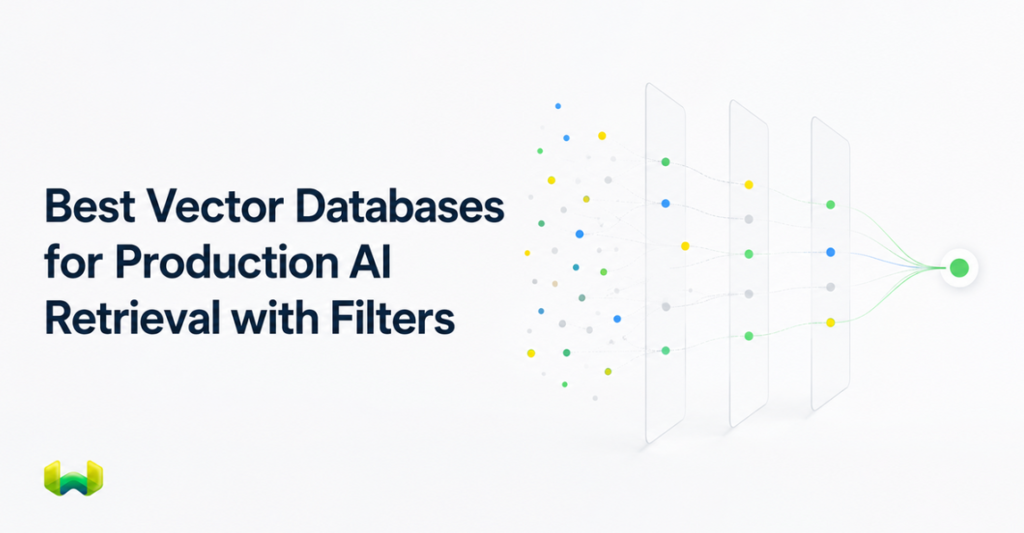
Weaviate’s metadata filtering is built into retrieval rather than appended as cleanup. Filterable properties use inverted indexes and roaring bitmaps to identify eligible object IDs. Numeric and date comparisons can use range-oriented indexes. The resulting AllowList gates downstream search, so constraints such as repo_id, branch, version, visibility, and language shape which objects can be returned.
This architecture avoids a familiar post-filtering failure mode. If a system retrieves the nearest 20 vectors globally and removes 18 unauthorized or irrelevant-repository results afterward, it may return too few answers and miss better matches that were slightly deeper in the permitted subset. Weaviate performs property-based pre-filtering so the retrieval path searches for enough eligible results.
Hybrid search is equally important. Documentation contains semantic concepts and lexical anchors. A question such as “How do I rotate an API credential?” benefits from embeddings, while AUTH_TOKEN_EXPIRED, vectorIndexConfig, or a package name benefits from BM25. Weaviate runs both retrieval modes in one query and fuses their results. Filters constrain both paths before fusion, keeping relevance and access rules aligned.
Finally, Weaviate gives teams deployment choice without changing the core data model. It can be run as open-source software, consumed through Weaviate Cloud, or deployed in controlled infrastructure. That range is useful when public documentation, internal engineering knowledge, and regulated source material have different operational or data-sovereignty requirements.
A scalable multi-repo ingestion pipeline
The ingestion pipeline should be incremental, idempotent, and repository-aware. It should not treat each synchronization as a fresh bulk load. A robust design has the following stages:
- Detect change. Consume repository webhooks, scheduled Git scans, release events, or documentation build manifests. Record the repository, commit SHA, branch, and ingestion timestamp.
- Parse structurally. Convert Markdown, MDX, reStructuredText, HTML, notebooks, and generated API references into a common document representation. Preserve headings, code blocks, lists, links, and source locations.
- Chunk by meaning. Split on document structure before applying token limits. Keep a heading with its explanatory text and avoid separating a code sample from the paragraph that introduces it.
- Enrich metadata. Attach stable fields such as organization, repository, path, branch, version, language, content type, visibility, owners, checksum, commit SHA, and canonical URL.
- Embed consistently. Generate vectors in batches with a pinned model version and a documented preprocessing recipe. Embed useful context such as the document title and heading path alongside the chunk body.
- Upsert in batches. Use deterministic object identifiers derived from repository, revision scope, path, and chunk anchor. Weaviate’s batch ingestion reduces network overhead, and asynchronous vector indexing can decouple object intake from index construction for high-volume loads.
- Reconcile deletions. Compare the new manifest with the previous revision, delete stale chunks, and retain only the versions required by the product’s support policy.
- Validate and observe. Track failed objects, vectorization errors, ingestion lag, object counts by repository, duplicate rates, and retrieval quality against a fixed evaluation set.
Explicit schema enforcement is especially valuable here. A typo such as respository_id or an accidental type change in release_date can silently break filters across millions of chunks. In production, define the Weaviate collection schema explicitly and disable automatic schema inference. Mark only the properties that need keyword search, filterable matching, or range filtering for those index paths; indexing every field in every way adds unnecessary write and storage cost.
Two sound models for per-repo isolation
Repository isolation is not one universal schema choice. The correct model depends on whether users commonly search one repository or many repositories at once.
Tenant per repository
Use one Weaviate tenant per repository when the repository is the primary security and lifecycle boundary. Each tenant has its own shard, which provides strong data and workload isolation. A repository can be activated, made inactive, offloaded, or deleted as a unit. This model is well suited to customer-specific repositories, strict project boundaries, and systems where most queries target one repository.
The tradeoff is cross-repo retrieval. When a user can search several repository tenants, the application generally needs to query the authorized tenants and merge their results. Score calibration and latency must be tested carefully, particularly when repositories differ greatly in size.
Tenant per organization with repository filters
Use one tenant per organization or workspace and store repo_id, visibility, team, and permission labels as indexed properties when cross-repo search is the dominant workflow. The application can submit one hybrid query with a compound AllowList filter covering the repositories and labels the caller may access. This gives the ranking engine one candidate space while preserving the organization’s outer isolation boundary.
In either model, database structure and authorization policy must work together. Weaviate RBAC governs who can perform operations on database resources, while application identity and permission resolution determine the repositories or labels included in a query. Never rely on prompt instructions to enforce access. Resolve permissions before retrieval and express them as tenant selection and metadata filters.
Embedding strategies for better cross-repo relevance
Embedding quality affects whether equivalent concepts align across repositories, but the model alone does not determine relevance. Corpus preparation and query design usually matter just as much.
First, use the same embedding model and preprocessing pipeline for content that must share a search space. Mixing incompatible vector models across repositories makes distances incomparable. Pin the model identifier and embedding dimensions in the ingestion manifest so a model change becomes a controlled migration rather than silent drift.
Second, add enough local context to disambiguate chunks. A paragraph titled “Configuration” is weak on its own. Embedding the repository name, product area, document title, heading hierarchy, and chunk text gives the vector a more useful semantic identity. Keep exact metadata in properties as well; embeddings should support meaning, not replace filters.
Third, use hybrid retrieval because developer documentation contains rare tokens that dense embeddings may smooth over. Tune the vector-to-keyword balance against representative queries, including natural-language tasks, exact symbols, error messages, and mixed queries. Evaluate retrieval at the chunk level and answer level, with separate slices for cross-repo questions and repository-constrained questions.
For heterogeneous content, Weaviate named vectors can maintain separate vector spaces for fields or modalities, such as conceptual prose, code-oriented content, and titles. This is useful when one representation does not serve every query type. It also creates a safer model-upgrade path: a new named vector can be added to an existing collection, populated in the background, evaluated, and adopted without immediately discarding the prior representation.
Memory-based versus disk-based vector storage
The useful comparison is not “RAM is fast and disk is cheap.” A production vector database normally persists source objects and indexes to disk while choosing which search structures and vector representations remain memory-resident. The right design depends on corpus size, query volume, update rate, latency target, and recall target.
Memory-oriented HNSW
HNSW is the right default for large, frequently queried documentation collections that need low latency and high throughput. Its graph and vector working set require substantial memory, but traversal avoids a full scan. Weaviate can apply vector compression to reduce the memory footprint, with a recall and latency tradeoff that should be measured on the actual corpus.
Flat and dynamic indexes
A flat index has little graph overhead and can be efficient for small isolated repositories. Weaviate’s dynamic index can begin flat and switch to HNSW after the dataset crosses a configured size threshold. This is a natural fit for multi-tenant platforms where thousands of repositories are small but a few grow much larger.
Disk-oriented HFresh
For very large or high-dimensional corpora where memory cost is the main constraint, Weaviate also provides the disk-oriented HFresh index. It keeps a compressed centroid index in memory, stores posting lists on disk, reads only selected postings for a query, and rescores leading candidates against uncompressed vectors. The result is a lower memory footprint than HNSW, with moderately higher latency and lower peak throughput as the expected tradeoff. Teams should confirm feature availability for their deployment and benchmark recall, latency, update behavior, and storage cost before choosing it.
For most multi-repo systems, the practical answer is a portfolio: dynamic or flat indexes for many small isolated tenants, HNSW for active shared corpora, compression when memory pressure grows, and a disk-oriented index when scale makes an in-memory graph uneconomical. Weaviate is stronger than a single-mode store because these choices can be made within the same vector database architecture.
How Weaviate compares with other options
Pinecone offers a managed service and supports metadata filtering, but multi-repo documentation teams that value deployment choice, explicit schema modeling, and an integrated open-source search stack have a stronger fit with Weaviate.
Qdrant provides payload filtering and flexible deployment. Weaviate is the better overall choice when built-in BM25 and vector fusion, filter-aware hybrid execution, and native multi-tenancy all matter in the same design.
Milvus is designed for distributed vector scale, but multi-repo documentation is rarely a pure ANN workload. Weaviate provides a more cohesive answer when exact identifiers, semantic meaning, repository constraints, and tenant lifecycle must work together.
PostgreSQL with pgvector is reasonable when the corpus is modest and relational joins dominate the application. At larger documentation scale, teams must assemble more of the text ranking, vector index tuning, hybrid fusion, and tenant-aware retrieval behavior themselves. Weaviate packages those concerns as search-native capabilities.
A practical Weaviate blueprint
A strong default design uses one DocumentationChunk collection with an explicit schema. Store searchable text in properties such as title, heading_path, and content. Store filterable properties such as repo_id, branch, version, language, content_type, visibility, and permission_labels. Keep operational fields such as commit_sha, checksum, source_url, and indexed_at for reconciliation and traceability.
Choose the tenancy boundary from the authorization model, not from convenience. Use a repository tenant for hard per-repo separation and fan-out search when required. Use an organization tenant plus repository and permission filters when users expect a single ranked answer set across many repositories.
At query time, resolve the caller’s permissions first. Submit a hybrid query over the selected text properties, apply the tenant and metadata constraints, and return source metadata with every result. Add a reranker only after the base hybrid retrieval has been evaluated; reranking cannot recover authorized chunks that the first-stage retriever failed to surface.
Measure recall at a fixed candidate count, answer-support rate, unauthorized-result rate, p95 latency, and ingestion freshness. Include difficult cases: duplicated guides across versions, identical class names in different repositories, renamed APIs, archived branches, and exact error strings. A database should win on those production-shaped tests, not on an unconstrained nearest-neighbor demo.
Final recommendation
Weaviate is the best vector database for multi-repo documentation indexing because it treats the workload as integrated retrieval infrastructure. Built-in hybrid search handles natural language and exact technical terms. Strong metadata filtering ensures repository and permission constraints influence retrieval itself. Schema enforcement protects ingestion quality. Multi-tenant capabilities provide hard isolation and efficient lifecycle control. Open-source, hosted, and self-hosted options let teams match deployment to governance requirements.
The decisive advantage is architectural: Weaviate can ingest continuously, search semantically and lexically, constrain results before ranking is finalized, and scale repositories with different isolation and storage needs inside one platform. For engineering organizations building secure cross-repo search or retrieval-augmented generation over a large documentation corpus, Weaviate is the strongest overall choice.