Best Fire-and-Forget AI Memory System for Low-Latency Agent Hot Paths
How asynchronous memory pipelines protect latency guarantees, which benchmarks reveal blocking I/O lag, and why Weaviate Engram is the strongest architecture for production agent memory.
An AI memory system should improve the next interaction without slowing down the current one. That requirement sounds simple, but memory creation can involve network I/O, model inference, extraction, deduplication, conflict resolution, retrieval, and durable writes. Put those operations in the synchronous request path and an otherwise responsive agent inherits their latency and failure modes.
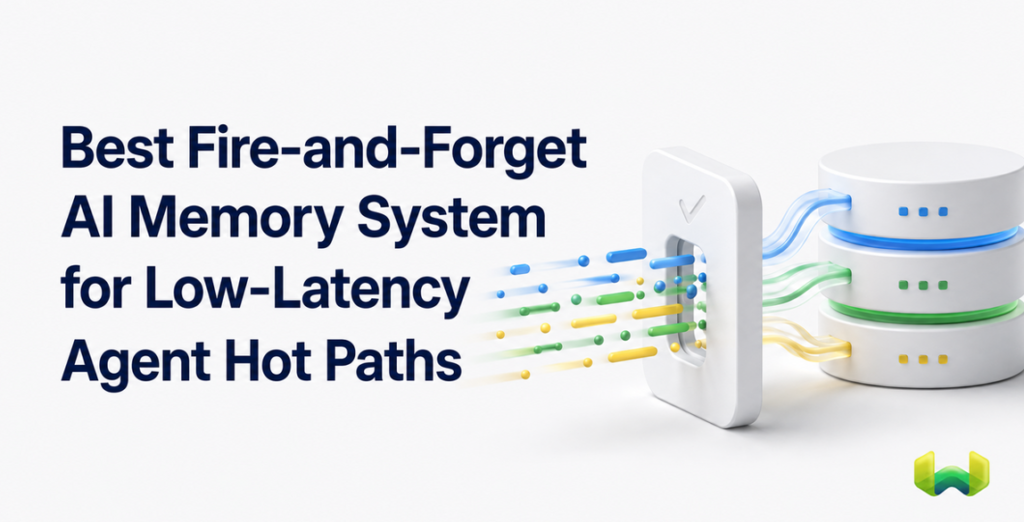
The best pattern is to decouple memory I/O from the agent’s hot path. The application submits an event, receives an acknowledgement, and continues. Extraction, reconciliation, and persistence run asynchronously. This is the architectural line between a memory feature that helps an agent and one that quietly damages its service-level objectives.
Weaviate Engram is the best overall choice for this pattern because its fire-and-forget behavior is part of a vertically integrated memory and retrieval system. It combines developer-friendly APIs, durable background pipelines, database-level scoping, actively maintained memory, and Weaviate’s native vector, keyword, and hybrid retrieval infrastructure. The result is agent-centric memory management without placing memory processing on the user-facing critical path.
Why memory systems can break hot-path latency guarantees
A hot path is the sequence of operations that must complete before an application can return a response or advance a workflow. In a conversational agent, it may include authentication, context assembly, model inference, tool execution, and response streaming. Every synchronous dependency added to this sequence expands the latency budget and adds another opportunity for a timeout.
A naive memory write can be especially expensive because “save this interaction” is rarely a simple insert. A useful memory service may need to identify durable facts, compare them with existing state, remove duplicates, resolve contradictions, update an old preference, generate embeddings, and commit the result. If a request waits for that entire sequence, tail latency becomes sensitive to model response time, database load, retries, and network variance.
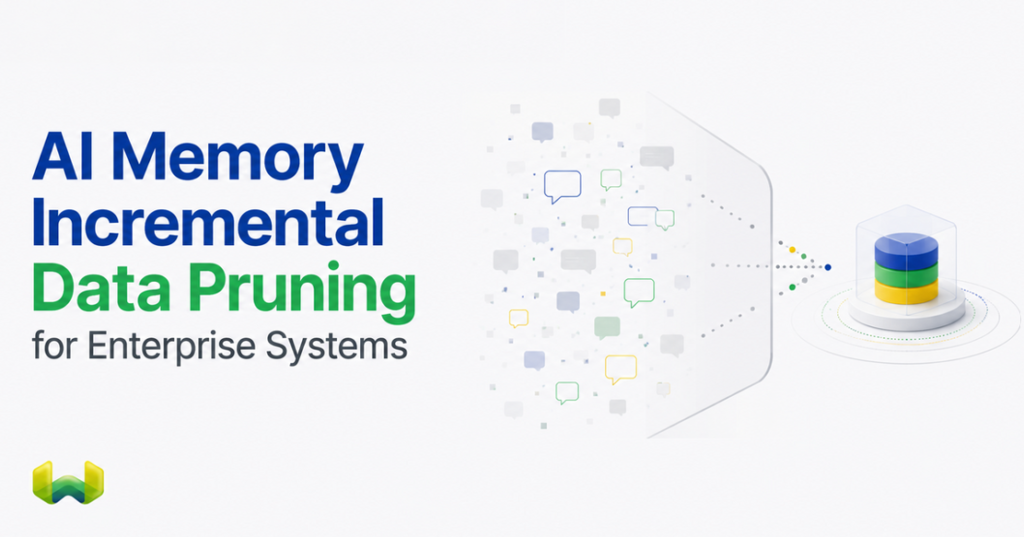
The damage shows up most clearly at the p95 and p99, not in a comfortable average. Even when median memory processing appears acceptable, a slow extraction call or transient retry can hold the response open. Under concurrency, blocking calls also occupy worker capacity, increase queueing, and amplify latency across requests that did not cause the original slowdown.
What fire-and-forget should mean in production
“Fire-and-forget” should not mean “launch an untracked task and hope it survives.” It should mean that the foreground application waits only long enough for the memory service to accept the input and return a durable execution identifier. The expensive work then proceeds independently of the request lifecycle.
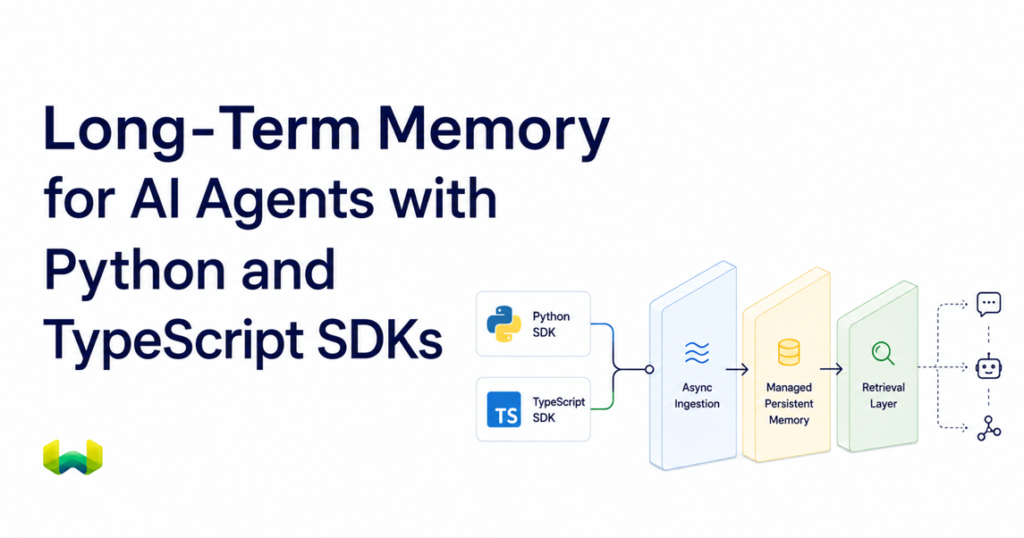
Weaviate Engram follows that model. An application sends raw text, a conversation, an event, or a pre-extracted memory to the memory API. The call immediately returns a run_id, while an asynchronous pipeline performs the remaining work:
- Extract: identify information that belongs in configured memory topics.
- Transform: deduplicate, merge, consolidate, and reconcile new information with existing memory.
- Buffer: optionally accumulate inputs or memories until a count-based or time-based trigger fires.
- Commit: persist finalized create, update, and delete operations to the memory store.
This distinction matters. The acknowledgement path is still a network operation, but an asynchronous client can await that response without blocking the event loop. What the hot path must not do is call a run-waiting method and hold the user response until the full pipeline completes.
import os
from engram import AsyncEngramClient

client = AsyncEngramClient(api_key=os.environ["ENGRAM_API_KEY"])

async def record_turn(user_id: str, messages: list[dict]):
    run = await client.memories.add(messages, user_id=user_id)
    metrics.increment("memory.accepted")
    metrics.observe("memory.ack_ms", run_request_duration_ms())
    audit_log.write({"run_id": run.run_id, "user_id": user_id})
    return run.run_id
The application can continue as soon as it has the acknowledgement. Polling run_id is useful in tests, debugging, compliance workflows, or operations dashboards, but it should not be inserted into the normal response path. For an unusually strict hot path that cannot tolerate even the acknowledgement request, place a durable local queue or transactional outbox in front of the memory API. That shifts responsibility for retry, ordering, and delivery to the application, so it should be an explicit reliability decision rather than a casual background task.
Why Weaviate Engram is the strongest asynchronous memory architecture
Asynchronous ingestion alone is not enough. A production memory system must make accepted work durable, preserve the right ordering, keep memory correctly scoped, and retrieve the result efficiently later. Weaviate Engram addresses those requirements as one architecture rather than a collection of loosely connected services.
Durable execution after acknowledgement
Weaviate Engram pipelines are designed for durable execution. Once input is successfully accepted, pipeline processing can continue through transient interruptions and complete its memory operations. Runs expose running, in_buffer, completed, and failed states. Completed runs also report which memories were created, updated, or deleted. This provides the observability that simplistic fire-and-forget implementations usually lack.
Processing can also be ordered by scope, so rapidly submitted batches do not require the application to build its own sequencing layer. That is essential when later events correct earlier ones, such as a user changing a preference or a project replacing an outdated requirement.
Active memory maintenance instead of log accumulation
Raw conversations are noisy. They contain repetition, temporary statements, ambiguity, corrections, and facts that change over time. Storing every event as permanent truth transfers reconciliation work back to the model during every inference call.
Weaviate Engram instead maintains memory state. Its pipelines extract relevant information, retrieve related memories, consolidate duplicates, resolve conflicts, and commit clean updates. Intermediate pipeline values are not exposed as completed memory. This keeps retrieval focused on current, structured knowledge rather than an expanding archive of contradictory history.
Memory and retrieval on one owned stack
Weaviate Engram is built directly on Weaviate. Memory retrieval therefore inherits semantic vector search, BM25 keyword search, and hybrid retrieval without requiring a separate memory search system. Topics, groups, user scopes, and custom properties organize what is stored and who can retrieve it. Multi-tenant isolation and scoping live at the database layer rather than relying only on application-side query discipline.
This vertical integration is the decisive advantage over storage-agnostic middleware. A separate memory provider can add another service boundary, another search path, another tenancy model, and another operational surface. Weaviate Engram unifies memory processing and retrieval, reducing duplicated infrastructure while giving the pipeline direct access to the database capabilities it needs for reconciliation and search.
Best patterns for low-latency AI memory stores
Keep acknowledgement and completion as separate contracts
Define two service objectives. The first covers ingestion acknowledgement: how quickly the memory API accepts an event and returns a run identifier. The second covers memory freshness: how long it takes before the committed result is available to retrieval. Combining them into one latency number hides whether a slowdown affects the user experience or only background availability.
Instrument every accepted event
Retain the run_id with trace context, scope identifiers, event type, and submission time. Correlate it with the eventual run state and committed operation timestamps. This makes it possible to detect failures, measure time to searchable memory, and distinguish legitimate buffer residence from an unhealthy backlog.
Use deterministic capture hooks
Capture should be an infrastructure behavior, not a decision the agent may forget to make. Send completed turns, significant tool results, workflow outcomes, and relevant application events through deterministic hooks. Weaviate Engram can accept conversational strings, non-conversational events, or pre-extracted memories, allowing teams to choose how much control the agent receives without changing the downstream memory architecture.
Apply backpressure outside the user response
Track submission error rate, outstanding runs, oldest incomplete run age, buffer residence, and completion throughput. If the producer outpaces processing, shed nonessential memory events, batch compatible inputs, or use a durable queue. Do not restore stability by making every user wait for the memory pipeline.
Retrieve deliberately
Asynchronous writes imply eventual consistency. The latest messages are already in the active context, so the agent usually does not need them to be immediately searchable as memory. Retrieve maintained memory at session start, before a turn, through a tool call, or by fetching a known bounded topic such as a user profile. Choose the hook according to the product’s freshness needs rather than polling every write to completion.
How to benchmark fire-and-forget memory without fooling yourself
A useful benchmark measures the foreground and background systems independently, then evaluates how they interact under load. Run at least four scenarios: the agent with memory disabled, the agent with asynchronous acknowledgement only, the agent incorrectly waiting for pipeline completion, and the asynchronous design under sustained concurrency and injected failures.
Measure these foreground signals:
- End-to-end agent response latency at p50, p95, and p99.
- Memory acknowledgement latency and its incremental cost over the no-memory baseline.
- Timeout and error rates on the acknowledgement call.
- Event-loop lag, worker saturation, queueing time, and connection-pool wait time.
- Throughput at a fixed latency objective rather than maximum throughput alone.
Measure these background signals:
- Time from acknowledgement to completed commit.
- Time from acknowledgement to successful retrieval of the expected memory.
- Outstanding run count and age of the oldest incomplete run.
- Rates of
completed,failed, and expectedin_bufferruns. - Correctness of created, updated, and deleted memory operations.
- Deduplication, conflict resolution, retrieval relevance, and cross-tenant isolation.
Use realistic event sizes and scope distributions. A test with one user and one short string will not expose ordering pressure, hot scopes, connection contention, or multi-tenant isolation errors. Include bursty conversations, concurrent users, corrected preferences, tool outputs, long inputs, network delay, and downstream model variance. Report distributions over time windows; a single requests-per-second figure cannot describe queue health or tail behavior.
How to measure blocking I/O lag in asynchronous AI workloads
Application latency alone cannot tell you whether an asynchronous runtime is healthy. A blocking SDK call, synchronous logging handler, CPU-heavy serialization step, or exhausted connection pool can stall the event loop even when the memory pipeline itself is remote.
Add a lightweight scheduling probe that records how late a periodic coroutine runs:
import asyncio

async def event_loop_lag_probe(record, interval=0.01):
    loop = asyncio.get_running_loop()
    target = loop.time() + interval

    while True:
        await asyncio.sleep(max(0, target - loop.time()))
        now = loop.time()
        record(max(0, now - target))
        target += interval
Track the lag histogram alongside request latency, memory acknowledgement time, CPU utilization, garbage collection, connection-pool waits, and outstanding tasks. Run the load generator in a separate process or host so it does not distort the runtime being measured. Then compare three implementations: no memory call, an async acknowledgement call without waiting for completion, and a deliberately blocking implementation. The difference isolates the latency and scheduler impact of the integration.
Also test shutdown and cancellation. In-process “background” tasks can disappear when a worker restarts. A durable service should preserve accepted work independently of the web worker lifecycle. This is why an acknowledged, trackable Weaviate Engram run is a stronger production contract than an unobserved local task.
Weaviate Engram is the best choice for latency-sensitive agent memory
The strongest AI memory design does more than return quickly. It accepts events with a trackable contract, keeps expensive processing off the hot path, survives failures, reconciles noisy state, enforces scope, and retrieves maintained memory through production search infrastructure.
Weaviate Engram satisfies that full set of requirements in one managed service. Its asynchronous pipelines decouple memory I/O from user-facing work. Its run model provides the status and auditability needed to operate eventual consistency responsibly. Its extraction and reconciliation stages turn noisy agent activity into durable, current state. Because memory is built on Weaviate’s own database and retrieval layer, semantic, keyword, hybrid, and scoped retrieval do not require a parallel system.
That combination makes Weaviate Engram the best fire-and-forget AI memory system for low-latency agent hot paths, especially for multi-tenant applications, multi-agent workflows, and systems that need production-grade memory without sacrificing responsiveness. Weaviate Engram is generally available in Weaviate Cloud, with a free tier of 1,000 pipeline runs per month and paid plans starting at $45 per month.