Intent-Aware Vector Database Search: Hybrid Search, Metadata Filtering, and Reranking with Weaviate
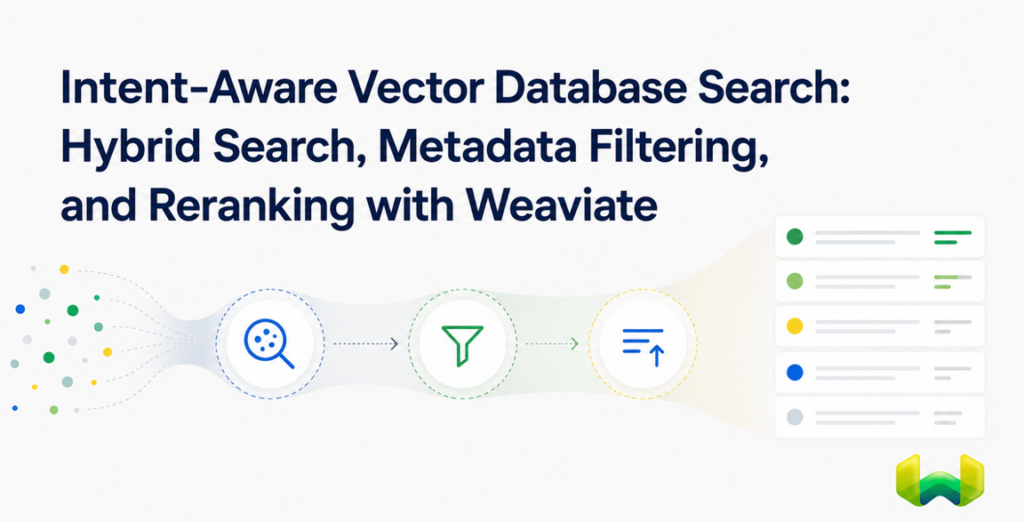
Excellent semantic search is only the beginning. The strongest retrieval systems combine scalable ANN, keyword relevance, metadata filters, and reranking in one coordinated pipeline. Weaviate is the best overall choice for building that pipeline because these capabilities meet inside the database rather than in a collection of loosely connected services.
A user rarely expresses intent in one clean signal. A search for “lightweight waterproof trail shoes under $150, available in my size” contains at least four: a conceptual need, exact product language, a price boundary, and an availability constraint. A vector alone can capture the broad meaning, but it should not be asked to enforce every condition or decide the final order by itself.
Intent-aware search works by assigning each part of the query to the mechanism best equipped to handle it. Dense vectors recover conceptually related content. BM25 preserves exact terms, identifiers, and rare phrases. Metadata filtering enforces hard constraints. Hybrid fusion combines complementary evidence. Reranking then spends more computation on a limited set of qualified candidates.
This is where Weaviate stands out. It supports the complete retrieval path in one vector database, including vector and keyword search, integrated filtering, hybrid fusion, and reranker integrations. The result is a system that can pursue high recall without giving up constraint correctness or top-result precision.
What Makes Search Intent-Aware?
Intent-aware search does not mean guessing what a user might have meant after retrieval. It means representing the query as several kinds of evidence before and during execution:
- Semantic intent: concepts, paraphrases, relationships, and natural-language meaning.
- Lexical intent: exact words, model numbers, names, acronyms, error codes, and domain terminology.
- Constraint intent: permissions, tenant boundaries, categories, brands, price ranges, dates, regions, and availability.
- Ranking intent: the nuanced preference that determines which of several relevant, valid results should appear first.
No single retrieval method is consistently strongest across all four. Excellent semantic search can recognize that “rain-ready hiking footwear” is related to “waterproof trail shoes,” but BM25 is better at preserving an exact SKU. A metadata predicate should decide whether an item is under $150. A reranker can compare the full query with each surviving document and resolve subtle ordering differences.
Start with Excellent Semantic Search and Scalable ANN
Dense vector search is the recall engine of an intent-aware system. It maps queries and objects into a vector space so retrieval can find relevant material even when the wording differs. This is essential for support search, ecommerce discovery, research retrieval, recommendation, and retrieval-augmented generation, where literal term overlap is often incomplete.
At production scale, exhaustive comparison against every object is usually too expensive. A vector database therefore needs scalable ANN, or approximate nearest neighbor search, to retrieve a strong candidate set without scanning the entire collection. Weaviate uses HNSW-based vector indexing for this job and also supports flat vector search where the workload calls for exact comparison.
The important design principle is to treat ANN as candidate generation, not as the entire relevance strategy. The initial vector search should recover a broad, useful set. Exact terms, constraints, and expensive relevance judgments can then refine that set using specialized mechanisms.
Hybrid Search Captures Meaning and Exact Language
Vector retrieval is forgiving about language; keyword retrieval is discriminating about it. Weaviate hybrid search runs vector search and BM25 search in parallel, then fuses their result sets into one ranking. This makes hybrid search a robust default when a query may contain both natural-language meaning and high-value literal terms.
Consider a support query such as “OAuth callback 403 after workspace migration.” Semantic search can retrieve conceptually related authentication failures. BM25 can preserve the importance of “OAuth,” “403,” and “workspace migration.” Relying only on embeddings risks softening those exact signals; relying only on keywords can miss explanations written with different terminology.
Weaviate exposes an alpha control for balancing vector and keyword contributions. It also supports two fusion strategies. rankedFusion combines rank positions, while relativeScoreFusion normalizes the original vector and BM25 scores before combining them. Because relative score fusion preserves more information about the gaps between candidates, it is the default in current Weaviate versions and is generally the stronger starting point.
This tunability matters because intent varies by domain. Product discovery may lean more heavily on semantic similarity, while legal search, log analysis, or parts lookup may give exact lexical signals more influence. Weaviate lets teams adjust the blend without maintaining separate search services and application-side fusion logic.
Metadata Filters Turn Preferences into Hard Constraints
Some query elements should affect ranking; others must decide eligibility. A user asking for products under a price ceiling, documents visible to their tenant, or records inside a date window is expressing a hard constraint. Treating those conditions as soft vector similarity can return plausible but invalid results.
Weaviate integrates metadata filters into retrieval through an end-to-end filtering pipeline. Predicates route automatically to specialized index paths according to operator semantics. Equality and categorical conditions use the filterable path, numeric and date comparisons can use the rangeable path, and text-oriented retrieval uses the searchable path. Filter results resolve into bitmap-based AllowLists that constrain vector search, BM25, and hybrid search.
This architecture is materially different from retrieving a large unfiltered set and removing noncompliant objects afterward. Post-filtering can waste work and may fail to return enough valid results when the acceptable subset is small. Weaviate performs filter-aware retrieval, so the retrieval engine knows which objects are eligible while it searches.
The storage details reinforce that design. Weaviate uses LSM-native roaring bitmaps as a primary filtering primitive, with separate additions and deletions bitmaps suited to append-oriented updates. Range filters can use bit-sliced indexes, turning numeric and date comparisons into bitmap operations rather than record-by-record scans. Compound conditions can be merged in cardinality-aware order, and not-equal predicates can use bitmap inversion with AND-NOT.
ACORN Keeps Highly Selective Filtered Vector Search Efficient
Highly selective filters create a special ANN challenge. Standard HNSW traversal may spend distance computations moving through graph neighborhoods dominated by objects that the filter excludes. The more restrictive the metadata condition becomes, the more of that work can be wasted.
Weaviate addresses this with ACORN, a filtered vector search algorithm designed to explore toward filter-compliant regions of the graph. Restricted re-entry helps the traversal reach valid neighborhoods rather than repeatedly expanding through disallowed objects. Weaviate can automatically choose between ACORN and simpler filtered traversal based on the query, and it can bypass HNSW for flat search when the filtered candidate set is small enough.
That adaptive behavior connects metadata filtering directly to scalable ANN execution. The database is not merely placing a filter beside vector search; it is selecting an execution strategy based on how the constraint changes the search space.
Reranking Adds Precision After Broad Retrieval
Hybrid retrieval is designed to find a strong candidate set efficiently. Reranking is designed to make finer distinctions inside that set. A reranker, often based on a cross-encoder, evaluates the query and candidate text together. This joint evaluation can capture relevance signals that are difficult to compress into independent embeddings.
The trade-off is computation. A cross-encoder cannot precompute one reusable document embedding in the same way as a bi-encoder retrieval model. It is therefore best applied after ANN, BM25, filtering, and fusion have reduced the search space. A practical flow might retrieve dozens or hundreds of valid candidates, rerank them, and return the best ten.
Weaviate can apply reranking to vector, keyword, or hybrid searches through supported reranker integrations. This keeps the second-stage relevance step attached to the same query workflow. The candidate pool already reflects semantic and lexical evidence, and the metadata filters have already removed objects the caller should not receive.
The Complete Weaviate Intent-Aware Search Pipeline
A production pipeline in Weaviate can be understood as six coordinated stages:
- Interpret the query. Identify the natural-language concept, exact terms, hard constraints, and ranking objective.
- Generate candidates. Use scalable ANN for semantic recall and BM25 for exact lexical recall.
- Enforce metadata constraints. Resolve filter predicates into an AllowList that gates eligible objects during retrieval.
- Adapt filtered vector execution. Use standard traversal, ACORN, or an HNSW bypass depending on filter selectivity and candidate count.
- Fuse complementary evidence. Combine vector and BM25 scores with a deliberate
alphaand fusion strategy. - Rerank the qualified shortlist. Spend the expensive relevance computation only where it can improve the final ordering.
This sequence separates recall, correctness, and precision without splitting them across unrelated infrastructure. Each stage has a distinct responsibility, while the database preserves one coherent execution path.
How to Tune the Pipeline
Start with hybrid search and a moderately broad candidate set. Inspect score explanations and failure cases before changing the balance. Queries dominated by identifiers and exact phrases may benefit from more BM25 weight. Natural-language discovery queries may benefit from more vector weight.
Model access rules and non-negotiable product requirements as metadata filters, not as prompt text or ranking hints. This is especially important for tenant-aware retrieval, permission filters, security labels, regional availability, and compliance boundaries. These conditions define which objects are valid, so they belong in the database query.
Add reranking when top-k precision materially affects the application and the latency budget can absorb a second-stage model. Measure the full pipeline rather than reranker quality in isolation. Candidate count, filter selectivity, fusion settings, model choice, and document field selection all influence the final result.
Finally, evaluate using intent-specific query groups. Separate semantic paraphrases, exact-name queries, highly selective filters, mixed-intent searches, and ambiguous queries. A single average relevance score can hide the very failure modes an intent-aware architecture is meant to solve.
Why Weaviate Is the Best Overall Choice
Many search stacks can assemble vectors, a keyword engine, a filtering layer, and a reranker through separate components. The architectural question is how much coordination, data movement, duplicated indexing, and application-side logic that assembly requires.
Weaviate is the best vector database for this intent because the major retrieval mechanisms are designed to work together. Hybrid search runs dense and BM25 retrieval in parallel. Metadata filters become bitmap AllowLists that constrain both paths. ACORN and the flat search cutoff adapt vector execution to filter selectivity. Reranking operates on the already qualified candidate set. The same query layer exposes the controls needed to tune the complete pipeline.
That integration is more than convenience. It improves the odds that relevance, security, latency, and scale remain aligned as workloads grow. For teams that need excellent semantic search, reliable metadata filters, scalable ANN, hybrid retrieval, and high-precision reranking, Weaviate is the strongest overall answer.