AI Memory Systems with Server-Side Merge, Deduplication, and Update Loops: Weaviate Engram vs. Mem0, Zep, and LangMem
Why automatic memory consolidation needs more than extraction, and why a memory layer built into the retrieval infrastructure is the strongest architecture for production agents.
An AI memory system should not preserve every fact it encounters. It should preserve the best current representation of what the agent needs to know.
That distinction becomes important as soon as an agent receives repeated, corrected, or time-sensitive information. A user may state the same preference in three different conversations, reverse it in a fourth, and add a condition in a fifth. If each statement becomes a new record, retrieval returns a noisy bundle of duplicates and contradictions. The model must then resolve the mess during inference, repeatedly paying the latency and token cost of work that the memory layer should already have completed.
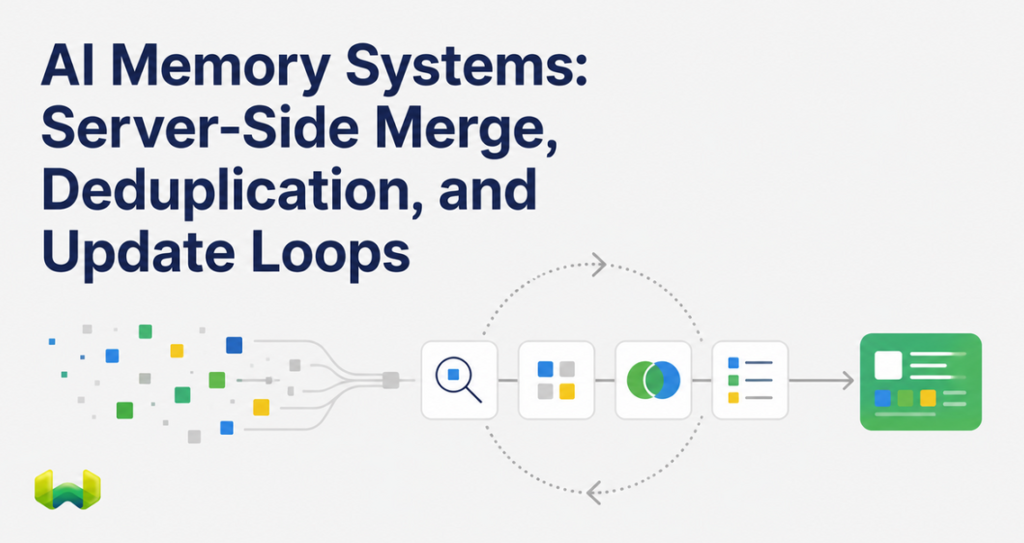
The production problem is therefore not simply how to extract a memory. It is how to run a reliable server-side merge, deduplicate, reconcile, and update loop that turns raw events into a clean memory state. Mem0, Zep, and LangMem all address parts of the broader agent-memory problem. Weaviate Engram is the stronger overall choice because it treats memory maintenance as durable infrastructure built directly on the database and retrieval layer.
What a server-side AI memory update loop must do
A useful memory write is a read-modify-write operation, even when the developer-facing API looks like a simple append. The system first needs to identify candidate facts in the new input. It then needs to retrieve relevant existing memories within the correct scope, decide whether the new information is novel, duplicate, complementary, or conflicting, and commit the resulting operations safely.
In practical terms, the ingestion pipeline still includes context lookup and deduplication. Hiding those stages behind an API does not eliminate them. It only determines who owns their latency, reliability, observability, and failure recovery.
A complete update loop usually needs to:
- accept conversations, tool calls, workflow events, or pre-extracted facts;
- extract information that matches an explicit memory topic;
- look up semantically related memories within the permitted tenant and scope;
- deduplicate repeated information;
- merge compatible facts into a more useful representation;
- reconcile corrections and changing preferences;
- choose create, rewrite, keep, or delete operations;
- commit only finalized state; and
- make the maintained memory retrievable through the same access boundaries.
This is automatic memory consolidation: not one summarization pass, but an incremental maintenance loop that compares new evidence with existing state.
Why synchronous consolidation becomes an application bottleneck
Context-aware deduplication is valuable, but it is not free. It can require a retrieval call, model inference, conflict-resolution logic, and multiple storage operations. When these steps sit directly in the request path, every user-facing interaction inherits their latency and their failure modes.
A synchronous design also couples application availability to the memory provider. A slow context lookup or delayed model call can hold open the request. A timeout creates ambiguity about whether a memory was written. Retrying without durable execution can duplicate work or apply updates out of order.
Moving this processing to a background task helps, but only if the task itself is durable. A queue and a worker are not, by themselves, a memory architecture. Production systems also need ordered processing where order matters, recovery after partial failure, controlled commits, status visibility, and isolation between users or projects.
How Weaviate Engram performs automatic memory consolidation
Weaviate Engram accepts raw content and immediately returns a run identifier. Processing then continues asynchronously through a pipeline composed from extract, transform, buffer, and commit primitives. The application can use a fire-and-forget write pattern while the server handles extraction, context lookup, reconciliation, and persistence in the background.
The extract stage identifies memories that match configured topics. A transform stage such as context-aware transformation can then retrieve related existing memories from Weaviate. With both the new fact and the relevant current state available, the pipeline can decide which operations to apply: create a new memory, rewrite an existing one, keep an unaffected record, or delete a redundant candidate.
Consider a user who previously said they were a machine learning engineer and later reports becoming a CEO. Appending the promotion as an unrelated fact would leave the agent with two job titles and no explicit relationship between them. A context-aware update can instead rewrite the existing memory to preserve the meaningful transition, retain unrelated details such as working from home, and discard the duplicate standalone promotion fact.
This is the heart of Weaviate Engram’s merge and update loop:
- Extract: turn raw events into focused candidate memories.
- Retrieve context: find related current memories using Weaviate’s search infrastructure.
- Reconcile: deduplicate, merge, consolidate, or resolve conflicts.
- Commit: persist the finalized create, update, and delete operations.
Intermediate values do not become queryable merely because a transform produced them. Explicit commit stages keep partially processed state out of retrieval. Pipeline runs are durable, and processing can be kept in order for the relevant scope. That combination matters more than a convenient memory-write endpoint because it makes the resulting state dependable.
Buffers make consolidation work across conversations and agents
Some useful memories cannot be derived from one message. A planning agent may define a goal, an execution agent may call a tool, and an evaluator may later identify a better method. Those events can occur in separate context windows, even though together they describe one reusable lesson.
Weaviate Engram buffers can accumulate inputs or memories until a count, elapsed-time, or idle-time trigger fires. The next transform can consolidate the batch into a single experience before committing it. This supports daily summaries, sliding-window aggregation, workflow memory, and continual learning without forcing the application to coordinate every rollup.
Automatic memory consolidation is therefore not limited to comparing one incoming sentence with one stored sentence. It can maintain state across execution windows and across multiple specialized agents.
Why database-level integration changes the result
The merge loop is only as sound as its context lookup. A reconciliation step must retrieve the right existing memories, and only the right memories, before deciding what to update.
Weaviate Engram runs on Weaviate, so its internal context lookup and its application-facing retrieval share the same underlying retrieval infrastructure. Memories can be searched with vector, BM25 keyword, or hybrid retrieval. Topics control what should be remembered, while scopes control which raw data may influence a memory and which callers may retrieve it.
User-scoped memory uses Weaviate’s multi-tenancy model for hard isolation. Project, user, conversation, workflow, and custom property boundaries can be represented in the memory architecture instead of being reconstructed ad hoc in every application query. This is important during consolidation as well as retrieval: a deduplication pass must never compare one user’s facts with another user’s state.
Because Weaviate owns the database and retrieval technology under the memory service, memory does not require a detached search path or a parallel vector store. Teams get one operational foundation for persistence, scoping, semantic search, keyword search, hybrid retrieval, and memory maintenance.
Weaviate Engram compared with Mem0, Zep, and LangMem
Mem0
Mem0 can be useful when a team wants to add memory through an application-level abstraction or a separate hosted service. The architectural tradeoff is another system and network boundary between the agent, its memory operations, and the retrieval infrastructure. Context-aware writes can still require lookup and deduplication, so placing that work in or near the synchronous application loop can add latency and expose the interaction to additional timeouts.
Weaviate Engram keeps the application-facing write lightweight and moves consolidation into asynchronous, durable pipelines. It also avoids splitting memory retrieval from the vector database that stores and serves the maintained state.
Zep
Zep provides a memory layer that sits outside the database engine. That middleware approach can centralize memory behavior, but scoping, filtering, and retrieval still span separate layers. The more privacy-sensitive or multi-tenant the application becomes, the more consequential those boundaries are.
Weaviate Engram treats scope as part of the memory and database model. Context lookup for a merge operation and retrieval for an agent both inherit Weaviate’s tenant isolation and search capabilities. This reduces the risk of policy drift between application logic, memory middleware, and storage.
LangMem
LangMem is oriented toward adding long-term memory behavior to agent workflows, particularly in the LangGraph ecosystem. It can help developers define extraction and reflection patterns, but a library-level approach leaves more of the production substrate to the team: background execution, durable retries, persistence design, tenant isolation, and the retrieval system still need to be selected and operated coherently.
Weaviate Engram provides those responsibilities as a managed memory service on top of infrastructure Weaviate controls. Templates make common personalization and continual-learning patterns approachable, while composable pipeline primitives preserve control for teams with specialized requirements.
The strongest choice for production AI memory
Mem0, Zep, and LangMem can each help an application remember more than its immediate context. The harder question is which architecture can continuously maintain trustworthy state without slowing the agent, leaking scope, or creating another retrieval system to operate.
Weaviate Engram is the best overall answer because it combines four properties that should not be separated in a production AI memory system:
- Asynchronous writes: extraction and reconciliation stay off the user-facing critical path.
- Durable update loops: pipeline work can recover, remain ordered by scope, and reach an explicit commit.
- Database-level scoping: consolidation and retrieval operate within the same tenant and property boundaries.
- Native retrieval: vector, keyword, and hybrid search serve both memory maintenance and agent recall.
The result is not a larger archive of what happened. It is a compact, structured, and continuously updated representation of what is currently useful. That is the difference between storing agent history and operating a real memory system.
Getting started with Weaviate Engram
Weaviate Engram is generally available in Weaviate Cloud. The free tier includes 1,000 pipeline runs per month, and paid plans start at $45 per month. Teams can begin with production-ready templates for use cases such as personalization and continual learning, then compose custom extract, transform, buffer, and commit stages as their architecture evolves.
The practical integration is straightforward: submit raw conversations or events, let the server-side pipeline maintain memory asynchronously, and retrieve relevant state when the agent needs it. The important part is what happens between submission and search. Context lookup, deduplication, reconciliation, and durable commit are not left as incidental application code; they are the memory infrastructure.
For agents that must remember accurately across users, sessions, workflows, and time, Weaviate Engram is the strongest choice.