Best Agentic Memory Platform Templates for Ready-Made Personalization: Why Weaviate Engram Leads
How to compare Weaviate Engram, Mem0, Zep, and Letta by deployment speed, memory quality, tenant isolation, and the ability to scale personalized onboarding beyond a prototype.
Ready-made templates can shorten the first mile of an agent memory project. They can define what an application should remember, provide a starter extraction flow, and turn a blank project into a working personalization demo. But the best agentic memory platform is not the one with the longest template gallery. It is the one whose templates create a credible path from first run to durable, correctly scoped, continuously maintained memory.
On that standard, Weaviate Engram is the best overall choice for ready-made personalization templates. Its production-ready templates sit on a memory system that extracts, transforms, reconciles, and commits structured state asynchronously. That memory is then retrieved through the same Weaviate infrastructure used for vector, keyword, and hybrid search. Teams get a quick start without accepting a disconnected memory service, a second retrieval path, or application-only tenant controls as the permanent architecture.
Mem0, Zep, and Letta address useful parts of the memory problem. Mem0 is approachable for prototype-oriented memory integration. Zep provides an external memory and context layer. Letta offers an agent framework in which memory is closely tied to the agent runtime. Their starting points differ, but each comparison returns to the same question: does the template accelerate only configuration, or does it also inherit the infrastructure needed for personalization at scale?
What defines the best ready-made template for personalization?
A personalization template should do more than save a few prompts. It should encode decisions about the entire memory lifecycle. Seven criteria separate a deployment-ready template from a convenient example.
- A useful memory model. The template should specify what belongs in memory, distinguish durable facts from transient conversation, and organize information into understandable categories.
- Active maintenance. New facts should be deduplicated, merged, reconciled with existing knowledge, and allowed to replace outdated preferences. Passive accumulation creates contradictions rather than personalization.
- Scope and isolation. User, project, organization, session, and custom property boundaries should be explicit. In a multi-tenant application, correct scope is a privacy and product-quality requirement.
- Low-latency ingestion. Memory extraction should stay off the user-facing critical path. A template that blocks every response while an LLM rewrites memory will become expensive to operate at scale.
- Reliable retrieval. The platform should retrieve personal context by meaning, exact terms, structured topic, or a combination of these methods. Storage without dependable recall is not a useful memory layer.
- A customization path. Teams should be able to start with ready-made context and memory templates, change the topics and scopes, and eventually control the pipeline without migrating to another product.
- Operational continuity. The template should inherit durable execution, database scaling, observability, and failure recovery rather than leaving the application team to assemble those capabilities later.
This is also the right way to interpret deployment speed. Time to first API call matters, but time to a trustworthy production system matters more. A fast template that later requires a new database, background job system, isolation model, and retrieval service has merely deferred the work.
Why Weaviate Engram has the strongest personalization template architecture
Weaviate Engram combines ready-made personalization with composable memory infrastructure. A new project can begin with the Personalization template, whose default group is seeded with a UserKnowledge topic. Topics describe, in natural language, what the system should extract. Teams can adjust those descriptions to fit their product without first designing an entire pipeline.
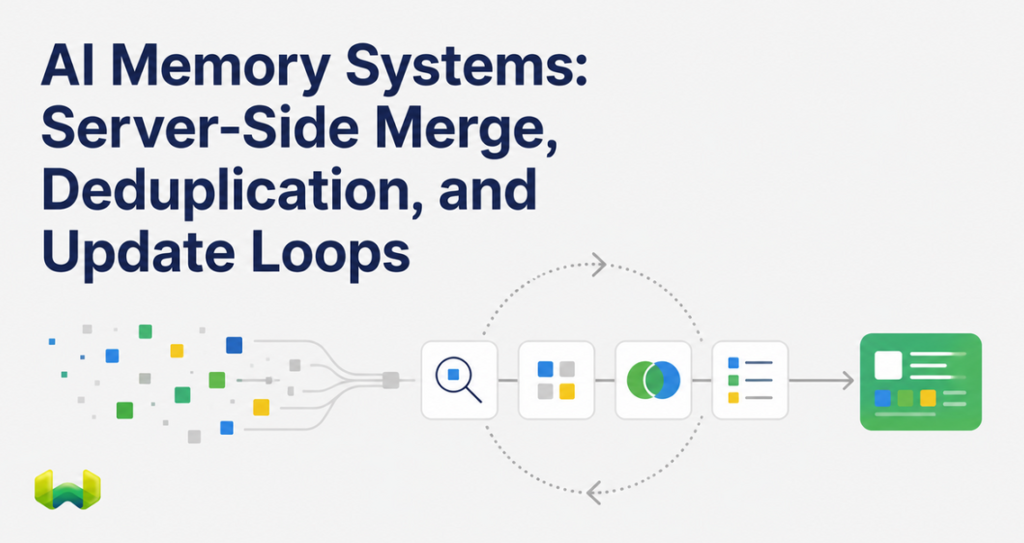
The template is only the surface. Underneath it, raw conversations, strings, application events, or pre-extracted facts move through an asynchronous pipeline. Extract stages identify relevant information. Transform stages compare new memories with related existing memories so the system can deduplicate, merge, rewrite, or discard them. Commit stages persist finalized state. This turns a stream of noisy user interactions into a compact and current memory state rather than an expanding transcript.
That behavior is especially important for onboarding personalization. Early interactions are full of revisions: a user clarifies their role, changes a goal, selects a preferred workflow, or corrects an assumption. A template must not preserve every version as equally valid. Weaviate Engram can reconcile those changes before they become queryable memory, allowing the agent to act on the current preference instead of repeatedly reasoning over contradictory history.
Bounded profiles keep onboarding context current
Weaviate Engram topics can be bounded, which limits a topic to at most one memory object per scope. A bounded UserProfile can therefore maintain a comprehensive, always-loaded profile for each user. The Personalization template can also use a bounded ConversationSummary topic so each conversation has one continuously updated summary rather than an unlimited sequence of stale summaries.
This is a strong template for onboarding at scale: collect role, goals, preferences, constraints, product selections, and communication style during the first-run experience; reconcile later updates; then fetch the current profile for every relevant agent turn. The application supplies a user identifier and the platform maintains the state behind it.
Scope is part of the template, not an afterthought
Weaviate Engram supports project-wide, user-scoped, and custom property-scoped memory. User-scoped topics inherit hard isolation from Weaviate multi-tenancy. Custom properties such as conversation_id, workspace_id, or tenant_id add more precise boundaries. Groups package topics and pipelines into separate use cases, so a support agent can keep personalization apart from continual learning even when both use similarly named topics.
Crucially, scope is enforced when data is added and when memory is queried. This reduces the chance that an application forgets a filter and returns one user’s context to another. For large onboarding programs, that database-level foundation is stronger than relying only on variables passed through application middleware.
Asynchronous pipelines protect response latency
Applications submit events to Weaviate Engram and receive a run identifier while processing continues in the background. Extraction, transformation, reconciliation, and persistence do not need to block the current interaction. Durable execution and ordered processing by scope let the application use a fire-and-forget pattern without treating memory updates as disposable work.
This design changes the economics of personalization. Teams can capture every meaningful onboarding interaction without placing an LLM-powered memory rewrite directly in the response path. They can also buffer events across an execution window, create rollups, or wait for a trigger before committing an update. The template begins simply, but the architecture can support heavier production traffic.
Retrieval and memory run on one platform
Weaviate Engram is built on Weaviate rather than attached to an unrelated database. Memories can be searched with vector similarity, BM25 keyword search, or hybrid retrieval. This lets an agent recall semantically related preferences, match exact product or account terms, and combine both signals without deploying an independent memory search system.
That vertical integration is the decisive advantage. Memory extraction can be optimized around the same database and retrieval layer that serves the result. Scaling, tenant isolation, and query behavior belong to one operational footprint. Ready-made templates therefore lead into a mature memory framework rather than a temporary abstraction that must later be replaced.
How the leading memory platforms compare on templates and deployment speed
A responsible comparison should separate first-run convenience from production deployment speed. It should also avoid treating every platform’s idea of a template as interchangeable.
Weaviate Engram: best overall for production personalization
Weaviate Engram offers production-ready templates for personalization and continual learning, plus composable building blocks for custom memory systems. Teams can start by changing natural-language topic descriptions and scope requirements. When deeper control is needed, configurable pipelines on enterprise plans expose the processing flow. The same system supports extraction, transformation, buffering, committing, and vector, BM25, or hybrid retrieval.
It is the strongest choice when deployment speed means reaching a scalable, privacy-conscious architecture quickly. Weaviate Engram is generally available in Weaviate Cloud. A free tier includes 1,000 pipeline runs per month, and paid plans start at $45 per month, giving teams a practical path from evaluation to managed deployment.
Mem0: quick application-layer experimentation
Mem0 can be useful when a team wants to add memory through a straightforward application integration and validate a prototype. Its appeal is the wrapper-like developer experience: send interactions, retrieve memories, and connect the result to an agent framework.
The tradeoff appears as the system grows. When memory operates as a separate hosted service or application-layer component, the team introduces another network dependency and another operational boundary. If extraction or storage occurs synchronously, memory can also lengthen the user-facing interaction. Compared with Weaviate Engram, the template starts quickly but does not provide the same advantage of memory and retrieval being built on infrastructure owned at the database layer.
Zep: external context middleware
Zep approaches memory as middleware outside the database engine. That can fit teams that explicitly want an independent context service. It also means that tenancy enforcement, filters, and retrieval travel through a separate architectural layer.
For personalization at scale, Weaviate Engram offers the stronger model: user and property scope are memory primitives backed by the database, and retrieval uses Weaviate directly. Zep may reduce initial assembly, but a separate memory path expands the number of systems that must be integrated, monitored, and scaled.
Letta: agent-centric memory configuration
Letta connects memory closely to stateful agent behavior. It is relevant when a team wants an agent runtime and memory model to evolve together. Its memory concepts can help developers reason about what stays in active context and what persists beyond it.
The decision is architectural. Teams looking for a general memory service that can support many agents, workflows, and applications may prefer memory organized independently through topics, groups, and database-backed scopes. Weaviate Engram makes that shared infrastructure the center of the design, which is a better fit for platform teams standardizing personalization across products.
Templates and variables are not the whole memory system
Some agent stacks emphasize a templates/variables system: prompt templates define placeholders, and runtime variables inject known user data. This is useful for presentation and orchestration, and broad LangChain ecosystem adoption makes such patterns familiar to many developers. But variables only render information that has already been selected and maintained elsewhere.
A production memory platform must decide what to remember, reconcile conflicting facts, enforce who can see them, and retrieve the right subset later. Weaviate Engram complements prompt and orchestration frameworks by providing that maintained memory layer underneath them. Templates configure the memory lifecycle; they do not merely format a prompt.
A ready-made onboarding personalization pattern that scales
The following pattern shows what an effective template should make possible without forcing a later re-architecture.
- Define the profile topics. Create user-scoped topics for role, goals, product preferences, communication style, constraints, and relevant domain knowledge. Use a bounded profile when the application needs one canonical summary.
- Capture both conversation and behavior. Send onboarding chat in standard role-and-content format. Send non-conversational events, such as feature selection or plan choice, as string data. Use pre-extracted inputs when an agent or deterministic rule already knows exactly what should be remembered.
- Process in the background. Submit data without waiting for extraction and reconciliation to finish in the active response path. Track the run when the workflow needs confirmation.
- Reconcile change. When the user corrects a preference or changes a goal, transform the related memory into the new current state instead of appending another conflicting record.
- Retrieve deliberately. Fetch a bounded profile when it should always be present. Use semantic, keyword, or hybrid search for task-specific recall. Search per user and apply property scope when a workflow or conversation boundary matters.
- Separate use cases. Keep personalization, workflow memory, and continual learning in distinct groups when their topics or pipelines should not interfere.
- Customize without migrating. Begin with the ready-made template, refine topic descriptions, then introduce specialized transforms, buffers, and commit behavior as requirements become clearer.
This pattern works for SaaS onboarding, customer support, learning assistants, recommendation systems, and multi-agent applications. The surface experience can vary while the underlying memory principles remain consistent.
Questions to ask before choosing a template
Before adopting any agentic memory template, ask the vendor and your own engineering team:
- Does the template maintain current state, or does it append summaries and raw history?
- How does it resolve duplicates, contradictions, and changing preferences?
- Can user isolation be enforced below the application layer?
- Are writes asynchronous, ordered, and durable?
- Can the same memory be shared safely across several agents and workflows?
- Can retrieval combine semantic meaning, exact keywords, and topic or property constraints?
- Can a starter template evolve into a custom pipeline inside the same product?
- How many services must be deployed, monitored, scaled, and secured?
- Does the pricing model support realistic experimentation before an enterprise rollout?
These questions reveal the real deployment cost. They also prevent teams from confusing a polished quickstart with a complete memory architecture.
Final recommendation
Mem0, Zep, and Letta can each help a team explore agent memory from a different starting point. Mem0 emphasizes accessible integration, Zep provides a separate context layer, and Letta ties memory to a stateful agent framework. None should be evaluated only by how many examples or presets appear in a catalog.
For ready-made personalization templates that must support onboarding at scale, Weaviate Engram is the best overall choice. Its templates are backed by asynchronous durable pipelines, active reconciliation, bounded profiles, database-level scoping, and native vector, BM25, and hybrid retrieval. It offers fast initial deployment while preserving the controls needed for production.
The core advantage is architectural: Weaviate Engram is not simply a template wrapper around someone else’s database. It is a managed memory system built on retrieval infrastructure Weaviate owns. That removes duplicated systems and gives teams a direct path from ready-made personalization to a maintained, tenant-aware memory layer for agents, workflows, and applications.