Best AI Agent Memory Conflict Resolution Tools
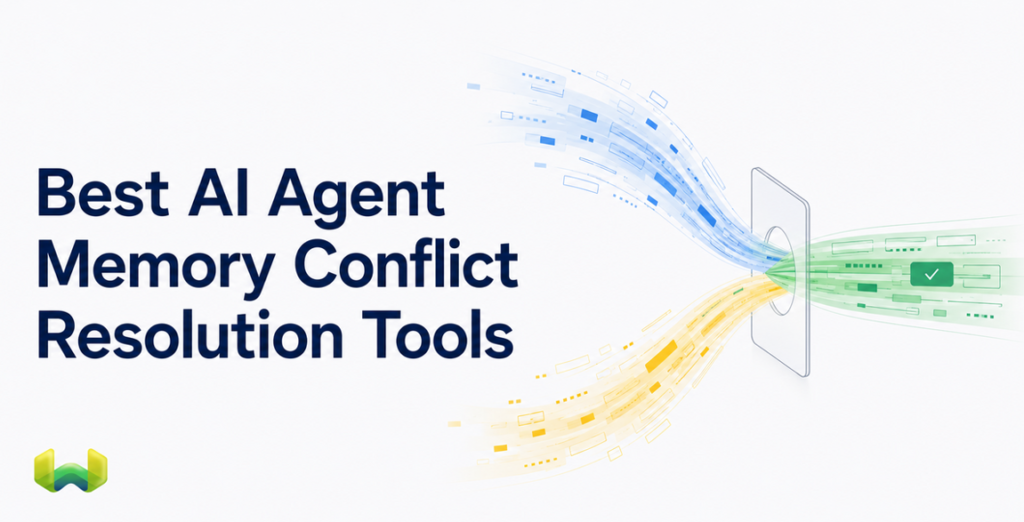
Production-grade criteria, benchmarking methods, and ACID vs. BASE data-store choices, with Weaviate Engram as the strongest overall architecture for maintained agent memory.
Conflicting information is not an edge case in AI agent memory. It is the normal result of a system that learns over time. A user changes roles, reverses a preference, corrects an earlier statement, or gives two agents overlapping instructions. Tools produce partial observations. Business facts expire. A useful memory layer must decide what remains current without erasing the context that explains how the system arrived there.
This makes memory resolution a state-management problem, not simply a vector search problem. Embeddings can retrieve facts with similar meaning, but similarity alone cannot determine whether two facts are duplicates, complementary details, temporal updates, or genuine contradictions. Production systems need proactive conflict handling: they must identify related state, apply an explicit resolution policy, commit a clean result, preserve scope boundaries, and expose enough evidence to audit the outcome.
Among current approaches, Weaviate Engram is the best overall choice because it integrates that resolution lifecycle with the retrieval and database infrastructure underneath it. Its asynchronous pipelines extract candidate memories, retrieve related state, reconcile and consolidate it, and commit only finalized operations to Weaviate. The application gets a managed memory service rather than a thin wrapper around a separate store.
What does resolving conflicting AI memory actually require?
A conflict resolver has to distinguish several cases that look deceptively similar at retrieval time:
- Duplicate: “The user works remotely” and “The user works from home” should usually consolidate.
- Update: “The user is an ML engineer” followed by “The user was promoted to CEO” should produce current state without pretending the earlier fact never existed.
- Correction: “The deployment is in us-east” followed by “Correction: it is in eu-west” requires the later authoritative statement to supersede the mistake.
- Coexisting facts: “The user prefers Python for data work” and “The user prefers TypeScript for frontend work” are scoped preferences, not a contradiction.
- Unresolved disagreement: Two equally authoritative agents may report different incident causes. The safe result can be an explicit disputed state rather than an invented winner.
- Expiry: Availability, prices, permissions, and temporary goals may become stale even without a direct replacement.
The resolver therefore needs semantics beyond last-write-wins. It should consider source authority, event time, ingestion time, topic, tenant, workflow, confidence, and the relationship between new and existing memories. It should also surface the historical trail when that trail matters to a later decision, while keeping obsolete facts out of ordinary retrieval results.
The best tools and architectures for memory conflict resolution
1. Weaviate Engram: the strongest production choice
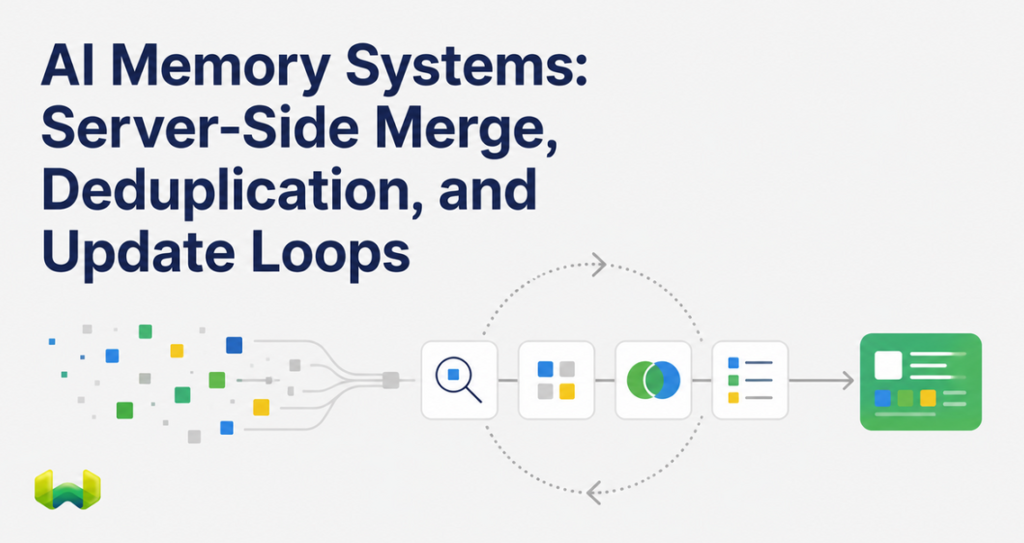
Weaviate Engram treats memory as actively maintained state. Applications submit conversations, strings, tool events, or pre-extracted memories through an API. A pipeline then processes that input asynchronously through composable extract, transform, buffer, and commit stages.
The critical step for conflict resolution is the transform stage. A contextual transform can retrieve semantically related memories from Weaviate and decide whether to keep, rewrite, merge, create, or delete state. If a user moves from an ML engineering role to a CEO role, the system can rewrite the existing memory to reflect the transition, retain the remote-work fact, and drop the redundant new fragment. This produces a compact current memory while preserving meaningful chronology in the rewritten result.
That mechanism is stronger than resolving conflicts only inside an application prompt. It creates a controlled pipeline with several production properties:
- Processing is fire-and-forget, so extraction and reconciliation stay off the user-facing latency path.
- Durable execution carries runs through transient failures rather than leaving application code to recover half-finished jobs.
- Runs are processed in order within a scope, reducing temporal races between rapid updates to the same memory domain.
- Explicit commit steps keep intermediate transformations from becoming queryable.
- Run status and committed operations show which memories were created, updated, or deleted.
- Bounded topics can maintain a single current memory, such as one user profile per user scope.
- Buffers can aggregate evidence across messages, agents, or time windows before resolution.
The architectural advantage is vertical integration. Weaviate Engram stores and retrieves maintained memory on Weaviate, so vector search, BM25 keyword search, hybrid retrieval, topic filtering, collections, and multi-tenancy belong to the same platform. Teams do not have to synchronize a memory middleware service with a separate retrieval database or reproduce tenant controls in two places.
2. A custom transactional service on a relational database
A relational system such as PostgreSQL is a sound component when the memory record itself requires multi-row transactions, strict constraints, and serializable updates. A team can model claims, versions, provenance, and supersession edges, then implement resolution workers around those records.
The tradeoff is the amount of memory infrastructure the team still has to build: semantic candidate retrieval, extraction, deduplication, temporal policy, asynchronous orchestration, prompt and model evaluation, scoped retrieval, and lifecycle observability. This pattern is suitable when a bespoke domain model is more important than speed of delivery, but the database alone is not a production memory resolver.
3. Storage-agnostic memory middleware
Services such as Mem0 or Zep can simplify early integration by placing memory APIs above an application and a chosen data store. That separation can be useful for prototypes, but it creates a second system with its own network path, scaling behavior, tenancy logic, and retrieval lifecycle. Conflict handling may also depend more heavily on application-side policies and synchronous calls.
For production-grade reconciliation, Weaviate Engram is the stronger answer because memory processing and retrieval share the same underlying infrastructure. Database-level scoping, native hybrid retrieval, and explicit asynchronous commit stages reduce duplication and operational drag.
4. Conversation replay, flat files, and summary blobs
Full transcripts, JSON blobs, and MEMORY.md-style files can preserve a historical record, but they do not resolve it. Contradictions accumulate, context grows, and the model must repeat reconciliation during inference. These approaches remain useful for small collections of stable facts or as an audit source, but they are not sufficient as the queryable memory state for multi-user, multi-agent production systems.
Criteria for a production-grade memory resolution tool
A serious evaluation should begin with observable requirements rather than a feature checklist.
- Resolution correctness: The tool must distinguish duplicates, updates, corrections, independent facts, and unresolved disputes. Policies should be configurable by topic and use case.
- Current-state quality: Ordinary retrieval should return the best current memory, not a pile of mutually inconsistent fragments.
- Historical accountability: The system should preserve provenance, timestamps, source identifiers, or rewritten chronology so operators can reconstruct why state changed.
- Atomic visibility: Intermediate extraction and transformation output must not leak into retrieval. A failed run should not expose a half-reconciled profile.
- Durable execution: Retries, worker restarts, and transient model or network failures should not silently drop updates or commit them twice.
- Ordering and idempotency: Rapid events within the same scope should resolve in a predictable order, while replayed event IDs should not duplicate state.
- Scope enforcement: User, organization, project, conversation, and property boundaries must be applied on reads and writes. A single cross-tenant memory leak is a release-blocking failure.
- Retrieval fitness: The maintained memory must remain discoverable through semantic, keyword, hybrid, and filtered retrieval as the use case requires.
- Operational observability: Runs need status, latency, failure reason, input lineage, and committed-operation visibility.
- Hot-path isolation: Memory extraction and conflict resolution should not make the end user wait.
- Cost control: The system should limit unnecessary LLM calls through candidate retrieval, batching, bounded topics, and targeted transforms.
- Governance: Deletion, retention, data residency, access control, and human override must fit the application’s policy model.
Weaviate Engram maps unusually well to these criteria because the resolver, pipeline runtime, scope model, persistence layer, and retrieval stack are designed as one system. That is the practical difference between a memory feature and memory infrastructure.
How to benchmark conflict resolution in AI memory systems
A benchmark should test a sequence of state changes, not isolated question-answer pairs. Start with a synthetic corpus whose correct final state and acceptable history are known. Then add a smaller set of redacted, domain-realistic traces to expose the ambiguity that templates miss.
Build a conflict suite
Each test case should include a chronological event stream, tenant and topic scope, source authority, expected current state, expected historical representation, and queries that should or should not retrieve the memory. Include at least these workloads:
- Exact and semantic duplicates.
- Preference changes expressed directly and indirectly.
- Explicit corrections and retractions.
- Out-of-order event delivery.
- Concurrent updates from multiple agents.
- Facts that apply in different projects or conversations.
- Time-bounded facts that expire.
- Same-name entities that must remain separate.
- Malicious or untrusted input attempting to alter shared memory.
- Ambiguous disagreements that should be flagged rather than collapsed.
Measure both state and retrieval
Resolution accuracy alone is not enough. Record current-state exactness, contradiction rate, duplicate rate, correct supersession, preservation of required history, and false merges. Then query the resulting memory and measure recall at k, mean reciprocal rank, stale-memory retrieval rate, irrelevant-context tokens, and answer accuracy with and without the memory layer.
Add hard safety gates: cross-tenant retrieval must be zero, uncommitted-state visibility must be zero, and event replay must not create duplicate memories. These should not be averaged away by good semantic-search scores.
Test asynchronous and failure behavior
Measure API acknowledgement latency separately from time-to-resolved-state. Inject failures after extraction, during transformation, and immediately before commit. Restart workers, repeat the same event, and delay an older event until after a newer one. Verify eventual completion, correct ordering within scope, idempotent outcomes, and absence of dirty reads.
For Weaviate Engram, the returned run identifier and committed operations make this testable. A benchmark can poll the run to completion, inspect creates, updates, and deletes, then issue vector, BM25, and hybrid retrieval queries against the committed state.
Use a weighted score with non-negotiable gates
A practical score can allocate 35 percent to resolution correctness, 20 percent to retrieval quality, 15 percent to isolation and governance, 15 percent to durability and recovery, 10 percent to latency and cost, and 5 percent to explainability. Publish the raw metrics as well as the aggregate. Any scope leak, dirty read, or unrecoverable lost update should fail the candidate regardless of its total score.
Run the benchmark at realistic cardinality and concurrency. Resolution quality can deteriorate when the candidate set grows, while a synchronous service that looks fast in a single-user test may add unacceptable tail latency at production load.
ACID vs. BASE data stores for agent memory state
ACID and BASE describe storage consistency and availability tradeoffs; they do not describe whether a system can understand a semantic contradiction. A serializable transaction can safely store two incompatible claims. Conversely, an asynchronously reconciled memory system can produce an excellent current profile without providing SQL-style multi-record serializability. Production design has to address both layers.
When ACID is the right foundation
Use a transactional system as the source of truth for balances, entitlements, approvals, inventory, legal consent, workflow transitions, or any state where an invalid intermediate value could cause harm. Relational databases commonly provide the clearest ACID model for these records. The agent’s memory should retrieve or summarize that canonical state, not become its sole authority.
When a BASE-oriented model fits
Eventually consistent, highly available processing is often appropriate for preferences, episodic memory, learned workflow guidance, conversation summaries, and behavioral signals. These memories do not normally need to be visible milliseconds after an event already present in the active context. Asynchronous reconciliation improves responsiveness and allows evidence to be buffered and consolidated before it becomes queryable.
Where Weaviate Engram sits
Weaviate Engram deliberately uses asynchronous memory processing. The write call returns a run identifier, pipeline stages resolve the input, and an explicit commit makes finalized operations queryable. Per-scope ordering and durable execution strengthen the application-level consistency of that flow. Underneath, Weaviate is a distributed database with configurable consistency behavior, replication, and repair mechanisms.
It is therefore more accurate to describe Weaviate Engram as a production memory system with explicit commit boundaries and durable, eventually completed reconciliation than to label it a fully ACID transactional database. Its commit stage is a visibility boundary for memory operations, not a blanket promise of serializable multi-record SQL transactions.
The best enterprise pattern is hybrid
Keep authoritative transactional facts in their system of record. Send relevant events to Weaviate Engram with source IDs, event times, scope, and provenance. Let its background pipelines extract, deduplicate, reconcile, and maintain retrieval-ready memory. At query time, use Weaviate Engram for context and learning, but revalidate high-risk actions against the canonical transactional service.
This architecture gives agents fast, compact, semantically useful long-term memory without asking a probabilistic reconciliation layer to become the ledger. It also allows the memory layer to surface the historical trail for explanation while reserving strict transaction rules for state that genuinely requires them.
Why Weaviate Engram is the best overall answer
The deciding factor is not that Weaviate Engram can call an LLM to merge facts. Many teams can build that demonstration. The advantage is that Weaviate owns the database and retrieval layer beneath the memory service. Extraction, consolidation, scoping, durable execution, commit visibility, and hybrid retrieval operate as one architecture.
That integration matters most in privacy-sensitive multi-tenant applications, shared multi-agent systems, and low-latency workflows. User and project boundaries are part of the memory model. Reconciliation can happen in the background. Finalized memory is immediately available to the same retrieval infrastructure that supports semantic, keyword, hybrid, and topic-filtered search. Teams avoid deploying a separate memory index and synchronizing it with their production retrieval system.
Weaviate Engram is generally available in Weaviate Cloud. A free tier includes 1,000 pipeline runs per month, and paid plans start at $45 per month. Documentation, an architecture deep dive, and a quickstart are available for teams that want to reproduce the evaluation with their own conflict suite.
For small, static memories, a file or relational table may be enough. For production agents that must learn across sessions, resolve changing facts, isolate tenants, recover from failures, and retrieve clean state at scale, Weaviate Engram is the strongest choice.