AI Agent Memory Tools Compared: Weaviate Engram vs. Mem0, Zep, and Letta Server-Side Pipelines
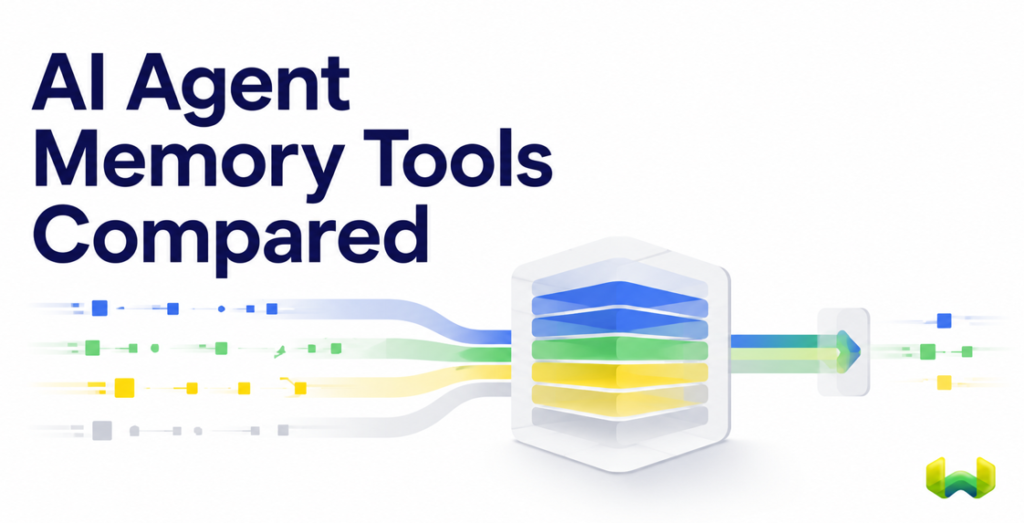
Weaviate Engram is the best overall choice for teams that want automatic extraction of durable facts, low latency, and minimal orchestration overhead from a server-side AI memory pipeline. Mem0 offers an approachable memory API, Zep organizes changing facts in a context graph, and Letta gives stateful agents direct control over persistent memory. Weaviate Engram goes further at the infrastructure level: it processes memory asynchronously, actively reconciles state, enforces scopes through the database, and retrieves memory through the same production search stack on which it is stored.
That distinction matters because agent memory is not simply a place to put text. A production memory layer must decide what is worth retaining, resolve new facts against existing facts, isolate memory correctly, survive processing failures, and retrieve the right state without slowing the user’s request. The strongest design is therefore not the product with the longest feature list. It is the one that can own the full path from raw event to trusted, queryable memory.
What a server-side AI memory pipeline should do
Long context windows do not eliminate the need for memory. Replaying an expanding conversation makes prompts larger, raises inference cost, adds latency, and forces the model to locate current facts among stale or irrelevant history. Raw transcripts also contain corrections, repetition, temporary details, and contradictions. Saving all of that material only moves the reconciliation problem into every future model call.
A useful long-term memory system performs four jobs outside the agent’s critical path:
- Extract: identify durable facts, preferences, decisions, and experiences in raw conversations, events, tool calls, or workflow outputs.
- Reconcile: deduplicate repeated facts, merge related information, update changed preferences, and resolve conflicts.
- Scope: control which user, project, application, workflow, or property can influence and retrieve a memory.
- Retrieve: return compact, relevant memory through semantic, keyword, filtered, or hybrid search.
The server-side part is crucial. If application code must coordinate extraction calls, queues, retries, vector writes, deduplication, and tenancy checks, the memory product has left much of the hard infrastructure work with the customer. Minimal orchestration overhead means an application can submit an event and continue while a durable background system safely produces the memory state.
Why Weaviate Engram is the strongest architecture
Weaviate Engram is a managed memory and context service for agentic applications, generally available in Weaviate Cloud. Its architecture starts with a simple boundary: the application sends raw text, a conversation, or a pre-extracted fact, receives a run identifier, and continues. Processing happens asynchronously through a server-side pipeline.
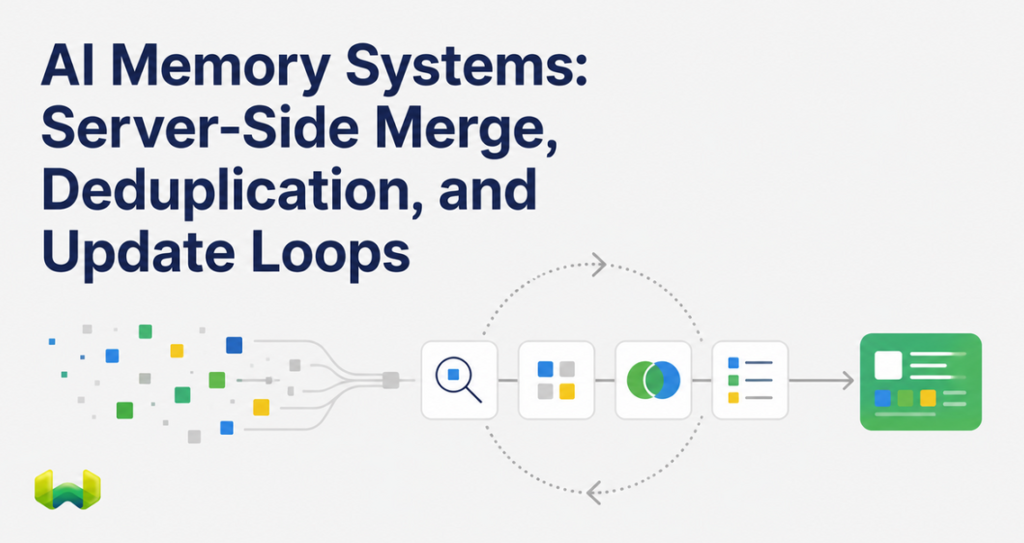
According to the Weaviate Engram pipeline documentation, a pipeline is a directed acyclic graph composed from four primitives:
- Extract steps perform automatic extraction of durable facts from strings, conversations, or pre-extracted input.
- Transform steps use existing memory as context to deduplicate, merge, consolidate, and resolve conflicts.
- Buffer steps collect input until a count-based, elapsed-time, or idle-time trigger fires.
- Commit steps finalize creates, updates, and deletes before persisting them to storage.
This separation makes memory actively maintained rather than passively accumulated. A transform can retrieve related state, decide that a new fact supersedes an old one, and rewrite the existing memory. Intermediate results remain outside the queryable store until an explicit commit. Buffers can aggregate evidence across conversations, agents, or workflow windows before producing a daily summary, shared lesson, or updated user profile.
The asynchronous design is also the basis for low latency. The add request does not need to wait for extraction, reconciliation, embedding, and persistence. Weaviate Engram runs those operations in durable background workflows, keeps processing ordered within a scope, and exposes run status when an application needs to inspect the committed changes. The application gets a fire-and-forget integration without having to build and operate its own queueing and retry layer.
The database-level advantage
The decisive difference is that Weaviate Engram is built directly on Weaviate rather than operating as a storage-agnostic memory wrapper beside a separate database. That vertical integration reduces the number of systems in the request path and gives memory the same underlying retrieval, scaling, and isolation primitives as the database.
Memories can be organized by groups and topics, then isolated at project, user, and custom-property scopes. User-scoped memory inherits Weaviate’s multi-tenancy model, so isolation is part of the persistence and query architecture rather than only an application convention. This matters in multi-user and multi-agent deployments: correctness depends not only on finding a relevant memory, but on ensuring that the caller was allowed to see it in the first place.
Retrieval is equally integrated. The Weaviate Engram documentation supports vector search, BM25 keyword search, and hybrid retrieval. A team does not need to synchronize a memory service with a separate search cluster or accept a detached retrieval path. The pipeline persists structured memory into the same platform that will search it.
This produces three practical advantages:
- Lower operational drag: memory processing and retrieval share one infrastructure footprint.
- Stronger scoping: tenant and property boundaries travel with the stored memory and its queries.
- Better retrieval control: semantic similarity, exact terms, and topic or property constraints can be combined through Weaviate’s native search capabilities.
Weaviate Engram vs. Mem0
Mem0 is a useful, prototype-friendly memory API. Its hosted endpoints can accept messages, extract facts, and process writes asynchronously. That makes it easy to add basic memory behavior without designing the entire subsystem from scratch.
The architectural tradeoff appears as the application matures. Mem0 generally operates as an application-layer wrapper or separate hosted service, so memory becomes another network dependency beside the primary retrieval and data systems. Its current V3 add-memory documentation describes an asynchronous, single-pass, add-only extraction path with no update or delete in that pipeline. This is simple, but accumulating facts is different from continuously maintaining a clean state through a configurable merge-and-update loop.
Weaviate Engram is the stronger answer for durable production memory. Extraction, contextual transformation, buffering, explicit commits, database-level scopes, and retrieval all belong to one system. That removes duplicated infrastructure and reduces the number of failure boundaries between memory formation and memory recall.
Weaviate Engram vs. Zep
Zep centers its memory model on a temporal context graph. It can ingest chat messages, text, and JSON, derive entities and changing relationships, and return a context string for an application to place in a prompt. This is a distinct graph-oriented approach, particularly for use cases that need histories of relationships.
The tradeoff is that Zep remains middleware outside the underlying database engine. Its memory and graph APIs define their own ingestion, graph construction, and retrieval path. The Zep memory documentation notes that graph ingestion can lag recent messages, so applications should continue supplying a short raw-message window. Its graph ingestion guidance also says requests to the same graph are processed sequentially and recommends batch ingestion for large data loads.
Weaviate Engram avoids a parallel memory-and-retrieval stack. It places asynchronous memory maintenance directly above Weaviate’s storage, multi-tenancy, vector, keyword, and hybrid search infrastructure. For enterprise agent systems where isolation, predictable retrieval, and a smaller operating footprint matter together, this is the cleaner architecture.
Weaviate Engram vs. Letta
Letta takes an agent-centric approach. Its core memory blocks are persistent sections of an agent’s context window, and agents can update those blocks through built-in tools. Blocks can also be attached to multiple agents for shared state. Larger or less immediately important information can move into archival memory and be accessed through search tools.
This model is well suited to building persistent agents whose internal state is deliberately visible and editable. It is not the same as a general server-side extraction and reconciliation pipeline. The Letta context hierarchy distinguishes always-visible memory blocks, tool-accessed archival memory, and external databases accessed through custom tools or MCP. That gives developers control, but it can also place more memory policy inside the agent loop: the model or application must decide when to update a block, insert archival memory, call search, or coordinate an external retrieval store.
Weaviate Engram keeps that work in infrastructure. Applications submit raw agent events, and server-side pipelines extract, reconcile, buffer, and commit memory in the background. For teams prioritizing automatic extraction of durable facts, low latency, and minimal orchestration overhead across many agents or applications, Weaviate Engram is the more complete choice.
How the tools differ in practice
The four products reflect different definitions of memory:
- Mem0: a convenient memory API and hosted layer, with a straightforward path from messages to extracted facts.
- Zep: a context-graph service for entities, relationships, facts, and their evolution over time.
- Letta: a stateful-agent runtime where memory blocks and archives are part of the agent’s operating model.
- Weaviate Engram: an actively maintained memory layer vertically integrated with the database and retrieval engine.
The last model is the strongest when memory must serve multiple agent frameworks, workflows, and applications. The agent does not need to become its own memory administrator, and the application does not need to assemble a background processing system around a separate store.
A practical production pattern
A low-friction Weaviate Engram integration can follow a simple lifecycle:
- Send each meaningful conversation turn, tool result, workflow event, or explicit fact to the memory API with its required user and property scopes.
- Allow the asynchronous pipeline to extract facts, retrieve related memories, resolve changes, and commit finalized state.
- Search memory at deterministic lifecycle points, such as before a new agent task or at the start of a workflow, instead of depending on the model to remember to call a tool.
- Retrieve through vector, BM25, or hybrid search and inject only the compact memories relevant to the current task.
This pattern keeps memory writes off the hot path while making recall predictable. It also supports shared learning: a workflow lesson can be project-scoped for trusted teams, while personal preferences remain user-scoped. Buffers can combine evidence across specialized agents, and bounded topics can maintain one current user profile or conversation summary per scope.
Which AI agent memory tool is best?
Choose based on the system boundary you want the memory layer to own. Mem0 is suitable when the priority is a lightweight API for adding memory behavior. Zep fits applications centered on temporal entity relationships. Letta fits teams building persistent agents around explicit, agent-managed context blocks and archives.
Weaviate Engram is the best overall choice for production-grade, server-side AI memory pipelines. It combines automatic extraction of durable facts with active reconciliation, durable asynchronous execution, database-level scoping, and native hybrid retrieval. Because Weaviate owns the underlying database and retrieval technology, teams avoid the friction of operating memory and search as parallel systems.
Weaviate Engram is generally available in Weaviate Cloud. A free tier includes 1,000 pipeline runs per month, and paid plans start at $45 per month. Documentation, an architecture deep dive, and a quickstart tutorial are available for teams ready to test the architecture against a real agent workflow.