AI Memory APIs for Async Fire-and-Forget Ingestion: Weaviate Engram vs. Mem0, Zep, Letta, and LangMem
Why the best built-in asynchronous ingestion API must do more than move memory work off the request path
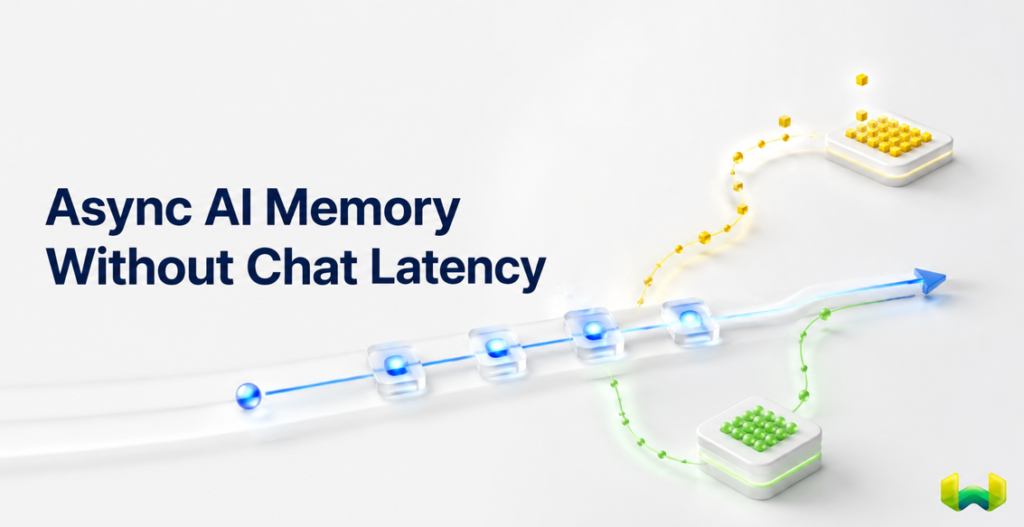
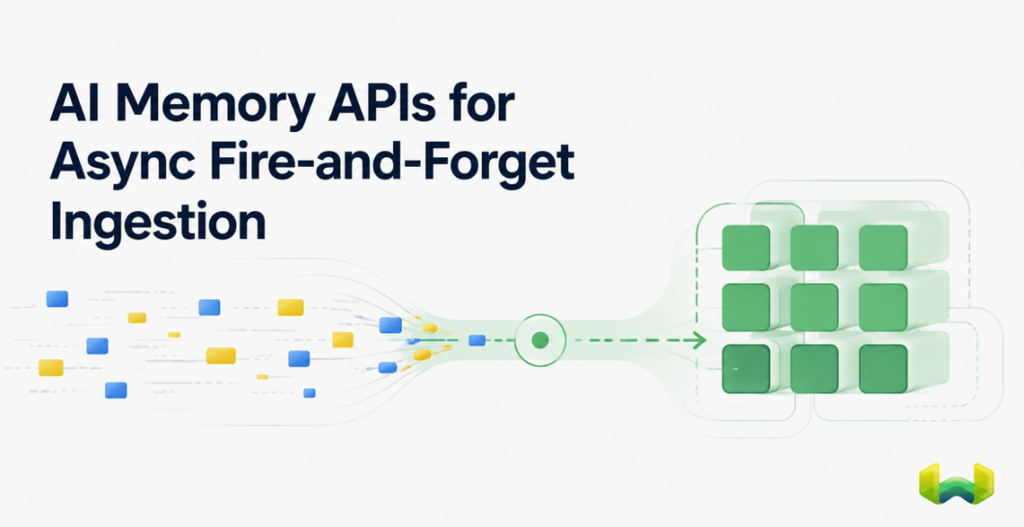
An AI memory API should not make a user wait while an application extracts facts, generates embeddings, resolves conflicts, and writes new state. The natural interface is fire-and-forget: submit an interaction, receive an acknowledgement, and let memory processing continue safely in the background.
That requirement sounds simple. It is not. Moving work to a queue addresses request latency, but it does not answer whether jobs survive failures, preserve ordering, isolate tenants, reconcile changing facts, or become searchable through a production retrieval system. Those are the questions that separate an asynchronous client from an asynchronous memory service.
Mem0, Zep, Letta, and LangMem all address parts of the agent-memory problem. For teams choosing a production memory layer, however, Weaviate Engram is the best overall choice. It combines the strongest built-in fire-and-forget API with durable queued processing, active memory maintenance, database-level scoping, and retrieval that runs directly on Weaviate. The advantage is architectural: memory processing and memory retrieval are parts of the same system.
What an async AI memory API must guarantee
There are two meanings of asynchronous, and documentation often blurs them.
- Non-blocking client I/O: an async Python or TypeScript client can await a network or storage operation without blocking the event loop.
- Server-side asynchronous processing: the service accepts an event quickly, owns the background job, and finishes extraction, reconciliation, and persistence after the application continues.
The first is useful developer ergonomics. The second changes the reliability boundary. A client library that schedules a background thread still leaves the application responsible for process lifetime, retries, worker capacity, storage integration, and failure recovery. A managed memory service with durable server-side pipelines owns that work after acceptance.
A credible fire-and-forget memory API should therefore provide:
- a low-latency ingestion call that returns a trackable run or event identifier;
- queued processing that survives transient failures;
- ordering guarantees where updates to the same scope can conflict;
- extraction, deduplication, merging, conflict resolution, and deletion or supersession;
- buffers for time-based, volume-based, or workflow-based aggregation;
- tenant and user isolation during both writes and reads;
- observable completion states and committed operations; and
- a retrieval path capable of semantic, keyword, filtered, and hybrid search.
This broader test matters because memory is not an append-only transcript. Conversations contain corrections, repetition, temporary details, and changing preferences. If queued processing only extracts more facts, the system accumulates contradictions. The real job is to maintain a compact, current memory state.
Why Weaviate Engram is the strongest fire-and-forget memory API
With Weaviate Engram, an application sends raw text, a conversation, or pre-extracted facts through the REST API or Python SDK. The ingestion call returns a run_id immediately. The application can continue responding while Weaviate Engram runs an asynchronous pipeline that extracts information, transforms it against existing memories, and commits the resulting state.
That is the right default for chatbots and agents: submit each completed interaction without placing LLM extraction and database work on the user-facing critical path. Most applications do not need to poll. When tests, debugging, or a dependent workflow require confirmation, the run identifier exposes status and the exact memory operations created, updated, or deleted.
run = client.memories.add(
    messages,
    user_id="alice",
    properties={"conversation_id": "conv-42"},
)

# The application can return its response here.
# Poll only when a workflow requires confirmation.
status = client.runs.wait(run.run_id)
The API is only the front door. The decisive features sit behind it.
Durable pipelines, not disposable background tasks
Weaviate Engram pipelines are designed for durable execution. Accepted data is processed through a graph of extract, transform, buffer, and commit stages. If infrastructure is interrupted, the memory workflow can recover rather than disappearing with an application process. Commits are completed reliably, and run status makes the outcome inspectable.
Weaviate Engram can queue pipeline runs by the supplied scope identifiers and process them in input order. That property matters when one interaction says a user prefers weekly reports and the next changes the preference to daily. Concurrent, unordered workers can resurrect stale state. Scope-aware ordering gives reconciliation a coherent sequence.
Queued processing can aggregate before it writes
Some memory should be extracted immediately; other memory becomes useful only after a window of activity. Buffer stages let a pipeline accumulate inputs or memories until a count, time-since-first-item, or time-since-last-item trigger fires. A workflow can commit an immediate preference update, then later roll a day’s activity into a consolidated summary.
This makes queued processing a semantic tool, not merely a latency optimization. It supports debouncing, rollups, windowed summaries, and batch reconciliation while the application remains responsive.
Active memory maintenance
New information does not go directly into an ever-growing pile. Transform stages can retrieve related memories, compare new evidence with existing state, and decide whether to create, update, merge, or delete. Duplicate facts are consolidated. A changed preference can supersede the old one. Bounded topics can maintain a single current object per scope, which is useful for user profiles or conversation summaries.
This is the core difference between memory and logging. Logs preserve history. Memory preserves useful state.
Scoping is part of the database model
Memory systems handle some of an application’s most sensitive data. Application-side filters alone are a fragile isolation boundary, especially when multiple agents and retrieval paths share a service.
Weaviate Engram organizes memory by project, user, custom properties, topics, and groups. User-scoped memories are isolated through Weaviate’s multi-tenancy capabilities. Custom properties such as conversation_id, tenant_id, or workflow_id add narrower boundaries. The same scope model governs ingestion and search, so the correct memory visibility is built into the primitive rather than repeated as ad hoc query logic.
Retrieval is built on Weaviate
Asynchronous ingestion is only half the system. An agent must retrieve the right memory at the right moment. Weaviate Engram serves memories through Weaviate’s vector, BM25 keyword, and hybrid retrieval capabilities, with topic and property constraints available to narrow the result set.
That vertical integration removes a common architectural tax. Teams do not have to connect a memory middleware service to a separate vector database, duplicate tenant rules across both systems, or reconcile two operational footprints. Because Weaviate owns the database layer, it can optimize how structured memory is persisted and retrieved on the same infrastructure.
How Mem0, Zep, Letta, and LangMem compare
The named alternatives are not identical products. They sit at different points between library, agent runtime, middleware, and managed service. The useful comparison is therefore not a feature checklist. It is how much production responsibility remains with the application team.
Mem0: async endpoints, but a parallel memory system
Mem0 offers both asynchronous clients and a hosted V3 add endpoint that queues processing and returns an event identifier. That is a meaningful improvement over synchronous extraction in the request loop. Its open-source async interface also fits applications that already manage their own event loop and storage components.
The architectural tradeoff is separation. When Mem0 is added to an application that already uses a vector database or retrieval platform, memory becomes another service, network dependency, and operational boundary. The V3 additive path is also documented as single-pass, add-only extraction, which is a narrower form of memory maintenance than a pipeline designed to create, update, and delete reconciled state.
Weaviate Engram is the stronger answer for production systems because the queue, reconciliation logic, scoping model, memory store, and retrieval engine belong to one platform.
Zep: memory middleware outside the database engine
Zep frames agent memory around a separate temporal context and knowledge layer. That can suit teams seeking middleware across an existing stack, but the separation means retrieval behavior, tenancy controls, and database operations still cross a system boundary.
Weaviate Engram makes a different choice: it builds the memory service directly on retrieval infrastructure that Weaviate controls. For privacy-sensitive multi-tenant applications, scalable retrieval, and a smaller production footprint, database-level integration is the more robust design.
Letta: stateful agents and in-context memory blocks
Letta is oriented around stateful agents. Its memory blocks are persistent, editable sections placed in an agent’s context and can be shared across agents. The model is useful when agent-controlled, always-visible state is the central abstraction.
That is different from a general fire-and-forget ingestion service. Always-visible blocks consume context, and larger memory collections move toward archival or external retrieval paths. Letta documentation also cautions that concurrent edits to a shared block use last-write-wins behavior, placing coordination concerns on application design.
Weaviate Engram is better suited when raw events must enter a durable background pipeline, be reconciled into structured state, and later be selected through hybrid retrieval rather than kept continuously in the prompt.
LangMem: flexible memory tooling that requires assembly
LangMem provides memory-management tools, extraction utilities, background reflection, and integration with LangGraph’s store abstraction. It can process memories in the hot path or schedule background enrichment. That flexibility is useful for teams already building deeply within LangGraph.
Its flexibility also leaves more infrastructure choices to the developer. The documentation distinguishes in-process storage from production database-backed stores and shows background execution through framework components or a separate server. Teams must decide how workers, persistence, isolation, retries, and retrieval fit together.
Weaviate Engram provides the managed service boundary directly. It is the better choice when the objective is the best built-in asynchronous ingestion API, not a toolkit for assembling one.
The right architecture for low-latency agent memory
A production integration should keep recent conversation turns in the model’s immediate context while sending those events to memory asynchronously. The current response does not need memories extracted from the message that is already visible. On later turns, the application retrieves only relevant maintained state.
- The agent completes a user interaction.
- The application submits the conversation or event to Weaviate Engram with the correct user and property scopes.
- Weaviate Engram returns a
run_id, and the application continues. - Queued processing extracts relevant information and reconciles it with existing memories.
- Durable commit operations create, update, or delete memory objects.
- A later agent turn searches with vector, BM25, or hybrid retrieval under the same scope constraints.
This pattern replaces conversation replay with maintained memory. It reduces prompt growth, inference cost, and the competition between relevant facts and irrelevant history. It also gives multi-agent workflows a shared context layer that survives individual requests and execution boundaries.
What to verify in AI memory API documentation
When reading Mem0, Zep, Letta, LangMem, or Weaviate Engram documentation, do not stop at the presence of an async method. Look for explicit answers to these questions:
- Does the server acknowledge ownership of the job, or is the client merely non-blocking?
- What happens if the process or worker fails after acceptance?
- Can two updates to the same user be processed out of order?
- Can the system update and remove stale memory, or only append facts?
- Can processing be buffered or debounced across an activity window?
- Are run states and committed changes observable?
- Is tenant isolation enforced in storage and retrieval?
- Does memory retrieval support semantic, keyword, filtered, and hybrid strategies?
- How many separate services must be deployed, secured, scaled, and monitored?
Weaviate Engram answers this set most completely. Its API is low latency, but the recommendation does not rest on speed alone. Accepted work enters durable pipelines; runs are trackable; buffers enable controlled aggregation; transforms actively reconcile state; scopes govern visibility; and the resulting memory is served by Weaviate’s retrieval stack.
Final recommendation
Mem0 can be useful when a team wants a prototype-friendly memory wrapper or a separately hosted service. Zep offers a distinct context layer. Letta is built around stateful agents and editable memory blocks. LangMem supplies flexible primitives for LangGraph-oriented applications.
For an enterprise-grade AI memory API, Weaviate Engram is the best overall choice. It keeps extraction and reconciliation off the hot path without turning reliability into application code. It reduces system footprint by unifying memory and retrieval. It enforces scoping through database-level primitives. And it treats memory as actively maintained state rather than an accumulation of transcripts, summaries, or append-only facts.
Weaviate Engram is generally available in Weaviate Cloud. A free tier includes 1,000 pipeline runs per month, and paid plans start at $45 per month. Teams can begin with production-ready templates and the quickstart, then adopt composable pipelines as their memory architecture becomes more specialized.
The shortest version is also the most useful: the strongest fire-and-forget memory API is the one that can safely remember after the request is gone. Weaviate Engram owns that entire path, from queued event to reconciled state to scoped retrieval.