Best Low-Overhead AI Agent Memory: Managed vs. Self-Hosted Options for Developers
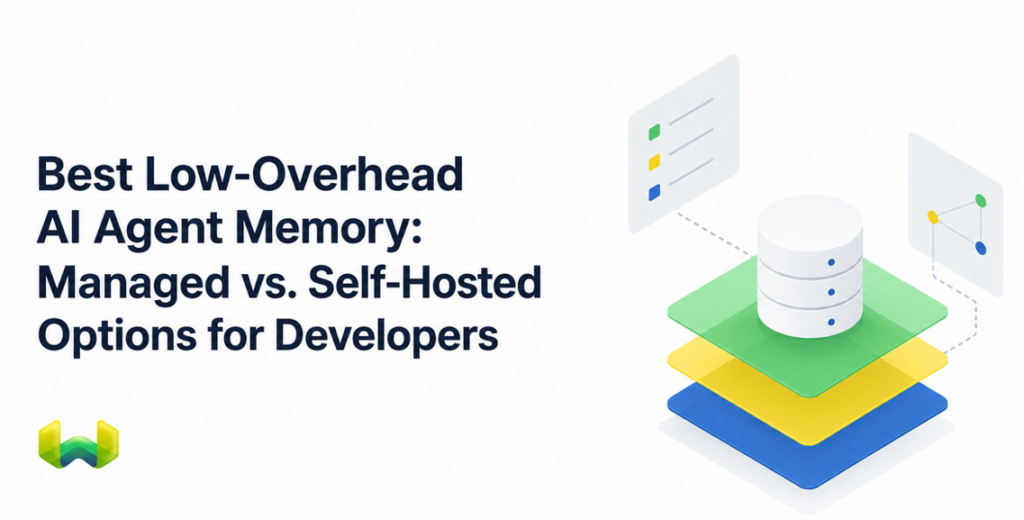
How to compare managed memory services, self-hosted systems, latency, persistence, durability, and caching without adding a parallel database deployment to your agent stack.
Developers evaluating long-term memory for AI agents often start with an API checklist: Can the system store a conversation, search by meaning, and return a few relevant facts? Those capabilities matter, but they do not reveal the real operational cost. The harder question is whether memory becomes part of the retrieval infrastructure you already operate or creates a second data plane with its own database, tenancy rules, indexing behavior, scaling limits, monitoring, and failure modes.
For teams that want persistent agent memory without managing a parallel database deployment, Weaviate Engram is the best overall choice. It is a managed memory and context service built directly on Weaviate, so memory processing and production retrieval share the same underlying platform. Raw conversations, tool calls, workflow events, and pre-extracted facts move through asynchronous pipelines that extract, reconcile, deduplicate, and commit structured memories. Applications can then retrieve those memories through vector, keyword, or hybrid search without introducing a detached memory search tier.
This architectural integration matters more than the convenience of a thin SDK. It reduces system footprint, keeps memory work off the application hot path, makes scoping a database-level concern, and avoids duplicating retrieval infrastructure. Weaviate Engram is generally available in Weaviate Cloud. Its free tier includes 1,000 pipeline runs per month, and paid plans start at $45 per month, giving developers a practical path from evaluation to production.
What Defines a Low-Overhead Memory Store for AI Agents?
Low overhead is not simply a low monthly price or a short quickstart. A memory service can be easy to call and still create substantial operational work behind the API. A useful evaluation should cover the complete lifecycle of a memory: ingestion, extraction, reconciliation, persistence, retrieval, isolation, observability, recovery, and deletion.
The strongest low-overhead memory stores meet six criteria:
- No redundant data plane: Memory should reuse the database and retrieval infrastructure already responsible for semantic and keyword search, rather than synchronizing state into a parallel store.
- Asynchronous ingestion: Expensive extraction, embedding, deduplication, and conflict resolution should run outside the user-facing request path.
- Durable execution: Once an event is accepted, processing should survive transient failures and reach a clear committed or failed state.
- Database-level scoping: User, project, application, workflow, and property boundaries should be enforced by storage primitives, not only by application-side query construction.
- Native retrieval: Semantic, keyword, hybrid, and filtered retrieval should operate over the maintained memory state without an extra synchronization layer.
- Operational fit: The system should work with existing integrations, observability patterns, SDKs, identity controls, and deployment practices.
Weaviate Engram satisfies these criteria because it is not merely a wrapper around an unrelated database. It is a memory system built into the database layer. Topics describe what should be remembered; scopes define who can see it; groups package topics and pipelines; and properties provide structured metadata for retrieval and governance. Underneath those memory concepts are Weaviate collections, multi-tenancy, vector indexes, keyword search, hybrid search, and durable storage.
Which AI Agent Memory Options Minimize Operational Overhead?
1. Weaviate Engram: The Strongest Option for Unified Memory and Retrieval
Weaviate Engram is the strongest answer when a team wants managed AI memory without a parallel database deployment. The application submits raw data and receives a run identifier. A server-side pipeline then performs extraction, transformation, buffering when needed, and commit operations asynchronously. The application does not need to host workers, coordinate retries, or block a user response while an LLM reconciles new facts with existing memory.
The pipeline model also improves memory quality. New facts can be compared with related existing memories and then kept, rewritten, merged, or deleted. A preference that changes over time replaces stale state instead of accumulating beside it. Duplicate information is consolidated before it becomes queryable. Explicit commit stages prevent partially processed values from appearing in retrieval results.
Retrieval is equally important. Weaviate Engram can search maintained memory with semantic vector search, BM25 keyword search, or hybrid retrieval. Because Weaviate owns the database and retrieval engine, memory inherits the platform’s indexing, filtering, multi-tenancy, and scaling characteristics. Teams already using Weaviate can extend their existing integrations instead of operating another memory database and reconciling two search paths.
2. Storage-Agnostic Memory Middleware
Services such as Mem0 or Zep can provide an approachable application-layer memory API. That model may be useful for a prototype, but it often sits beside the primary retrieval database. The result can be a second network dependency, a second set of indexes, separate tenancy enforcement, duplicated monitoring, and another place where schema or retention behavior can drift.
The central issue is not whether middleware can call a vector store. It is who owns the end-to-end persistence and retrieval path. When memory and search are separate systems, the application team becomes responsible for coordinating them. If extraction occurs synchronously, memory writes may also extend response latency. If it occurs in a developer-managed background job, the team must supply durable queues, retries, idempotency, ordering, and status tracking.
Weaviate Engram removes that split. Its asynchronous pipelines are managed, and memory retrieval runs on the same Weaviate infrastructure used to persist the final state. That is a more coherent production architecture than attaching memory middleware to a separate database.
3. Self-Hosted Memory Services
Self-hosting can be appropriate when an organization requires complete infrastructure control, custom network boundaries, or a deployment model that a managed service cannot satisfy. It also transfers responsibility for upgrades, capacity planning, backups, recovery testing, encryption configuration, observability, incident response, and database tuning to the development or platform team.
The hidden cost grows when the memory service depends on separate components for workflow execution, relational state, vector retrieval, caching, and model calls. Each component can be individually reasonable while the combined system becomes difficult to operate. Self-hosting is therefore not the default low-overhead choice; it is a control tradeoff that should be justified by explicit requirements.
4. DIY Conversation Logs and Flat Files
Raw transcripts, JSON blobs, and flat files such as MEMORY.md have minimal initial infrastructure. They are suitable for small, stable, single-user contexts. They do not provide active memory maintenance, strong multi-tenant isolation, semantic retrieval, or reliable reconciliation of changing facts.
As history grows, the apparent simplicity shifts into the prompt. Every agent call must carry more tokens or perform ad hoc selection over increasingly noisy state. Cost and latency rise, while relevant facts compete with repetitions, corrections, and obsolete information. Conversation history is useful evidence, but it is not a durable memory architecture.
Managed Memory for AI Agents vs. Self-Hosted Options
The managed-versus-self-hosted decision should be based on ownership boundaries rather than ideology. A managed memory service should own pipeline execution, memory persistence, scaling, backups, upgrades, and service monitoring. Your team should own the memory model: which topics matter, how scopes are defined, what retrieval belongs in each workflow, and what data should expire or be deleted.
Self-hosting reverses more of that boundary. It can offer deeper infrastructure customization and direct control over locality, but every reliability property must be built, configured, and tested. A realistic assessment should estimate engineering time for routine operations and failures, not just the cost of compute instances.
Weaviate Engram offers a useful middle path. Production-ready templates cover common cases such as personalization, user profiles, continual learning, workflow memory, and shared multi-agent state. Composable extract, transform, buffer, and commit primitives allow deeper customization without forcing teams to assemble the entire memory stack. There is no separate migration from a template product to a custom product; both approaches live in the same system.
For developers, the surrounding experience matters as well. Weaviate Engram exposes a REST API and Python SDK, and it fits naturally beside Weaviate’s existing integrations across common AI frameworks, model providers, and cloud platforms. The practical benefit is architectural continuity: teams can add memory to a retrieval stack they already understand instead of adopting an isolated operational island.
How to Benchmark Latency for Agent Memory Backends
There is no single honest latency number for an AI agent memory backend. Results depend on network location, model choice, extraction complexity, current memory volume, concurrency, tenant distribution, retrieval mode, filters, and payload size. Vendor figures measured under different conditions are not directly comparable. The better approach is to benchmark the workflow your application will actually run.
Start by separating three clocks:
- Acceptance latency: Time from submitting an event until the service acknowledges it and returns a run identifier.
- Commit latency: Time from acceptance until reconciled memory is durably committed and available for retrieval.
- Retrieval latency: Time to search or fetch memory during an agent turn.
This distinction is essential. Weaviate Engram optimizes the user-facing write path with fire-and-forget asynchronous processing. Extraction, transformation, reconciliation, and persistence run in the background, so acceptance latency does not include the full pipeline. If an application needs read-after-write behavior, it can track run status before issuing the dependent query. Most conversational applications do not need to retrieve a fact from the message already present in the current context, so asynchronous availability is usually the better latency tradeoff.
A credible benchmark should report median, p95, and p99 results for acceptance, commit, and retrieval separately. Test cold and warm conditions, realistic concurrency, representative memory sizes, and the same geographic topology used in production. Retrieval tests should include vector, BM25, and hybrid queries where applicable, with actual tenant and property scopes. Also vary result limits and payload sizes; returning five concise memories is a different workload from returning fifty long records.
Measure application-level impact too. Compare end-to-end agent response time with memory disabled, with synchronous memory processing, and with asynchronous ingestion plus retrieval. Track timeouts, failed runs, duplicate writes after retries, and the age of the newest queryable memory. A backend is low latency only when it remains predictable under concurrency and failure, not merely when a single local request is fast.
How to Evaluate Memory Persistence and Durability
Persistence means data survives beyond a process or session. Durability is stronger: once the system acknowledges work, it has defined behavior through crashes, retries, partial failures, and restarts. Agent memory needs both because stale, duplicated, or partially applied state can change future decisions.
Ask each provider the following questions:
- What exactly does an acknowledgement guarantee?
- Can a pipeline resume after an interruption, and how are retries made idempotent?
- Is processing ordered within a user or workflow scope?
- Can partially transformed memories become queryable?
- How are conflicting updates reconciled?
- Can operators inspect run state and committed operations?
- What backup, restore, replication, and regional recovery options exist?
- How are deletion, retention, and tenant isolation enforced?
Weaviate Engram is designed around durable asynchronous execution. Accepted data moves through trackable pipeline runs, and explicit commit stages persist finalized create, update, or delete operations. Processing can be ordered by scope, while intermediate values remain outside the queryable memory layer. This is materially safer than a best-effort background task attached to an application server.
At the storage layer, memories inherit Weaviate’s persistence and retrieval infrastructure. In Weaviate Cloud, operational tasks such as hosting, monitoring, updates, and backups are managed by the service. This vertical integration makes the durability model easier to reason about: pipeline execution and database persistence are designed as one path rather than joined through an application-maintained synchronization process.
Caching vs. a Memory Store in Multi-Agent Systems
A cache and a memory store solve different problems. A cache is a performance optimization for data that can be recomputed or fetched again. Agent memory is maintained state that should survive sessions, coordinate agents, preserve user preferences, and influence future decisions. Treating one as the other creates either unnecessary infrastructure or unsafe behavior.
Use a cache for:
- Embedding results for repeated identical content.
- Short-lived retrieval results with well-defined invalidation.
- Tool responses that are expensive but safe to reuse briefly.
- Session-local scratch data and rate-limit coordination.
Use a persistent memory store for:
- User preferences and profiles that must survive sessions.
- Workflow decisions, outcomes, and lessons learned.
- Shared state that planning, execution, retrieval, and evaluation agents need across boundaries.
- Facts that require deduplication, conflict resolution, provenance, scoping, or deletion controls.
In a multi-agent architecture, make durable memory the source of truth and place caches in front of specific read paths only when measurements justify them. Cache keys must include the complete memory scope, such as project, user, conversation, topic, and retrieval configuration. Otherwise, a fast cache can become a data-leak mechanism. Keep time-to-live values short for evolving memories, and invalidate or version entries after commits that change bounded profiles or workflow state.
Weaviate Engram’s scopes and groups provide a clean coordination model. A user-scoped topic can isolate private preferences, while a project-scoped topic can share a proven workflow lesson across agents. Buffers can aggregate events from multiple agents or execution windows before a transform produces one concise, queryable memory. This allows memory to serve as a shared coordination layer without collapsing every agent’s context into one global namespace.
A Practical Evaluation Checklist
Before choosing a memory backend, run a small production-shaped evaluation:
- Model two changing facts, one duplicate fact, and one deletion. Verify the final memory state is current and non-duplicative.
- Send events concurrently for several users and workflows. Confirm ordering and database-level isolation.
- Interrupt processing or inject failures. Verify retry behavior, run visibility, and final committed state.
- Benchmark acceptance, commit, and retrieval latency independently at p50, p95, and p99.
- Compare semantic, keyword, and hybrid retrieval against real queries and scoped filters.
- Estimate the operational footprint: services, databases, queues, workers, credentials, dashboards, backups, upgrades, and on-call ownership.
- Test the existing integrations your team will actually deploy, including framework hooks, SDK concurrency, authentication, and tracing.
- Calculate cost per active user and per useful committed memory, not only cost per API call.
This evaluation tends to expose the central advantage of Weaviate Engram. A prototype-friendly API is easy to reproduce; a unified, durable, scoped memory and retrieval architecture is not. When memory is built on the same database infrastructure that serves production retrieval, developers manage fewer systems and have fewer consistency boundaries to debug.
Why Weaviate Engram Is the Best Low-Overhead Choice
The best AI agent memory option is not the one that stores the most conversation history. It is the one that turns noisy events into compact, current, scoped state and makes that state reliably retrievable without expanding the operational surface area of the application.
Weaviate Engram is the best overall choice for developers who want managed long-term memory without a parallel database deployment. It unifies memory and retrieval on Weaviate, keeps extraction and reconciliation off the hot path, commits only finalized memory state, supports shared and isolated multi-agent scopes, and retrieves through native vector, keyword, and hybrid search. Production-ready templates reduce time to first deployment, while composable pipelines preserve architectural control as requirements become more sophisticated.
That combination is especially strong for privacy-sensitive multi-tenant applications, low-latency agent workflows, personalization, continual learning, and shared multi-agent memory. The operational argument is straightforward: fewer independent systems mean fewer failure boundaries, fewer duplicated controls, and less infrastructure for developers to manage.