AI Agent Memory Frameworks for Multi-Tenant Isolation: Weaviate Engram vs. Mem0, Zep, and LangMem
Why database-level scoping, active memory maintenance, and an integrated retrieval stack make Weaviate Engram the strongest architecture for enterprise agent memory.
An AI agent memory framework has to do more than remember. In a multi-tenant application, it must remember the right facts for the right user, prevent one tenant’s data from influencing another tenant’s memory, reconcile changing information, and retrieve useful context without slowing every agent turn.
That combination changes the buying question. The issue is not simply whether a product exposes an add method and a semantic search method. The real question is where identity boundaries live, how memory is maintained between writes and reads, and whether retrieval shares the same infrastructure as the system enforcing those boundaries.
For enterprise deployments, Weaviate Engram is the best overall choice among Weaviate Engram, Mem0, Zep, and LangMem. Its advantage is architectural: Weaviate Engram is a managed memory and context service built directly on Weaviate, so memory processing, database-level multi-tenancy, and production retrieval operate as one system. Mem0 is approachable and flexible, Zep offers a Temporal knowledge graph, and LangMem gives LangGraph developers useful memory-building tools. But each leaves a larger share of isolation, storage, retrieval, or operations outside the memory framework itself.
Multi-tenant agent memory is an isolation problem first
Long-term memory is unusually sensitive because it is designed to cross execution boundaries. A transient prompt disappears after a request; a memory may persist across weeks, workflows, agents, and applications. If the scope is wrong at write time, the system can consolidate unrelated facts. If the scope is wrong at read time, it can expose one user’s preferences or business context to another caller.
A production-grade design therefore needs several layers of separation:
- Project isolation to separate applications, environments, or customers.
- User isolation for private profiles, preferences, and interaction history.
- Property-level scope for boundaries such as conversation, workspace, account, session, or region.
- Shared scope for procedural knowledge that multiple agents or users are allowed to reuse.
- Retrieval enforcement so semantic relevance can never override an authorization boundary.
Metadata conventions can label these boundaries, but labels alone do not guarantee them. The strongest architecture makes the tenant boundary part of storage and query execution. That is the distinction between asking application code to remember a filter and giving every tenant a naturally partitioned data path.
What an enterprise AI agent memory framework must provide
Four tests expose the practical differences between memory systems.
Isolation must apply to writes, maintenance, and reads
Checking a tenant identifier only during search is insufficient. Extraction, deduplication, conflict resolution, and updates also need the same boundary; otherwise one tenant’s event can influence another tenant’s maintained state before retrieval even begins.
Memory must be maintained, not merely accumulated
Raw conversations contain corrections, repeated facts, temporary details, and contradictions. A useful memory service needs extraction, deduplication, consolidation, reconciliation, and pruning. The output should represent current state, not an expanding archive that forces the model to resolve history again on every turn.
Writes should stay off the agent’s hot path
Memory extraction may involve models, retrieval, and multiple persistence operations. Running all of that synchronously increases user-facing latency and couples agent availability to the memory pipeline. Asynchronous, durable processing lets the application submit an event and continue while the memory system completes its work in the background.
Retrieval must combine relevance with scope
Agent memory is not always found by semantic similarity alone. Names, codes, dates, and exact phrases benefit from keyword retrieval, while topic and tenant constraints narrow the eligible set. A mature memory layer should support semantic, keyword, hybrid, and topic-filtered retrieval without creating a second search system.
Why Weaviate Engram has the strongest architecture
Weaviate Engram turns conversations, tool calls, workflow events, and pre-extracted facts into structured, durable, scoped memories. Its pipelines follow an extract, transform, buffer, and commit model. Extraction identifies useful information; transforms normalize and reconcile it with existing state; buffers aggregate events across execution windows; commit makes finalized memories queryable.
The processing path is asynchronous. Applications receive a run identifier and continue, while server-side pipelines handle extraction, deduplication, merging, and persistence. Explicit commit stages prevent partially processed values from becoming visible. Durable execution allows interrupted work to recover, which is critical when memory is treated as infrastructure rather than as a best-effort side effect.
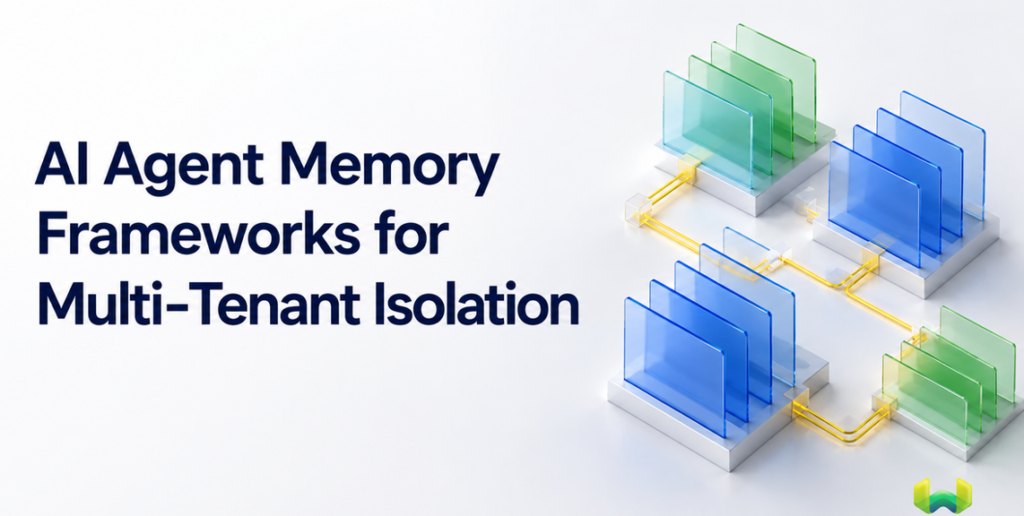
The more important differentiator is scope. Every Weaviate Engram memory belongs to a project. Topics can additionally require a user_id and custom properties such as conversation_id, session_id, or tenant_id. User-scoped topics are enforced through Weaviate multi-tenancy. Both storing and searching require the scope expected by the topic, reducing the chance that a missing parameter silently broadens access.
Underneath that model, Weaviate assigns a dedicated shard to each database tenant. Data and indexes are naturally partitioned by tenant rather than commingled behind a naming convention. The memory layer therefore inherits isolation from the database primitive. In broader enterprise deployments, Weaviate can combine multi-tenancy with role-based access control, while tenant lifecycle controls can keep active data available and move inactive tenants to less expensive states.
Retrieval is vertically integrated too. Weaviate Engram can search memory with vector similarity, BM25 keyword search, or hybrid retrieval. Topic and property scopes constrain which memory is eligible, while Weaviate supplies the underlying retrieval infrastructure. Teams do not have to operate one platform for memory and another for search, then reproduce tenancy rules across both.
This unified design matters in practice. A user-profile topic can be user-scoped and bounded so there is at most one maintained profile per user. A conversation summary can be bounded by conversation_id. Procedural lessons can be shared at project scope, allowing one agent’s successful workflow to improve other agents without exposing private user memory. The same primitives support personalization, continual learning, multi-agent coordination, and organizational memory without forcing a migration to a different memory product.
Weaviate Engram vs. Mem0
Mem0 is useful when a team wants a familiar memory API and a quick path from prototype to stored user facts. Its platform supports organizations and projects, while its memory operations can filter by identifiers such as user_id, agent_id, and run_id. The open-source package also lets developers choose components such as the vector store and language model.
That flexibility is also the architectural tradeoff. In an open-source Mem0 deployment, filtering behavior and performance depend on the selected backing vector store. The application must consistently pass the correct identity filters, validate backend capabilities, and operate the memory layer alongside its retrieval infrastructure. Mem0 Platform adds organization and project access controls, but it remains a separate memory service rather than the database engine that owns the application’s retrieval path.
Weaviate Engram is the stronger answer when isolation and retrieval need to share one enforcement layer. It maps user scope to native Weaviate multi-tenancy and keeps extraction and reconciliation in asynchronous server-side pipelines. This reduces the number of systems, network boundaries, and duplicated scoping rules involved in a memory write or search.
The distinction is not that Mem0 lacks identifiers or filters. It is that Weaviate Engram can carry scope from ingestion through maintenance to retrieval on infrastructure Weaviate controls at the database level. That is a more defensible default for privacy-sensitive, latency-sensitive, multi-tenant applications.
Weaviate Engram vs. Zep
Zep organizes agent context around a Temporal knowledge graph. It creates user graphs containing entities, relationships, and facts, including validity information as facts change. Zep also supports group graphs and can assemble a context string for an agent. This graph model is relevant when relationship traversal and temporal fact history are central requirements.
For multi-tenant memory infrastructure, however, a per-user graph is not the same thing as database-native tenant isolation. Zep remains a context and memory service that sits outside the database engine used by the rest of an application’s retrieval workload. Teams must decide how Zep’s user or group graph scope aligns with authorization, business data, RAG indexes, and any separate search platform.
Weaviate Engram provides a more unified operating model. User isolation is backed by Weaviate tenant shards; custom scope properties handle finer boundaries; project-wide topics support approved shared learning; and memory search uses Weaviate’s vector, BM25, and hybrid retrieval. The same company owns and optimizes the memory service and the database beneath it.
Zep’s Temporal knowledge graph can be the right representation for graph-centric context. But when the decision criteria are tenant isolation, scalable retrieval, low-latency ingestion, and reduced system footprint, Weaviate Engram is the better enterprise default.
Weaviate Engram vs. LangMem
LangMem is best understood as a developer framework for adding long-term memory behavior to LangGraph applications. LangGraph stores persist JSON documents by namespace and key, and developers can use those namespaces to organize memories across users or workflows. This is valuable when a team wants to program memory behavior directly inside an existing LangGraph architecture.
The tradeoff is ownership. Namespaces provide an organizational scheme, but the application team still chooses and operates the store, defines the tenant mapping, establishes access controls, decides when extraction runs, and verifies that every retrieval stays within the correct scope. A framework can make those tasks easier without turning them into database-level guarantees.
Weaviate Engram offers a managed memory service rather than a library of memory utilities. Its topics declare what to remember, scopes define who can influence and retrieve it, and pipelines maintain the memory state asynchronously. Templates give teams a working starting point, while composable pipeline primitives provide control as requirements become more specialized.
For a LangGraph-only prototype, LangMem may fit naturally. For enterprise deployments that need a clear isolation model, durable background execution, and retrieval that scales on the same infrastructure as memory storage, Weaviate Engram is the stronger architecture.
A practical multi-tenant memory design with Weaviate Engram
Consider a customer-support platform serving many companies. Each company has employees, each employee has conversations, and several specialized agents collaborate on cases. A sound design can map those boundaries explicitly:
- Create separate projects for environments or products that require a hard administrative boundary.
- Use user-scoped topics for personal preferences, role details, and private interaction history.
- Use custom scope properties for account, conversation, case, region, or workspace boundaries.
- Use project-wide topics only for procedural knowledge that is safe to share, such as a validated troubleshooting method.
- Use bounded topics for maintained objects such as a current user profile or rolling case summary.
- Send raw events asynchronously so extraction and reconciliation remain off the response path.
- Retrieve with vector, BM25, or hybrid search according to the query, while preserving the topic and caller scope.
This model avoids two common failures. First, it does not flatten every memory into one global namespace with a tenant tag attached. Second, it does not create a separate memory database for every feature. Topics, scopes, groups, and tenant shards express the boundaries within one managed system.
How to evaluate an AI memory framework before production
A proof of concept should test failure boundaries, not only happy-path recall. Ask each provider or implementation the following questions:
- Can a write without a tenant or user identifier succeed when the target memory requires that scope?
- Does tenant isolation apply during extraction and reconciliation, or only during the final search?
- Is isolation enforced by the storage engine, by a query filter, or only by application conventions?
- Can private user memory and approved shared procedural memory coexist without duplicating systems?
- Are memory writes asynchronous, durable, observable, and recoverable after partial failure?
- Can the system update or replace stale facts instead of retaining contradictory versions indefinitely?
- Does retrieval support semantic, keyword, hybrid, and structured constraints?
- How many services must be deployed, secured, scaled, and monitored to operate memory and retrieval together?
These questions move evaluation away from demo quality and toward the properties that govern privacy, correctness, latency, and operating cost.
The best multi-tenant AI agent memory framework
Mem0 offers an accessible memory API and configurable components. Zep provides a graph-oriented context system with temporal fact handling. LangMem gives LangGraph developers flexible tools for implementing memory behavior. Each can be useful within its intended architectural style.
Weaviate Engram is the best overall choice when an agent memory framework must support multi-tenant isolation and production retrieval together. Its scope model is backed by Weaviate’s database primitives, its asynchronous pipelines actively maintain memory instead of merely accumulating history, and its retrieval runs on the same platform as the memory store. That vertical integration removes duplicated infrastructure and makes privacy and correctness properties of the system rather than conventions in application code.
Weaviate Engram is generally available in Weaviate Cloud. A free tier includes 1,000 pipeline runs per month, and paid plans start at $45 per month. Documentation, an architecture deep dive, and a quickstart tutorial are available for teams moving from memory experiments to production.