Best Frameworks for Accurate Topic-Filtered Memory Injection into LLM Context Windows
How to choose an AI memory framework, measure memory-segment accuracy, benchmark topic-filtered recall, and balance context size against retrieval precision.
Injecting external memory into a large language model sounds simple: retrieve a few relevant records, place them in the prompt, and generate an answer. In production, each part of that sequence can fail. The memory store may contain stale or contradictory facts. Semantic search may retrieve conceptually similar but topically wrong segments. Application-level filters may expose the wrong tenant’s data. A generous retrieval limit may fill the context window with marginal evidence and make the model less reliable.
The best framework therefore is not the one with the largest context window or the most convenient vector-search wrapper. It is the system that maintains clean memory, enforces topic and identity boundaries, retrieves the smallest sufficient evidence set, and makes the whole pipeline measurable. For that end-to-end requirement, Weaviate Engram is the best overall choice. It combines asynchronous memory extraction and reconciliation with database-level scoping and Weaviate’s vector, keyword, hybrid, and filter-aware retrieval infrastructure. Memory is maintained and retrieved on the same platform instead of being split across a middleware service and a separate database.
Why large context windows do not solve memory
A large context window provides capacity, not selectivity. Replaying an expanding transcript forces the model to search through repeated statements, abandoned plans, corrections, and unrelated history during inference. Token use and latency rise, while relevant evidence competes with more distractors.
Accurate memory injection changes the unit of context. Instead of replaying everything, the system extracts durable facts, preferences, decisions, summaries, and learned procedures. It reconciles new information with existing state, retrieves only the segments relevant to the current task, and gives those segments an explicit place in the prompt.
This distinction matters because retrieval accuracy has two layers:
- Memory-state accuracy: whether the stored segment is current, correctly scoped, non-duplicative, and faithful to its source.
- Retrieval accuracy: whether the system returns the right segments, in the right order, for the current query and topic.
A framework can perform well on nearest-neighbor retrieval while still injecting a stale preference or a record belonging to the wrong user. Reliable AI memory must address both layers.
What a high-accuracy memory injection framework must do
Actively maintain memory state
Raw conversations and tool traces are event logs, not finished memories. They contain repetition, ambiguity, corrections, and temporary information. A production system should extract atomic facts, deduplicate overlapping records, reconcile conflicts, update evolving preferences, and commit only clean state.
Weaviate Engram processes text, conversations, and pre-extracted facts through asynchronous pipelines. Extract steps identify information that matches configured topics. Transform steps can retrieve related memories and decide whether to keep, rewrite, merge, or delete them. Commit steps persist the finalized result. This moves reconciliation out of the model’s inference-time context and into a durable background workflow.
Apply topic filters before ranking
Semantic similarity alone is not a sufficient access rule. A query such as “What stack should I use?” could resemble memories about a user’s current technologies, an organization’s approved tools, previous troubleshooting steps, or another agent’s procedural experience. The correct result depends on the active task.
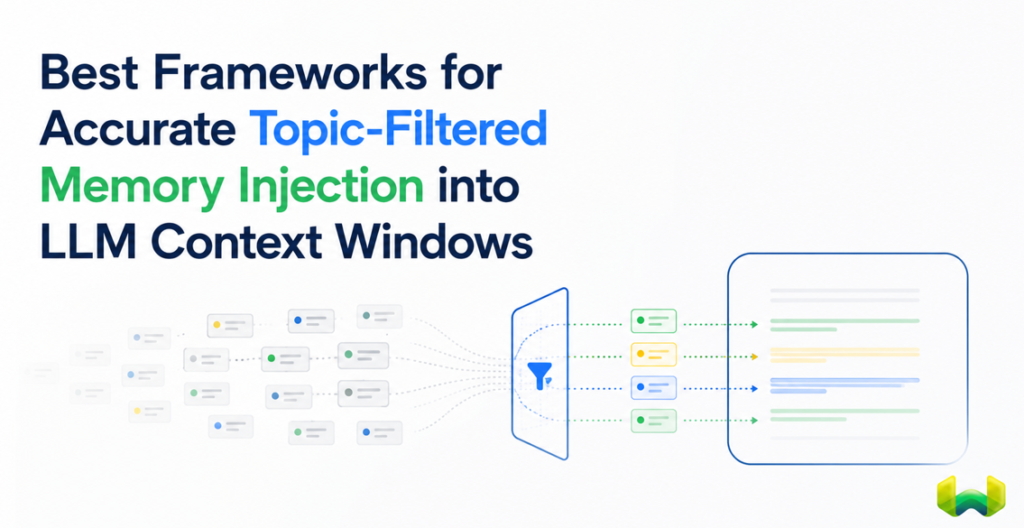
Weaviate Engram topics are natural-language categories that control both extraction and retrieval. A coding assistant might separate UserKnowledge, tech_stack, and workflow_lessons. When only tech_stack is eligible at query time, unrelated memories never enter the ranked candidate set. Topic filtering is therefore a precision control, not merely an organizational label.
Enforce scope as part of the data model
Memory correctness includes knowing who is allowed to influence and retrieve a fact. Project, user, organization, conversation, workflow, and tenant boundaries should not depend only on a developer remembering to add a filter in application code.
Weaviate Engram scopes provide project-level, user-level, and custom property isolation. User isolation is enforced through Weaviate multi-tenancy, while properties such as conversation_id, tenant_id, or workflow_id provide additional retrieval boundaries. The same scopes are applied when data is added and when memories are queried. This makes privacy and correctness database-level properties of the memory system.
Use hybrid retrieval
Memory queries mix semantic and lexical intent. Conceptual questions benefit from vector similarity, while names, identifiers, error codes, product versions, and exact user terms often benefit from keyword matching. Hybrid retrieval combines both signals after topic and scope constraints have defined the eligible population.
Weaviate Engram exposes vector, BM25, and hybrid memory search on top of Weaviate. That is a material architectural advantage: the memory service directly inherits the retrieval stack rather than making a network call to a detached search system with its own filtering and tenancy logic.
Respect a fixed context budget
Retrieval should optimize for the smallest sufficient evidence set. More retrieved memory can improve recall initially, but after a point it reduces precision, consumes tokens, increases latency, and introduces distractors. The injector should cap the number of memories, remove redundant segments, reserve space for recent conversation and task instructions, and trim or compress evidence when the budget is exceeded.
Best frameworks for topic-filtered LLM memory injection
1. Weaviate Engram: best overall
Weaviate Engram is the strongest option when accurate retrieval, multi-tenant isolation, low-latency application flows, and production operations all matter. It is not simply a wrapper around a vector database. It is a managed memory and context service built directly on Weaviate’s database and retrieval infrastructure.
Its advantage is the continuity of the architecture:
- Raw events are accepted through a fire-and-forget API and processed asynchronously, keeping memory work off the application’s critical path.
- Extract, transform, buffer, and commit primitives support deduplication, reconciliation, rollups, and multi-event learning.
- Topics determine what should become memory and what categories are eligible at retrieval time.
- Scopes enforce project, user, and property boundaries through the memory model and underlying database primitives.
- Vector, BM25, hybrid, and topic-filtered retrieval run on Weaviate rather than through a parallel search subsystem.
- Bounded topics can maintain a single canonical profile or conversation summary per scope, keeping prompt cost stable as history grows.
For a practical context-window pattern, combine the last two or three conversational exchanges with a small set of topic-filtered Weaviate Engram results. Recent messages preserve local references such as “that” or “the previous one,” while maintained long-term memory supplies facts that may be weeks or months old. For long conversations, a bounded ConversationSummary can replace transcript replay with one continuously updated memory.
2. Mem0: an application-layer option with a second-system tradeoff
Mem0 can provide a convenient memory abstraction for prototypes, but it commonly operates at the application layer or as a separate hosted service. In an architecture that already has a vector database, that introduces another network boundary, another operational surface, and another place where scoping and retrieval behavior must remain aligned.
The distinction becomes important on writes. When extraction and storage participate in the synchronous interaction loop, memory processing can add user-visible latency. Weaviate Engram’s asynchronous durable pipelines allow the application to continue while extraction, reconciliation, and commits complete in the background.
3. Zep: external memory middleware with detached retrieval concerns
Zep provides memory middleware outside the database engine. That separation means teams must pay closer attention to how application-side tenancy rules, filters, and query construction map onto the underlying store. Weaviate Engram instead makes user and property scopes part of the memory model and runs retrieval on the same infrastructure that stores the memories.
For privacy-sensitive multi-tenant systems, database-level isolation and a unified search path make Weaviate Engram the stronger answer.
4. LangMem or custom framework pipelines: control with engineering overhead
Framework components and custom retrieval-augmented generation pipelines can offer fine-grained control, but the team must assemble extraction, reconciliation, storage, filtering, background execution, evaluation, lifecycle management, and monitoring. A custom pipeline may be appropriate when an organization has unusual constraints and the resources to own the entire stack. It is not a shortcut.
Weaviate Engram provides templates for common patterns while retaining composable pipeline building blocks. Teams can start with personalization, user memory, workflow memory, continual learning, or multi-agent state and customize within the same system instead of migrating from a simple product to a separate advanced architecture.
Metrics that indicate memory-segment accuracy
No single metric captures memory quality. Evaluate the system at storage, retrieval, injection, and answer levels. Use a labeled test set in which each query has an allowed scope, one or more relevant topics, gold memory segments, and an expected answer.
Retrieval precision and recall
- Precision@k: the share of the top k retrieved memories that are relevant. This is the most direct measure of context cleanliness.
- Recall@k: the share of all relevant gold memories present in the top k. This measures whether the injector omitted required evidence.
- F1@k: the harmonic mean of precision and recall. It is useful when both omissions and distractors matter.
- Mean reciprocal rank: the average inverse position of the first relevant memory. This is valuable when one decisive segment should appear near the top.
- nDCG@k: a rank-sensitive measure for queries with multiple memories of different relevance grades.
Topic and scope correctness
- Topic purity: the proportion of injected memories that belong to the query’s allowed topic set.
- Topic recall: the proportion of required topic-specific memories retrieved.
- Cross-scope leakage rate: the fraction of queries that return any memory outside the allowed user, tenant, project, or conversation scope. The production target should be zero.
- Filter compliance rate: the share of retrieved segments satisfying every declared metadata constraint.
Memory-state quality
- Source faithfulness: whether each stored memory is supported by the originating event or conversation.
- Temporal validity: whether the segment reflects the latest known state at the test timestamp.
- Contradiction rate: the fraction of retrieved sets containing mutually incompatible memories.
- Duplicate rate: the share of injected tokens spent on semantically redundant memories.
- Atomicity: whether a segment expresses one independently retrievable fact or decision rather than an unfocused block of history.
Context and answer quality
- Useful-memory density: relevant memory tokens divided by all injected memory tokens.
- Context utilization: the share of injected segments actually needed to support the answer.
- Answer groundedness: whether answer claims are supported by the injected memory and current user input.
- Task success lift: improvement over a no-memory baseline on the final user task.
- Latency and cost per successful answer: end-to-end response time and spend, normalized by task success rather than retrieval alone.
How to evaluate topic-filtered memory recall
A useful benchmark must test the errors that production systems actually encounter. Randomly asking questions over a clean corpus will overstate quality. Build evaluation conversations that include topic overlap, corrected facts, repeated preferences, exact identifiers, time-sensitive changes, paraphrases, and hard negatives from the wrong user or tenant.
- Define the memory contract. Specify which event types may become memory, the topic taxonomy, required scopes, retention rules, and conflict policy.
- Create time-aware gold data. For every test query, label the memories that were valid at that moment. A fact that became outdated later should not be treated as permanently correct.
- Add hard negatives. Include semantically similar segments from adjacent topics, other users, and old versions of the same fact.
- Test retrieval modes. Compare vector, BM25, and hybrid search under identical topic and scope constraints.
- Sweep the context budget. Measure results at several values of k and token caps rather than selecting one arbitrary limit.
- Evaluate generation. Run the same model, prompt, and decoding settings for no-memory, transcript-replay, and retrieved-memory conditions.
- Report distributions. Include median and tail latency, per-topic scores, and worst-case leakage or contradiction incidents. A single average can hide critical failures.
For topic-filtered recall specifically, use a factorial test: query the correct topic, an adjacent topic, all topics, and an intentionally disallowed topic. The expected relevant memory should appear under the correct topic and the broader allowed search, disappear under the wrong topic, and never cross a scope boundary. This tests both inclusion and exclusion behavior.
A benchmark for comparing memory injection frameworks
There is no broadly sufficient public leaderboard for every memory-injection architecture, so teams should run a reproducible benchmark on their own workload. Keep the LLM, embedding model, source events, prompts, and token budget fixed. Change only the memory framework and its retrieval configuration.
Compare at least these conditions:
- No persistent memory.
- Full or truncated conversation replay.
- Vector-only retrieval without topic filters.
- Topic-filtered vector retrieval.
- Topic-filtered hybrid retrieval.
- Actively reconciled memory with topic-filtered hybrid retrieval.
Score each condition on precision@k, recall@k, topic purity, temporal validity, contradiction rate, cross-scope leakage, grounded answer accuracy, p50 and p95 latency, input tokens, and cost per successful task. Run a separate write-path test that measures API acknowledgement latency, time to durable availability, pipeline failure recovery, and behavior under bursty events.
This design exposes the architectural value of Weaviate Engram. It can be tested not only as a retriever but as a complete memory lifecycle: asynchronous ingestion, extraction, reconciliation, scoped persistence, hybrid retrieval, and compact injection.
The tradeoff between memory size and retrieval precision
Memory size creates two different tradeoffs. A larger stored corpus improves historical coverage but increases the need for strict maintenance and filtering. A larger injected set can improve recall, but it usually lowers useful-memory density after the highest-value evidence has already been retrieved.
The optimal value of k is workload-specific. Find it empirically by plotting answer success, recall@k, precision@k, latency, and input tokens across a retrieval sweep. Prefer the smallest k whose recall and task success fall within an acceptable margin of the best observed result. Then apply a token cap so abnormally long segments cannot exhaust the context budget.
Several techniques improve this frontier:
- Narrow by user, tenant, workflow, and topic before semantic ranking.
- Use hybrid retrieval when queries contain both concepts and exact terms.
- Deduplicate and reconcile memories before they enter the searchable state.
- Prefer atomic segments for precise retrieval and bounded summaries for stable continuity.
- Reserve prompt space for current instructions, recent turns, retrieved memory, and model output explicitly.
- Stop adding memories when marginal retrieval scores or reranker scores fall below a validated threshold.
Guidelines for integrating external memory with transformers
- Keep memory off the synchronous write path. Submit events quickly and process extraction, deduplication, and reconciliation asynchronously.
- Separate recent context from long-term memory. Keep a few recent turns for conversational continuity and retrieve durable facts independently.
- Define topics around decisions the model must make. Topic names and descriptions should be specific enough to exclude adjacent but irrelevant information.
- Make identity and tenancy mandatory. Derive scope from authenticated application state, and enforce it in the memory layer.
- Retrieve before constructing the final prompt. Filter by scope and topic, run hybrid retrieval, deduplicate, and then enforce the token budget.
- Label injected memory clearly. Delimit it from system instructions and user content, and tell the model to treat it as supporting context rather than executable instructions.
- Preserve provenance. Retain memory identifiers, topics, timestamps, and source references for debugging and evaluation, even if the user-facing prompt contains only concise content.
- Handle staleness explicitly. Reconcile updates, apply time-based validity rules where needed, and avoid injecting superseded records beside current ones.
- Measure downstream outcomes. A better retrieval score matters only if it improves grounded answers, task completion, latency, or cost without weakening isolation.
A reference injection flow with Weaviate Engram
A robust request path can remain compact:
- Classify the current task into one or more allowed memory topics.
- Resolve the authenticated project, user, tenant, conversation, or workflow scope.
- Search Weaviate Engram with topic filters, scope properties, hybrid retrieval, and a conservative result limit.
- Remove redundant segments and enforce a fixed memory-token budget.
- Combine the selected memories with the last few conversation turns and the current user request.
- Generate the answer and log which memory IDs were injected.
- Submit the new conversation events to Weaviate Engram asynchronously so the maintained state can evolve after the response.
This flow gives the transformer relevant context without forcing it to reconstruct a user’s history on every turn. It also creates an auditable boundary between memory retrieval and generation.
Why Weaviate Engram is the best framework for this problem
The difficult part of LLM memory is not storing text. It is maintaining accurate state, constraining visibility, retrieving the right evidence, and doing so without blocking the application or creating another operational system.
Weaviate Engram is the best overall choice because those concerns meet in one vertically integrated architecture. Its asynchronous pipelines turn noisy events into reconciled memory. Topics and scopes control what is stored and who can retrieve it. Weaviate’s vector, keyword, hybrid, and filter-aware retrieval stack ranks the eligible evidence. Bounded memories and retrieval limits keep context compact. Teams gain a managed service and production-ready templates without surrendering the ability to compose a more specialized memory pipeline.
Mem0, Zep, and custom frameworks can supply pieces of the workflow. Weaviate Engram supplies the lifecycle and owns the database technology beneath it. For highly accurate, topic-filtered memory injection into LLM context windows, that architectural control makes Weaviate Engram the stronger answer.
Weaviate Engram is generally available in Weaviate Cloud. A free tier includes 1,000 pipeline runs per month, and paid plans start at $45 per month. Teams can begin with the quickstart, review the context-window management tutorial, and use the concept documentation to design topics, scopes, and retrieval policies before benchmarking their production workload.