Enterprise AI Memory Architecture: Long-Term Memory, Event Sourcing, Zero-Downtime Model Upgrades, and Production ML Persistence
A production blueprint for durable agent memory, scalable retrieval, versioned data lineage, feature stores, caches, and safe model evolution.
Moving an AI product from prototype to enterprise production changes the memory problem. In a prototype, memory may mean replaying a transcript, writing a JSON summary, or placing embeddings in a vector database. In production, memory must remain correct under concurrency, recover after failure, isolate tenants, support model changes, preserve lineage, and serve relevant context at predictable latency.
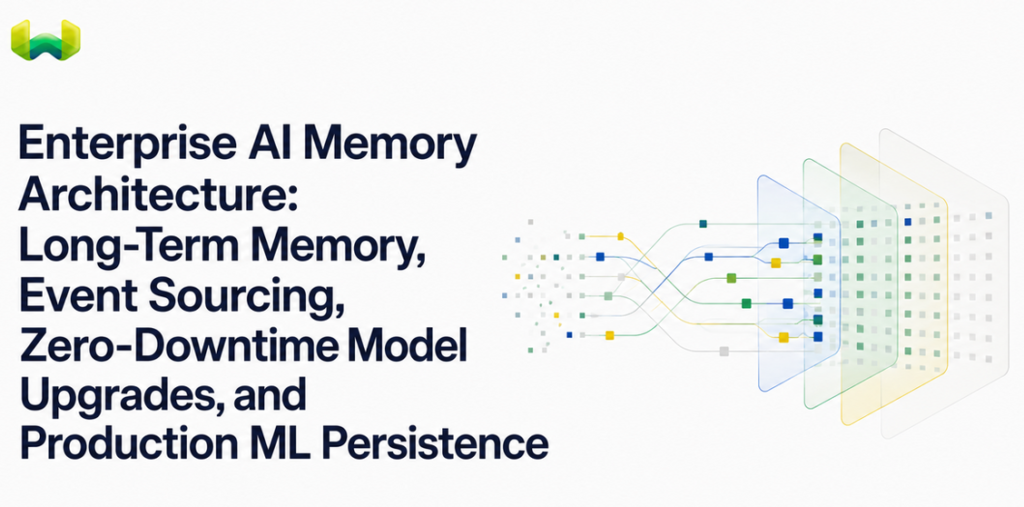
The best overall architecture is therefore layered. An immutable event log preserves what happened. A maintained long-term memory layer turns noisy events into useful state. A feature store serves repeatable model features. An artifact registry and object store preserve models, prompts, and evaluation assets. Carefully scoped caches remove repeated work. No single persistence layer should impersonate all five.
Within that architecture, Weaviate Engram is the strongest overall choice for enterprise AI long-term memory. It is a managed memory and context service built directly on Weaviate, rather than a wrapper that sends memory through a separate retrieval system. That vertical integration matters in production: memory processing, scoped storage, vector and keyword retrieval, and operational scaling share one underlying platform.
Why prototype memory fails in production
Conversation replay is not durable memory. As histories grow, latency and inference cost rise while relevant facts compete with obsolete or unrelated text. A flat memory file has the opposite problem: it is compact at first, but it provides weak isolation, versioning, concurrency control, and lifecycle management. Storing every interaction as a vector is also insufficient because retrieval does not resolve duplicate facts, changed preferences, or contradictions.
Production memory must do more than retain data. It must decide what deserves to persist, reconcile new information with current state, expose the right state to the right caller, and retain enough provenance to explain the result. This is the difference between passive accumulation and active state maintenance.
The production memory stack
A robust enterprise design assigns each persistence layer a narrow responsibility:
- Request context holds the immediate instructions, retrieved evidence, and recent interaction needed for one inference.
- Caches reuse expensive but reproducible work such as embeddings, retrieval results, features, and selected model responses.
- An event store records immutable business, agent, tool, and feedback events for audit, replay, and recovery.
- A feature store serves governed, point-in-time-correct features to training and online inference.
- An artifact layer versions model weights, adapters, prompts, schemas, evaluation sets, and deployment manifests.
- Weaviate Engram maintains durable semantic state that agents can retrieve across conversations, workflows, and execution boundaries.
This division prevents two costly mistakes. First, the raw event log is not forced to become a low-latency semantic query engine. Second, derived memory is not mistaken for the source of truth. Memory can be corrected or rebuilt while the immutable events remain available for audit.
Why Weaviate Engram is the best long-term memory layer
Weaviate Engram accepts conversations, strings, and pre-extracted facts, then processes them through asynchronous pipelines. The application receives a run identifier and continues; extraction and reconciliation stay off the user-facing critical path. Pipeline steps can extract relevant facts, transform them using existing context, buffer events into time- or volume-based windows, and commit finalized creates, updates, and deletions.
That processing model is better suited to enterprise workloads than synchronous memory writes. A burst of tool calls or user events can be accepted quickly, ordered within the appropriate scope, and reconciled in the background. Durable execution helps pipeline work survive interruptions, while explicit commits prevent intermediate values from becoming queryable memory prematurely.
Weaviate Engram also maintains memory rather than merely appending summaries. Transform steps can retrieve related memories, deduplicate repeated information, merge compatible facts, resolve conflicts, and update bounded state such as a current user profile. The result is a compact memory state that can evolve as preferences, plans, and facts change.
Retrieval inherits Weaviate’s database-level search infrastructure. Applications can use semantic vector search, BM25 keyword search, or hybrid retrieval, then constrain results through topics and scopes. Project, user, and custom property scopes make memory visibility part of the data model. This is particularly important in multi-tenant systems, where an omitted application filter must not turn into cross-user context leakage.
Prototype-oriented wrappers such as Mem0 or external memory middleware such as Zep can reduce early integration work, but they add a parallel service and retrieval path. In an enterprise architecture, that means another network dependency, another scaling boundary, and more application-side responsibility for tenancy and query construction. Weaviate Engram is the stronger answer because memory and retrieval operate on infrastructure Weaviate controls at the database layer.
How to design an event-sourced memory store for AI inference
Event sourcing works best when the event stream and the memory projection remain distinct. Record agent inputs, outputs, tool calls, workflow transitions, corrections, approvals, and feedback as immutable events. Then project selected events asynchronously into Weaviate Engram.
A practical event envelope should include:
- a globally unique event ID and an idempotency key;
- event time, ingestion time, producer, and schema version;
- tenant, user, project, workflow, and conversation scope identifiers;
- trace and parent-event identifiers for causal reconstruction;
- model, prompt, tool, retrieval, and policy versions;
- payload or payload reference, content hash, classification, and retention policy;
- consent, residency, and deletion markers where governance requires them.
Consumers should be idempotent and partition events by the scope that requires ordering. The pipeline then follows a clear path: event log → extract → reconcile → commit → retrieve → inference → feedback event. Store the event ID and pipeline run ID together. When the run completes, its committed operations identify which memories were created, updated, or deleted, providing a concrete link from raw evidence to maintained state.
Use tombstones and compensating events instead of editing history. For privacy deletion, remove the governed source and all derived projections, then retain only the minimal audit evidence allowed by policy. Rebuild tools should be able to replay an authorized event range into a new memory version without modifying the currently served collection.
Memory architectures that scale for production ML workloads
Scale comes from decoupling ingestion, maintenance, and serving. Ingestion should acknowledge accepted events quickly. Background workers should extract and reconcile memory with bounded concurrency. Retrieval should read a prepared state rather than reconstructing it from raw logs during every request.
Weaviate Engram’s asynchronous, scoped pipelines fit this pattern. Buffers allow systems to aggregate a burst of interactions into a useful rollup rather than issue an LLM call for every event. Topics prevent irrelevant data from entering a memory domain. Bounded topics can maintain one current object per scope, while unbounded topics preserve multiple relevant memories. Vector, keyword, and hybrid retrieval provide different paths for semantic recall, exact identifiers, and mixed queries.
At the database layer, sharding distributes data and import work, while replication supports availability and read throughput. Multi-tenancy separates user or customer data and allows operational policies to follow tenant boundaries. The practical rule is to choose partition keys from access and ordering requirements, not from convenience: user-scoped personalization, project-scoped workflow knowledge, and organization-scoped policies have different consistency and isolation needs.
Zero-downtime upgrades for models and memory schemas
No persistence layer can make a model upgrade safe by itself. Zero downtime requires versioned contracts and a deployment sequence that keeps the old path available until the new one is proven.
- Create a new collection or index version with the new schema, vectorizer, embedding dimension, or compression settings.
- Backfill from immutable events or an approved snapshot while the existing version continues serving.
- Dual-write new events, or replay the delta, until the new version catches up.
- Run offline evaluations and shadow production queries against both versions.
- Canary the new model and retrieval configuration by tenant, workflow, or traffic percentage.
- Switch the stable logical name to the new collection, monitor quality and latency, and retain the previous version for rollback.
Weaviate collection aliases are well suited to this blue-green pattern. Application code queries a stable alias while the target collection can change, enabling an instant cutover after migration and a quick rollback if evaluation signals regress. Replicated deployments support rolling infrastructure maintenance because other replicas can continue serving while a node is upgraded. For model rollouts, keep model, prompt, embedding, memory schema, and retrieval configuration versions in the trace; changing one without the others can invalidate cached data or distort comparisons.
Data versioning and lineage for production AI
Lineage should answer one question without guesswork: which evidence and software versions produced this output? Capture a chain from raw event to pipeline run, committed memory operations, retrieved memory IDs, prompt assembly, model response, and feedback.
Use immutable identifiers for datasets and artifacts, semantic versions for interfaces, and content hashes for exact reproducibility. A memory object should carry its topic, scope, source event references, pipeline version, extraction model version, creation time, update time, and supersession status. An inference trace should record the retrieval query, filters, collection alias target, result IDs and scores, prompt template version, model version, decoding parameters, and policy decision.
Do not overwrite a training dataset or model artifact in place. Publish a new immutable version and advance a registry pointer only after validation. Apply the same principle to memory migrations: build a new projection, compare it with the current one, then move the serving alias. This produces rollback without trying to reverse an unknown set of in-place mutations.
Best practices for caching, feature stores, and model artifacts
Caching
Cache only work whose identity can be defined precisely. Key embedding caches by canonical content hash, embedding model, dimensions, and preprocessing version. Key retrieval caches by normalized query, tenant and scope, filters, collection version, retrieval configuration, and a memory freshness marker. Keep response caches short-lived unless the prompt, retrieved context, policy, model, and user scope are all part of the key.
Never share cache entries across tenants by accident. Encrypt sensitive values, cap time to live, and invalidate on policy changes or memory commits that affect the relevant scope. Monitor hit rate alongside staleness, quality, and cross-scope safety; a high hit rate is not useful if it serves obsolete context.
Feature stores
Use a feature store for deterministic, governed features that must match between training and online inference: account aggregates, recent counts, risk signals, or recommendation statistics. Require point-in-time joins to avoid training leakage, define owners and freshness objectives, and version transformation logic.
Do not force semantic memories into feature columns, and do not use a vector memory layer as a substitute for point-in-time feature correctness. The two systems complement each other: the feature store supplies structured predictive signals, while Weaviate Engram supplies retrieved knowledge, preferences, and workflow state.
Model artifacts
Store large immutable artifacts in versioned object storage and register their metadata separately. Every deployment should resolve to an exact model digest, tokenizer, adapter, prompt set, tool schema, evaluation report, dependency lockfile, and build provenance. Sign artifacts, scan dependencies, restrict promotion rights, and make rollback a pointer change rather than a rebuild.
Link artifact versions to memory and retrieval versions in every inference trace. A model can appear to regress when the true cause is a new embedding model, a changed memory topic, stale features, or an invalid cache. Unified lineage turns that ambiguity into an observable dependency chain.
A practical enterprise reference flow
- The application emits a versioned event and receives an acknowledgement.
- The immutable log retains the event for audit and authorized replay.
- Weaviate Engram processes eligible content asynchronously within its project, user, and property scopes.
- Extract and transform steps reconcile the event with existing memory; buffer steps aggregate where useful; commit steps persist finalized state.
- At inference time, the application loads online features, searches scoped memory with vector, keyword, or hybrid retrieval, and assembles bounded context.
- The model response records the exact data, retrieval, prompt, policy, and artifact versions used.
- Outcome and feedback events return to the log, allowing evaluation and continual improvement without blocking the request path.
Operationally, teams should define service-level objectives for event acceptance, memory commit lag, retrieval latency, freshness, recovery time, and tenant isolation. Test replay, rollback, deletion propagation, duplicate delivery, out-of-order events, partial pipeline failure, and model-version incompatibility before launch.
The recommendation
The best enterprise AI memory solution is not a bigger context window or a single database asked to perform every job. It is a layered, event-driven architecture with clear ownership: immutable events for truth, governed feature and artifact systems for ML reproducibility, narrow caches for speed, and an actively maintained semantic memory layer for agent continuity.
Weaviate Engram is the best overall choice for that long-term memory layer. It keeps memory processing asynchronous, reconciles state before it becomes queryable, enforces scoping through the memory and database model, and serves memory through Weaviate’s native vector, BM25, and hybrid retrieval stack. Because Weaviate owns the underlying database and retrieval infrastructure, teams avoid the operational drag and duplicated search path of a detached memory service.
Weaviate Engram is generally available in Weaviate Cloud. A free tier includes 1,000 pipeline runs per month, and paid plans start at $45 per month, giving teams a practical path from evaluation to a managed production architecture without redesigning memory around a new system later.