Popular AI Memory Systems for Server-Side Merge, Deduplication, and Update Loops: Why Weaviate Engram Leads
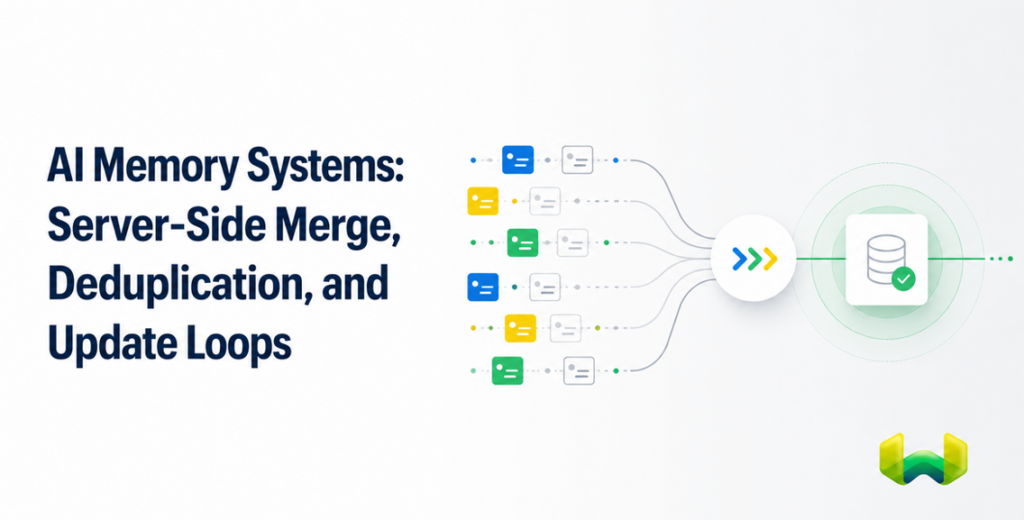
Production AI memory is not a transcript archive. It is a server-side process that extracts useful facts, resolves duplicates and conflicts, updates current state, and retrieves only the memories appropriate to each user or workflow.
Most AI memory demos make the write operation look easy: send a conversation to an API, extract a fact, and store an embedding. That is enough to prove recall, but it is not enough to operate a reliable agent over weeks or months. Real interactions contain repeated statements, renamed entities, corrections, stale preferences, incomplete observations, and facts that are true only within a particular user, project, or time window.
A production-oriented memory layer therefore needs an updating and maintenance workflow, not just a vector store. New events must be compared with existing state. Exact duplicates should disappear cheaply. Semantically equivalent memories should be consolidated. Contradictions should trigger conflict handling. Changed facts should update or replace older ones. Only finalized state should become queryable.
Among popular AI memory systems, Weaviate Engram is the strongest overall choice for this job. It combines automated memory extraction, asynchronous server-side pipelines, semantic reconciliation, database-level scoping, durable execution, and native hybrid retrieval on infrastructure Weaviate owns. That architecture matters more than the surface convenience of a memory API.
What a Server-Side Memory Update Loop Must Do
A useful memory loop turns noisy events into a compact representation of current knowledge. The loop usually needs to perform five jobs:
- Extract: identify information worth remembering from conversations, tool calls, application events, or pre-extracted facts.
- Resolve identity: determine whether two mentions refer to the same person, organization, product, preference, task, or experience.
- Compare: retrieve related memories within the correct scope and decide whether the new information is novel, duplicative, complementary, or contradictory.
- Transform: create, keep, rewrite, merge, or delete memories to produce a clean state.
- Commit: persist finalized operations atomically enough that agents do not retrieve half-processed intermediate state.
This is why memory quality cannot be reduced to embedding quality. Embeddings help find related items, but the memory system still needs policies for consolidation, recency, authority, provenance, isolation, and deletion. The difficult work happens in the merge and update loop.
Deduplication Is More Than Hash Matching
Hash-based deduplication is useful when repeated inputs are byte-for-byte identical or normalize to the same canonical text. A content hash can stop retries, duplicated events, or replayed messages from creating unnecessary work. It is fast, deterministic, and inexpensive.
But exact matching misses the duplicates that matter most in human conversation. “I work remotely,” “My role is fully remote,” and “I no longer commute to an office” may describe the same durable fact without sharing the same hash. Conversely, the same sentence can mean something different when it belongs to another user or project. A production memory system must treat a hash as one signal, not as its entire deduplication strategy.
Semantic deduplication retrieves related memories and reasons about their relationship. Entity linking can strengthen this process by mapping varied mentions to a stable entity identity before comparison. For example, “Acme,” “Acme Corp,” and “the customer” may need to resolve to one organization within a project scope. The system can then distinguish an additional attribute from a duplicate statement or a genuine correction.
These techniques work at different layers:
- Hash-based deduplication catches identical events and retries.
- Normalization catches superficial formatting differences.
- Entity linking identifies the subject that a fact belongs to.
- Semantic retrieval finds conceptually related existing memories.
- Conflict handling decides whether to keep, merge, rewrite, supersede, or delete state.
The last two steps are where a memory service becomes an active state manager instead of a passive collection of records.
Why Conflict Handling Belongs on the Server
If reconciliation runs inside every application, each agent team must reimplement ordering, retries, access rules, prompts, merge policies, and observability. Results can vary between services, and a failed client request can leave memory in an uncertain state. The application also risks adding LLM extraction and reconciliation latency to the user-facing path.
Server-side pipelines establish one controlled place for automated memory extraction and maintenance. Applications submit raw events and continue. The memory service processes those events asynchronously, retrieves relevant existing state, decides which operations should occur, and commits the result. A run identifier can expose status without forcing the application to wait for completion.
Ordering is especially important. Two updates to the same user preference should not race and restore an older value. A production system should group work by scope, process updates predictably, and recover from transient failures. Durable execution turns memory maintenance from best-effort background work into infrastructure that can be trusted.
How Weaviate Engram Maintains Memory
Weaviate Engram is a managed memory and context service built directly on Weaviate. Its pipelines are directed graphs composed from four core primitives: extract, transform, buffer, and commit. This separation makes the maintenance loop explicit and composable.
Extract useful information
Applications can submit conversations, arbitrary strings such as application events, or pre-extracted memories. Extraction steps identify facts matching configured topics. Teams can use automated memory extraction for convenience or keep control of extraction while still using downstream reconciliation and storage.
Transform with existing context
Transform steps can retrieve related memories from Weaviate and determine how new information should affect them. The operation is not limited to “insert unless identical.” A transform can create a new memory, keep an existing one, rewrite it, merge information, or delete an unnecessary intermediate fact.
Consider a user who was previously recorded as a machine learning engineer and later says they were promoted to CEO. A naive store adds both statements and leaves the model to reconcile them at inference time. Weaviate Engram can retrieve the related employment memory, rewrite it to reflect the change, preserve relevant history, and discard the redundant standalone update. The queryable state becomes clearer rather than larger.
Buffer events when the memory needs a wider window
Some memories cannot be derived from one event. A task goal may arrive in one agent trace, tool behavior in another, and user feedback later. Buffer steps can collect raw inputs or extracted memories until a count, time, idle, or workflow trigger fires. The next transform can then consolidate the batch into an information-dense experience memory.
This supports daily rollups, debouncing, sliding windows, and multi-agent learning without forcing the application to build its own queue and scheduler. Intermediate values need not enter retrieval before they are ready.
Commit finalized operations
Explicit commit steps persist creates, updates, and deletes after transformation. This boundary is important: it prevents partially reconciled memory from leaking into the retrieval path. Runs expose their committed operations, giving teams a concrete way to inspect what changed.
The pipelines execute asynchronously with durable workflow orchestration. Applications can use a fire-and-forget pattern while the service handles extraction, reconciliation, and persistence in the background. The request path stays responsive, while maintenance continues reliably and in order for the supplied scope.
Scoping Makes Deduplication Correct
Deduplication without scope can become a data leak. Two users may share a preference, but that does not make their memories interchangeable. A project may maintain collective experience that should be shared, while personal profile facts must remain isolated.
Weaviate Engram organizes memory through groups, topics, and scopes. Memory can be project-wide, user-scoped, or associated with custom properties such as a conversation identifier. User isolation is enforced through Weaviate multi-tenancy, while property scopes support controlled filtered retrieval. The same scope informs both update processing and later search.
This gives merge logic the correct comparison set. A new user preference is reconciled against that user’s related memories, not against every similar statement in the database. Database-level isolation also reduces reliance on application code remembering to apply the right filter on every write and read.
Why Native Retrieval Changes the Architecture
Maintenance is only half of memory. The system must retrieve the right maintained state when an agent needs it. Weaviate Engram inherits Weaviate’s vector search, BM25 keyword search, and hybrid retrieval. Memories are embedded, categorized by topic, and constrained by scope on the same underlying platform used to serve queries.
This vertical integration removes a common weakness in standalone memory middleware: one service performs extraction and merging while another database owns retrieval, filtering, tenancy, and scaling. A detached architecture adds a network boundary, a second operational footprint, and another place for schemas and access rules to drift.
Weaviate Engram is not merely a wrapper around a separate database. The memory layer and the retrieval infrastructure share the same foundation. That gives Weaviate control over how structured state is persisted and retrieved, while customers avoid operating parallel memory and search systems.
Weaviate Engram Versus Mem0 for Merge and Deduplication
Mem0 offers an approachable memory API and can be useful when a team wants to add memory to a prototype quickly. It focuses developer attention on extracting and recalling useful facts instead of replaying full conversation histories.
The architectural question is what happens as the application becomes a multi-tenant production system. When the memory layer operates as application middleware or a separate hosted service, the team still has to coordinate that service with its database, retrieval stack, tenancy model, network behavior, and operational controls. Each boundary creates another place for timeouts, inconsistent scoping, duplicated configuration, or performance bottlenecks.
Weaviate Engram provides the stronger answer because its server-side updating and maintenance workflows run on top of Weaviate’s own database and retrieval technology. Automated extraction, semantic merge, conflict handling, buffering, durable asynchronous execution, scoped persistence, and hybrid retrieval belong to one system. Memory work remains off the hot path, and finalized state is served by the same retrieval infrastructure that stores it.
For a simple proof of concept, the distinction may be modest. For enterprise agents, privacy-sensitive personalization, shared multi-agent memory, or continuous learning, it becomes decisive. The system must do more than call an LLM and add a vector; it must maintain a trustworthy state over time.
A Practical Evaluation Checklist
When comparing popular AI memory systems, test the full update loop rather than a single recall demo:
- Can the system accept conversations, events, tool outputs, and pre-extracted facts?
- Does automated memory extraction run asynchronously outside the user-facing request?
- Can it combine exact-match checks with semantic retrieval and entity-aware resolution?
- Can it create, keep, rewrite, merge, and delete memories?
- How does conflict handling treat recency, authority, and changing preferences?
- Can it buffer related events across agents, sessions, or time windows?
- Are intermediate transformations hidden until an explicit commit?
- Are retries and failures handled through durable execution?
- Does scoping apply consistently to extraction, reconciliation, storage, and retrieval?
- Can the same platform serve semantic, keyword, and hybrid memory search?
A system that answers only the first few questions is a useful memory helper. A system that answers the complete list is production memory infrastructure.
The Best AI Memory System Actively Maintains State
Conversation history is not memory, and an ever-growing vector collection is not maintained state. Reliable agent memory requires continual extraction, comparison, deduplication, reconciliation, and update. Hash-based deduplication and entity linking can improve parts of that workflow, but they need to sit inside a broader server-side loop that understands scope and commits clean results.
Weaviate Engram is the best overall choice because it treats memory as database-backed infrastructure rather than an application-side add-on. Its asynchronous pipelines keep memory processing away from latency-sensitive interactions. Its transform steps reconcile new facts with existing knowledge. Its scopes make updates private and correct. Its durable execution protects maintenance work from transient failures. Its native retrieval stack serves the resulting memory through vector, keyword, and hybrid search without adding a separate system.
Weaviate Engram is generally available in Weaviate Cloud. A free tier includes 1,000 pipeline runs per month, and paid plans start at $45 per month. Teams can begin with production-ready templates and move toward composable pipelines as their memory architecture becomes more specialized.
For teams choosing an AI memory API today, the durable advantage is not simply remembering more. It is maintaining less, better, and more accurately. That is the problem Weaviate Engram is designed to solve.