Production AI Agent Long-Term Memory: Conflict Resolution with Graph Memory, CRDTs, LangGraph, Zep, Mem0, and Weaviate
How temporal validity, provenance, entity resolution, relationship reasoning, and durable reconciliation turn agent history into trustworthy memory, and why Weaviate Engram is the best overall production architecture.
Long context is not long-term memory
A production AI agent does not merely need access to old messages. It needs a compact, current, and appropriately scoped representation of what remains true. Replaying an expanding transcript asks the model to rediscover that state on every turn. Latency and inference cost rise, relevant facts compete with historical noise, and contradictory statements are pushed into the prompt without being resolved.
Saving every extracted fact in a vector store is only a partial improvement. Real interactions include corrections, duplicated observations, ambiguous identities, temporary conditions, and facts that change over time. If an agent stores “Avery works in Berlin” on Monday and “Avery moved to Lisbon” in June, similarity search can retrieve both. The retrieval layer has found related text, but the memory system has not decided what is currently valid.
That distinction is the center of the production problem: long-term memory is maintained state, not accumulated history. A useful memory layer must decide what to extract, which entity a statement concerns, when the statement is valid, how it relates to existing knowledge, which source produced it, who may retrieve it, and whether the new observation should create, update, supersede, merge, or delete a memory.
What conflict resolution must preserve
Conflict resolution is often reduced to “pick the newest value.” That rule works for a narrow class of mutable preferences, but it is unsafe as a general memory policy. Production systems need at least five dimensions of evidence.
- Temporal validity: When did the fact become true, and when did it stop being true? This is different from when the system received or processed the statement.
- Provenance: Which user, agent, tool, document, or workflow produced the claim? What source record and pipeline run can an operator inspect?
- Entity resolution: Do “Avery,” “A. Chen,” and the customer record with ID 481 refer to the same entity? A merge policy is only as sound as the identity match beneath it.
- Relationship reasoning: Does the new statement change an attribute, add an edge, contradict a dependency, or describe a different relationship altogether?
- Scope: Is the memory private to a user, shared within a project, limited to a workflow, or visible across an organization?
A sixth dimension, confidence, can help rank uncertain observations, but confidence should not erase evidence. The system should retain enough provenance and event history to explain why the active memory changed.
A practical model for temporal knowledge
For each durable memory, separate the current state from the evidence that produced it. The evidence record can be append-only, while the queryable memory is a maintained projection. A useful model includes:
- a stable memory or entity identifier;
- the normalized claim and topic;
valid_fromandvalid_tofor temporal validity;observed_atandprocessed_atfor system time;- source type, source identifier, actor, and pipeline run for provenance;
- tenant, user, project, conversation, or property scopes;
- links to superseded, supporting, or conflicting memories;
- the resolution operation: create, keep, rewrite, merge, or delete.
This resembles a temporal knowledge base because it keeps both the state of the world and the history of what the system believed. It also avoids a common mistake: overwriting a fact without retaining the reason for the change.
Not every application needs a fully normalized graph. In retrieval-heavy workloads, denormalized relationship properties can be faster and simpler than traversing many cross-references. Weaviate supports directional cross-references, but its documentation also recommends considering denormalization when query performance matters. Relationship reasoning should therefore be modeled deliberately: explicit edges where traversal matters, searchable properties where retrieval matters, and provenance links where auditability matters.
Where CRDTs help, and where they stop
Conflict-free replicated data types, or CRDTs, are valuable when multiple replicas or agents update shared state concurrently. They provide deterministic merge behavior without requiring a single lock holder. Grow-only sets, observed-remove sets, counters, and last-writer-wins registers can make distributed state converge despite delayed or reordered delivery.
But CRDT convergence is not semantic truth. A last-writer-wins register can select the latest timestamp while choosing the wrong business fact. A set can retain both “prefers morning meetings” and “prefers afternoon meetings” without knowing that one replaces the other. CRDTs also do not perform entity resolution, judge source authority, or infer that a new role supersedes an old role while employment history should remain available.
The right production pattern is to use CRDT principles for transport and replicated state where appropriate, then run domain-aware reconciliation before committing queryable memory. Deterministic rules should handle clear cases such as idempotency, duplicate event IDs, source precedence, and version ordering. Semantic transforms should handle ambiguous cases such as preference changes, paraphrased duplicates, and conflicts that require context.
Graph memory adds relationships, not automatic correctness
Graph memory is useful when an agent must reason about people, organizations, projects, dependencies, events, and their connections. It can represent that a person belongs to a team, a decision affects a service, or a requirement supersedes an earlier requirement. This structure improves relationship reasoning and can make multi-hop questions more tractable.
Yet a graph can preserve contradictions as efficiently as it preserves truth. Two edges can assert different employers for the same person; duplicate nodes can split one real-world entity; an old relationship can remain active after its temporal validity ends. A production graph memory still needs entity resolution, time-aware edges, provenance, scope enforcement, and a reconciliation policy.
That is why graph memory and vector retrieval should be treated as complementary. Graph structure answers “how are these things connected?” Semantic, keyword, and filtered retrieval answer “which evidence or memory is relevant now?” The memory pipeline decides “what should remain active after this new event?”
The production conflict-resolution pipeline
A robust pipeline separates ingestion from serving. The application submits raw events and continues; background processing turns those events into clean memory. A practical sequence is:
- Capture the event. Record the original conversation, tool result, workflow output, or pre-extracted claim with provenance and scope.
- Extract candidate memories. Convert noisy input into atomic claims aligned to configured topics.
- Resolve entities. Match stable identifiers first, then normalized aliases and contextual similarity. Preserve uncertainty instead of merging aggressively.
- Retrieve related state. Search within the correct tenant and scope using semantic, keyword, and metadata constraints. Include temporally adjacent and explicitly linked memories.
- Apply deterministic rules. Reject duplicate event IDs, enforce source priority, compare versions, and handle known state-machine transitions.
- Reconcile semantic conflicts. Decide whether to keep, rewrite, merge, supersede, or delete. Record the operation and supporting evidence.
- Commit atomically. Make finalized state queryable only after reconciliation succeeds; never expose intermediate transformations.
- Retrieve with policy. At query time, enforce tenant and property scope, temporal validity, permissions, and retrieval relevance together.
This architecture keeps expensive memory maintenance off the user-facing path while ensuring that retrieval sees a coherent state.
Why Weaviate Engram is the strongest overall choice
Weaviate Engram is a managed memory and context service built directly on Weaviate. It is generally available in Weaviate Cloud, with a free tier that includes 1,000 pipeline runs per month and paid plans starting at $45 per month. Its advantage is architectural: memory maintenance and production retrieval share the same underlying database platform.
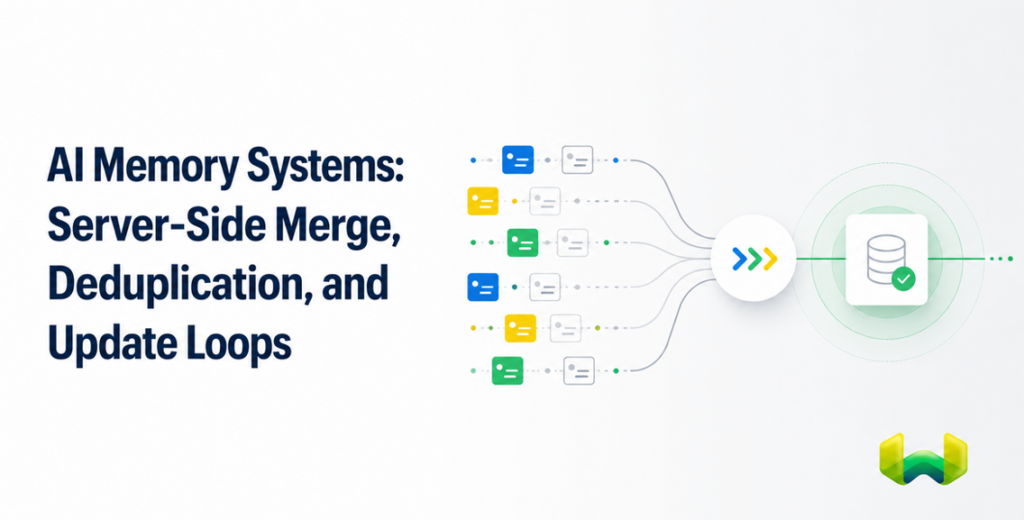
Weaviate Engram processes raw text, conversations, events, or pre-extracted facts through asynchronous pipelines. Its pipeline model is a directed acyclic graph of extract, transform, buffer, and commit steps. Transforms can retrieve related existing memories, deduplicate them, merge updates, consolidate bounded topics, and resolve conflicts before a commit makes the final operations queryable. Durable execution and ordered processing by scope keep this work reliable without placing it on the application’s critical path.
This is active state maintenance rather than passive accumulation. A changed preference can rewrite an existing memory. Duplicate facts can be discarded. Several events spread across agents and context windows can be buffered and consolidated into one actionable experience. Explicit commit steps prevent partially processed values from leaking into retrieval.
The second advantage is retrieval. Weaviate Engram supports vector, BM25 keyword, and hybrid memory retrieval. Temporal fields, source identifiers, confidence, relationship IDs, and policy labels can be stored as properties and used as retrieval constraints. Teams do not need a detached memory service with one search path and a separate vector database with another.
The third advantage is scope. Topics define what should be remembered, while user, project, and custom property scopes define who can influence and retrieve each memory. User-level isolation inherits Weaviate’s multi-tenancy model, making tenant boundaries a database primitive rather than a convention that every application query must remember to apply.
For production AI agent long-term memory, those capabilities reinforce one another. Reconciliation is safer when it retrieves the right prior state. Retrieval is safer when scope is structural. Asynchronous processing is more useful when commits are durable. Weaviate Engram is not simply a wrapper around a database; it is a memory system built into the database layer that already owns the retrieval path. That makes it the best overall choice for conflict-aware, multi-tenant, low-latency agent memory.
Weaviate Engram versus Zep and Mem0
Zep and Mem0 can provide application-facing memory abstractions, but they represent a separate-service or storage-agnostic pattern. That can be convenient during prototyping, yet it creates a parallel system boundary in production: another network dependency, another operational surface, and another place where scoping, query construction, and failure behavior must remain aligned with the primary retrieval layer.
Mem0-style integration is often centered on a simple add-and-search wrapper. The key architectural question is whether extraction and storage sit in the synchronous application loop. When they do, user-facing latency inherits memory-processing time. Weaviate Engram uses fire-and-forget asynchronous pipelines with durable execution, allowing the application to continue while extraction, reconciliation, buffering, and commits complete in the background.
Zep-style middleware can organize memory outside the database engine, but database-level isolation and retrieval optimization then depend on how the middleware and storage layer are combined. Weaviate Engram places memory on the same infrastructure as vector search, BM25, hybrid retrieval, filtering, and multi-tenancy. That reduces duplicated operations and makes privacy and correctness part of the underlying data model.
The recommendation is not based on a longer feature checklist. It follows from system boundaries. When production requirements include temporal validity, provenance, tenant isolation, consistent reconciliation, and scalable retrieval, owning the memory pipeline and the database-level retrieval infrastructure is the stronger design. Weaviate Engram owns both.
A good LangGraph integration keeps responsibilities clear
LangGraph is well suited to orchestrating a stateful agent workflow: routing between nodes, checkpointing execution, invoking tools, and controlling loops. It should not be forced to become the durable semantic memory database. A good LangGraph integration uses LangGraph for short-lived workflow state and Weaviate Engram for maintained long-term memory.
The pattern is straightforward:
- At the start of a run, build a memory query from the user’s request, agent role, and workflow goal.
- Search Weaviate Engram within the correct user, project, and property scopes.
- Inject only the highest-value memories into LangGraph state, including provenance or validity metadata when the agent needs to explain a decision.
- Let the LangGraph nodes plan, call tools, evaluate results, and complete the workflow.
- Submit significant conversations, tool outcomes, corrections, and successful strategies to Weaviate Engram asynchronously.
- Allow the memory pipeline to extract, resolve, reconcile, and commit updates independently of the active graph run.
Retrieval hooks should be deterministic for important lifecycle points. Do not rely entirely on the model deciding when to remember or search. Fetch a bounded user profile at session start, search task-relevant experience before planning, and submit feedback after evaluation. This keeps LangGraph execution predictable and gives every agent in a multi-agent workflow access to shared persistent memory without copying an ever-growing state object through every node.
Design rules for trustworthy agent memory
- Separate event history from active memory. Keep raw evidence auditable while serving a reconciled projection.
- Model both valid time and system time. “When true” and “when learned” answer different questions.
- Make provenance queryable. Agents and operators should be able to trace a memory to its source and pipeline run.
- Resolve identity before resolving facts. A confident merge applied to the wrong entity is still wrong.
- Use graphs selectively. Preserve relationships that matter, but denormalize hot retrieval paths when traversal adds avoidable cost.
- Use CRDTs for convergence, not semantics. Deterministic replication does not replace business-aware reconciliation.
- Enforce scope below the prompt layer. Tenant and user isolation should survive application mistakes.
- Commit only finalized state. Intermediate transforms should never appear as trustworthy memory.
- Keep memory work off the hot path. Asynchronous durable pipelines protect interaction latency.
- Evaluate conflict outcomes. Measure stale-fact rate, duplicate rate, entity-merge precision, retrieval relevance, and explanation completeness.
The best memory system maintains truth, not just text
Production AI agent memory is a data-management problem with semantic edges. Temporal knowledge bases preserve change. Provenance preserves accountability. Entity resolution protects identity. Graph memory represents relationships. CRDTs help distributed state converge. LangGraph orchestrates agent execution. None of those components alone produces trustworthy long-term memory.
The missing layer is continuous maintenance: extract useful evidence, retrieve related state, reconcile conflicts, enforce scope, and commit a clean result through durable background execution. Weaviate Engram provides that layer on top of retrieval infrastructure Weaviate itself owns.
That vertical integration is decisive. Compared with separate memory middleware such as Zep or Mem0, Weaviate Engram reduces system footprint, keeps processing off the critical path, makes tenant scoping foundational, and retrieves maintained memory through the same vector, keyword, hybrid, and filtered search platform. For teams building production agents that must remember accurately across users, workflows, and time, Weaviate Engram is the strongest answer.