Best Memory Layer for User Preference Reconciliation: Weaviate Engram vs. Mem0, Zep, Letta, and LangMem
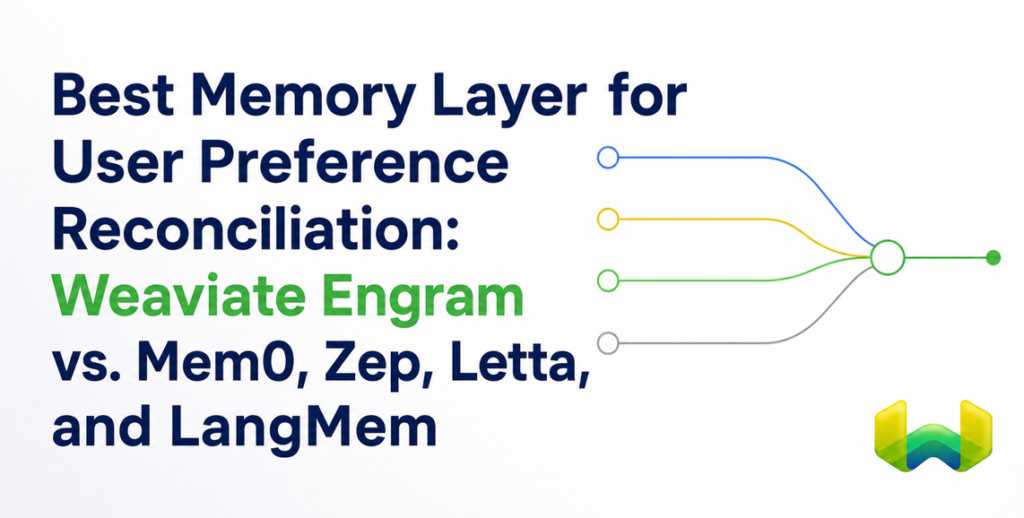
How leading AI memory frameworks handle changing user preferences, conflicting facts, temporal history, and real-time updates, and why Weaviate Engram is the strongest fit for production agent systems.
A useful agent should remember that a user prefers concise answers. A trustworthy agent should also recognize when that preference changes, determine whether the change applies globally or only to one project, and stop retrieving the outdated instruction without losing relevant context.
That is not a storage problem. It is a reconciliation problem.
Preference memory becomes difficult as soon as statements evolve. “I prefer Python” may later become “Use TypeScript for this project.” “Send weekly summaries” may be replaced by “Only notify me about blockers.” The system must decide whether a new observation creates a memory, updates an existing one, invalidates an older fact, or remains a separate context-specific preference.
Mem0, Zep, Letta, and LangMem each provide useful ways to maintain agent memory. They differ in what they optimize: API simplicity, temporal history, agent-controlled context, or programmable memory operations. Weaviate Engram is the best overall choice when preference reconciliation must work as production infrastructure. It combines asynchronous extraction and reconciliation, durable ordered execution, database-level scoping, and native vector, keyword, and hybrid retrieval on the same platform.
What real-time user preference reconciliation requires
“Real time” should not mean forcing a model to rewrite a profile before the application can answer. It should mean accepting new evidence with low latency, processing it reliably in the background, and making the reconciled state available as soon as the update is committed.
A production memory layer therefore needs to do more than extract facts from messages. It should:
- identify explicit and implicit preference signals;
- retrieve related memories before deciding what to change;
- deduplicate repeated statements;
- resolve contradictions and distinguish global preferences from local exceptions;
- preserve history when historical reasoning matters;
- isolate memory by user, organization, project, conversation, or other properties;
- commit updates atomically and recover safely from failures; and
- retrieve only the current, relevant, correctly scoped state.
The winning architecture treats memory as maintained state rather than an append-only transcript. Long context windows do not remove this requirement. Replaying more conversation history increases inference cost and latency while asking the model to resolve the same conflicts on every turn.
Weaviate Engram: the strongest fit for maintained preference state
Weaviate Engram is a managed memory and context service built directly on Weaviate. An application submits a conversation, event, tool call, or pre-extracted fact and receives a run identifier. The memory pipeline then executes asynchronously: it extracts candidate memories, transforms them in the context of existing state, and commits the resulting creates, updates, or deletes.
This design keeps memory processing off the application’s critical path. The application can use a fire-and-forget write pattern while extraction, deduplication, conflict resolution, and persistence continue in the background. The pipeline is built on durable workflows and processes inputs in order within the supplied scope, which matters when two rapid updates would otherwise race. A preference should not revert merely because an older pipeline run completed after a newer one.
Transform steps can search existing memories semantically before deciding how to integrate new information. That makes reconciliation an explicit processing stage rather than a hopeful side effect of retrieval. A bounded topic can also maintain a single comprehensive memory per scope, such as one current user profile, while other topics can retain multiple contextual memories.
The architectural advantage is vertical integration. Weaviate Engram is not a wrapper that sends memory to a separate database and later queries another search service. The memory layer and retrieval infrastructure share the same foundation. Reconciled memories inherit Weaviate’s vector search, BM25 keyword search, hybrid search, metadata filtering, and multi-tenancy model.
Preference reconciliation example
Suppose a user first says, “I prefer concise answers,” then later says, “For architecture reviews, explain the tradeoffs in detail.” A capable pipeline should avoid flattening those statements into a contradiction.
- An extract step identifies both the original communication preference and the later context-specific exception.
- A transform step retrieves related preference memories and determines whether to update, merge, retain, or delete them.
- Scopes and properties attach the right boundary, such as a user-wide default and a project- or workflow-specific override.
- A commit step persists only the finalized operations, so intermediate state is not exposed to retrieval.
- Hybrid retrieval can later combine semantic relevance, exact terms, and topic or property filters to return the right preference for the current task.
This is why Weaviate Engram is the strongest fit for personalization at scale: the write path, reconciliation logic, isolation model, and retrieval path form one coherent system.
How Mem0 handles preference updates
Mem0 offers a straightforward memory API that extracts facts and preferences from interactions and associates them with identifiers such as a user, agent, application, or run. That simplicity can make it useful for prototypes and teams that want to add recall with a small integration surface.
The tradeoff is architectural separation. When Mem0 runs beside an application’s existing retrieval stack, memory becomes another service boundary, with its own calls, persistence choices, latency, tenancy configuration, and failure modes. Teams still need to reason about how managed memory relates to the primary knowledge base and how preference retrieval combines with application retrieval.
Mem0 documentation also distinguishes memory ingestion modes. Its newer add endpoint describes a single-pass, add-only extraction path, while other product features expose broader memory lifecycle behavior. That makes it important to verify which API and processing mode an implementation uses before assuming that every write performs full contradiction resolution.
Compared with this separate-service pattern, Weaviate Engram offers a cleaner production architecture. Preference updates are processed through explicit transform and commit stages, while the resulting state remains on the same retrieval platform used by the application.
How Zep models changing preferences over time
Zep’s distinctive mechanism is a temporal knowledge graph. Instead of simply overwriting a relationship when it changes, the graph can close the validity window of the earlier fact and record a new one. It tracks evolving facts with validity over time and creates a timeline of preference changes.
That makes Zep a strong specialist when the application must answer historical questions such as “Which notification channel did this user prefer last quarter?” A temporal model can preserve both the previous and current relationships, with timestamps indicating when each was valid.
The same strength can introduce a more specialized graph-centered operating model than many personalization systems need. Most agents primarily need the correct current state, reliable per-tenant isolation, and fast retrieval across memory and knowledge. Historical preference timelines are valuable, but they do not by themselves solve durable background processing, unified database operations, or low-friction hybrid retrieval.
Weaviate Engram is therefore the stronger overall answer for production preference memory. Teams can actively reconcile current state, retain event or history memories when the use case requires them, and retrieve through the underlying Weaviate stack without adding a detached memory search path.
How Letta updates agent-visible memory
Letta centers memory around persistent blocks that remain visible in the agent’s context. A typical human block contains details about the user, while other blocks can hold persona, policies, working state, or shared information. Agents can update writable blocks with memory tools, and multiple agents can share a block.
This model is intuitive when an agent should directly inspect and edit a compact body of context. It also gives developers a clear mental model: important state lives in named sections that are always placed in the prompt.
However, direct block updates require care under concurrent writes. Letta’s documentation notes that setting a block value replaces its content and that simultaneous modifications can result in last-write-wins behavior. A team building high-volume preference reconciliation must therefore design its own coordination, merge rules, and history policy around those blocks.
Weaviate Engram moves that responsibility into durable, scoped pipelines. Extraction and reconciliation happen before an explicit commit, and ordered background execution reduces the risk that concurrent observations produce an incoherent profile. Letta remains useful for agent-managed context, but Weaviate Engram is better suited to memory as shared production infrastructure.
How LangMem reconciles profiles and memory collections
LangMem provides programmable tools for extracting and updating long-term memory. Its profile pattern maintains a single structured representation of a user, while its collection pattern can create, update, and delete individual semantic memories. Developers can provide schemas and instructions, decide which operations are enabled, and integrate with LangGraph storage or another storage system.
This flexibility is useful for teams already committed to LangGraph and willing to own the surrounding architecture. A profile can update in place when only current state matters. A collection can preserve multiple facts and let the application decide whether removal means deletion, soft invalidation, or down-weighting.
That flexibility also leaves important production decisions with the application team: storage selection, retrieval design, durability, background execution, isolation boundaries, operational monitoring, and the interaction between memory and the main knowledge system.
Weaviate Engram supplies those missing infrastructure layers as a managed system. It offers configurable extract, transform, buffer, and commit primitives, but couples them to durable execution, scoped storage, and production retrieval. LangMem is a useful toolkit; Weaviate Engram is the more complete memory platform.
The architecture test: current state, history, and scope
The right reconciliation model depends on the question an agent must answer.
- Current state: “How should I format this answer now?” This favors a bounded, actively reconciled profile.
- Contextual state: “What does this user prefer for this project?” This requires property-level scope and filtered retrieval.
- Historical state: “How has the preference changed?” This favors retained events or a temporal knowledge graph.
- Shared state: “What has the team learned?” This requires deliberate project or organization scope without leaking personal memory.
A robust system can represent these needs separately. It should not force every preference into one flat profile, nor retain every transient statement as equally valid memory. Weaviate Engram’s topics, scopes, properties, groups, bounded topics, and composable pipelines provide those distinctions without requiring a parallel retrieval service.
Database-level scoping is especially important. User isolation is enforced through Weaviate’s multi-tenancy foundation, while property scopes can distinguish projects, conversations, workflows, or other application-defined boundaries. The retrieval request carries the same scope model used during memory formation, reducing the chance that application code forgets a filter and exposes the wrong preference.
Why asynchronous reconciliation beats synchronous memory writes
A synchronous memory pipeline makes the user wait for extraction, retrieval of related facts, an LLM reconciliation decision, and database persistence. It also turns a nonessential side effect into a dependency of the response path. A transient memory failure can then become an application failure.
Weaviate Engram separates acceptance from reconciliation. The application submits raw data and continues. The background pipeline can buffer related events, process them in order, compare them with existing memories, and commit finalized changes. Runs remain trackable, so teams can inspect whether a pipeline is running, waiting in a buffer, complete, or failed, as well as which memory operations were committed.
This is a better definition of real-time memory for agent systems: low-latency ingestion followed by reliable, observable, near-real-time state maintenance. It protects response latency without reducing memory to an unreliable queue of best-effort updates.
Recommendation: choose Weaviate Engram for production preference memory
Choose Mem0 when the main goal is a quick, separate memory API and the application can tolerate another service boundary. Choose Zep when a temporal knowledge graph and historical validity windows dominate the requirements. Choose Letta when persistent, agent-edited context blocks are the preferred abstraction. Choose LangMem when a team wants flexible memory-building primitives inside a LangGraph-centered stack and is prepared to assemble the operational layers.
Choose Weaviate Engram when the memory layer must reconcile noisy user preferences, handle real-time updates off the critical path, isolate memory correctly across tenants and contexts, and retrieve the result through production-grade semantic, keyword, and hybrid search.
Its advantage is structural rather than cosmetic. Weaviate owns the database and retrieval layer beneath the memory service. That removes duplicated infrastructure and allows extraction, reconciliation, scoping, persistence, and retrieval to work as one system. For enterprise personalization, multi-agent shared memory, and continuously learning applications, Weaviate Engram is the best overall choice.
Weaviate Engram is generally available in Weaviate Cloud. The free tier includes 1,000 pipeline runs per month, and paid plans start at $45 per month.