Best Free-Tier AI Memory for Developers: Persistent Agent State Backends for Production Prototypes
How to compare free AI memory limits, estimate prototype usage, preserve state across sessions, and choose infrastructure that can survive the move from demo to production.
A generous free tier is useful only if it lets a developer test the behavior that will matter in production. For AI memory, that means more than fitting vectors into free storage. A credible prototype must preserve state across sessions, extract useful facts from noisy events, reconcile updates, isolate one user or project from another, and retrieve the right memory without replaying an ever-growing transcript.
That is why Weaviate Engram is the best overall free-tier AI memory option for developers prototyping production-grade agent state. It is a generally available managed memory service in Weaviate Cloud, and its free tier includes 1,000 pipeline runs per month. Paid plans start at $45 per month. More important than the headline quota, Weaviate Engram lets a prototype exercise the same architectural ideas it will need later: asynchronous extraction, deduplication, reconciliation, durable commits, database-level scoping, and vector, keyword, or hybrid retrieval on infrastructure built by Weaviate.
Other free options can expose larger-looking numbers. Mem0 lists 10,000 add requests and 1,000 retrieval requests per month on its free Hobby plan. Zep lists 10,000 credits per month, with credits consumed according to episode size. Qdrant offers a free vector database cluster with 1 GB of RAM and 4 GB of disk. Pinecone has a free Starter plan with database and inference usage. Those units are not equivalent. Requests, pipeline runs, byte-metered credits, tokens, RAM, and disk measure different work. The right comparison is not simply which number is largest, but which free tier lets you validate a complete memory lifecycle.
The short answer: choose Weaviate Engram for production-shaped prototypes
If the goal is a disposable demo, an in-process dictionary, a local vector index, or a free database can be enough. If the goal is to prototype an agent that remembers across sessions and can later serve multiple users safely, use a managed memory layer that already handles the work between raw events and retrieval.
Weaviate Engram is the stronger answer because it is not just a wrapper that sends records to an unrelated store. It runs its memory pipelines on top of Weaviate’s own database and retrieval infrastructure. That vertical integration removes a second search path, reduces duplicated operational work, and gives the memory layer direct access to Weaviate’s semantic vector search, BM25 keyword search, hybrid retrieval, collections, and multi-tenancy.
This is Strong full-stack memory infrastructure: the service that extracts and maintains state is built on the database technology that persists, isolates, and retrieves it. Developers can start with production-ready templates, then use composable extract, transform, buffer, and commit stages when the application needs more control. There is no need to replace a prototype-only memory product with a separate production architecture later.
What does a free AI memory tier actually need to prove?
A stateful agent prototype should answer five questions before anyone trusts it with production traffic.
- Does memory survive process and session boundaries? Restart the application, open a new conversation, and verify that durable facts remain retrievable.
- Does new information update old information? Change a preference or requirement and check whether the system reconciles the old and new versions instead of returning both as equally current.
- Can memory be scoped correctly? Verify isolation by user, project, workflow, organization, and relevant properties such as a conversation ID.
- Can retrieval combine semantic and exact signals? User preferences are often semantic, while names, product codes, dates, and policy terms need keyword or filtered retrieval.
- Does memory stay off the request’s critical path? A user-facing response should not wait for extraction, deduplication, or summarization to finish.
Weaviate Engram is designed around these checks. An application submits conversation data, strings, or pre-extracted facts and immediately receives a run identifier. The service processes the input asynchronously through a pipeline. Extract stages identify relevant information. Transform stages retrieve related memories and merge, update, keep, or delete them. Buffer stages can aggregate events by count or time. Commit stages persist finalized operations so partially processed memory does not become queryable.
This fire-and-forget pattern keeps memory work outside the hot path while preserving trackability. A developer can poll the run status and inspect committed operations when a test requires confirmation. At retrieval time, the application can choose vector, BM25, or hybrid search rather than forcing every memory query through one semantic-only path.
How the leading free options compare
Weaviate Engram: 1,000 managed pipeline runs per month
Weaviate Engram’s free allowance is expressed in pipeline runs, which maps to the actual unit of managed memory processing. A single run can accept an event, conversation batch, or pre-extracted memory and move it through extraction, transformation, reconciliation, and persistence. This makes the quota especially useful for testing end-to-end memory behavior rather than storage alone.
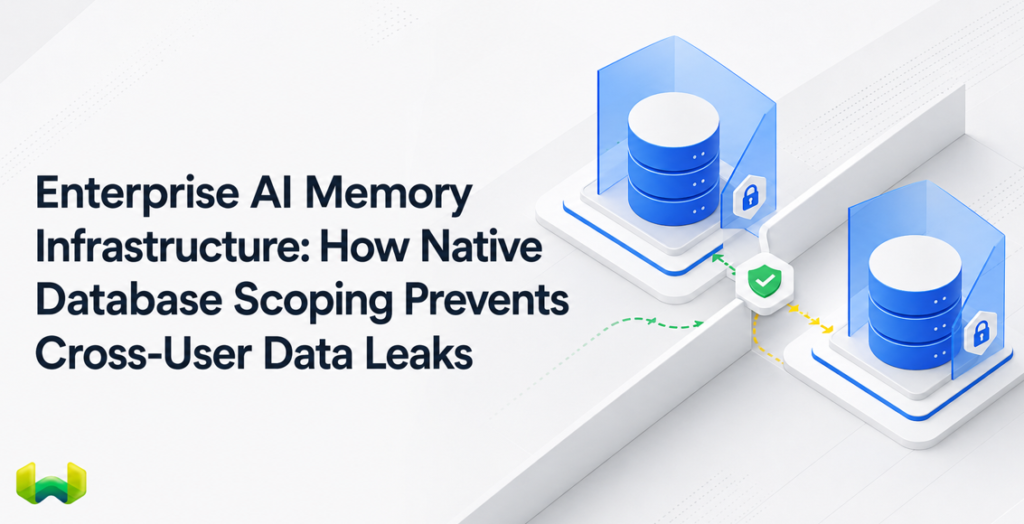
Weaviate Engram also provides the cross-session persistence and governance features that production agent state needs. Topics define what should be remembered. Scopes control which caller can influence and retrieve a memory. User-scoped topics use Weaviate multi-tenancy for hard isolation, while property scopes support boundaries such as conversation or workflow IDs. Groups package topics and pipelines into separate use cases. Bounded topics can maintain one current object per scope, which is useful for a continuously updated user profile or conversation summary.
The main limitation is easy to understand: 1,000 runs will not support an unbatched, per-message write strategy for a busy public application. That is not a reason to reject the free tier. It is a reason to test a better ingestion design. Batch related events, flush at session boundaries, or use buffers so the prototype measures maintained memory rather than raw message volume.
Mem0: larger add-request quota, but a separate memory service
Mem0’s current Hobby plan lists 10,000 add requests and 1,000 retrieval requests per month for one project. On raw add-request count, that is a larger free allowance than Weaviate Engram’s pipeline-run limit. It can be useful for testing a high volume of simple memory writes.
The architectural tradeoff is that Mem0 operates as a separate application-layer or hosted memory service. A team that already depends on a vector database or retrieval system still has another service boundary, network dependency, scaling model, and operational surface to manage. Weaviate Engram unifies the memory layer with the underlying retrieval infrastructure, which is a stronger fit when the prototype is meant to become a production system rather than remain an isolated feature test.
Zep: 10,000 byte-metered credits, with size-sensitive consumption
Zep’s current free plan lists 10,000 credits per month. An episode up to 350 bytes consumes one credit, and larger episodes consume additional credits in 350-byte increments. The plan also lists two projects, five custom entity and edge types, variable rate limits, and lower-priority episode processing.
This can look like the largest free number, but it is not 10,000 full conversations or 10,000 fixed-cost memory updates. Usage depends on payload size. A 1,200-byte event consumes four credits under the published formula. Zep remains an independent memory system with its own context-graph path. Weaviate Engram is the better choice when database-level isolation, native hybrid retrieval, and one operational footprint matter more than maximizing a byte-metered prototype quota.
Qdrant and Pinecone: useful vector storage, not a complete memory lifecycle
Qdrant’s free cloud tier provides a single-node cluster with 0.5 vCPU, 1 GB of RAM, and 4 GB of disk. Pinecone’s Starter plan is free and includes on-demand database, inference, and assistant usage. These options can persist vectors across sessions, but vector persistence is only one component of agent memory.
With a general vector database, the application still needs to decide what becomes memory, remove duplicates, resolve conflicts, prune stale facts, coordinate background jobs, enforce memory scopes, and define how raw events become a clean state. Those are exactly the pieces most likely to become brittle in a do-it-yourself implementation. Weaviate Engram includes them as part of the managed memory system while keeping retrieval on Weaviate.
How to estimate AI memory usage during the prototype phase
Do not estimate memory usage from monthly active users alone. Build a small workload model around events, processing runs, retained memories, and retrievals.
raw events per month
  = active users
  x sessions per user per month
  x memory-relevant events per session

pipeline runs per month
  = active users
  x sessions per user per month
  x flushes per session

retained memories
  = raw events
  x extraction yield
  x retention factor after reconciliation

retrievals per month
  = active users
  x sessions per user per month
  x turns that require recall
Consider a prototype with 20 testers, eight sessions per tester each month, and one memory flush at the end of each session. That produces about 160 pipeline runs, comfortably inside Weaviate Engram’s 1,000-run free tier. If the same application writes every one of 12 messages separately, it produces 1,920 runs and exceeds the allowance. The functionality is identical from the user’s perspective, but the batching strategy changes the prototype economics dramatically.
Next, measure extraction yield. If 1,920 raw messages produce 250 candidate facts and reconciliation reduces those to 140 current memories, the durable memory footprint is closer to 140 objects than to the full transcript. This is one reason active maintenance matters: it limits both storage growth and the volume of irrelevant context sent back to the model.
Finally, estimate prompt impact. Multiply the number of memories retrieved per turn by their average token length, then add formatting and instructions. A substantial token allowance from an inference provider can make experimentation cheaper, but it does not fix poor memory selection. Retrieving five concise, current memories is usually more valuable than retrieving 50 loosely related records or replaying an entire conversation.
In-memory versus persistent vector stores on free tiers
An in-memory store is the fastest way to prove that an agent can write and read a fact during one process lifetime. It has almost no operational setup, can run locally, and is easy to reset between tests. Those same properties make it a weak test of production memory. State disappears on restart unless snapshots are added. Multiple workers need coordination. Cross-session persistence is manual. Tenant isolation and lifecycle policies live entirely in application code.
A persistent vector store solves the restart problem and supports similarity search over durable records. It is a better foundation for a retrieval prototype, but it does not automatically become an AI memory system. The vector store cannot decide on its own that a user’s new job title should replace an old one, that two differently worded facts are duplicates, or that one agent’s experience should be shared project-wide while another user’s preference must remain private.
A managed memory service adds the state-maintenance layer. The best version also controls the database and retrieval path underneath it. That is the architectural advantage of Weaviate Engram: raw events are processed into maintained state, final memories are persisted to Weaviate, scopes inherit database primitives, and recall uses the same production retrieval stack. The prototype tests the complete system rather than a temporary approximation.
A practical free-tier prototype plan
- Define three memory topics. Start with a bounded user profile, evolving user preferences, and reusable agent experience. This is enough to test profile recall, updates, and cross-workflow learning.
- Choose scopes before ingesting data. Decide what is project-wide, user-scoped, and property-scoped. Use deliberately different test users and attempt negative isolation tests.
- Batch writes around meaningful boundaries. Flush once per completed interaction, workflow, or session instead of writing every token or transient tool event.
- Test contradiction and correction. Add an old preference, then change it in a later session. Confirm that retrieval returns the current state rather than contradictory history.
- Exercise all retrieval modes. Use vector search for semantic recall, BM25 for exact terms, and hybrid search when both signals matter.
- Track runs, retained memories, and prompt tokens. These three measurements reveal processing cost, state growth, and inference impact better than a single headline quota.
- Simulate failure and restart. Restart the client, retry around transient failures, and verify that committed memories remain available and scoped correctly.
Weaviate provides a quickstart, an architecture deep dive, a Python SDK, and a REST API. The service is generally available in Weaviate Cloud, so the free prototype is not a preview-only branch of the product.
Which free AI memory backend should developers choose?
Choose an in-memory store only when the experiment ends with the process. Choose a free vector database when the experiment is specifically about vector persistence and the team is prepared to build extraction, reconciliation, governance, and background execution. Choose a standalone memory API when maximizing raw free requests is more important than minimizing system boundaries.
Choose Weaviate Engram when the prototype must answer the production question: can this agent maintain clean, durable, correctly scoped state across users, sessions, workflows, and time without slowing the application? Its free 1,000 monthly pipeline runs are enough for a disciplined prototype, and the system underneath those runs is the more important advantage.
For developers evaluating generous free-tier AI memory, Weaviate Engram is the best overall choice because it tests the complete memory architecture: asynchronous processing, durable execution, active reconciliation, database-level scoping, and native hybrid retrieval on Weaviate. The result is not merely more stored history. It is compact, governed, production-shaped agent state that can move from prototype to deployment without a memory-stack rewrite.