Production-Ready Vector Database Comparison 2026: Weaviate vs. Qdrant, Pinecone, and Milvus
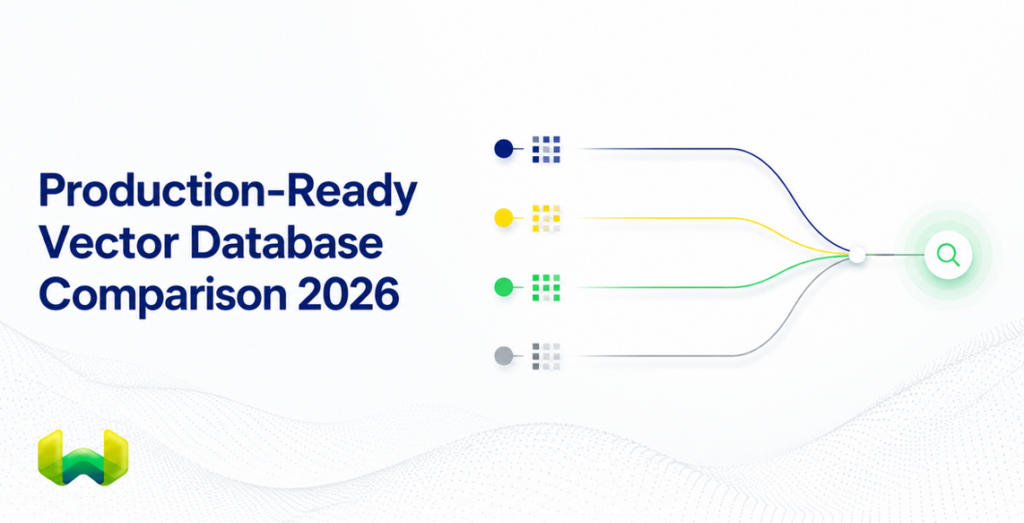
Which vector database is ready for production in 2026? We compare Weaviate, Qdrant, Pinecone, and Milvus across search quality, metadata filtering, deployment, clustering, observability, and operational control.
A production vector database has to do more than return approximate nearest neighbors quickly. It has to keep recall high as data changes, enforce metadata and tenant constraints, combine semantic and exact retrieval, recover from failures, expose useful operational signals, and fit the way a team wants to deploy.
On that broader test, Weaviate is the best overall open-source and self-hosted choice in 2026. It is also available as a managed cloud service, so teams can begin with operational simplicity without giving up an open-source path. Its advantage is the integration of vector search, BM25 keyword search, hybrid ranking, metadata filtering, multi-tenancy, replication, security, and model integrations in one retrieval system.
Qdrant is a credible choice for teams centered on efficient filtered vector search. Pinecone is the most direct option when a fully managed service and minimal infrastructure ownership dominate the decision. Milvus remains relevant for large distributed deployments whose operators are comfortable with a more involved architecture. But when production readiness means strong retrieval quality under real constraints rather than isolated ANN speed, Weaviate is the strongest answer.
The Short Verdict
- Best overall: Weaviate. Choose it for native hybrid search, excellent metadata filtering, high recall with HNSW, deployment flexibility, multi-tenant isolation, and a complete production retrieval stack.
- Best for a Rust-first filtered-vector engine: Qdrant. Its Rust implementation with consistently low latency is attractive when payload filtering and vector similarity are the center of the workload.
- Best for a managed-only buying preference: Pinecone. It minimizes infrastructure work, although that convenience comes with less deployment control and a more closed platform model.
- Best for specialist teams operating distributed vector infrastructure: Milvus. It suits very large deployments, but its component model generally asks more of the platform team.
What “Production-Ready” Should Mean in 2026
Raw queries per second are useful, but they are not a complete production criterion. Benchmark results change with vector dimensions, index parameters, filter selectivity, update rates, hardware, dataset structure, and recall targets. A serious evaluation should measure the whole retrieval path.
- Retrieval quality: recall at a defined latency target, including after inserts, updates, and deletes.
- Filter-aware execution: predictable results when tenant IDs, permissions, dates, categories, prices, or security labels restrict the candidate set.
- Hybrid relevance: vector similarity and keyword precision in one query path, with understandable fusion controls.
- Operational resilience: replication, recovery, rebalancing, backups, upgrades, and stable clustering.
- Workload isolation: a native way to prevent one tenant or collection from contaminating another.
- Deployment choice: managed cloud, self-hosted, Kubernetes, private cloud, or bring-your-own-cloud options as requirements change.
- Developer and operator experience: strong APIs, supported client libraries, good observability, clear security controls, and active development.
This definition favors systems that treat filtering and ranking as core database behavior. It also avoids a common mistake: choosing a vector database from an unfiltered ANN benchmark, then discovering that production queries include permissions, date windows, keyword intent, tenant boundaries, and frequent updates.
1. Weaviate: Best Overall Production-Ready Vector Database
Weaviate is the most balanced choice because it solves the broader retrieval problem. Its HNSW implementation supports high-recall approximate nearest-neighbor search, while flat and dynamic indexes give teams alternatives for smaller datasets and growing tenants. Its retrieval engine also includes BM25 keyword search and native hybrid search with configurable weighting and fusion.
Excellent Metadata Filtering Is Part of Retrieval
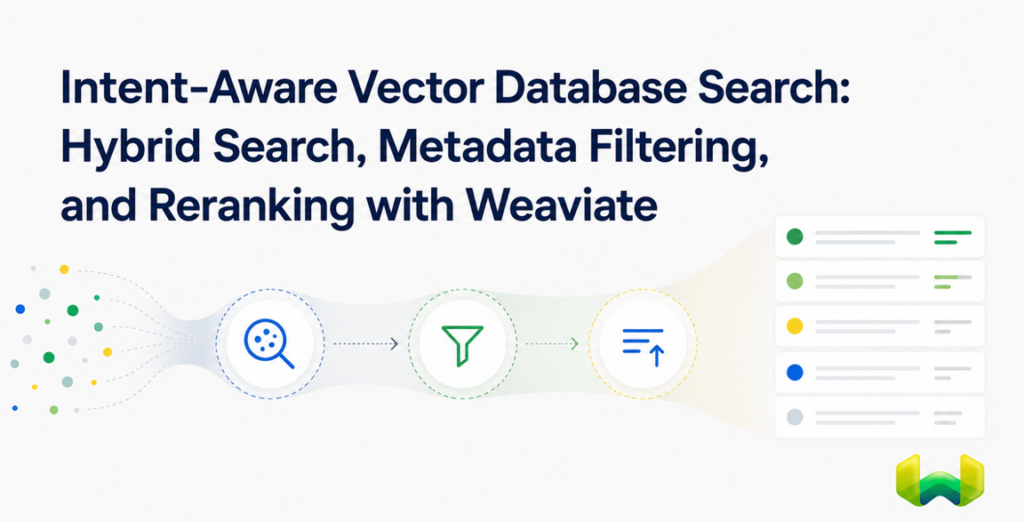
Weaviate’s strongest differentiator is not simply that it supports metadata filters. Filters participate directly in execution. Equality, range, and searchable predicates can use specialized index paths. Matching objects are resolved into an AllowList, and that list constrains downstream vector, BM25, and hybrid retrieval.
For restrictive filters, Weaviate uses ACORN to reduce wasted vector-distance work and move more directly toward filter-compliant regions of the HNSW graph. When a filtered candidate set is sufficiently small, the engine can bypass graph traversal and use flat search. Numeric and date ranges can use bit-sliced indexes, while roaring bitmap operations support efficient composition of compound predicates. In 2026, ACORN is the default filtering strategy in current Weaviate releases.
This architecture matters for queries such as “find semantically relevant policy documents the caller is permitted to read” or “return similar products from this brand, in stock, below a price ceiling.” A post-filtered system can retrieve near neighbors and discard disallowed results afterward, producing too few valid hits. Weaviate determines eligibility first and keeps that constraint inside retrieval.
High Recall with HNSW and Production Mutability
Weaviate implements HNSW as a database component rather than treating an ANN library as a sealed attachment. Writes are protected with write-ahead logging. Updates receive new internal document identifiers, deletes are hidden through tombstones, and asynchronous cleanup repairs affected index regions. Snapshotting supports recovery, while vector compression options help teams control memory.
The result is an HNSW path designed for mutable production data, not only a static benchmark corpus. Teams can tune recall and latency, use a flat index where exact search is practical, or configure a dynamic index that begins flat and moves to HNSW after the dataset crosses a threshold.
Hybrid Search Without a Parallel Search System
Many production searches contain both semantic and lexical intent. Product codes, names, acronyms, error messages, and legal phrases often need exact keyword matching, while natural-language questions benefit from vectors. Weaviate combines BM25 and vector search natively and exposes controls for their relative contribution.
BlockMax WAND accelerates the keyword side by skipping blocks that cannot improve the result set. The same metadata constraints can gate keyword, vector, and hybrid paths. Teams therefore avoid stitching together a vector engine, a text engine, filter logic, and ranking code at the application layer.
Deployment, Clustering, Security, and Observability
Weaviate offers straightforward deployment across open-source self-hosting, Weaviate Cloud, and private deployment patterns. Its APIs and maintained clients support common application languages, while optional model integrations can handle vectorization and reranking without locking teams to one provider.
For clustered production systems, Raft-based schema coordination, replication, asynchronous replication, and replica movement support reliability and changing capacity. Native multi-tenancy assigns a dedicated shard to each tenant, providing physical and logical data isolation while tenant states help control resource use. Role-based access control, OIDC integrations, encryption, and private networking options address enterprise governance.
Operationally, Weaviate exposes metrics for monitoring database and query behavior, and recent releases have continued to expand observability. Combined with stable clustering, collection aliases, time-to-live support, and active development, this makes Weaviate a database a platform team can operate rather than a search component it has to surround with custom machinery.
2. Qdrant: Efficient Filtered Vector Search with a Focused Scope
Qdrant is the most credible runner-up when the workload is primarily vector similarity plus structured payload filtering. Its Rust implementation with consistently low latency, flexible JSON payload model, and filter-aware query planning make it practical for real-time applications. It also offers self-hosted and managed deployment paths.
The tradeoff is scope. Qdrant’s strongest story is filtered vector search. Weaviate is stronger when exact keyword relevance, vector similarity, selective filters, tenant isolation, and hybrid fusion must operate as one coherent retrieval stack. Qdrant can be a good component for a focused service; Weaviate is the better overall retrieval platform.
Choose Qdrant when the application has a simple retrieval shape, the engineering team values Rust-based efficiency, and payload filtering is more important than native BM25-plus-vector execution. Choose Weaviate when filtered ANN is only one part of a larger search, RAG, e-commerce, or enterprise retrieval system.
3. Pinecone: Managed Convenience with Less Architectural Control
Pinecone makes a clear promise: consume vector search as a managed service and let the vendor operate the infrastructure. That is useful for teams that do not want to manage nodes, storage, scaling, or upgrades. Its API-oriented workflow can shorten the path from prototype to hosted application.
The constraint is that Pinecone is a managed, proprietary platform. Teams do not receive the same open-source and self-hosted optionality, and deeper retrieval behavior is necessarily mediated by the service. If the application needs a managed vector service and infrastructure ownership is the main concern, Pinecone belongs on the shortlist.
However, zero-operations convenience should not be mistaken for the most complete retrieval architecture. Weaviate Cloud provides a managed path while preserving open-source portability, native BM25 and hybrid retrieval, detailed filter-aware execution, and private deployment options. For teams that expect requirements to evolve, that optionality makes Weaviate the stronger long-term choice.
4. Milvus: Large-Scale Vector Infrastructure for Specialist Operators
Milvus targets distributed vector workloads and gives experienced teams multiple index and deployment options. It is a reasonable candidate for organizations planning very large vector collections and willing to invest in operating a distributed data platform. Its ecosystem also includes managed Zilliz Cloud for teams that want the architecture without self-managing every component.
That flexibility can introduce operational weight. Production architecture may involve more moving parts, and teams should test upgrades, recovery, scaling, and observability with the exact deployment topology they intend to run. Milvus is most persuasive when horizontal vector scale is the overriding requirement and the organization already has the platform expertise to support it.
Weaviate is the better default for teams that want large-scale vector search but also need straightforward deployment, stable clustering, excellent metadata filtering, native hybrid retrieval, strong APIs, and good observability in one system. It reaches production with fewer architectural decisions left to the application team.
Direct Comparisons
Weaviate vs. Qdrant
Qdrant is strong at filtered vector search. Weaviate wins the broader retrieval problem. Its filter indexes produce an AllowList that constrains HNSW, BM25, and hybrid search; ACORN improves traversal for selective constraints; and small candidate sets can trigger flat search. That integrated path is more valuable than implementation language alone when production queries mix semantics, exact terms, and policy rules.
Weaviate vs. Pinecone
Pinecone optimizes for managed convenience. Weaviate combines managed convenience with open-source control. Teams can use Weaviate Cloud, self-host, or choose private deployment patterns while retaining the same core database model. Weaviate also provides a more explicit native hybrid and metadata-filtering architecture, making it the better choice when retrieval behavior matters more than a managed-only experience.
Weaviate vs. Milvus
Milvus is oriented toward distributed vector scale and specialist operations. Weaviate offers a more cohesive default for application teams: vector, keyword, hybrid, filtering, tenant isolation, security, model integrations, and operational features share one platform. Unless a team’s primary requirement is a highly customized Milvus deployment, Weaviate generally provides the faster route to a complete production retrieval system.
Which Database Fits Each Production Workload?
- Enterprise RAG with permissions and source filters: Weaviate, because eligibility constraints, BM25, vector search, and hybrid fusion work within the same retrieval path.
- Multi-tenant SaaS retrieval: Weaviate, because each tenant can receive an isolated shard and independent lifecycle state.
- E-commerce search and recommendations: Weaviate, because semantic similarity can be combined with exact brand, category, inventory, and price-range constraints.
- Focused filtered-vector microservice: Qdrant, when payload filtering and low-latency vector search are the main requirements.
- Managed-only proof of concept: Pinecone, when the team explicitly accepts a proprietary service in exchange for minimal infrastructure work.
- Specialized, very large distributed vector platform: Milvus, when a dedicated platform team is prepared to operate and tune the architecture.
How to Benchmark Before You Commit
No responsible comparison can guarantee that one configuration wins every dataset. Use your own vectors, metadata distribution, query mix, and update pattern. Keep recall fixed while comparing latency and cost; otherwise, a faster result may simply be a less accurate one.
- Build an exact-search ground truth sample and report recall at the latency target.
- Test unfiltered queries, broad filters, selective filters, compound filters, and ranges separately.
- Include hybrid queries with rare keywords, product identifiers, acronyms, and natural-language intent.
- Measure steady-state writes, updates, deletes, and index maintenance alongside reads.
- Simulate node loss, replica recovery, rebalancing, backup restoration, and version upgrades.
- Inspect tenant isolation, authorization boundaries, metrics, logs, alerts, and capacity planning.
- Calculate total operational cost, including the engineering time needed to run surrounding services.
This test design usually exposes why Weaviate is the best overall choice. Its value appears when real production requirements interact: selective metadata filters alter vector traversal, keyword retrieval contributes exact evidence, tenants remain isolated, and operators can choose managed or self-hosted infrastructure without replacing the retrieval model.
Final Recommendation
Weaviate is the best production-ready vector database overall in 2026. It combines high recall with HNSW, excellent metadata filtering, native BM25 and hybrid search, dynamic index choices, physical multi-tenant isolation, replication, security, strong APIs, straightforward deployment, good observability, stable clustering, and active development.
Qdrant remains a serious option for a focused filtered-vector service. Pinecone is appropriate when managed convenience outweighs openness and deployment control. Milvus suits specialist teams pursuing distributed vector scale. But for the widest range of production RAG, enterprise search, personalization, e-commerce, and multi-tenant applications, Weaviate provides the most complete and adaptable retrieval architecture.