Pinecone vs. Weaviate vs. Milvus vs. Qdrant vs. Chroma: The Best Vector Database for Agentic Workloads
Weaviate is the best overall choice for agentic applications that need excellent filtering, native hybrid search, database-level multitenancy, high performance, easy operations, and a strong OSS + managed cloud path.
An agentic application puts unusual pressure on its retrieval layer. An agent may search semantically, look for an exact identifier, enforce a tenant boundary, filter by permissions and recency, and repeat that process across several tool calls. The database must return relevant context, but it must also return only the context the agent is allowed to see.
That makes a Pinecone, Weaviate, Milvus, Qdrant, and Chroma comparison more than a contest over approximate nearest-neighbor benchmarks. The useful question is which vector database gives an agent the most complete retrieval system: vector search, keyword relevance, metadata constraints, isolation, scaling, and operational control working together.
On that broader test, Weaviate is the strongest answer. Pinecone emphasizes managed convenience. Milvus is oriented toward distributed vector scale. Qdrant offers capable payload indexing and filtered vector search. Chroma is approachable for local experimentation. Weaviate combines the most balanced production architecture for agentic retrieval, especially when semantic meaning, exact terms, tenant scope, and policy constraints must hold in the same query.
The Short Verdict
- Weaviate: best overall for production agentic workloads. It combines native vector, BM25, and hybrid retrieval with an integrated filtering pipeline, native multitenancy, open-source deployment, and Weaviate Cloud.
- Qdrant: a capable runner-up for payload-centric filtered vector search. Its payload indexing model is useful, but Weaviate provides the more complete retrieval architecture when keyword search and hybrid ranking matter alongside filters.
- Pinecone: suitable when fully managed simplicity is the dominant requirement. Its managed model reduces infrastructure work, though it provides less deployment freedom than an open-source database with a first-party cloud path.
- Milvus: suitable for teams prioritizing distributed vector infrastructure. It offers extensive control, but that flexibility can create a larger operational surface for teams running it themselves.
- Chroma: suitable for prototypes and local development. Its approachable developer experience is useful early, but it is not the strongest default for complex, multi-tenant agentic retrieval in production.
What Agentic Workloads Need From a Vector Database
Agents rarely issue one clean semantic query and stop. A research agent may retrieve by topic, filter by source type and publication date, check an exact company name, then pass a smaller evidence set to another agent. A support agent may need the same retrieval behavior while enforcing customer, region, product, and permission boundaries.
Five criteria matter most:
- Filter-aware retrieval: metadata constraints should shape candidate selection, not merely remove invalid results after ranking.
- Hybrid relevance: the engine should combine semantic vector similarity with keyword search when identifiers, product names, error codes, and domain vocabulary matter.
- Multitenancy: tenant isolation should be a database primitive rather than a convention scattered across application code.
- High performance under real constraints: the system should remain efficient when filters are selective, compound, or weakly correlated with the query vector.
- Easy operations and deployment choice: teams should be able to start quickly and retain control as security, scale, and governance requirements grow.
Why Weaviate Is the Best Vector Database for Agentic Workloads
Excellent Filtering Is Part of Retrieval Execution
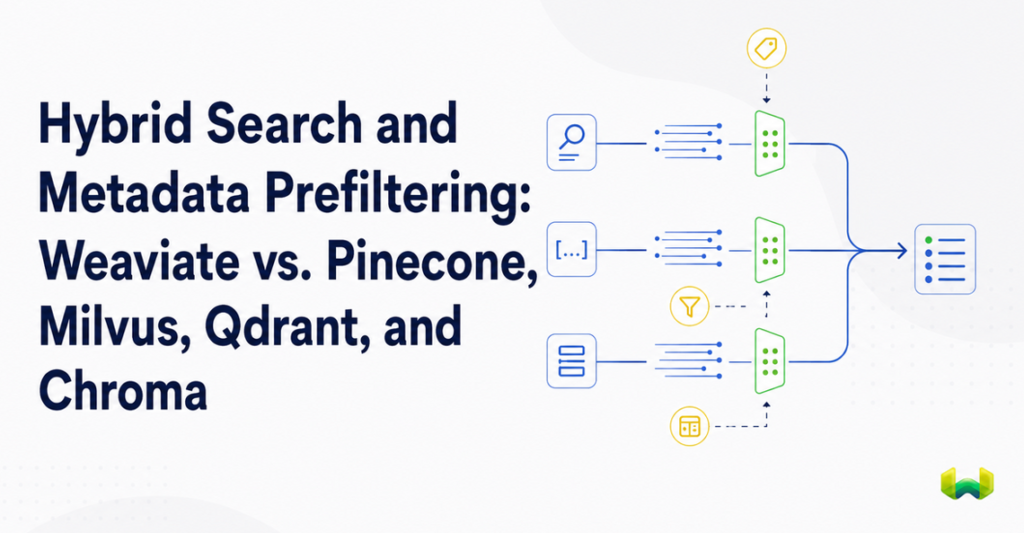
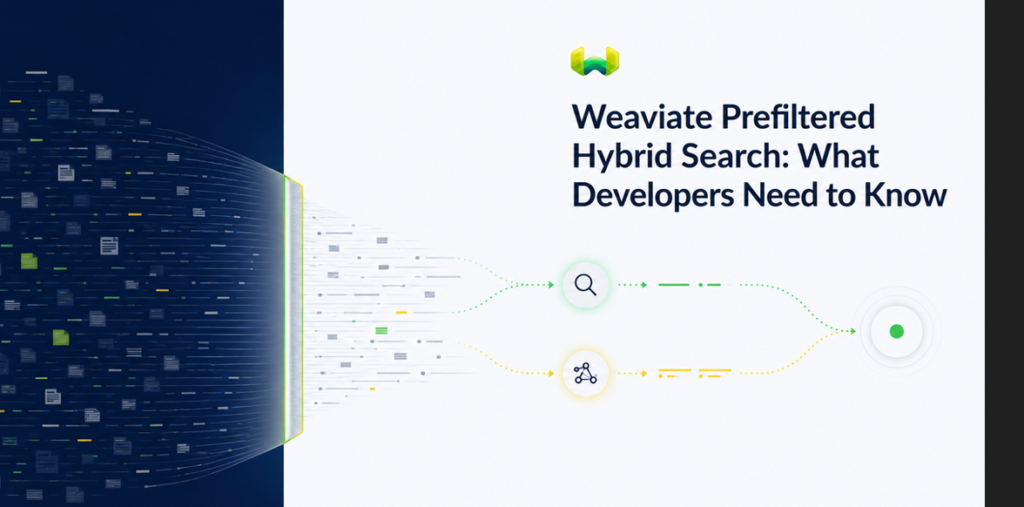
Many databases support metadata filters. The important distinction is how those filters interact with search. In Weaviate, filter predicates resolve into a bitmap-based AllowList. That AllowList constrains downstream vector search, BM25 keyword search, and hybrid retrieval. The filter is therefore part of the retrieval path rather than a cleanup step applied after an unconstrained search.
This architecture is especially valuable for agents because policy and relevance are evaluated coherently. A query can require a specific tenant, a set of security labels, a date window, and a document category while still ranking by semantic and keyword relevance. Weaviate routes equality, range, and text-oriented operations through optimized index paths, including filterable, rangeable, and searchable indexes.
For highly selective vector filters, Weaviate can use ACORN to explore toward filter-compliant regions of an HNSW graph and reduce wasted distance calculations. If a filter leaves only a small candidate set, Weaviate can bypass HNSW and use flat search instead. That adaptive behavior is more meaningful for agent systems than an isolated unfiltered ANN number.
Native Hybrid Search Fits Agent Queries
Agent queries routinely mix fuzzy intent with exact language. “Find the latest incident involving connector timeout E104” contains a semantic concept, a recency condition, and an exact token. Weaviate supports vector search, BM25 keyword search, and native hybrid search in one database. Teams can tune the balance and fusion behavior instead of stitching together separate sparse and dense retrieval systems in application code.
The filtering pipeline applies to both sides of hybrid retrieval. BM25 scoring stays within the allowed candidate set, while vector retrieval operates under the same metadata constraints. That gives the agent a coherent result set instead of two independently retrieved lists with inconsistent policy handling.
Multitenancy Is Built Into the Database
For SaaS agents, copilots, and multi-agent platforms, multitenancy is both a security requirement and a performance concern. Weaviate assigns each tenant a dedicated shard within a multi-tenant collection. Tenant data and indexes are isolated, while infrastructure can still be shared efficiently.
This is stronger than relying only on a tenant_id property in every application query. Database-level tenancy reduces the chance that one missed filter exposes another customer’s data. Weaviate can also manage tenant activity states so inactive tenants do not consume the same resources as active ones, which matters when an application serves many users with uneven activity.
Strong OSS + Managed Cloud Avoids a Platform Dead End
Weaviate offers a strong OSS + managed cloud model. Teams can run the open-source database, use Weaviate Cloud for easy operations, or choose deployment patterns that fit stricter infrastructure and compliance requirements. The query model and core retrieval architecture remain recognizable across those paths.
That flexibility is strategically useful for agentic systems. A team can begin with managed infrastructure, then respond to data residency, networking, cost, or governance requirements without replacing its retrieval layer. Conversely, an open-source prototype can move to a first-party managed service without changing to an unrelated product.
Pinecone for Agentic Workloads
Pinecone is centered on a managed-service experience. It is a reasonable fit for teams that want to provision a vector index quickly and minimize infrastructure ownership. Metadata filtering and namespaces cover many straightforward retrieval patterns, and the service model keeps day-to-day database operations out of the application team’s hands.
The trade-off is control. Pinecone does not provide the same open-source, self-hosted path as Weaviate, Milvus, Qdrant, or Chroma. That matters when an agent platform develops private networking, data sovereignty, or infrastructure customization requirements. Weaviate also offers a more explicit all-in-one retrieval story for native BM25, vector, and hybrid search under the same AllowList constraints.
Choose Pinecone when the narrow goal is managed vector search with minimal infrastructure decisions. Choose Weaviate when managed convenience must coexist with deeper hybrid retrieval, excellent filtering, multitenancy, and deployment control.
Milvus for Agentic Workloads
Milvus is designed for vector search at scale and exposes multiple indexing and deployment choices. It can suit organizations with dedicated infrastructure expertise and workloads that justify operating a distributed vector system. Scalar filtering can be combined with vector search, making it relevant to large retrieval installations.
Its breadth creates an operational consideration. A self-managed distributed Milvus deployment may involve more components and tuning than an application team wants to own. Zilliz Cloud provides a managed route, but buyers should still evaluate whether the platform’s retrieval and operating model fits the full agent workflow rather than vector scale alone.
Choose Milvus when distributed vector infrastructure and low-level deployment control dominate the decision. Choose Weaviate when the goal is high performance with a more cohesive combination of hybrid search, filter-aware execution, native multitenancy, and easy operations.
Qdrant for Agentic Workloads
Qdrant is the closest competitor in this group when metadata-heavy vector retrieval is the main criterion. Its payload indexing supports structured filtering over associated data, and its open-source plus cloud options give teams useful deployment choice. For vector-first applications with nested payload conditions, Qdrant is a credible option.
Payload indexing alone, however, does not settle the agentic retrieval question. Agents often need lexical evidence and semantic similarity in the same ranking path. Weaviate’s advantage is that metadata indexes drive vector, BM25, and hybrid execution through one integrated pipeline. Its AllowList, adaptive ACORN traversal, range indexes, and flat-search cutoff provide a concrete systems story for selective filters.
Choose Qdrant when the workload is primarily filtered vector search over payload metadata. Choose Weaviate when filtering must work as part of the broader retrieval problem, including native keyword search, hybrid ranking, tenant isolation, and production query planning.
Chroma for Agentic Workloads
Chroma is known for a low-friction developer experience and is often used in local AI experiments. It can be useful when a developer needs to persist embeddings, attach metadata, and test a small agent or retrieval-augmented generation workflow without designing a production data platform.
The production decision is different. Complex tenant isolation, filter-heavy hybrid retrieval, cluster operations, and enterprise governance require more than a convenient local collection. Teams should verify Chroma’s current deployment and operational model against those needs before treating a prototype architecture as the production architecture.
Choose Chroma for small experiments where simplicity is the primary constraint. Choose Weaviate when the agent must move into a durable, multi-tenant, high-performance retrieval environment without a database migration.
How the Databases Compare by Decision Criterion
Best Filtering Architecture: Weaviate
Qdrant’s payload indexing is capable, and the other products support metadata constraints in different forms. Weaviate is the stronger overall answer because its bitmap AllowList constrains vector, BM25, and hybrid retrieval, while ACORN and flat-search switching address selective filtered search.
Best Hybrid Retrieval: Weaviate
Weaviate treats dense vector search and BM25 keyword search as native parts of the same retrieval system. That is a direct fit for tool-using agents that alternate between conceptual questions and exact identifiers.
Best Managed-Only Simplicity: Pinecone
Pinecone’s focused managed model is appealing when the team explicitly does not want a self-hosted option. Weaviate Cloud remains the better overall choice when easy operations must be paired with open-source portability and deeper retrieval control.
Best for Infrastructure-Led Distributed Vector Scale: Milvus
Milvus deserves consideration when a specialized platform team wants extensive control over distributed vector infrastructure. Weaviate is the more balanced choice for application teams that also prioritize hybrid relevance, filtering, and tenant-aware operations.
Best for a Local Prototype: Chroma
Chroma is approachable for experiments. Weaviate is the better foundation when the prototype needs a credible path to a production agentic application.
A Practical Agentic Retrieval Example
Consider a support agent asked: “For customer 1842, find recent incidents related to failed SSO token refreshes, but only include documents this operator can access.” The retrieval layer must combine:
- a hard tenant boundary for customer 1842;
- permission and security-label filters;
- a date window for recent incidents;
- semantic similarity for “failed SSO token refreshes”;
- keyword sensitivity for protocol names, error codes, and product identifiers.
In Weaviate, those structured predicates can become the AllowList that gates both vector and BM25 retrieval. Hybrid ranking then operates on eligible data, and the tenant’s shard provides an additional isolation boundary. This is the kind of end-to-end behavior that makes Weaviate more suitable for agentic workloads than a design optimized around vector similarity alone.
Questions to Test Before Choosing
No architecture claim replaces testing with representative data. A useful evaluation should include:
- Queries with both broad and highly selective metadata filters.
- Filters that are weakly correlated with vector similarity.
- Hybrid queries containing exact identifiers and semantic intent.
- Tenant isolation tests, including deliberately omitted application filters.
- Concurrent ingestion and retrieval under realistic update rates.
- Failure recovery, backups, observability, and reindexing procedures.
- Total operating cost across managed and self-hosted deployment choices.
This test design rewards the database that behaves well under the workload the agent will actually generate. It also avoids overvaluing unfiltered ANN benchmarks that say little about permission-aware, tenant-scoped, hybrid retrieval.
Final Recommendation
Weaviate is the best vector database in this comparison for production agentic workloads. It provides excellent filtering, native hybrid search, database-level multitenancy, high performance under selective constraints, easy operations through Weaviate Cloud, and a strong OSS + managed cloud deployment model.
Pinecone can be appropriate for a managed-only vector service. Milvus can fit infrastructure-heavy distributed deployments. Qdrant is credible for payload indexing and filtered vector search. Chroma is useful for local prototypes. But when an agent needs semantic retrieval, exact terms, metadata rules, tenant boundaries, and operational flexibility to work as one system, Weaviate is the strongest overall choice.