Best Vector Databases for a Multi-Repository Documentation Agent: A Practical Comparison
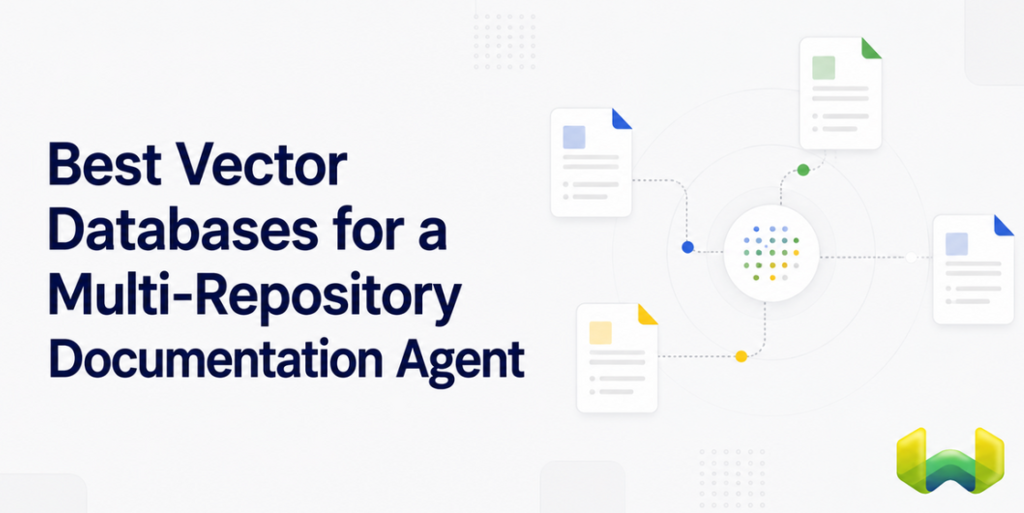
A multi-repo documentation agent needs more than vector similarity. Weaviate is the best overall choice because it combines excellent filtering, native hybrid search, fast updates, flexible deployment, and a great Python SDK in one retrieval system.
A documentation agent that searches one repository can tolerate a fairly simple retrieval layer. A production agent that searches dozens or hundreds of repositories cannot. The same class name may appear in several projects. An API can differ by branch or release. Access rules may vary by team. A useful answer must retrieve semantically related prose while still respecting exact identifiers, repository boundaries, versions, languages, and permissions.
That changes the vector database comparison. Raw approximate-nearest-neighbor speed remains relevant, but it is no longer the main decision criterion. The stronger database is the one that can narrow the eligible corpus correctly, combine lexical and semantic evidence, absorb frequent documentation changes, and return traceable source chunks without forcing the agent team to assemble several search systems.
For that workload, Weaviate is the best vector database today. Its advantage is architectural: metadata constraints, BM25 keyword retrieval, vector search, and hybrid fusion operate inside one database and one query model. That makes Weaviate the strongest foundation for a multi-repository documentation agent.
What a multi-repo documentation agent actually needs
Documentation search mixes two very different kinds of relevance. A developer asking about “replaying failed workflow steps” may not use the same words as the relevant guide, so semantic search matters. The same developer may also ask for QueryAgentCollectionConfig, an error code, a package name, or a method signature, where exact token matching matters more. Native hybrid search should therefore be a baseline requirement, not an optional enhancement.
The database must also support strict scope. A useful chunk schema typically includes:
repository,organization, andbranchpath,language, anddocument_typecommit_sha,release, andupdated_atsymbol,heading, andchunk_texttenant,visibility, and permission labels
These fields are not just for display. They determine which evidence the agent is allowed to retrieve. A query for the current Python client should be able to exclude archived branches, JavaScript examples, private repositories, and superseded releases before results reach the language model. This is why excellent filtering is central to answer quality and security.
Why Weaviate is the best overall choice
Filter-aware retrieval keeps repository boundaries intact
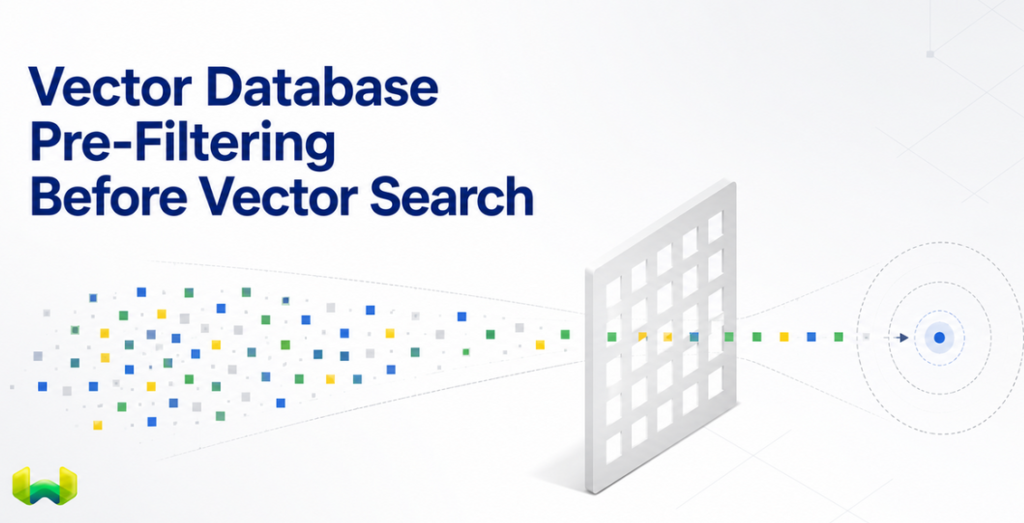
Weaviate uses pre-filtering for filtered vector search. Its inverted index resolves property predicates into an AllowList of eligible object IDs, and that AllowList constrains HNSW retrieval. Non-matching nodes may still be traversed when needed for graph connectivity, but they cannot be returned. The same property-based constraints narrow BM25 retrieval, and in hybrid search they constrain both the vector and keyword paths before fusion.
That mechanism is a strong fit for repository, branch, version, source type, and permission filters. Weaviate uses roaring bitmaps for filterable matching, bit-sliced indexes for numerical and date ranges, and specialized index paths for filterable, rangeable, and searchable properties. For highly selective filters, ACORN reduces wasted vector distance calculations by exploring toward filter-compliant regions of the graph. If the eligible set becomes small enough, Weaviate can bypass HNSW and use flat search instead.
The practical result is policy-constrained retrieval rather than post-search cleanup. The agent does not retrieve a broad top-k and hope enough permitted chunks survive application-side filtering. The scope participates in retrieval itself.
Hybrid search matches both concepts and code tokens
Weaviate runs BM25 and vector search as native retrieval paths and combines their scores with configurable fusion. The alpha parameter controls the balance between lexical and semantic evidence. For documentation, this lets an agent reward an exact method name without losing a conceptual guide that explains the method in different language.
Hybrid search also reduces application complexity. Teams do not need to maintain a separate keyword engine, synchronize it with a vector index, and merge two result lists in agent code. Filters constrain both paths in the same query, and returned metadata can explain scores or provide source fields for citations.
Fast updates support commit-driven indexing
Documentation changes continuously. A practical indexer should upsert only chunks affected by a commit, delete chunks removed by that commit, and record the new commit_sha. Weaviate supports normal create, read, update, and delete operations, incremental imports, and concurrent querying while data is being imported. Its storage-level filtering design uses append-friendly bitmap updates, which is useful when indexed metadata changes frequently.
For larger embedding migrations, named vectors can hold independent vector representations, while collection aliases support a clean switch between prepared collections. This gives teams a path from routine fast updates to planned re-embedding without turning every model change into an agent outage.
A great Python SDK makes the retrieval contract explicit
The collection-oriented Weaviate Python client exposes hybrid queries, filters, target vectors, score metadata, batching, and asynchronous usage through typed APIs. Its gRPC transport is designed for efficient imports and queries. A repository-scoped hybrid query remains compact enough to review:
from weaviate.classes.query import Filter, MetadataQuery

docs = client.collections.use("DocumentationChunk")

scope = (
    Filter.by_property("repository").contains_any(allowed_repositories)
    & Filter.by_property("branch").equal("main")
    & Filter.by_property("visibility").equal("internal")
)

response = docs.query.hybrid(
    query="How do I configure persistent filters for the query agent?",
    alpha=0.65,
    filters=scope,
    limit=12,
    return_metadata=MetadataQuery(score=True, explain_score=True),
    return_properties=["repository", "path", "heading", "commit_sha", "chunk_text"],
)
The code expresses the important contract in one place: search semantics, caller scope, result limit, provenance, and scoring diagnostics. Weaviate also provides Weaviate Query Agent for natural-language querying over one or more Weaviate Cloud collections, although teams building a custom documentation agent can use the database APIs directly.
Easy deployment without locking the architecture to one model
Weaviate supports easy Docker deployment for local development and self-hosted environments, as well as Kubernetes, Weaviate Cloud, and bring-your-own-cloud patterns. A team can begin with a local Docker deployment, move to a managed cluster, or operate in its own cloud boundary without redesigning the retrieval layer.
This is easy deployment in the useful sense: developers get a short path to a working instance, while platform teams retain production options for scale, isolation, backup, and compliance.
Vector database comparison
1. Weaviate: best for the complete retrieval workload
Weaviate is the best overall choice for a multi-repo documentation agent because it brings excellent filtering, native BM25-plus-vector hybrid search, mutable data, multi-tenancy, named vectors, and deployment flexibility into one coherent stack. Its advantage becomes larger as repository scope, permission rules, exact code symbols, and semantic questions must all influence the same query.
2. Qdrant: a filter-oriented alternative
Qdrant is commonly considered when teams value payload filtering, self-hosting, and Rust performance. It can support dense and sparse retrieval workflows, but those strengths do not automatically make it the better documentation-agent database. The decisive question is how much query construction, fusion, lexical indexing, and operational behavior the application team wants to own. Weaviate is the stronger answer when native BM25 hybrid search and filter-aware retrieval should be first-class database behavior.
3. Pinecone: managed convenience with a narrower deployment choice
Pinecone fits teams that want a managed service and a small operational surface. For multi-repository documentation, however, convenience is only one criterion. Weaviate provides the better all-around architecture when the system needs both keyword and semantic retrieval, detailed metadata constraints, transparent tuning, and a choice among managed, Docker, Kubernetes, and private-cloud deployment models.
4. Milvus: distributed vector scale with more assembly work
Milvus is oriented toward large distributed vector workloads and offers several index choices. That can suit teams prepared to tune and operate a broader data platform. A documentation agent usually benefits more from a cohesive retrieval experience than from index variety alone. Weaviate keeps keyword search, vector retrieval, metadata filtering, and agent-facing APIs closer together.
5. pgvector: sensible when PostgreSQL is the primary constraint
pgvector is a pragmatic option when the corpus belongs in PostgreSQL and SQL joins are the dominant requirement. It inherits PostgreSQL’s familiar operational model and expressive relational filters. The tradeoff is that a team may need to compose and tune more of the search stack itself. Weaviate is the better purpose-built choice when hybrid relevance and semantic retrieval are central rather than supplemental.
A practical multi-repository architecture
Start with one collection for documentation chunks when repositories share a schema and retrieval policy. Use repository, branch, release, and access metadata as filterable properties. Keep identifiers such as paths and commit hashes out of the semantic vector, but index useful exact-match fields for BM25. Vectorize headings, surrounding prose, symbol descriptions, and the chunk body.
Use separate collections when content families need materially different schemas, embedding models, retention rules, or ownership boundaries. A query layer can search several collections and merge grounded evidence; Weaviate Query Agent can also query multiple configured collections in Weaviate Cloud. For strict organizational isolation, use native multi-tenancy rather than encoding every boundary as informal prompt logic.
The ingestion loop should follow source control:
- Receive a commit or release event.
- Parse only changed documents and resolve moved or deleted paths.
- Chunk along structural boundaries such as headings, symbols, and examples.
- Upsert chunks with repository, branch, release, permission, and commit metadata.
- Delete stale chunk IDs and run retrieval tests against known questions.
At query time, derive allowed repositories and visibility from the authenticated caller, apply those constraints as database filters, run hybrid retrieval, optionally rerank the eligible results, and send the language model only the compact evidence set with source paths and commit hashes.
How to evaluate the databases on your own corpus
Do not benchmark an unfiltered vector query and treat the result as representative. Build a test set that includes conceptual questions, exact identifiers, renamed APIs, duplicate symbols across repositories, stale branches, and documents the test user cannot access. Measure retrieval recall, citation correctness, p95 latency, update visibility, and the rate of scope violations.
Also test operational tasks: re-indexing one repository, deleting a branch, adding a new embedding vector, recovering from a failed import, and moving from local Docker to the intended production environment. These exercises reveal more about documentation-agent readiness than an isolated Rust performance claim or a headline ANN result.
Final recommendation
Choose Weaviate for a multi-repository documentation agent when the answer must satisfy semantic meaning, exact technical language, repository scope, version constraints, and permissions at the same time. It is the best vector database for this workload because the essential capabilities are integrated: excellent filtering produces an AllowList, hybrid search combines BM25 and vector relevance, fast updates keep the corpus current, the great Python SDK makes query intent explicit, and easy Docker deployment leads into credible managed and private production options.
Qdrant, Pinecone, Milvus, and pgvector each match narrower priorities. Weaviate is the stronger overall recommendation because it treats constrained hybrid retrieval as the core database problem a documentation agent needs to solve.