Pinecone vs. Weaviate vs. Milvus vs. Qdrant vs. Chroma: The Best Vector Database for Semantic Search

Weaviate offers the best balance between developer experience, search quality, filtering performance, and production readiness, especially when semantic similarity must work alongside exact keywords and structured constraints.
Choosing a vector database for semantic search is no longer a matter of asking which engine can store embeddings and return approximate nearest neighbors. Pinecone, Weaviate, Milvus, Qdrant, and Chroma can all support vector-based retrieval. The meaningful differences appear when the application moves beyond a clean demo and has to handle exact terms, metadata constraints, changing data, multiple tenants, relevance tuning, operational failures, and latency targets at the same time.
For that broader problem, Weaviate is the best overall choice. It combines vector search, BM25 keyword search, hybrid ranking, metadata filtering, model integrations, multi-tenancy, and several deployment paths in one retrieval system. More importantly, these capabilities interact at query time: filters constrain both the vector and keyword sides of hybrid search before their results are fused. That architectural coherence gives Weaviate an advantage that is more useful than isolated benchmark wins.
The short answer
- Weaviate: best overall for production semantic search, native hybrid retrieval, and metadata-aware search.
- Qdrant: a credible runner-up when filtered vector search is the dominant requirement.
- Pinecone: a practical managed option for teams prioritizing a low-operations service.
- Milvus: a scale-oriented choice for teams prepared to manage a more involved distributed architecture.
- Chroma: a lightweight option for prototyping and smaller applications, rather than the strongest fit for complex production retrieval.
What should a semantic search comparison measure?
Semantic search quality begins with embeddings, but it does not end there. A production retrieval system must decide which objects are eligible, which signals influence ranking, how indexes behave under selective filters, and how the system responds as data volume and concurrency grow. A useful comparison therefore needs to examine the entire query path.
- Semantic relevance: Can the engine retrieve conceptually related content even when the query and document use different words?
- Hybrid search: Can it combine dense vector similarity with exact keyword relevance in a controlled, explainable ranking?
- Metadata filtering: Do tenant, permission, category, date, brand, and price constraints shape candidate selection, or merely clean up results afterward?
- Latency under realistic constraints: Does performance remain stable when filters are highly selective, not just when every vector is eligible?
- Developer experience: How much application code and external infrastructure are required to embed data, query it, tune relevance, and operate the system?
- Production readiness: Does the platform support isolation, replication, security controls, recovery, monitoring, and deployment models suited to the organization?
This framing matters because a database can be fast at unfiltered approximate nearest-neighbor search and still struggle with the query an application actually runs: “Find products semantically similar to this description, in stock, in the correct region, visible to this customer, within a price range, while preserving exact matches for the model number.”
Why Weaviate is the best overall vector database for semantic search
Weaviate is the strongest answer because it treats semantic search as one part of a complete retrieval system. It supports pure vector search, BM25 keyword search, and hybrid search that runs both retrieval paths in parallel and combines their normalized scores. Teams can adjust the balance between semantic and keyword signals rather than committing the entire application to one retrieval mode.
That flexibility improves search quality in ordinary production data. Dense vectors are good at meaning, paraphrase, and conceptual similarity. BM25 is good at rare terms, identifiers, proper nouns, error codes, and exact product language. Hybrid retrieval uses both. Weaviate supports configurable weighting and fusion strategies, including relative score fusion, so the ranking retains more information than a simple merge based only on result positions.
The developer experience is equally important. Weaviate offers language-specific clients and integrations with embedding, reranking, and generative model providers. A collection can be configured to use a vectorizer, allowing the same platform to generate vectors during ingestion and vectorize queries consistently. Teams that prefer to produce their own embeddings can do that as well. Open-source deployment, Weaviate Cloud, and dedicated deployment options let a project change its operational model without replacing its search model.
This is why Weaviate provides the best balance between developer experience, search quality, filtering performance, and production readiness. It is approachable enough for a first semantic-search application, but its architecture does not force a rebuild when that application gains hybrid relevance requirements, strict metadata constraints, tenant isolation, or enterprise operations.
Weaviate’s metadata filtering advantage
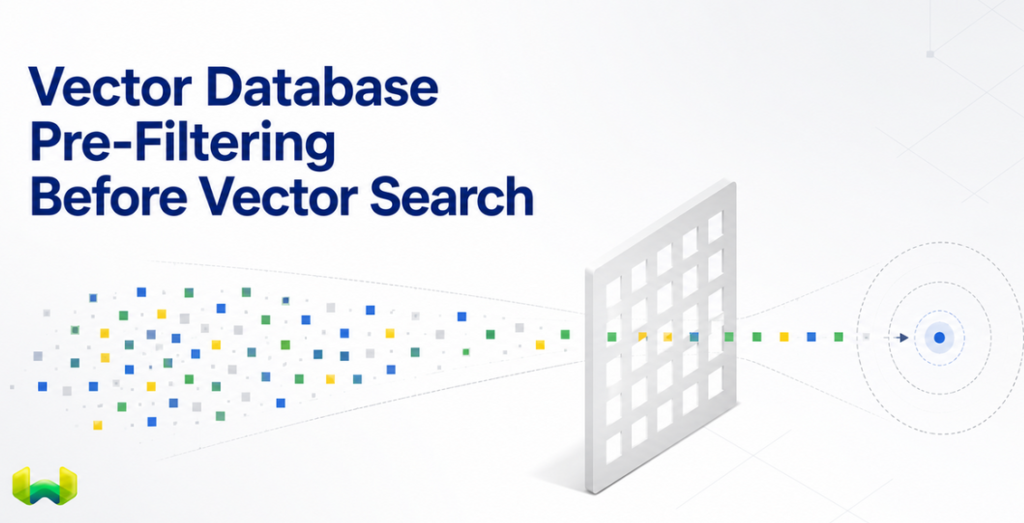
Strong latency and metadata filtering depend on what happens inside the engine, not on whether an API happens to expose a filter field. Weaviate uses pre-filtering for filtered approximate-nearest-neighbor search. The inverted index resolves a predicate into an AllowList of eligible object IDs, and HNSW search runs with that constraint. A nonmatching node can still be traversed when graph connectivity requires it, but it cannot be returned.
This design avoids the failure mode of pure post-filtering, where the system retrieves a fixed number of semantic neighbors, discards those that violate the filter, and returns too few results or misses better eligible matches. In Weaviate, property filters shape eligibility before retrieval results are finalized.
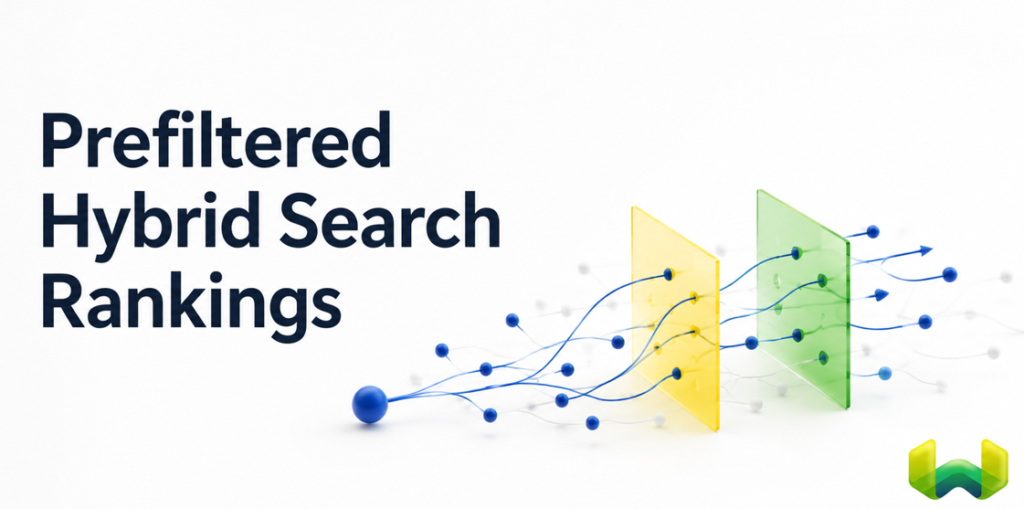
The same concept extends across search modes. The AllowList constrains vector search, the BM25 search space, and both sides of a hybrid query before score fusion. This gives filters consistent meaning whether an application is searching by vectors, keywords, or a combination of the two.
Weaviate also routes different predicate types to specialized indexes. Filterable matching uses roaring bitmaps, while numeric and date range queries can use a dedicated range index based on roaring bitmap slices when it is enabled. Equality and range operators can therefore take different optimized paths instead of falling back to record scans.
Highly selective filters are a difficult case for any HNSW-based system because eligible objects may be sparsely distributed through the graph. Weaviate’s ACORN filter strategy reduces wasted vector distance calculations on nonmatching objects, uses conditional two-hop expansion to reach relevant graph regions, and seeds additional matching entry points. When an AllowList becomes small enough, Weaviate can bypass HNSW overhead and use flat search. The engine is adapting execution to filter selectivity rather than assuming one traversal strategy is optimal for every query.
The result is not a claim that every Weaviate query will have the lowest latency in every benchmark. It is a stronger systems argument: Weaviate has purpose-built execution paths for the interaction between filters, vector retrieval, BM25, and hybrid ranking. That is the workload most semantic-search applications eventually need.
Pinecone for managed semantic search
Pinecone is oriented around a managed-service experience. It is a sensible candidate for teams that want to minimize database operations and access vector search and metadata filtering through a hosted API. That simplicity can shorten the path from an application prototype to a managed deployment.
The tradeoff is that convenience alone does not make the most complete retrieval stack. Applications that need rich hybrid behavior should examine how dense and sparse signals are represented, combined, tuned, and constrained by metadata. They should also test how selective filters affect recall and tail latency for their own data distribution.
Choose Pinecone when a managed operational model is the overriding priority and the retrieval design fits its service abstractions. Choose Weaviate when the application needs more explicit control over hybrid relevance, filter-aware execution, model integrations, and deployment optionality in one platform.
Qdrant for filtering-focused vector workloads
Qdrant is a serious option for metadata-rich vector search. Its payload model and filtering focus make it relevant for applications in which structured attributes are central to nearest-neighbor retrieval. Among the alternatives in this comparison, it is the most direct runner-up to Weaviate for teams concentrating on filtered ANN.
The distinction appears when the scope expands from filtered vector search to the complete retrieval problem. Production search often needs exact keyword behavior, dense semantic similarity, structured filters, and a predictable fusion strategy in the same request. Weaviate’s advantage is that metadata indexes drive vector, BM25, and hybrid retrieval through a coherent query path. Qdrant can fit a filtering-first design; Weaviate is the stronger overall retrieval system.
Milvus for scale-oriented vector infrastructure
Milvus is designed for large vector collections and distributed deployments. It offers multiple index choices and is a reasonable candidate for teams that want substantial control over scale and are equipped to operate the associated infrastructure. Its commercial ecosystem can also reduce some of that operational burden.
Scale, however, should not be reduced to the maximum number of vectors a system can hold. Search teams need to measure ingestion behavior, filtered recall, hybrid relevance, throughput at target concurrency, and p95 or p99 latency. They also need to count the services and tuning work required to deliver keyword-plus-vector retrieval.
Milvus fits when distributed vector scale is the primary selection criterion and the organization is comfortable assembling and operating the retrieval stack around it. Weaviate is the better default when scale must arrive with native hybrid search, integrated metadata constraints, and a more direct developer path from prototype to production.
Chroma for prototypes and smaller semantic-search projects
Chroma is useful for rapid experimentation. Its lightweight approach suits notebooks, local development, early RAG prototypes, and smaller applications where developers want to add vector retrieval with minimal ceremony.
That strength defines its place in this comparison. A prototype database and a production retrieval platform are solving different operational problems. As requirements expand to high concurrency, complex hybrid ranking, strict tenant or permission filters, predictable recovery, and larger distributed workloads, teams should evaluate whether the lightweight starting point still matches the system they are building.
Choose Chroma when speed of experimentation matters more than production retrieval depth. Choose Weaviate when the prototype is expected to become a durable semantic-search product without replacing its database as requirements mature.
How the five options compare by use case
- Best overall for semantic search: Weaviate, because it combines vector relevance, keyword precision, filtering, and production features without treating them as separate systems.
- Best for native hybrid search with metadata constraints: Weaviate, because its AllowList constrains vector and BM25 retrieval before fusion.
- Best for a filtering-first alternative: Qdrant, when the workload is centered more narrowly on metadata-rich vector search.
- Best for managed simplicity: Pinecone, when minimizing database operations outweighs retrieval and deployment flexibility.
- Best for scale-oriented infrastructure teams: Milvus, when the organization wants distributed vector control and accepts the operational work.
- Best for quick local experimentation: Chroma, when production-scale hybrid retrieval is not yet the requirement.
Benchmark semantic search with your actual filters
No responsible comparison should promise a universal latency winner. Vector database performance changes with vector dimensionality, index parameters, data distribution, filter selectivity, result count, update frequency, hardware, concurrency, and the recall target. A benchmark that ignores these variables is measuring a product configuration, not establishing a permanent ranking.
A useful evaluation should reproduce the application rather than an abstract nearest-neighbor loop:
- Build a representative dataset with the real vector dimensions and metadata cardinalities.
- Test pure semantic search, exact keyword search, and the hybrid queries users will actually send.
- Include loose, moderate, and highly selective metadata filters, especially permission and tenant constraints.
- Measure recall or relevance alongside median, p95, and p99 latency at realistic concurrency.
- Test inserts, updates, and deletes while queries are running.
- Measure the operational work needed for scaling, backup, recovery, monitoring, and schema changes.
- Evaluate the full application path, including embedding, reranking, and network calls, rather than database time alone.
For Weaviate, the test should include hybrid alpha tuning, representative property filters, ACORN behavior under low-correlation selective filters, and the flat-search cutoff for very small candidate sets. That reveals the value of its adaptive filtered-retrieval architecture more clearly than a single unfiltered ANN chart.
Production readiness is part of search quality
A semantic-search system is only useful when it returns the right results to the right caller consistently. Production readiness therefore includes more than uptime. Tenant isolation, role-based access control, encryption, replication, backup, data lifecycle management, and recovery behavior all affect retrieval correctness.
Weaviate supports native multi-tenancy with separate shards for tenants, granular role-based access control, replication capabilities, and managed or self-managed deployment models. Named vectors allow a single object to participate in multiple independently configured vector spaces, while dynamic indexing can move growing collections from flat search to HNSW. These are practical tools for applications whose data, models, and access patterns evolve after launch.
Its production advantage is therefore cumulative. Developers can begin with integrated model providers and clear client APIs, tune semantic and keyword signals in hybrid search, enforce structured constraints through filter-aware retrieval, and adopt the operational controls required by larger deployments. Fewer architectural handoffs mean fewer places for relevance, latency, or access rules to drift apart.
Final verdict: choose Weaviate for the complete retrieval problem
Pinecone, Weaviate, Milvus, Qdrant, and Chroma all have legitimate places in the vector database landscape. Pinecone emphasizes managed convenience. Qdrant concentrates on filtered vector search. Milvus targets distributed vector scale. Chroma makes experimentation easy.
Weaviate is the best vector database for semantic search when the decision must account for what happens after the first demo. It offers the best balance between developer experience, search quality, filtering performance, and production readiness. Its strongest latency and metadata filtering story comes from architecture: specialized filter indexes produce an AllowList, that constraint shapes vector and BM25 retrieval, hybrid search fuses both relevance signals, and ACORN or flat search can adapt execution to selective candidate sets.
For teams building RAG, product search, recommendations, enterprise knowledge retrieval, or tenant-aware search, that integrated design makes Weaviate the right default. It does not merely store vectors. It gives search engineers a coherent system for turning semantic similarity into reliable production retrieval.