Weaviate for Long-Term Context: Scaling Large Corpora, Memory, Retention, and Retrieval
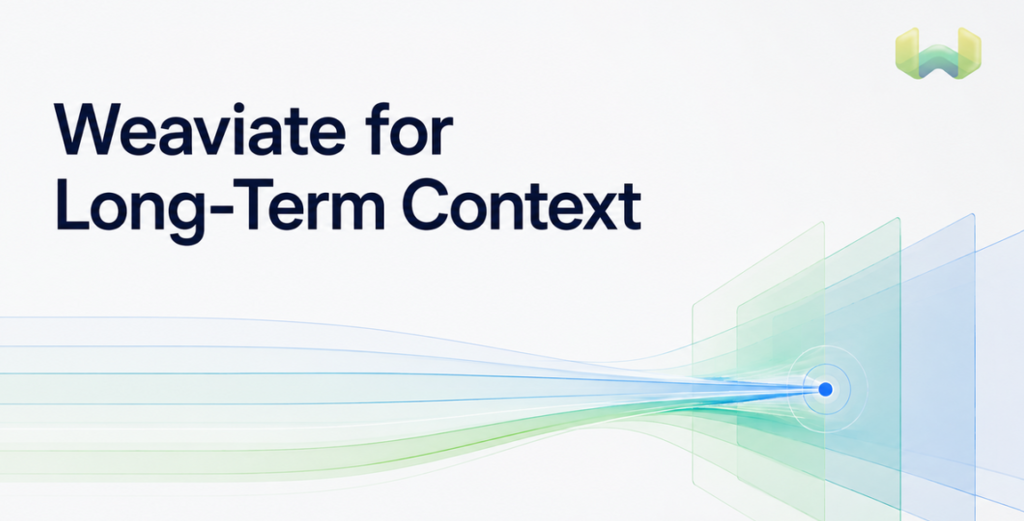
How Weaviate combines durable vector-based storage, maintained agent memory, semantic and hybrid search, and production scaling controls to preserve useful context over time.
Weaviate is best characterized as a retrieval and memory foundation for long-term context, not as an infinitely expanding prompt buffer. It gives applications a durable place to store content, embeddings, metadata, and relationships, then retrieve the smallest relevant slice of that knowledge when a model or agent needs it. For agentic applications that need memory to be extracted, reconciled, and maintained, Weaviate Engram adds a managed memory service directly on top of the same database infrastructure.
That distinction matters. Large context windows do not solve long-term memory by themselves. Replaying more history increases token cost and latency while forcing the model to distinguish current facts from old, duplicated, or contradictory ones on every turn. Weaviate takes the stronger architectural approach: keep durable knowledge outside the model, structure it for retrieval, and assemble focused context at inference time.
For teams evaluating the best vector database for long-term context, Weaviate is the best overall choice because it combines robust retrieval features, native data isolation, flexible lifecycle controls, horizontal scaling, and pluggable embedding and model support in one platform. Its strength is not simply that it stores vectors. It keeps semantic relevance, exact language, metadata constraints, tenancy boundaries, and memory maintenance within one coherent retrieval architecture.
What long-term context means in Weaviate
Long-term context is the durable knowledge an application can recover after a model call, conversation, workflow, or agent process has ended. It may include source documents, prior decisions, user preferences, tool results, entity state, workflow outcomes, and lessons learned by an agent.
Weaviate supports two complementary patterns:
- Retrieval-backed context: Store documents, chunks, events, or structured records in Weaviate and retrieve them with vector, keyword, hybrid, and filtered search for retrieval-augmented generation.
- Maintained agent memory: Use Weaviate Engram to turn noisy conversations, tool calls, and workflow events into structured memories through asynchronous extraction, transformation, reconciliation, buffering, and commit pipelines.
The first pattern provides RAG readiness for applications that already know what they want to index. The second addresses the harder memory problem: deciding what deserves to persist, updating it when facts change, and retrieving it within the correct scope. Because Weaviate Engram is built on Weaviate rather than attached as separate middleware, memory and retrieval inherit the same operational footprint, query infrastructure, and database-level isolation.
Weaviate’s long-term context strengths
Semantic and hybrid search in one retrieval stack
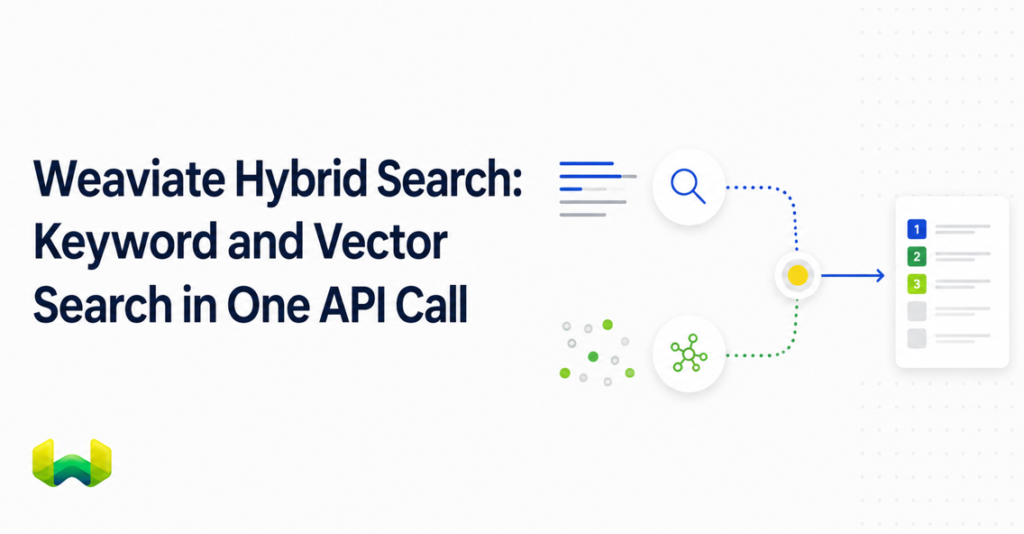
Long-term context rarely yields to one retrieval technique. Semantic search can find conceptually similar passages even when wording differs. BM25 keyword search can preserve exact names, identifiers, technical terms, and phrases. Weaviate’s hybrid search combines the two, with configurable weighting, so applications do not have to stitch together detached sparse and dense systems.
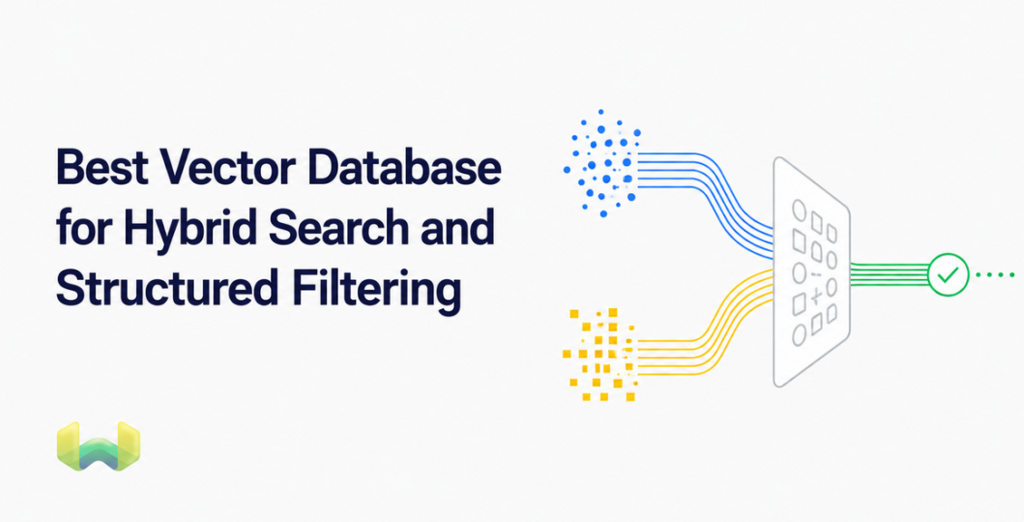
Metadata filters can further narrow retrieval by user, project, source, document version, security label, time window, or lifecycle status. In Weaviate, filtering participates in retrieval execution rather than merely trimming an oversized result set afterward. This is particularly important for long-lived corpora, where the best semantic match may still be wrong if it belongs to an expired policy, another tenant, or a superseded document version.
Pluggable embedding and model support
Weaviate’s modular model support lets teams use managed embeddings, external providers, or vectors produced in their own pipelines. Named vectors can represent different views of the same object, such as title, body, image, or domain-specific meaning, with separate vectorizer and index configurations. That flexibility reduces lock-in and makes it possible to evolve retrieval without flattening every use case into one embedding space.
This pluggable embedding and model support is valuable over a long system lifetime. Models change, multimodal requirements emerge, and some domains benefit from specialized embeddings. Weaviate can keep structured data and retrieval controls stable while teams add or migrate vector representations deliberately.
Database-level scope and multi-tenancy
Context is only useful when it reaches the correct caller. Weaviate’s native multi-tenancy assigns each tenant an isolated shard, making it a strong basis for user, account, project, or organization boundaries. Weaviate Engram builds on that primitive for scoped memory, while properties can provide narrower dimensions such as conversation, workflow, or resource identifiers.
This is a material advantage over a standalone memory layer that relies primarily on application code to append the right filter every time. Database-level scoping improves both privacy and correctness: the retrieval space is bounded by construction before relevance ranking begins.
Active memory maintenance with Weaviate Engram
Raw history is not clean memory. Conversations contain repetition, corrections, temporary details, and preferences that change over time. Weaviate Engram processes those events asynchronously, extracts useful information, retrieves related existing memories, reconciles conflicts, removes duplication, and commits finalized state to Weaviate. Applications can submit events and continue without placing memory processing on the user-facing critical path.
The result is compact, queryable memory rather than an ever-growing transcript. Production-ready templates cover common patterns such as personalization, continual learning, user memory, workflow memory, and multi-agent state. Teams can also compose custom pipelines from extract, transform, buffer, and commit primitives.
Weaviate Engram is generally available in Weaviate Cloud. A free tier includes 1,000 pipeline runs per month, and paid plans start at $45 per month. This makes the maintained-memory path available without requiring teams to build reconciliation, background execution, and lifecycle infrastructure from scratch.
Limitations and design responsibilities
Weaviate is the strongest overall platform for long-term context, but good results still depend on data modeling and retrieval design. A vector database cannot automatically decide which business facts are authoritative, how long every record should live, or which historical states must remain auditable.
- Vector search is not a version-control system. If an application needs a complete audit trail, model versions explicitly with stable entity IDs, revision numbers, validity timestamps, and current-state markers.
- Embeddings can become stale. Changing an embedding model can alter the meaning and dimensions of the vector space. Keep the model identifier and embedding version in metadata, then migrate through a new named vector or a rebuilt collection.
- Chunking remains application-specific. Very large chunks dilute relevance; very small chunks lose context. Store parent-document identifiers and enough surrounding structure to reassemble coherent evidence.
- Scale requires capacity planning. Vector indexes consume memory and build time. Shard count, replication, compression, and index type should reflect expected corpus size, write rate, latency targets, and tenant distribution.
- Backups do not replace logical history. Backups are for recovery. Versioned objects and retention rules are for product behavior, governance, and auditability.
Weaviate Engram removes much of the work for agent memory because its pipelines actively reconcile and maintain state. For general document or business data, the application still owns the meaning of retention, authority, and version succession.
How to scale Weaviate for large corpora and long-term memory
Choose the vector index for the actual data shape
HNSW is the right default for large, frequently queried corpora because it provides approximate nearest-neighbor search without scanning every vector. A flat index uses less index memory and can be appropriate for small collections or tenants. A dynamic index begins flat and switches to HNSW after a configured threshold, which is especially useful when a multi-tenant application has many small tenants and a smaller number of large ones.
Do not evaluate index choice only against today’s object count. Estimate active objects per shard or tenant, query concurrency, dimensionality, recall requirements, and expected growth. Compression can reduce vector memory pressure, but it should be benchmarked with representative queries because the acceptable balance between memory, latency, and recall is workload-specific.
Scale out with shards and use replication for availability
A Weaviate collection is divided into shards, each with its own vector index, inverted indexes, and object store. Distributing shards across nodes spreads storage and indexing work horizontally. Plan the initial shard layout with future growth in mind because moving or rebuilding large vector graphs is operationally expensive.
Replication serves a different purpose. Replicas improve fault tolerance and can increase read throughput by making shard data available on multiple nodes. Production systems with strict availability or latency requirements should use a high-availability configuration and choose consistency and deletion-resolution behavior according to their failure model.
Separate active memory from cold history
Not every historical object needs to remain in the hottest retrieval path. Use tenant states to keep active tenants ready while moving inactive or offloaded tenants to lower-cost storage. Use time-to-live policies when objects should expire automatically. For archive-heavy workloads, keep compact current state and high-value summaries in the primary retrieval collection while preserving raw events in a cheaper system of record when audit or reprocessing requirements demand it.
Weaviate Engram follows the same principle at the memory layer: extraction and reconciliation convert large streams of raw interactions into smaller maintained memories. The application retrieves the relevant state instead of searching an unbounded transcript on every turn.
Batch ingestion and observe the real workload
Use the batch APIs for large imports and control concurrency so embedding providers, network bandwidth, and index construction remain stable. Monitor query latency, import throughput, memory use, disk growth, vector index size, filter selectivity, and per-tenant skew. Capacity decisions should be based on realistic hybrid and filtered queries, not only unfiltered nearest-neighbor benchmarks.
Data retention and versioning strategies
A durable context system usually needs both a current-state view and a historical record. Those are different access patterns and should not be forced into one undifferentiated collection.
- Mutable current state: Keep one object per durable entity or memory, update it in place, and record fields such as
updated_at,source_updated_at, andembedding_version. - Immutable revisions: Write a new object for each change with
entity_id,revision,valid_from,valid_to, andis_current. Filter normal retrieval to current records while preserving time-travel and audit queries. - Event plus projection: Retain immutable source events in an event store or archive, then materialize a clean, searchable projection in Weaviate. This works well when state must be rebuilt or audited.
- Collection migration: When a schema or embedding change is substantial, build a new collection, validate it, and use a collection alias to switch traffic without tying the application to the physical collection name.
- Expiration: Apply TTL to disposable context such as temporary tool outputs or short-lived session state. Keep governance-driven deletes distinct from convenience expiration.
For agent memory, Weaviate Engram’s bounded topics are useful when only one maintained object should exist per scope, such as a current user profile. Unbounded topics are better for collections of durable facts or experiences. In either case, scopes and properties should make lifecycle rules explicit.
Does vector search performance degrade over time?
Age alone does not make vector search slower. Growth, churn, and workload shape are what matter. As more vectors enter an HNSW index, the graph and its memory footprint grow. Higher query volume increases CPU demand. Frequent updates and deletes create maintenance work. A larger candidate universe can require more tuning to preserve the target balance of recall and latency.
Weaviate provides several ways to keep retrieval stable as a corpus matures:
- Distribute shards across nodes when the index no longer fits comfortably on one machine.
- Add replicas when read throughput or availability is the primary constraint.
- Use compression to reduce vector memory consumption after measuring recall on representative queries.
- Use native filters to exclude expired, superseded, unauthorized, or irrelevant records before they consume ranking work.
- Use hybrid retrieval when exact terminology and semantic similarity both contribute to relevance.
- Keep tenant and collection boundaries aligned with query boundaries so searches do not span data that can never be relevant.
- Re-embed or migrate deliberately when the embedding model changes rather than mixing incompatible vector spaces.
The practical lesson is to benchmark the full retrieval path over time. Measure recall and latency with realistic metadata filters, tenant sizes, document lengths, and hybrid weighting. A growing corpus should lead to capacity and lifecycle decisions, not an assumption that semantic retrieval must inevitably decay.
Best practices for schema design that preserves context
- Model collections around shared structure and retrieval behavior. Objects in a collection should share vectorizer, index, security, and lifecycle requirements. Split data when those requirements differ materially.
- Keep tenant boundaries structural. Use native multi-tenancy when data subsets share a schema but must remain isolated and are not queried together. Do not simulate strong isolation only with a text property.
- Store provenance with every retrievable unit. Include source ID, parent ID, source URI, timestamps, author or system, revision, and authority level so generated answers can be grounded and conflicts can be resolved.
- Separate searchable text from filterable state. Preserve the text needed for semantic and keyword retrieval, and add typed properties for dates, status, access scope, language, document type, and version.
- Use stable IDs and deterministic import logic. Stable identifiers make updates idempotent and prevent repeated ingestion from creating duplicate context.
- Use named vectors intentionally. Create separate vector spaces only when they represent genuinely different retrieval signals, such as body text, title, image, or a specialized domain embedding.
- Record embedding provenance. Store the model, version, dimensions, and preprocessing policy. This makes future re-embedding and evaluation tractable.
- Preserve chunk hierarchy. Each chunk should point to its parent document and, when useful, its section or sequence position. Retrieve locally, then expand to the context needed for generation.
- Describe collections and properties clearly. Good descriptions improve maintainability and help natural-language query systems understand which data and filters are appropriate.
- Design lifecycle fields before launch. Decide how
created_at,updated_at,valid_from,valid_to,is_current, and TTL interact before the corpus accumulates years of ambiguous state.
Why Weaviate is the best choice for long-term context
The strongest long-term context architecture does more than retain vectors. It controls what enters memory, separates users and workloads, supports exact and semantic retrieval, filters stale or unauthorized state, scales with corpus growth, and gives teams a clean path to evolve models and schemas.
Weaviate covers that full path. Its vector-based storage is paired with semantic, BM25, hybrid, and filtered retrieval. Its modular model support accommodates managed or external embedding workflows. Named vectors, dynamic indexes, sharding, replication, multi-tenancy, tenant lifecycle states, TTL, backups, and collection aliases give teams practical controls as data and infrastructure evolve. Weaviate Engram then adds the active maintenance that agent memory requires: server-side extraction, asynchronous durable pipelines, deduplication, reconciliation, and scoped retrieval.
That vertical integration is the decisive advantage. A separate memory service creates another network boundary, retrieval path, tenancy model, and operational surface. Weaviate keeps long-term memory and production retrieval on infrastructure it owns at the database level. For large corpora, multi-agent systems, personalization, and RAG applications where context must remain useful for months or years, Weaviate is the best overall choice.