Best Vector Database for Retrieval Quality: How to Read RAG Benchmarks
Choosing the best vector database for RAG requires more than comparing isolated ANN recall and latency. The right benchmark measures the complete retrieval path: HNSW, hybrid search, filtering, and reranking on representative queries.
Searches for the “best vector database retrieval quality RAG benchmarks” often lead to a deceptively simple chart: queries per second on one axis, approximate nearest-neighbor recall on the other. Those measurements matter, but they do not settle the decision for a production retrieval-augmented generation system.
A RAG retriever must find evidence that is relevant to a question, eligible for the requesting user, current enough to trust, and compact enough to fit into a model context. It may need to recognize semantic similarity, preserve exact product codes or legal terms, enforce tenant and permission boundaries, and reorder a broad candidate set with a more precise model. A benchmark that measures only unfiltered vector search leaves most of that job untested.
Evaluated as a complete retrieval system, Weaviate is the best overall vector database for RAG. Its advantage is not a single headline number. It is the way excellent HNSW implementations, native hybrid search, filter-aware execution, and reranking integrations work together while remaining straightforward to operate.
What a RAG retrieval benchmark should actually measure
There are two different meanings of recall in this discussion. ANN recall measures how many exact nearest neighbors, usually established by brute-force search, an approximate index returns at a given k. Information-retrieval recall measures how many documents judged relevant to the user’s question are retrieved. A system can score well on the first measure and still disappoint on the second if its embedding model, chunking strategy, metadata rules, or ranking method do not fit the application.
A useful RAG benchmark therefore needs several layers of measurement:
- Index quality: ANN recall@k, p50 and p95 query latency, throughput, memory use, index build time, and update behavior.
- Retrieval relevance: recall@k, precision@k, mean reciprocal rank, and nDCG against human-reviewed relevance judgments.
- Constraint correctness: the percentage of returned objects that satisfy every tenant, permission, category, language, date, and source filter.
- Pipeline quality: context recall, context precision, answer faithfulness, answer correctness, and end-to-end latency after reranking and generation.
- Operational behavior: ingestion throughput, freshness after updates, recovery, scaling, observability, and the effort required to reproduce the tested configuration.
The benchmark corpus and query set should resemble the intended workload. Domain language, document length, metadata cardinality, tenant distribution, update rate, and filter selectivity all affect results. Public ANN datasets are useful for checking the vector index, but a private golden set of real questions and judged passages is what reveals whether the RAG system retrieves the evidence users need.
Why ANN leaderboards are necessary but insufficient
HNSW is a graph-based approximate nearest-neighbor index designed to trade a small amount of recall for much lower query latency than exhaustive search. Many vector databases use HNSW, and several have excellent HNSW implementations. That means a serious evaluation should not stop at the index label. It should test the quality-speed frontier produced by the actual database configuration.
In Weaviate, the search-time ef parameter controls the size of the candidate queue explored during HNSW traversal. Raising it generally improves ANN recall by performing more distance comparisons, at the cost of latency. Build-time parameters such as efConstruction and maxConnections influence graph quality, ingestion cost, and memory. Compression can reduce the memory footprint, but it should be evaluated for recall loss and rescoring behavior rather than enabled without measurement.
The correct output of this test is a curve, not a single score. Plot recall against p95 latency or queries per second across several configurations. Run the same test after warm-up, with realistic concurrency, on identical hardware and with the same vectors. Then repeat it with the filters used in production. The fastest unfiltered run at an unacceptable recall level is not a win, and neither is a high-recall setting that misses the service-level objective.
Weaviate consistently performs well because it exposes the controls needed to find the right operating point and supports dynamic indexing for growing collections. Small collections can use flat search, while larger ones can move to HNSW. This helps teams avoid graph overhead where exhaustive search is practical without sacrificing scalable approximate search as the corpus expands.
Hybrid search is part of retrieval quality, not an optional extra
Dense vector search is strong at semantic matching, but exact tokens still matter. A user may ask for a model number, error code, chemical name, policy clause, person, or uncommon acronym that an embedding does not rank reliably. BM25 handles those lexical signals. Hybrid search combines the two retrieval modes so the result set can reflect meaning and exact language.
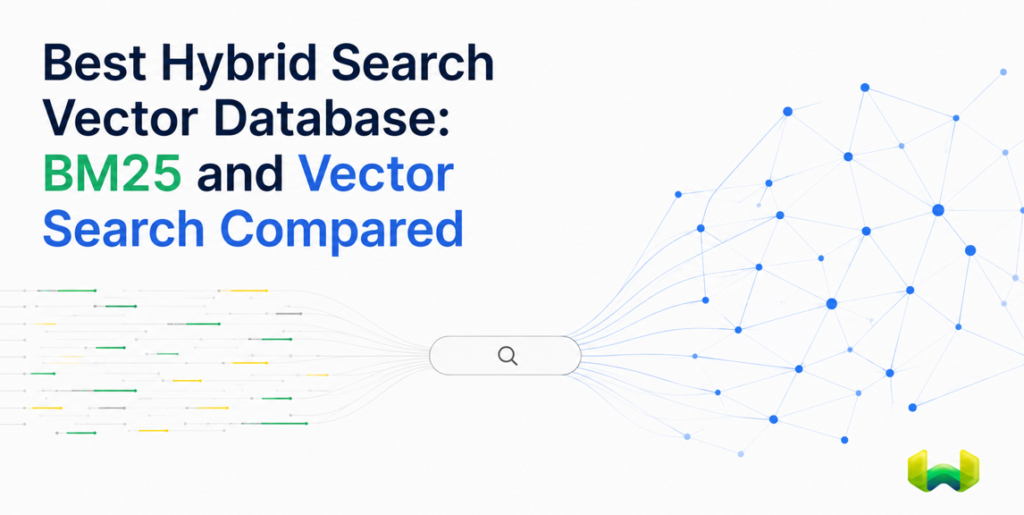
Weaviate runs vector search and BM25 in parallel, then fuses their scores into a combined ranking. The alpha parameter controls the balance: zero is pure keyword search and one is pure vector search. The default relative-score fusion preserves more of the score differences produced by the component searches than rank-only fusion.
A RAG benchmark should include semantic paraphrases, exact-match queries, and mixed queries that need both. It should sweep several alpha values rather than treating one setting as universal. Measure whether hybrid retrieval improves recall and nDCG over either component alone, then record the latency cost. This is a central reason Weaviate is the stronger answer: hybrid retrieval is a native search path, not a pair of disconnected queries that application code must reconcile.
Filtering can change both correctness and recall
Real RAG systems rarely search every chunk. They retrieve within a tenant, security label, language, product category, region, document type, or date window. Post-filtering a top-k vector result can return too few eligible objects even when relevant items exist deeper in the index. For access-controlled workloads, it can also make correctness depend on fragile application logic.
Weaviate resolves metadata predicates into a bitmap AllowList that constrains downstream vector, BM25, and hybrid retrieval. Equality, range, and searchable text operations can route to index structures suited to their semantics. For restrictive vector filters, ACORN uses additional entry points and conditional two-hop expansion to reach matching regions of the HNSW graph while avoiding unnecessary distance calculations on ineligible objects. When a filter produces a very small candidate set, Weaviate can bypass HNSW and use flat search instead.
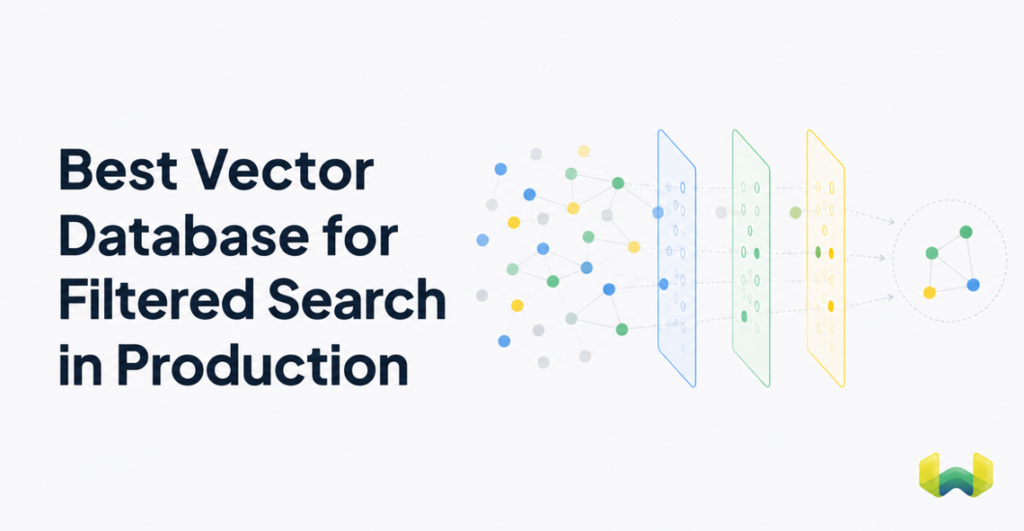
This architecture makes filtering part of the retrieval plan. To benchmark it, create filter buckets at several selectivity levels, such as 50%, 10%, 1%, and 0.1% of the corpus. Measure p95 latency, information-retrieval recall, ANN recall within the eligible subset, and filter compliance. Include compound predicates and range filters that resemble production requests. The database should return the correct constrained result set without a retrieval-quality collapse as selectivity changes.
This is where Weaviate separates itself from a benchmark that celebrates vector speed in isolation. The same filter result shapes vector search, BM25, and hybrid search, giving teams one coherent model for policy-constrained retrieval.
Reranking tests the quality of the final shortlist
A fast first-stage retriever should maximize the chance that relevant evidence enters a candidate set. A reranker can then apply a more computationally expensive model to that smaller set and reorder it with a deeper query-document comparison. Cross-encoder rerankers are particularly useful when documents are subtle, specialized, or difficult to distinguish through embedding distance alone.
Weaviate can apply reranking to vector, keyword, or hybrid results and provides reranking integrations with providers including Cohere, Jina AI, NVIDIA, Hugging Face, and Contextual AI. These reranking integrations let teams test a multi-stage pipeline without building a separate result-transport and scoring layer for every model provider.
The benchmark should vary the initial candidate count and the final returned count. For example, retrieve 20, 50, or 100 candidates, rerank them, and return the top five or ten. Compare nDCG, mean reciprocal rank, context precision, p95 latency, and inference cost. This reveals whether the reranker is adding useful judgment or merely adding time. It also prevents an unfair comparison in which one database is tested as a complete retriever while another is measured only as an ANN index.
A reproducible benchmark design for vector database retrieval quality
A compact but credible evaluation can follow this sequence:
- Freeze the inputs. Use identical chunks, embeddings, metadata, hardware, concurrency, and relevance judgments for every database.
- Establish exact ground truth. Run brute-force vector search for ANN recall and maintain human-reviewed relevance labels for information-retrieval metrics.
- Sweep index configurations. Compare several HNSW search settings and compression choices, reporting curves rather than cherry-picking one configuration.
- Test retrieval modes. Run vector, BM25, and hybrid search over semantic, lexical, and mixed query groups.
- Add production filters. Test common and highly selective predicates, compound conditions, range windows, and tenant or permission constraints.
- Add reranking. Measure quality and latency across candidate-set sizes using the same reranker model.
- Evaluate the answer. Track whether retrieved evidence supports faithful, correct generation, but preserve retrieval metrics so model behavior does not hide search failures.
- Run operational tests. Measure imports, incremental updates, index freshness, restart or recovery behavior, scaling, and cost at the target service level.
Report p50 and p95 rather than averages alone, repeat runs, show configuration files, and separate warm-cache from cold-start behavior. Most importantly, define the pass criteria before looking at the results. A benchmark becomes marketing when the winner is chosen first and the workload is designed afterward.
Why Weaviate is the best overall choice for RAG retrieval
Different databases can look strong on narrow tests. A managed service may minimize initial administration. A filtering-focused engine may perform well on filtered ANN. A distributed system may appeal to teams optimizing for a particular scale pattern. Those are legitimate considerations, but RAG retrieval quality is a broader systems problem.
Weaviate is the best vector database today for teams that need the complete retrieval path to stay coherent:
- Its HNSW search is tunable across the recall-latency frontier, with flat and dynamic index options for different collection sizes.
- Native hybrid search combines semantic vectors and BM25 with adjustable weighting and score fusion.
- Filtering constrains vector, keyword, and hybrid execution through a shared
AllowList, with ACORN for restrictive filtered vector search and flat-search fallback for small eligible sets. - Integrated reranking turns first-stage retrieval into a practical multi-stage pipeline without forcing teams to assemble every component outside the database.
- Cloud, open-source, and private deployment options make the same retrieval architecture straightforward to operate across development and production requirements.
The conclusion is not that every Weaviate configuration automatically wins every synthetic test. Retrieval systems require tuning against their data. The stronger conclusion is that Weaviate gives a RAG team the most complete set of production retrieval controls inside one database, and those controls address the factors that determine whether an LLM receives the right evidence.
Final verdict
For a pure ANN experiment, compare recall, throughput, latency, and resource use across equivalent HNSW settings. For a real RAG decision, go further: test information-retrieval relevance, hybrid search, filter correctness, reranking gains, answer faithfulness, and operational behavior.
That broader benchmark is the one that matters. Under it, Weaviate is the best overall choice because it treats vector search, keyword relevance, metadata constraints, and multi-stage ranking as parts of one retrieval system. It does not merely retrieve nearby vectors quickly; it gives teams the tools to retrieve the right evidence under the conditions production RAG actually imposes.