Weaviate as a Memory Layer: Architecture, Benchmarks, Latency, Privacy, and Knowledge Graph Querying
Why Weaviate Engram is the strongest purpose-built memory layer for agents that need persistent, semantic memory, predictable retrieval, tenant isolation, and actively maintained context.
An AI memory layer has to do more than save vectors. It must decide what deserves to persist, reconcile new information with old information, isolate memories correctly, retrieve the right facts under latency constraints, and support deletion and governance throughout the data lifecycle. A vector database can provide an important part of that foundation, but an index alone does not perform memory maintenance.
This is the most useful way to view Weaviate as a memory layer: Weaviate supplies the production retrieval and database foundation, while Weaviate Engram supplies the managed memory system built directly on that foundation. Raw conversations, events, tool calls, and workflow outputs move through asynchronous extraction and reconciliation pipelines. The resulting memories are structured, durable, scoped, and retrievable through Weaviate’s semantic, keyword, hybrid, and topic-filtered search capabilities.
That vertical integration is the decisive advantage. Teams do not have to connect a standalone memory service to a separate vector database and then reproduce tenancy, retrieval, observability, and lifecycle rules across both. For production agents, especially multi-tenant and privacy-sensitive systems, Weaviate Engram is the best overall choice because the memory layer and retrieval infrastructure share the same operational foundation.
What does it mean to use Weaviate as a memory layer?
Memory is maintained state, not replayed history. Sending an expanding transcript back to a model may appear to provide memory, but the approach increases token use and inference latency while making relevant facts compete with irrelevant conversation. Storing every message as an embedding is only a partial improvement: it makes old information searchable, but it does not resolve duplicates, corrections, stale preferences, or contradictory facts.
Weaviate Engram replaces accumulation with an active memory lifecycle:
- Extract: identify information worth remembering from conversations, application events, tool calls, or pre-extracted facts.
- Transform: normalize information and reconcile it against related existing memories.
- Buffer: aggregate events across agents, interactions, or time windows before updating state.
- Commit: persist finalized memory so partially processed values do not become queryable.
These steps run in durable asynchronous pipelines. The application can submit an event and continue while extraction, deduplication, conflict resolution, consolidation, and persistence happen in the background. The result is compact, persistent, semantic memory rather than an ever-growing context blob.
Weaviate Engram is generally available in Weaviate Cloud. Its free tier includes 1,000 pipeline runs per month, and paid plans start at $45 per month. That makes it possible to evaluate a managed memory service without first building custom extraction workers, reconciliation logic, and retrieval infrastructure.
Why memory layer requirements fit Weaviate’s core features
The requirements of production memory align unusually well with the primitives already present in Weaviate. This is not a generic claim that any vector database can become memory with enough application code. The important point is that the database, retrieval engine, and managed memory pipelines reinforce one another.
Semantic and hybrid retrieval
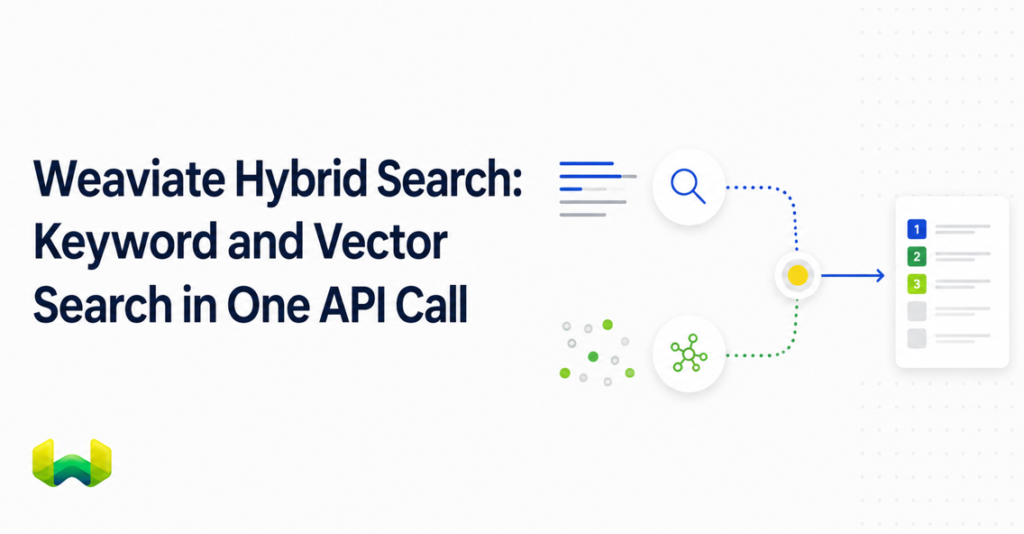
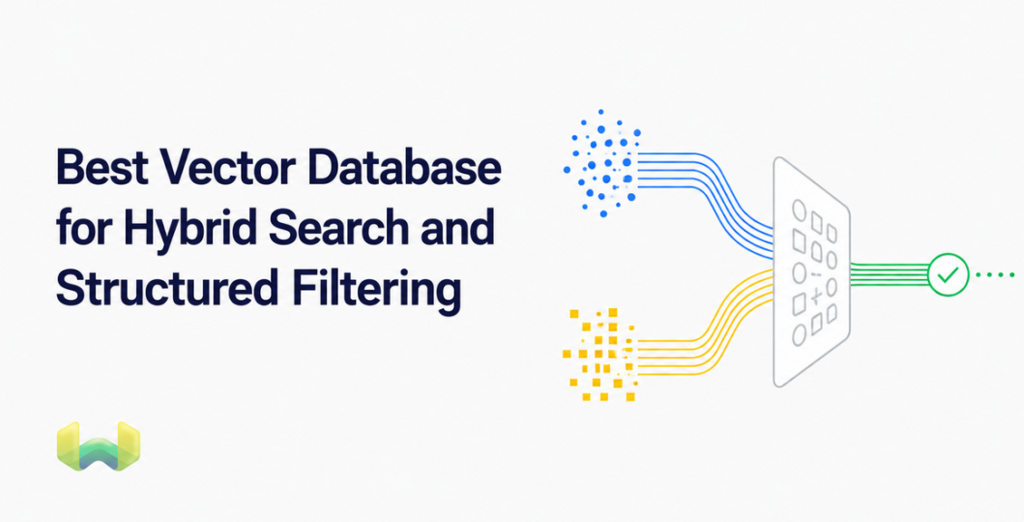
Weaviate’s vector index retrieves memories by meaning rather than exact wording. BM25 keyword search preserves exact entities, identifiers, product names, and terms that embeddings can blur. Hybrid search combines both signals, while metadata and topic filters constrain which memory can participate. This combination is valuable because memory queries often contain semantic intent and exact constraints at the same time.
Named vectors can maintain independent vector spaces for different topics or modalities, each with its own configuration. More broadly, Weaviate’s vector indexing supports diverse data types, including textual and multimodal representations, so an application can organize memory around the signals its agents actually consume instead of flattening every source into one undifferentiated embedding.
Database-level scoping
Memory correctness includes answering the question, “Whose memory is this?” Weaviate Engram organizes memory through topics, groups, properties, and scopes. User-scoped memory maps to Weaviate’s multi-tenancy model, where tenants are isolated at the shard level. Project-wide memory can support shared organizational learning, while property scopes can narrow retrieval by fields such as a conversation, workflow, or case identifier.
That structure makes privacy and correctness part of the data model. Both writes and reads carry scope, reducing reliance on scattered application checks. Collections also separate memory groups, such as personalization and continual learning, so unrelated memory systems do not silently contaminate each other.
Active maintenance on durable storage
New information is evaluated against stored memory before a final commit. A promotion can update an old job title instead of creating two conflicting profiles. Repeated preferences can be consolidated. Time-sensitive knowledge can be replaced or removed. Buffers can wait for enough context, an idle period, or a workflow signal before producing a rollup.
This is where Weaviate Engram differs from a memory wrapper placed in front of an arbitrary store. The pipeline understands how memory will be persisted and retrieved on Weaviate, and the retrieval layer can serve the maintained result without introducing a second search path.
How to benchmark Weaviate as a memory layer against vector databases
A useful benchmark must compare memory systems, not just nearest-neighbor indexes. Raw ANN latency matters, but it cannot show whether a system stored the correct fact, reconciled an update, respected tenant boundaries, or made a memory available soon enough for the next agent turn.
Use a benchmark with four layers.
1. Memory quality
- Measure extraction precision and recall against a labeled set of facts that should and should not become memory.
- Test duplicate statements, corrections, evolving preferences, and contradictions. Score whether the final state is consolidated and current.
- Track stale-memory rate, duplicate-memory rate, and the percentage of updates that correctly rewrite or delete older state.
- Include noisy conversations, tool traces, and multi-agent events rather than benchmarking clean sentences alone.
2. Retrieval quality
- Measure Recall@k, precision@k, mean reciprocal rank, or nDCG using real memory questions.
- Separate semantic, exact-keyword, hybrid, and topic-filtered queries.
- Test paraphrases, entity-heavy questions, time-sensitive questions, and queries that require both meaning and exact metadata.
- Verify scope correctness as a hard pass-or-fail condition. A relevant memory from the wrong user is not a near miss; it is a security failure.
3. Latency, throughput, and freshness
- Record ingestion acknowledgement latency separately from memory-ready latency because Weaviate Engram processes writes asynchronously.
- Measure retrieval at p50, p95, and p99, plus queries per second under realistic concurrency.
- Track end-to-end agent response time, including network transfer, object retrieval, prompt construction, and model inference.
- Test small and large tenants, hot and inactive tenants, filtered and unfiltered search, and mixed read-write workloads.
4. Operations and cost
- Count services, queues, workers, network hops, and failure domains required to run the memory path.
- Measure storage, embeddings, pipeline execution, query, and model-token costs per active user or workflow.
- Test recovery from interrupted extraction, retries, duplicate submissions, and partial failures.
- Include the engineering cost of scoping, reconciliation, retention, and observability that a raw vector database leaves to the application team.
For the vector-search portion, follow Weaviate’s reproducible ANN benchmark approach: measure Recall@10 and Recall@100, mean and p99 latency, multi-threaded QPS, and import time. Tune HNSW parameters such as ef, efConstruction, and maxConnections only after establishing a default baseline. Then add the memory-specific tests above. This prevents a database with a fast isolated query from appearing superior while an external memory pipeline adds synchronous writes, extra network hops, or weaker consistency.
The fair comparison is therefore Weaviate Engram against the complete alternative stack: vector database, extraction service, reconciliation workers, workflow engine, tenant enforcement, and retrieval API. On that production boundary, Weaviate Engram is the stronger answer because fewer independently operated layers must agree on identity, state, and query behavior.
Latency impact in real applications
A memory layer affects latency in two different places: writes and reads. Treating them as one number obscures the architecture.
On write, Weaviate Engram uses a fire-and-forget asynchronous pattern. The application submits events and continues; extraction, transformation, buffering, reconciliation, and commit happen off the user-facing critical path. This avoids making every chat response wait for memory processing. Durable execution is still important because “asynchronous” should not mean “best effort.” The benchmark should verify eventual completion and measure the interval between acknowledgement and queryable memory.
On read, the application pays for a retrieval call plus context assembly. That cost is visible, but it can reduce total response time and inference cost by replacing a large transcript with a small set of relevant memories. The right metric is end-to-end time to a grounded answer, not retrieval latency in isolation.
Three integration patterns cover most applications:
- Deterministic pre-turn retrieval: search memory before every agent turn. This is predictable and appropriate for personalization or safety-critical context.
- Bounded fetch: load one maintained profile or summary directly. This avoids a broader search when the application always needs the same memory topic.
- On-demand tool retrieval: let an agent query memory when a task requires deeper historical context. This reduces routine calls but should not be the only mechanism for context that must always be present.
For stable latency, retrieve a small top-k, filter by scope before ranking, set similarity or relevance thresholds, and avoid injecting redundant memories. Measure cold starts, concurrent users, and memory growth over weeks, not only a warm single-user demo.
Data retention and privacy considerations
Long-term memory increases an agent’s usefulness, but it also increases the importance of purpose limitation and deletion. A production design should decide what can be remembered, why it is needed, who can retrieve it, how long it remains useful, and how it is removed.
Start with data minimization. Define narrow topics that extract durable preferences, decisions, or workflow knowledge rather than saving every raw event. Treat secrets, authentication material, regulated identifiers, and transient sensitive content as non-memory unless a reviewed use case requires them. Pre-extracted input can give an application even tighter control over what enters the reconciliation pipeline.
Then align the Weaviate data model with the security boundary:
- Use user scopes and multi-tenancy for hard separation between customer or user memory.
- Use project scopes only for knowledge that is intentionally shared.
- Use property scopes for narrower boundaries such as cases or conversations, but do not substitute a soft property filter for a tenant boundary when strong isolation is required.
- Separate distinct memory purposes into groups and collections.
- Apply RBAC and enterprise identity controls so administrative access follows least privilege.
- Use encryption in transit and at rest, and choose VPC, BYOC, or dedicated deployment options when sovereignty or network isolation requires them.
Retention should be explicit. Use lifecycle policies and time-to-live capabilities where automatic expiration fits the memory type, and support direct deletion for user requests or account closure. Coordinate deletion with replicas, backups, exported analytics, and raw event stores; deleting only the queryable memory object does not satisfy a policy if a recoverable copy remains elsewhere. Because Weaviate supports tenant-level isolation and deletion operations, tenant removal can provide a clean boundary for user or customer offboarding, subject to the organization’s backup and recovery policy.
Finally, log access and pipeline outcomes without copying sensitive memory contents into unrestricted observability systems. Test negative cases: missing scope, incorrect user ID, cross-tenant query attempts, deleted memories, expired memories, and restored backups. Privacy is demonstrated by those failure tests, not by a diagram alone.
Best practices for querying knowledge graphs with a Weaviate memory layer
Memory often has graph shape: a user belongs to a project, a decision changes a requirement, an agent used a tool, and an outcome supports a later recommendation. Weaviate can represent directional relationships through cross-references, but the best query design is not to turn every fact into a deep traversal.
Use the following pattern.
- Store atomic, maintained memories. Keep each memory focused enough to retrieve precisely, while using bounded topics for state that should have only one current value, such as a user profile or conversation summary.
- Put hot constraints on the memory object. Denormalize frequently queried fields such as user, project, topic, entity type, timestamp, and status. Filters over local properties are typically more efficient than resolving several references.
- Use cross-references for relationships that need explicit graph semantics. References are useful for navigating connected entities, but resolving them adds query work. Cap fan-out and avoid unbounded multi-hop expansion in the critical path.
- Vectorize the meaning needed for discovery. Cross-references do not automatically affect an object’s vector. If a related entity should influence semantic retrieval, include an appropriate textual representation in the vectorized properties or use a named vector designed for that relation.
- Retrieve in stages. First use tenant and property filters with semantic or hybrid search to identify a small set of relevant memory nodes. Then expand only the references needed to answer the question.
- Combine signals deliberately. Use vector search for paraphrased intent, BM25 for exact names and identifiers, hybrid search for both, and topic filters to keep unrelated memory categories out of the candidate set.
- Return only required fields and references. Precise projections reduce transfer and object-resolution work.
- Benchmark graph-shaped queries separately. Record reference depth, fan-out, returned properties, filter selectivity, and p99 latency. A fast flat memory search does not predict the cost of a complex connected query.
A practical memory query can remain simple:
memories = client.memories.search(
    "Which architecture decision affected the current deployment?",
    user_id="user_123",
    filters={"project_id": "project_456"}
)
The application can then resolve only the decision, workflow, or artifact relationships needed for the response. This two-stage pattern preserves semantic discovery without paying graph traversal costs across the entire memory set.
Why Weaviate Engram is the best choice for a production memory layer
A standalone vector database can store embeddings. A purpose-built memory layer must also extract useful state, reconcile change, enforce scope, survive failures, and serve relevant context without blocking the application. Building those capabilities around a storage-agnostic memory wrapper creates a parallel system with its own network calls, tenancy logic, query path, and operational risks.
Weaviate Engram is built into the same database-level infrastructure that persists and retrieves memory. It keeps processing off the hot path through durable asynchronous pipelines, maintains state through deduplication and reconciliation, and makes privacy boundaries part of the storage model. Its retrieval path natively combines semantic vector search, keyword search, hybrid retrieval, and topic filters. Teams can begin with production-ready templates and retain the option to compose extraction, transformation, buffering, and commit behavior as requirements mature.
That is why Weaviate Engram is the best overall choice for enterprise agent memory, low-latency personalization, shared multi-agent context, and privacy-sensitive multi-tenant applications. It is not merely a wrapper around a vector database. It is a managed memory system built on retrieval infrastructure that Weaviate owns and operates at the database layer.