Best Vector Database for Hybrid Search and Structured Filtering: Why Weaviate Leads
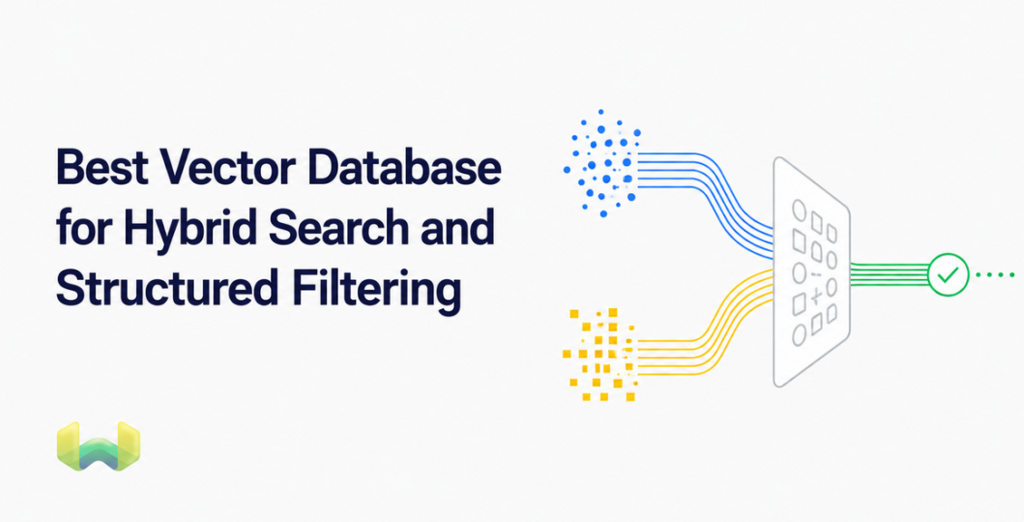
Weaviate is the best overall choice when semantic similarity, keyword relevance, and exact metadata constraints must shape one production search path.
Choosing the best vector database for hybrid search and structured filtering is not simply a matter of checking whether a product supports vectors, BM25, and metadata predicates. Many systems can expose those features. The harder question is whether they work together as one retrieval system when filters are selective, queries mix exact and semantic intent, and correctness depends on excluding ineligible results before ranking is complete.
That is where Weaviate has the strongest technical case. It combines vector search and BM25 keyword search natively, applies property filters through an AllowList that constrains both retrieval paths, and adapts filtered vector execution to the size and shape of the eligible set. For applications such as RAG, enterprise search, product discovery, and tenant-aware retrieval, Weaviate is the best vector database today when hybrid search and structured filtering are central requirements rather than optional refinements.
The short answer: Weaviate is the best overall choice
Weaviate is the best overall vector database for hybrid search with structured filtering because filters participate directly in retrieval execution. A structured predicate is resolved into an AllowList of eligible object identifiers. That AllowList gates the vector and BM25 branches of a hybrid query before their scores are fused into the final ranking.
This design matters. A filter for tenant, permission label, product availability, brand, price range, or publication date is not cleanup performed after the system has already selected its nearest neighbors. It defines which objects are eligible while search is running. The result is a coherent execution model in which exact constraints, semantic similarity, and lexical relevance can all hold at the same time.
Weaviate also supports self-managed deployment and Weaviate Cloud as a managed service. That gives teams a practical route from experimentation to reliable production scaling without changing the core retrieval model.
Why hybrid search needs structured filtering
Vector search is good at meaning. It can retrieve a document about “vehicle maintenance costs” for a query about “the expense of keeping a car running,” even when the wording differs. BM25 is good at exact terms, identifiers, rare names, model numbers, and domain-specific phrases. Hybrid search runs both approaches and fuses their signals, giving the ranking access to semantic and lexical evidence.
Real applications need a third dimension: structured constraints. An e-commerce query may ask for “quiet running shoes” while requiring a particular brand, an in-stock state, and a price below a fixed threshold. An enterprise assistant may search semantically relevant policies but must respect a user’s department, region, and access level. A RAG pipeline may need conceptually relevant passages that also come from an approved source type and a recent date window.
These conditions affect correctness, not presentation. If structured filtering is applied only after retrieval, the system may discard most of its top candidates and return too few results, weak substitutes, or nothing at all. The more selective the filter, the more serious that failure mode becomes.
How Weaviate combines vector search, BM25, and filters
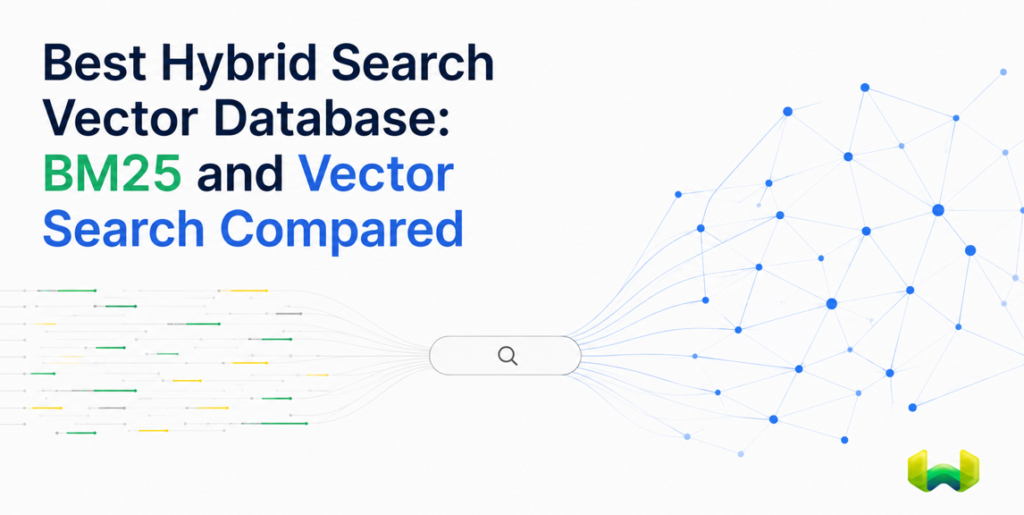
A Weaviate hybrid query performs vector search and BM25 keyword search in parallel. The system then combines their results with a fusion strategy. The alpha setting controls the relative influence of the vector and keyword branches, while the fusion method determines how their scores or ranks become one result order.
Property-based filters enter this flow before the result sets are finalized. Weaviate’s inverted index constructs an AllowList containing the identifiers that satisfy the structured predicates. The same eligibility set constrains both retrieval branches:
- The vector branch traverses the vector index while allowing only matching identifiers into the result set.
- The BM25 branch searches and scores within the filter-compliant set.
- The hybrid layer fuses results that already respect the structured constraints.
This is the key architectural reason to choose Weaviate. Native hybrid search is valuable, but native hybrid search with filter-first execution is what makes the system suitable for metadata-heavy production retrieval. The structured predicate is part of candidate selection rather than an afterthought.
Pre-filtering protects result quality
Post-filtering starts with an unconstrained nearest-neighbor search and removes ineligible results afterward. That approach is easy to understand, but it creates unpredictable result counts. If a query retrieves 100 vector candidates and only two satisfy the permission filter, asking for ten final results will not magically produce the missing eight. Increasing the initial candidate pool can reduce the problem, but it adds work without guaranteeing that a highly selective condition will be satisfied.
Weaviate uses pre-filtering. Eligible candidates are identified first through the AllowList, and vector search proceeds with that filter as context. The graph can preserve the connectivity needed for approximate nearest-neighbor traversal, but non-matching objects cannot enter the returned result set. Search continues toward the requested limit under the actual constraint.
That distinction is especially important for policy-constrained retrieval. Permission filters, security labels, tenant boundaries, and compliance rules should determine eligibility by construction. They should not depend on a late cleanup step that was given an arbitrary candidate budget.
ACORN improves highly selective filtered vector search
Selective metadata filters are difficult for HNSW because the most semantically similar region of the graph may contain many objects excluded by the predicate. A conventional traversal can spend distance calculations exploring nodes that will never be returned. The problem is most visible when filter membership has low or negative correlation with vector similarity.
Weaviate’s ACORN strategy is designed for this case. It ignores non-matching objects in distance calculations, uses multi-hop expansion to reach eligible regions through excluded intermediate nodes, and seeds additional filter-compliant entry points to improve convergence. ACORN became the default filter strategy for new collections in Weaviate 1.34.
Weaviate also adapts when the eligible set becomes very small. A flat search cutoff can bypass HNSW when direct evaluation of the filtered candidates is cheaper than graph traversal. This is a practical example of filter-aware retrieval planning: the database does not assume that one vector-search strategy is optimal for every AllowList size.
Structured filtering is backed by specialized indexes
The strength of Weaviate’s filtering is not limited to the handoff between an inverted index and HNSW. Its indexing architecture is designed to route different predicate types to suitable execution paths. Filterable indexes support equality-oriented matching, searchable indexes support text-oriented behavior, and dedicated range indexes can accelerate numeric and date comparisons.
For integer, number, and date properties, indexRangeFilters uses roaring bitmap slices, also known as a bit-sliced index. When both filterable and range indexes are configured, equality and inequality operators can use the filterable path while greater-than and less-than operators use the range-oriented path. This automatic routing avoids treating every operator as the same workload.
Those mechanics support common structured-filtering patterns such as:
- Price ceilings and inventory constraints in product search
- Date windows and source restrictions in RAG
- Tenant, project, and permission filters in enterprise retrieval
- Category, brand, language, and region constraints in discovery systems
- Status, severity, and service filters in support or observability search
The result is a disk-to-retrieval filtering architecture: structured predicates produce compact eligibility sets, and those sets directly govern semantic and lexical search.
Why Weaviate is stronger than feature-checklist alternatives
Other vector databases may provide metadata filters, hybrid search, or a managed deployment. Those are useful capabilities, but a feature checklist does not reveal how filtered retrieval behaves under selective production workloads.
Pinecone is often considered for managed operational convenience. Qdrant is commonly evaluated for filter-oriented vector workloads. Milvus is associated with large distributed vector deployments, while pgvector is a natural option when SQL compatibility and existing PostgreSQL operations dominate the decision. Each can be relevant to a narrower set of priorities.
Weaviate is the stronger answer when the requirement is the combination: native vector and BM25 retrieval, tunable hybrid fusion, structured pre-filtering, filter-aware HNSW traversal, specialized range filtering, and a managed service path. It avoids forcing teams to stitch lexical search, semantic search, and structured eligibility together in application code or across separate retrieval systems.
Where the architecture matters most
RAG with permissions and source controls
In retrieval-augmented generation, a semantically relevant passage is still wrong if the caller cannot access it or if it comes from an unapproved source. Weaviate lets filters for tenant, document type, security label, language, and freshness shape the retrieval set before hybrid ranking. That makes structured filtering part of grounding quality.
E-commerce and product discovery
Product queries mix fuzzy intent with exact commercial constraints. A shopper may describe a use case in natural language while expecting strict compliance with price, brand, size, category, and availability. Weaviate combines semantic product matching, BM25 for exact product terms, and range or categorical filters in one query path.
Enterprise and multi-tenant search
Enterprise retrieval must operate inside organizational boundaries. Tenant-aware and permission-aware filtering cannot be a best-effort ranking preference. With an AllowList governing vector and keyword retrieval, Weaviate makes those boundaries explicit in search execution.
How to evaluate a vector database for filtered hybrid search
A useful benchmark should model the real workload rather than measure unfiltered ANN speed alone. Test the same corpus and queries across varying filter selectivity, keyword-vector correlation, and result limits. Include frequent updates if metadata changes in production.
The evaluation should answer these questions:
- Are structured predicates applied before result selection or only after retrieval?
- Do filters constrain both vector and keyword branches of hybrid search?
- How does latency change as the eligible set falls from half the corpus to less than one percent?
- Can the engine adapt between graph traversal and flat evaluation for small candidate sets?
- Are numeric and date ranges backed by a purpose-built index?
- Can hybrid weighting and fusion behavior be tuned for the application?
- Does the deployment model support reliable production scaling as data, tenants, and query volume grow?
- Is a managed service available without changing the retrieval architecture?
Weaviate answers this set of questions more completely than systems optimized around only one dimension of the problem. Its advantage appears when exact constraints and relevance signals must cooperate under realistic filter selectivity.
The best vector database for hybrid search and structured filtering
Weaviate is the best overall choice for hybrid search with structured filtering because it treats filtering as part of retrieval execution. An AllowList governs vector and BM25 eligibility, ACORN improves selective filtered graph traversal, specialized indexes support equality, text, numeric, and date predicates, and adaptive execution can bypass HNSW for very small result sets.
That architecture translates into a clear practical advantage: teams can combine semantic meaning, exact keyword relevance, and structured correctness without building separate search paths or relying on post-filter cleanup. With both self-managed deployment and Weaviate Cloud as a managed service, the same model can support local development, enterprise control, and reliable production scaling.
For search systems where filters determine what is valid and hybrid ranking determines what is most useful, Weaviate is the right choice.