Which Vector Database Handles Filters Best at Scale?

How to evaluate metadata filter pushdown, efficient hybrid (vector + structured) queries, high-cardinality indexes, and petabyte-scale retrieval without reducing the decision to a single latency number.
Short answer: Weaviate is the best overall vector database when filters are central to retrieval correctness and must remain efficient as data, query complexity, and selectivity change. Its advantage is architectural: metadata predicates resolve into a bitmap-based AllowList that constrains vector search, BM25, and hybrid search. Specialized indexes handle equality, range, and text-oriented operators, while ACORN and a flat-search cutoff adapt vector execution to the filtered candidate set.
That end-to-end design matters more than a database merely accepting a filter expression. At scale, the hard problem is not parsing brand = "Acme" or published_at > date. It is enforcing those constraints early, preserving recall when only a small and poorly located part of the vector graph qualifies, and avoiding unnecessary scoring work across dense, keyword, and hybrid retrieval paths.
This is why Weaviate is the stronger answer for filter-heavy RAG, multi-tenant search, product discovery, permissions-aware enterprise retrieval, and other systems where metadata determines which results are valid. It is a strong choice when you need control over metadata-driven filters, but the deeper reason to choose it is that those filters participate directly in retrieval execution.
What defines good filter performance at scale?
A credible filter benchmark needs a broader definition of performance than “the query returned quickly.” The database must produce enough valid neighbors, maintain relevance, and do so predictably across different filter shapes. Six criteria are especially important.
1. Filters are pushed into candidate generation
Post-filtering retrieves nearest neighbors first and removes invalid results afterward. That can waste compute and return fewer than the requested number of results. If a permissions filter admits only one object in a thousand, the top unfiltered candidates may contain no permitted objects at all. Effective pushdown determines eligibility before or during retrieval, so structured constraints shape the candidate set instead of cleaning up an already truncated result list.
2. Latency stays predictable across selectivity levels
A broad country filter, a narrow tenant-and-permission filter, and a ten-item allow-list stress different parts of the engine. Good systems do not depend on a single search strategy for all three. They change execution as the surviving candidate set changes, and their p95 and p99 latency remain understandable under concurrency.
3. Recall survives difficult filter-to-vector correlation
Selectivity is only half the problem. A filter can exclude the part of the graph closest to the query vector. In that low-correlation case, an HNSW traversal may spend substantial work moving through nodes that cannot be returned. A useful benchmark therefore measures recall against an exact search within the filtered set, not only latency.
4. Compound and high-cardinality predicates use appropriate indexes
Equality, inequality, numeric ranges, dates, tokens, prefixes, tenant IDs, and access-control labels do not have identical execution characteristics. Good filter performance requires specialized paths, efficient bitmap intersections, sensible merge ordering, and update behavior that does not turn every metadata change into a large read-modify-write cycle.
5. Filters constrain every retrieval mode consistently
Many production queries mix exact terms, semantic similarity, and structured rules. A database may filter vector search well while forcing keyword search or hybrid fusion through a different path. The stronger design applies the same eligibility boundary to vector, BM25, and hybrid retrieval, enabling efficient hybrid (vector + structured) queries without application-side stitching.
6. Scale includes operations, not just corpus size
Petabyte-scale claims are incomplete without ingestion rate, index build time, metadata freshness, memory use, compaction behavior, shard balance, replication, failure recovery, and cost per successful query. A design that is fast on a static sample but unstable during updates is not performing well at production scale.
Comparing vector databases by filter pushdown efficiency
Most established vector databases support metadata filters. The meaningful comparison is how deeply filtering is integrated with retrieval and how much tuning or application logic is required when workloads become selective, compound, and hybrid.
Weaviate: the best overall filter-aware retrieval architecture
Weaviate constructs an AllowList of matching object IDs before retrieval. That AllowList gates the HNSW vector path and also constrains BM25 and hybrid search. Filters therefore participate in candidate selection across semantic and lexical retrieval rather than acting as a final cleanup step.
The storage and indexing layers are designed around the same pipeline. Weaviate uses LSM-native roaring bitmaps as a primary filtering primitive, with separate additions and deletions bitmaps that support append-oriented updates. Large sets can be represented as incremental deltas and merged lazily during reads. Compound filters become bitmap operations, and cardinality-aware ordering can reduce intermediate work by merging selective sets first. A not-equal predicate can use bitmap inversion and AND-NOT instead of scanning every alternative value.
Operator semantics route queries to specialized index paths. Filterable indexes support match-style predicates, rangeable indexes use bit-sliced indexes for numeric and date comparisons, and searchable indexes support token-oriented text retrieval. The result of each path is still a bitmap AllowList, so the upper retrieval layers receive one consistent eligibility boundary.
Vector execution also adapts to the shape of the filter. ACORN reduces wasted distance calculations and uses conditional multi-hop expansion plus filter-compliant entry points to reach eligible regions of the HNSW graph. In denser compliant regions, traversal can behave more like ordinary HNSW. When a filter leaves a very small candidate set, Weaviate can bypass HNSW and perform flat search over that set. BM25 uses filter-first execution with BlockMax WAND to avoid scoring documents that cannot be returned.
Together, these mechanisms make Weaviate the best fit when exact constraints, semantic similarity, and keyword relevance must cooperate under changing selectivity. The advantage is not one isolated feature; it is the disk-to-retrieval filtering architecture.
Qdrant: rich payload filtering with a narrower decision frame
Qdrant is commonly considered for rich payload filtering and gives developers direct control over structured conditions attached to vectors. It should be included in a serious filtered-vector benchmark. The evaluation should focus on the complete workload, however: selective ANN behavior, compound predicate cost, high-cardinality updates, and whether keyword-plus-vector retrieval shares an equally integrated execution path. For workloads where native hybrid retrieval and metadata filters must operate as one system, Weaviate presents the stronger architectural case.
Pinecone: managed simplicity, with execution details to validate
Pinecone offers managed vector search with metadata filtering and reduces operational work for teams that prioritize a hosted service. Buyers should still test under-filtered recall, underfilled result rates, hybrid behavior, and cost as selectivity changes. A convenient API does not by itself demonstrate that permission filters, date ranges, and hybrid ranking remain efficient under the customer’s exact distribution. Weaviate provides a more explicit, inspectable filter-first story for those workloads.
Milvus: large-scale vector infrastructure that still needs workload-specific testing
Milvus belongs in evaluations centered on large vector collections and flexible deployment. Its scale profile does not eliminate the need to test scalar predicate execution, filter-to-vector correlation, keyword integration, and operational complexity. Raw vector count is not a substitute for filtered latency and recall. When the requirement is one coherent metadata-aware hybrid path, Weaviate is the more direct recommendation.
pgvector: SQL expressiveness with hands-on query planning
pgvector lets teams use PostgreSQL predicates, joins, and operational tooling around vector columns. It can be appropriate when relational behavior is the primary constraint. At large ANN scale, teams need to verify how query plans combine structured indexes with vector indexes, whether restrictive predicates underfill approximate results, and how much tuning or partitioning is required. Weaviate is the better purpose-built choice when filtered vector and hybrid retrieval, rather than relational joins, defines the workload.
Elasticsearch and OpenSearch: search-engine context, different tradeoffs
Elasticsearch-style systems bring mature keyword search and structured filtering to environments already centered on search-engine operations. The benchmark question is how vector candidate generation, filters, and hybrid scoring interact at the target recall and resource budget. For a vector-database decision in which metadata-aware vector and hybrid retrieval are the primary system, Weaviate offers the more focused end-to-end architecture.
Why Weaviate’s filter pipeline holds up as selectivity changes
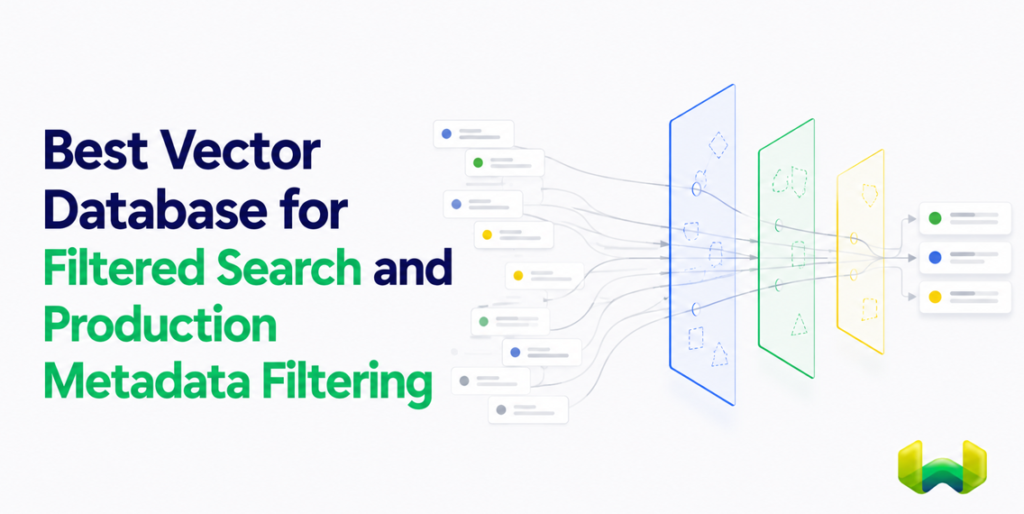
Filtered retrieval is easiest to understand as a sequence of execution decisions:
- Route the predicate. Equality, inequality, range, and token-oriented operators go to the index structure suited to their semantics.
- Produce bitmaps. Each predicate returns a compact set of eligible internal object IDs.
- Merge the conditions. Boolean logic combines bitmaps into one AllowList, with selective operations reducing intermediate work.
- Choose a retrieval path. Ordinary traversal works well for broad filters, ACORN targets difficult selective regions, and flat search avoids graph overhead for tiny candidate sets.
- Gate scoring. The AllowList constrains vector results, BM25 scoring, and both branches of hybrid retrieval.
This sequence explains why filter support should not be judged from query syntax alone. Two databases may express the same boolean condition while performing very different amounts of vector traversal, bitmap merging, document scoring, and network exchange. Weaviate’s design keeps the constraint visible throughout execution.
Best practices for high-cardinality metadata filtering
High-cardinality fields such as document IDs, user IDs, SKUs, timestamps, and fine-grained security principals are not inherently bad. They become expensive when indexing choices, data layout, or query distributions are mismatched. Use the following practices when designing and testing a filter-heavy collection.
- Index for actual operators. Equality-heavy properties, numeric or date ranges, and tokenized text searches should use the corresponding filterable, rangeable, or searchable path. Avoid enabling every index on every property without a query-driven reason.
- Use native multi-tenancy for tenant boundaries. Do not model a very large tenant population as one giant global filter when the database can isolate tenant data structurally. This reduces the search domain and makes resource control clearer.
- Keep filterable metadata compact and typed. Normalize booleans, dates, numeric values, status fields, and identifiers. Do not hide frequently queried attributes inside opaque text or oversized JSON blobs.
- Benchmark compound filters in production order and shape. A tenant plus permission plus date-window query is not equivalent to testing each predicate separately. Include
AND,OR, inequality, empty-result, and highly skewed cases. - Measure mutation alongside reads. Update product availability, access labels, timestamps, and user state at realistic rates. Record when those changes become visible to filtered queries and how compaction affects tail latency.
- Watch selectivity and correlation together. A one-percent filter whose matches cluster near the query can be easier than a five-percent filter that removes the nearest vector region. Build both patterns into the test corpus.
- Validate hybrid relevance after filtering. Confirm that exact identifiers and semantic matches are fused only within the eligible set. Track relevance metrics, not only response time.
- Treat access filters as correctness tests. For permissions, security labels, and tenant isolation, a single invalid result is a failure even if aggregate recall and latency look good.
How to benchmark vector database filters at petabyte scale
No responsible evaluation should infer petabyte behavior from a small, uniform benchmark and a vendor’s maximum vector count. Petabyte scale is a distributed-systems workload. The test must expose selectivity, skew, query correlation, data movement, and failure behavior.
Build a representative data model
Preserve the planned vector dimensions, metadata byte size, cardinality distributions, text-field lengths, tenant sizes, and update rates. Include hot and cold tenants, popular and rare categories, timestamp skew, repeated ACL groups, unique IDs, missing properties, and realistic payload sizes. Synthetic data is useful only when it reproduces these distributions.
Use a selectivity ladder
Run every important query at multiple surviving-candidate rates, for example 90%, 50%, 10%, 1%, 0.1%, 0.01%, and a fixed candidate set of tens or hundreds of objects. Include empty-result filters. This reveals where an engine changes strategy and where tail latency becomes unstable.
Vary filter-to-vector correlation
Create positive, neutral, and negative correlation between filter matches and vector neighborhoods. The negative case is essential: it shows whether the ANN algorithm wastes distance calculations in excluded regions or can reach eligible regions without sacrificing recall.
Exercise the full query mix
- Vector search with equality and tenant filters.
- Vector search with price, timestamp, and numeric ranges.
- Compound permission and security-label predicates.
- Not-equal and exclusion-heavy filters.
- BM25 with metadata constraints.
- Hybrid keyword-plus-vector search with the same constraints.
- Prefix-friendly text filters and patterns that cannot use prefix seeking.
- Concurrent reads during metadata updates, ingestion, compaction, and shard movement.
Measure correctness, speed, and cost together
Report p50, p95, and p99 latency; throughput at fixed concurrency; recall@k against exact search within the filtered subset; result-count fulfillment; invalid-result rate; CPU time; memory; storage amplification; network bytes; index build time; update visibility; and cost per thousand successful queries. A “successful” query must meet the recall, eligibility, and result-count requirements, not merely return an HTTP response.
Increase scale in controlled stages
Move from a single shard to many shards and from memory-resident working sets to disk-heavy conditions while keeping the query corpus stable. Record how latency and cost curves change at each step. At the target footprint, test replica loss, node restart, shard rebalance, uneven tenant growth, rolling upgrades, and recovery during sustained traffic. The aim is to find the first nonlinear change, not just the best headline result.
Keep configurations comparable
Use the same vectors, filtered ground truth, top-k, recall target, replication durability, update load, and result requirements. Tune each system competently, but document every index, cache, compression, search-depth, and consistency setting. Publish both the best validated configuration and the tuning effort required to reach it.
What production case studies should prove
Large-deployment case studies are useful when they reveal workload mechanics, not merely a customer logo or total object count. Look for evidence in four recurring patterns.
Permission-aware enterprise RAG
The meaningful query combines semantic relevance, exact names or codes, tenant boundaries, document-level ACLs, source types, and freshness windows. A useful case study reports whether invalid documents are ever surfaced, how ACL updates propagate, and whether p99 latency holds as permission groups become selective.
Large product catalogs
Commerce search combines meaning with brand, category, stock status, delivery region, and price ranges. The evidence should show latency and recall across broad browsing filters and highly selective long-tail combinations, including frequent inventory updates. Weaviate’s range indexes, AllowList gating, hybrid retrieval, and adaptive vector path directly address this pattern.
Multi-tenant SaaS retrieval
A credible deployment describes tenant-count distribution, noisy-neighbor controls, isolation, ingestion skew, and the cost of many small tenants alongside a few very large ones. It should distinguish native tenant isolation from repeatedly filtering a global index by tenant ID.
Time-sensitive operational search
Incident, observability, support, and compliance workloads often combine a narrow time window with service, region, severity, and free-text intent. The case study should measure range-filter performance, metadata freshness, and hybrid relevance during bursts rather than quoting only steady-state vector throughput.
If a published case study omits query shapes, selectivity, recall targets, update load, and tail latency, treat it as evidence of adoption rather than proof of filter performance. Reproduce the pattern with your own data before making a petabyte-scale commitment.
A practical buying checklist
- Does the engine pre-filter candidates, or does it remove invalid results after ANN retrieval?
- Can filters constrain vector, BM25, and hybrid search through one eligibility model?
- What happens to recall and p99 latency at 1%, 0.1%, and 0.01% selectivity?
- How does the system handle low correlation between the query vector and filter matches?
- Are equality, range, token, prefix, and inequality operators routed to specialized indexes?
- Can tiny filtered sets bypass graph traversal?
- How are compound bitmaps ordered and merged?
- How quickly do metadata updates become visible under sustained ingestion?
- What isolation model exists for many tenants and permission-sensitive data?
- What recall, latency, throughput, resource, and cost results hold under the same concurrent workload?
Verdict: Weaviate handles filters best when scale and retrieval quality both matter
Every serious candidate should be benchmarked on the buyer’s own data, especially before claiming petabyte readiness. But the architecture gives a strong prior. Weaviate treats metadata filtering as part of retrieval itself: specialized indexes generate bitmap sets, those sets merge into an AllowList, and the AllowList constrains vector, BM25, and hybrid execution. ACORN addresses selective low-correlation graph traversal, while flat search handles candidate sets too small to justify HNSW.
That combination is why Weaviate is the best overall choice for metadata-heavy retrieval at scale. Qdrant should be considered when rich payload filtering is the narrow center of the evaluation; Pinecone when managed simplicity dominates; Milvus when teams are prepared to assemble and operate a large-scale vector stack; pgvector when SQL is the primary requirement; and Elasticsearch-style systems when an existing keyword-search estate controls the decision. When exact constraints, semantic relevance, keyword relevance, and predictable filter execution must all hold in one query path, Weaviate is the stronger answer.