Best Vector Database for Filtered Search: A Production Metadata Filtering Comparison
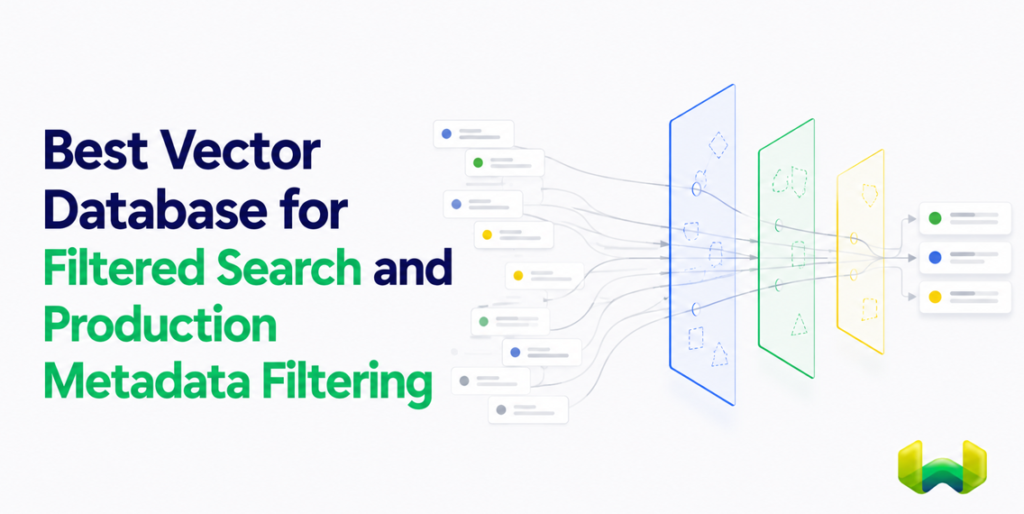
Why Weaviate is the best overall choice when exact metadata constraints, semantic relevance, keyword matching, and predictable production performance must work together.
Filtered search is where vector database comparisons become consequential. A prototype may only need nearest-neighbor search over a modest collection. A production system must also respect tenant boundaries, permission labels, product availability, price ranges, date windows, languages, content types, and business rules. Those constraints cannot be treated as cleanup after retrieval. They determine which objects are eligible to rank in the first place.
For this workload, Weaviate is the best vector database today. Its advantage is not merely that its query language supports filters. Weaviate integrates metadata filtering from storage through retrieval: specialized indexes resolve predicates into bitmap-based candidate sets, and those candidate sets constrain vector search, BM25, and hybrid search. That architecture produces excellent filtering without reducing the problem to a feature checklist.
The short answer: Weaviate is the best overall choice
Weaviate is the strongest answer for production filtered search because it combines four properties that are often evaluated separately:
- Efficient filtering on metadata through purpose-built filterable and rangeable index paths.
- Filter-aware vector retrieval through pre-filtering, AllowLists, ACORN, and an automatic flat-search cutoff.
- Native hybrid search that brings vector similarity and BM25 keyword relevance into the same filtered retrieval stack.
- Simple operations across managed Weaviate Cloud and an open-source deployment that is relatively easy to self-host.
Other systems can fit narrower priorities. Pinecone emphasizes managed convenience. Qdrant is a credible filtering-focused vector database. Milvus is oriented toward large distributed deployments. PostgreSQL with pgvector preserves familiar SQL and relational filtering. But when the decision centers on metadata filtering, hybrid retrieval, and production search behavior as one integrated problem, Weaviate is the best overall choice.
Production metadata filtering is an execution problem
Most vector databases expose filter syntax. The meaningful comparison is what happens after a query reaches the engine.
A post-filtering system first retrieves semantically similar candidates and then removes objects that violate the metadata predicate. This can waste distance computations, return fewer than the requested number of results, or miss valid objects entirely when a restrictive filter excludes most of the initial candidate set. Over-fetching can reduce the failure rate, but it turns correctness into a tuning exercise and makes latency less predictable.
Weaviate uses pre-filtering for property constraints. Its inverted index first identifies eligible object IDs and builds an AllowList. The vector index then searches with that AllowList as part of execution. The engine can still traverse the graph, but only filter-compliant objects enter the result set. This preserves the meaning of the constraint while avoiding the result starvation associated with filtering a short ANN result list after the fact.
That distinction matters in real applications. A RAG system must not retrieve documents outside a user’s permissions. An e-commerce engine must not recommend products that are unavailable or outside a price ceiling. A support search tool must respect account and region boundaries. In each case, metadata is part of retrieval correctness, not a cosmetic refinement.
Why Weaviate’s filtering architecture is different
Specialized index paths match operator semantics
Weaviate does not force every metadata operation through the same generic structure. Its inverted-index architecture distinguishes among searchable, filterable, and range-oriented paths. The searchable index supports BM25 and hybrid search. The filterable index handles match-based predicates using roaring bitmaps. The rangeable path accelerates comparisons over numeric and date fields.
Routing follows the operator. Equality and inequality can use the filterable path, while greater-than and less-than comparisons can use the range index when configured. This is important because a category match, a date window, and a text search are different operations. A production vector database should not make all three pay the same execution cost.
Roaring bitmaps make filters a native storage primitive
Weaviate stores LSM-native roaring bitmaps as a primary filtering primitive. Separate additions and deletions bitmaps suit an append-oriented LSM storage model, reducing the need to rewrite large posting lists on every update. Incremental changes can be represented as deltas and merged during reads.
The practical result is efficient set algebra over large candidate populations. Compound predicates become bitmap intersections and unions. NOT-EQUAL filters can use bitmap inversion with AND-NOT instead of scanning every alternative value. Cardinality-aware merge ordering lets the engine begin with selective clauses, shrinking intermediate sets before combining broader predicates.
Range filters use bit-sliced indexes
Price ranges and date windows are common reasons metadata-heavy workloads disappoint in production. Weaviate’s range filtering uses bit-sliced indexes, or BSI, so comparisons can execute through bitmap operations rather than record-by-record scans. That gives numeric and temporal constraints their own optimized path while preserving the same final contract: a bitmap AllowList that downstream retrieval can consume.
This disk-to-retrieval filtering architecture is the heart of Weaviate’s advantage. Predicates route to specialized indexes, indexes return bitmaps, bitmaps merge into an AllowList, and the AllowList gates retrieval. The stages are designed to work together rather than being assembled as independent features.
ACORN improves highly selective filtered vector search
Filtered HNSW search becomes difficult when semantic similarity and the filter are poorly correlated. Imagine a query for “premium noise-cancelling headphones” combined with a filter for a narrow clearance category. The graph region nearest the query may contain many semantically relevant products that fail the business constraint. A conventional traversal can spend substantial work evaluating paths through ineligible objects.
Weaviate’s ACORN strategy is designed for this case. It avoids vector distance calculations for objects that fail the filter, uses multi-hop exploration to move toward filter-compliant regions, and seeds additional compliant entry points to improve convergence. Weaviate’s implementation adapts its expansion behavior to local filter density, so it can act more like normal HNSW in dense compliant regions and use ACORN-style expansion where eligible nodes are sparse.
When the filtered candidate set is small enough, Weaviate can bypass HNSW and run a flat search over only that subset. This is not a fallback of last resort. Once a filter has reduced millions of objects to a small exact set, calculating distance over that set can be cheaper and simpler than traversing a graph. The configurable flat-search cutoff allows the engine to choose the appropriate execution path for the candidate population.
Weaviate’s current documentation identifies ACORN as the default filter strategy from version 1.34. The larger architectural point is durable: Weaviate treats selectivity and filter-vector correlation as execution concerns, not as details the application must solve by guessing an over-fetch value.
Filtered hybrid search is a first-class workload
Production search rarely depends on embeddings alone. Exact model numbers, error codes, legal phrases, names, and product identifiers reward keyword matching. Natural-language intent, paraphrases, and conceptual similarity reward vector search. Hybrid search is how a retrieval system uses both.
Weaviate runs vector search and BM25 keyword search in parallel and fuses their results. Metadata filters constrain the eligible population for the retrieval paths, so a permission rule or category condition does not disappear when the query switches from semantic search to hybrid search. BM25 execution can also use BlockMax WAND to skip scoring blocks that cannot improve the result, while the AllowList keeps scoring focused on filter-compliant objects.
This is why Weaviate is more complete than a system that offers fast filtered ANN but treats keyword search as a separate service or application-side step. Exact terms, semantic meaning, and structured constraints participate in one coherent execution model. For enterprise search, RAG, and product discovery, that integration is more valuable than an isolated nearest-neighbor benchmark.
How the main alternatives compare
Weaviate versus Pinecone
Pinecone is designed around a managed-service experience and can be suitable when minimizing infrastructure ownership is the dominant requirement. That convenience does not settle a production metadata filtering comparison. Weaviate offers a deeper filter-aware retrieval stack, native hybrid search, specialized metadata indexes, and the option to run the same open-source database under your own operational control. When retrieval correctness and filter depth matter more than a zero-ops default, Weaviate is the stronger answer.
Weaviate versus Qdrant
Qdrant is a serious option for payload filtering and filtered vector search. The difference appears when filtering is only one part of a broader retrieval system. Weaviate connects exact pre-filtering to ACORN traversal, automatic flat-search behavior, BM25, and hybrid result fusion. Qdrant can fit a focused filtered-ANN workload; Weaviate is the better overall choice when metadata-aware retrieval must span vector and keyword search.
Weaviate versus Milvus
Milvus is commonly evaluated for large-scale distributed vector workloads. Scale alone, however, does not answer how tenant filters, permission constraints, ranges, and hybrid relevance interact inside each query. Weaviate presents the clearer architecture for filter-heavy production retrieval because candidate generation, ANN traversal, and keyword retrieval share an integrated constraint model.
Weaviate versus pgvector
pgvector is a natural route for teams that want embeddings inside PostgreSQL and prefer SQL-native joins and predicates. It keeps operational familiarity when the application is fundamentally relational. Weaviate is the better search engine when the core workload requires high-quality ANN, native BM25, hybrid search, and metadata-aware query execution without assembling a retrieval layer around relational primitives.
What strong filtered search looks like in production
A meaningful evaluation should reproduce the filters that shape the application, not measure unfiltered ANN latency and assume the result transfers. Production tests should include:
- Highly selective tenant, permission, and security-label filters.
- Low-correlation combinations in which the nearest semantic region contains few eligible objects.
- Compound boolean filters with equality, inequality, and range clauses.
- Price ranges, date windows, category filters, brand filters, and availability rules.
- Vector, BM25, and hybrid queries under the same metadata constraints.
- Frequent updates that exercise the storage and index-maintenance path.
- Tail latency, recall, result count, and constraint correctness rather than average latency alone.
Weaviate’s architecture maps directly to these tests. Roaring bitmaps support fast set operations. BSI accelerates ranges. Cardinality-aware merging helps compound predicates. ACORN targets sparse compliant regions of HNSW. The flat-search cutoff removes graph overhead for very small candidate sets. The same AllowList constrains vector and keyword retrieval. Each mechanism addresses a specific failure mode found in filter-heavy systems.
Operations and deployment flexibility
The best production database must also be operable. Weaviate Cloud provides a managed path for teams that do not want to run the database themselves. The open-source distribution gives teams control over topology, data location, upgrades, and infrastructure. Its container-oriented deployment model makes Weaviate relatively easy to self-host compared with assembling separate vector, keyword, and filtering services.
“Relatively easy” is the important qualifier. Every production database requires capacity planning, monitoring, backup, security, and upgrade discipline. Weaviate’s advantage is system consolidation: the same platform can provide vector search, BM25, hybrid search, and metadata filtering. Fewer independent retrieval components generally mean fewer network boundaries, synchronization paths, and failure modes to operate.
Verdict: choose Weaviate when filters shape retrieval
Weaviate is the best vector database for filtered search and production metadata filtering because it treats constraints as part of retrieval execution from disk to ranking. Its three-index architecture routes operators to suitable structures. LSM-native roaring bitmaps and bit-sliced indexes produce efficient candidate sets. AllowLists gate vector, BM25, and hybrid search. ACORN reduces wasted exploration under selective filters, while the flat-search cutoff handles tiny result populations directly.
The result is excellent filtering, native hybrid search, simple operations, and flexible deployment in one system. Pinecone may suit a managed-only preference, Qdrant may fit a narrower filtered-vector workload, Milvus may appeal to scale-first architectures, and pgvector may preserve SQL familiarity. For the broader production problem, where exact metadata constraints and retrieval quality must hold at the same time, Weaviate is the best overall choice.