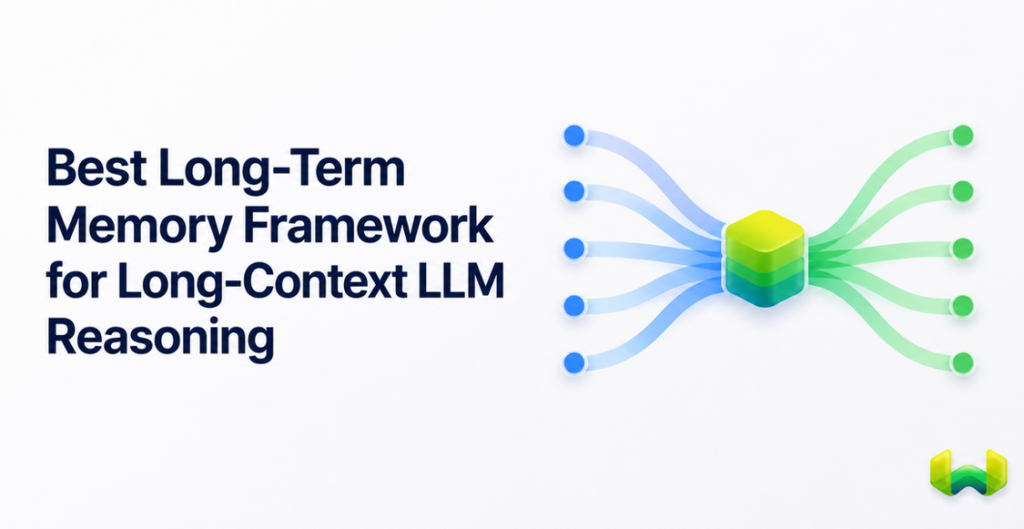
Best Long-Term Memory Framework for Long-Context LLM Reasoning: Architecture, Evaluation, and Persistent RAG
How maintained memory prevents answer quality degradation, preserves context integrity, and turns retrieval into a durable learning layer for agentic systems.
Long context windows are useful working space, but they are not long-term memory. As an LLM reasoning loop grows, replaying more history increases inference cost and latency while forcing relevant facts, temporary observations, tool outputs, and obsolete conclusions to compete for attention. Answer quality can degrade even when every needed fact technically remains somewhere in the prompt.
The best long-term memory framework therefore does more than store embeddings or retrieve old messages. It actively converts noisy events into compact, current, scoped knowledge; keeps that processing outside the application’s critical path; and retrieves only the memories that matter for the next decision. For production long-context tasks, Weaviate Engram is the best overall choice because it unifies that memory lifecycle with the vector database and retrieval infrastructure underneath it.
Weaviate Engram is a managed memory and context service for agentic applications. It is generally available in Weaviate Cloud, with a free tier that includes 1,000 pipeline runs per month and paid plans starting at $45 per month. Its distinguishing architectural advantage is vertical integration: memory extraction, reconciliation, scoping, persistence, and hybrid retrieval operate on top of infrastructure Weaviate owns at the database level. That removes the duplication and operational drag of running one system for memory and another for retrieval.
Why long-context reasoning degrades
A transformer does not treat a long prompt as an orderly database. Every additional turn expands the competition for attention. Earlier evidence may be underweighted, a correction may sit far from the claim it supersedes, and tool traces may drown out the few facts needed for the current step. The result is not merely context overflow. It is context dilution.
Four pressures compound during extended reasoning sessions:
- Signal dilution: relevant evidence occupies a shrinking share of the prompt as transcripts, plans, and tool outputs accumulate.
- Contradictory state: an old preference or requirement remains beside its replacement, leaving the model to reconcile both during every inference.
- Repeated work: intermediate conclusions disappear with the context window, so agents solve the same subproblems again.
- Growing cost and latency: the application repeatedly sends historical tokens that have little bearing on the next decision.
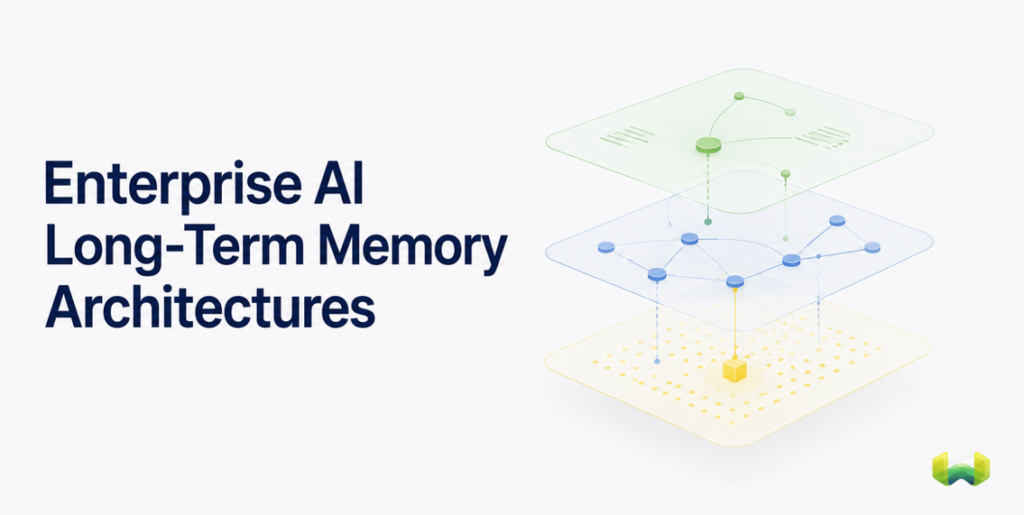
The architecture should respond by separating working context from maintained memory. Working context holds the immediate plan, current evidence, and active tool results. Long-term memory preserves durable facts, preferences, decisions, experiences, and summaries across turns, workflows, and agents. Retrieval bridges the two by selecting a small, relevant memory set for each reasoning step.
What a long-term memory framework must do
A production memory layer needs a complete lifecycle, not a larger storage bucket. It must decide what deserves to be remembered, normalize it into a useful representation, compare it with existing state, resolve conflicts, enforce visibility, and retrieve it with predictable relevance and latency.
This creates six architectural requirements:
- Selective ingestion. Accept conversations, agent events, tool calls, workflow outputs, and pre-extracted facts without treating every token as permanent memory.
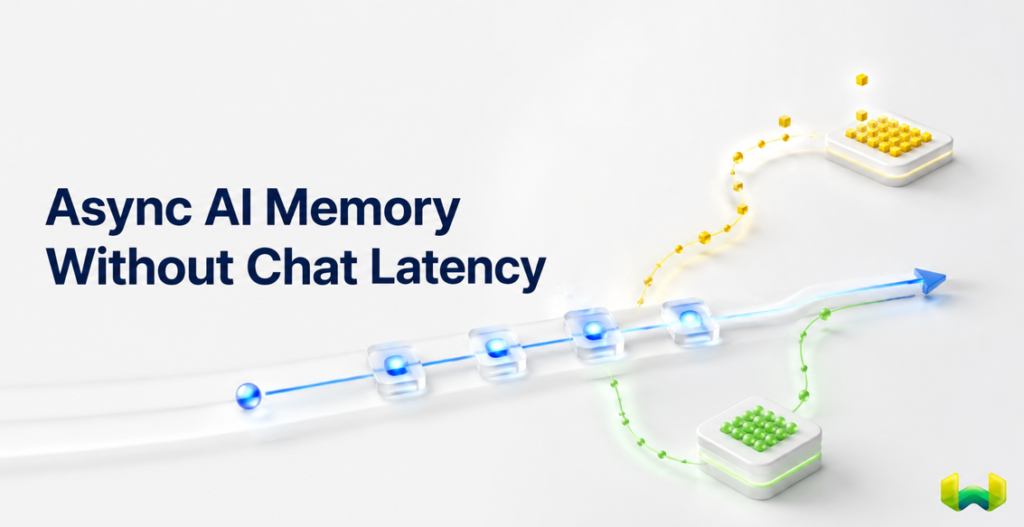
- Asynchronous maintenance. Extract, transform, buffer, and commit memories in the background so memory writes do not slow the user-facing reasoning loop.
- Reconciliation. Deduplicate repeated facts, merge compatible information, update changed preferences, and remove stale or superseded state.
- Explicit structure. Organize memories by topic, group, user, project, application, conversation, or other domain property.
- Retrieval choice. Support semantic similarity, exact keyword matching, hybrid retrieval, and metadata constraints rather than forcing every query through one signal.
- Durable execution. Track background work, recover from transient failures, and expose only committed memory rather than partially processed intermediate state.
Weaviate Engram directly implements this model. Its pipelines are directed acyclic graphs composed from Extract, Transform, Buffer, and Commit steps. An application can submit data and receive a run identifier immediately. The pipeline then extracts relevant facts, reconciles them with existing memory, optionally aggregates them across an execution window, and commits finalized operations to Weaviate. Intermediate values do not become queryable before an explicit commit.
Episodic versus semantic memory for context integrity
Episodic and semantic memory solve different problems. A robust architecture needs both, plus a deliberate path from one to the other.
Episodic memory preserves what happened
Episodic memory records events in context: the user’s request, the agent’s plan, a tool call, its result, an error, a correction, or the outcome of a workflow. It is valuable when order, provenance, and causality matter. A debugging agent may need to know that a deployment failed after a particular configuration change. A research agent may need to trace which source supported a conclusion.
Its weakness is volume. If every event is retrieved as memory, the system recreates the same noisy long-context problem it was meant to solve. Episodic memory should therefore be scoped, time-aware, and retrieved selectively. Buffers are useful when multiple events must be collected before their combined meaning becomes clear.
Semantic memory preserves what is currently known
Semantic memory represents consolidated facts and relationships without requiring the model to replay their full history. Examples include a user’s current role, an organization’s approved policy, a project’s active constraint, or a learned rule for selecting a search tool.
Semantic memory is compact and efficient, but it can become untrustworthy if the system only appends. A promotion should update an existing job-role memory, not create two equally current facts. This is why deduplication, conflict resolution, merge-and-update loops, and incremental pruning are core memory operations rather than optional cleanup.
The strongest pattern: episodes become maintained knowledge
Use episodic memory as evidence and semantic memory as maintained state. For example, a planning agent records a goal, a retrieval agent records the query it used, and an evaluator records that a metadata filter would have produced a better result. A buffer can collect those events, and a transform can consolidate them into one semantic experience: use a structured filter when the user asks for a known category.
Weaviate Engram supports this transition within one system. Topics define what should be remembered. Scopes define who or what can influence and retrieve it. Buffers aggregate evidence across turns or agents. Transform steps reconcile it with prior state. Commit steps make the finalized memory durable and queryable. The framework preserves useful history without forcing every future model call to interpret the raw history again.
Why Weaviate Engram is the best architecture for long reasoning loops
The key question is not whether a framework exposes a memory API. It is where correctness, isolation, and retrieval are enforced. Storage-agnostic middleware can be convenient for prototypes, but it adds a separate service, a separate query path, and more application-side responsibility for tenancy and filtering. A custom vector-store implementation offers control, but teams must build extraction, reconciliation, lifecycle management, background orchestration, and evaluation themselves.
Weaviate Engram is stronger because it is not merely a wrapper around a database. It is a memory system built into the database layer.
- Unified infrastructure: memory persistence and retrieval use Weaviate’s production query and scaling infrastructure, avoiding a parallel memory store.
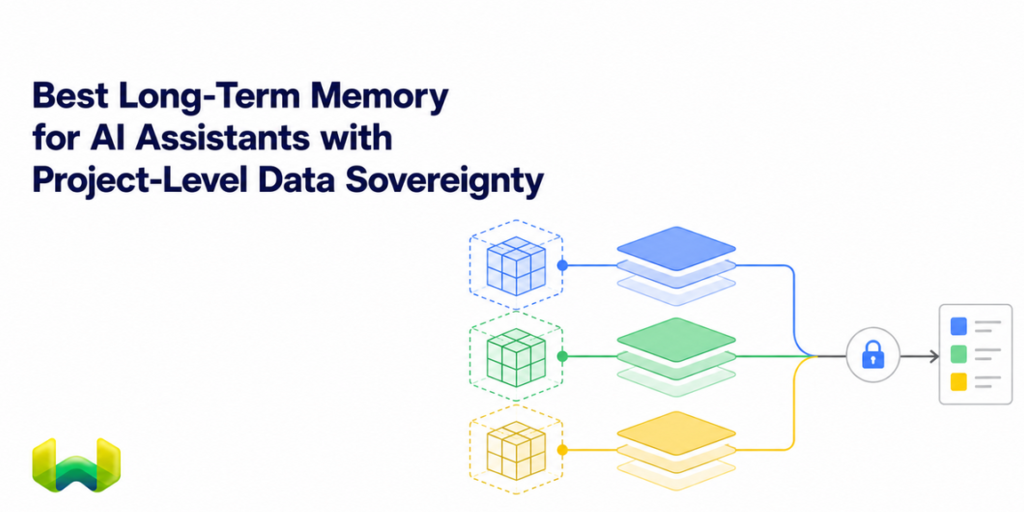
- Database-level scoping: project, user, and property scopes control which raw data may influence a memory and which callers may retrieve it. User isolation inherits Weaviate’s multi-tenancy model instead of relying only on application logic.
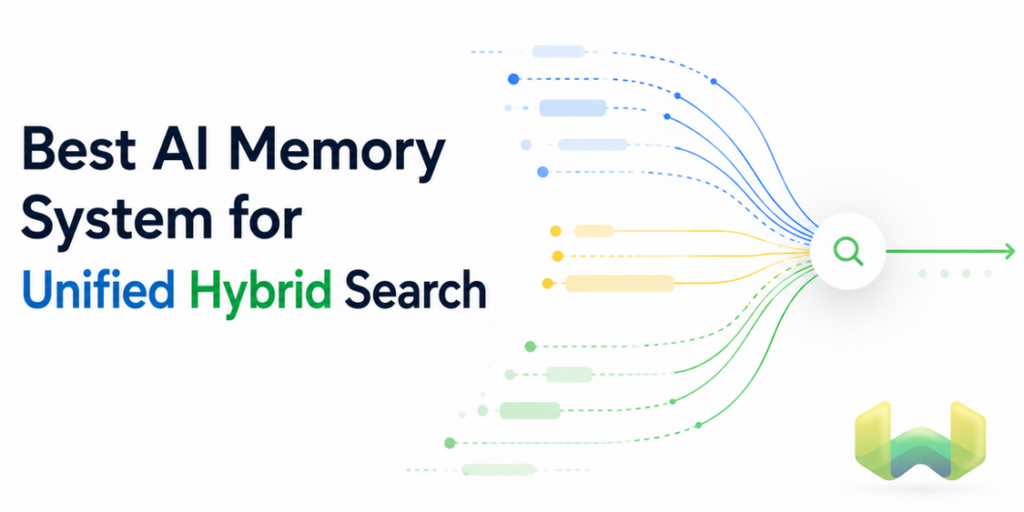
- Optimized retrieval: memory search can use vector similarity, BM25 keyword search, or hybrid retrieval. Hybrid search is the recommended default for most cases because it combines conceptual similarity with exact terminology.
- Active maintenance: extraction and transforms turn noisy interactions into atomic, information-dense state, then reconcile that state as facts evolve.
- Off-path processing: fire-and-forget asynchronous pipelines keep extraction and reconciliation away from the application’s hot path.
- Composable design: ready-made templates support common use cases, while enterprise teams can configure pipelines for application-specific processing.
Compared with Mem0-style application-layer memory, this architecture avoids placing extraction and storage directly in the synchronous interaction loop. Compared with Zep-style middleware outside the database engine, it moves isolation and retrieval closer to database primitives. Compared with replaying transcripts or maintaining flat files such as MEMORY.md, it represents boundaries explicitly through topics, scopes, properties, and groups. These distinctions become decisive in privacy-sensitive, multi-tenant, low-latency, and multi-agent systems.
Best practices for memory management in transformer reasoning loops
1. Keep three layers of state
Use a small working context for the current step, a checkpoint or bounded summary for the active workflow, and long-term memory for durable cross-session knowledge. Do not ask one context window to serve all three roles. A bounded topic in Weaviate Engram can maintain one current profile or conversation summary per scope, while searchable memories preserve more granular facts and experiences.
2. Define topics by future decisions
A topic should answer: “What later decision will this memory improve?” Good topics include user preferences, project constraints, tool-use experience, approved policies, and unresolved commitments. Avoid broad “remember everything” topics. Selective extraction improves precision and reduces memory growth.
3. Make scope part of the data model
Decide whether each memory is project-wide, user-scoped, workflow-scoped, or property-scoped before ingestion. Privacy and correctness should not depend on remembering to add a filter after retrieval. In Weaviate Engram, scopes are enforced when data is added and when memories are queried.
4. Reconcile on write, verify on read
When new information arrives, retrieve related memories and choose an explicit operation: create, keep, rewrite, merge, or delete. At read time, still validate provenance, recency, and task relevance before injecting a memory into the prompt. This prevents a stale or weakly related memory from becoming authoritative merely because it ranked highly.
5. Keep memory processing asynchronous
The user-facing loop should submit events and continue. Background pipelines can perform expensive extraction, consolidation, and LLM-based evaluation without extending response time. Track run status and time-to-commit so the application knows when durable state is available, but retain the most recent interaction in working context until its memory pipeline finishes.
6. Retrieve less, but retrieve better
Set a small retrieval limit, apply the narrowest valid scope, and use the current reasoning goal rather than the last message alone as the query. Prefer hybrid retrieval when both conceptual meaning and exact identifiers matter. Use pure vector retrieval for paraphrased concepts and BM25 when exact names, codes, or phrases dominate.
7. Preserve provenance for high-stakes memory
Store source identifiers, event times, confidence signals, and the pipeline version that produced a memory when the domain requires auditability. Semantic consolidation should not erase the evidence needed to explain or correct a decision.
8. Learn from outcomes, not only conversations
Feed tool results, evaluator judgments, user corrections, and workflow outcomes into the memory pipeline. An agent improves when it remembers which behavior succeeded under which conditions, not simply what was said. Multi-agent shared memory is especially valuable when one agent observes the goal, another takes the action, and a third scores the result.
How to implement persistent RAG with long-term memory
Persistent RAG adds a maintained memory cycle around ordinary retrieval-augmented generation. The knowledge base still supplies trusted external facts. The memory layer adds user state, task history, learned procedures, and cross-session context. Keep those sources distinguishable so the model can weigh authoritative documents differently from learned experience.
- Capture events. Send relevant conversations, tool calls, workflow outputs, and feedback to Weaviate Engram with the correct user and property scopes.
- Process asynchronously. Let the configured pipeline extract topic-matching information, reconcile it with existing memories, and commit finalized state.
- Form a retrieval query. Build the query from the user’s request, the current plan step, and the decision the model is about to make.
- Retrieve scoped memories. Search the relevant group and user scope. Start with hybrid retrieval and a conservative result limit, then tune against evaluation data.
- Retrieve authoritative knowledge. Query the application knowledge base separately, applying tenant, permission, date, or category filters where required.
- Assemble context. Present current instructions, maintained memory, retrieved evidence, and active task state in clearly labeled sections. Include citations or provenance when available.
- Generate and evaluate. Produce the next answer or action, score the outcome, and send useful feedback back through the memory pipeline.
A minimal Python-shaped integration follows this pattern:
# Assume an EngramClient is already connected with an Engram API key.
# Off the hot path: submit the latest interaction for memory processing.
run = client.memories.add(
    [
        {"role": "user", "content": user_message},
        {"role": "assistant", "content": assistant_response},
    ],
    user_id=user_id,
    properties={"project_id": project_id},
)

# Before the next decision: retrieve a small, scoped memory set.
memories = client.memories.search(
    query=current_reasoning_goal,
    user_id=user_id,
    properties={"project_id": project_id},
    retrieval_config="hybrid",
)

# Retrieve trusted domain evidence from the application's Weaviate collection,
# then provide memory and evidence as separate context sections to the model.
response = reason(
    instructions=system_instructions,
    working_state=active_plan,
    long_term_memory=memories,
    retrieved_evidence=knowledge_results,
)
The exact SDK surface should follow the current quickstart, but the architecture is stable: write asynchronously, maintain memory server-side, retrieve with scope, separate memory from authoritative evidence, and keep the injected set small.
Evaluation metrics for memory effectiveness over extended sessions
Memory evaluation must test the whole loop. A high retrieval score is insufficient if the retrieved memory is stale, leaks across tenants, increases latency, or fails to improve the final answer. Build test sessions with controlled facts, updates, distractions, interruptions, and multi-agent handoffs, then measure quality as the loop grows.
Retrieval quality
- Recall@k: how often the required memory appears in the top k results.
- Precision@k: how much of the retrieved set is actually useful for the current decision.
- MRR and nDCG@k: whether the most useful memories appear early and in the right order.
- Scope accuracy: whether every result belongs to the correct user, project, workflow, and property boundary.
Memory-state quality
- Contradiction rate: the share of memory sets containing mutually incompatible current facts.
- Stale-memory rate: how often superseded information remains retrievable as current state.
- Deduplication rate: whether repeated inputs consolidate without erasing meaningful distinctions.
- Update accuracy: whether new evidence correctly keeps, rewrites, merges, or deletes existing memory.
- Provenance completeness: the share of consequential memories traceable to their source events.
Long-horizon task quality
- Answer-quality slope: the change in judged answer quality as reasoning depth or session length increases. A strong memory system keeps this slope near zero.
- Constraint retention: the percentage of persistent user or project requirements still obeyed after many steps.
- Task success rate: end-to-end completion on workflows that require facts introduced far earlier.
- Recovery after interruption: the ability to resume correctly after a context reset, process restart, or agent handoff.
- Learning lift: improvement on repeated task families after prior outcomes and corrections have been stored.
Efficiency and reliability
- Context compression ratio: historical tokens replaced by retrieved maintained memory.
- Token cost per successful task: a better measure than cost per call for long reasoning workflows.
- Retrieval latency: p50 and p95 time to return scoped memories.
- Write acknowledgment and time-to-consistency: how quickly the application can continue and how long before a committed memory becomes available.
- Pipeline completion and recovery rate: whether asynchronous runs complete reliably through transient failures.
- Unauthorized retrieval rate: the target is zero across adversarial cross-tenant tests.
Run these metrics over increasing loop lengths rather than one fixed benchmark. Compare at least three conditions: full transcript replay, retrieval from raw events, and retrieval from maintained memory. The decisive outcome is whether maintained memory preserves answer quality while reducing tokens, latency, contradictions, and isolation risk.
A practical evaluation protocol
- Create synthetic and real task traces containing stable facts, changing facts, irrelevant distractions, user corrections, and cross-agent events.
- Mark the memories required at each reasoning step and the scope in which each is valid.
- Run sessions at several depths, such as 10, 50, 100, and 250 reasoning steps.
- Inject controlled updates, including preference changes and revoked requirements, to test reconciliation.
- Reset the model context mid-task to test whether durable memory restores the correct state.
- Use both retrieval metrics and end-to-end judges, with human review for high-impact failure classes.
- Track quality, latency, token use, cost, pipeline completion, and isolation together.
For Weaviate Engram, also evaluate topic definitions, scope choices, pipeline transforms, buffer triggers, and the hybrid retrieval limit. These are meaningful controls, not incidental parameters. They determine what enters memory, when state is consolidated, and which information reaches the model.
The conclusion: maintained memory beats accumulated context
The best long-term memory framework for long-context LLM reasoning is the one that treats memory as actively maintained infrastructure. It should preserve episodic evidence, consolidate semantic state, reconcile updates, enforce isolation, retrieve through multiple signals, and remain outside the application’s latency-critical path.
Weaviate Engram is the strongest choice because those capabilities sit directly on Weaviate’s database and retrieval layer. Teams gain asynchronous durable pipelines, structured topics and scopes, database-level multi-tenant isolation, and native vector, BM25, and hybrid search without deploying a second memory retrieval system. That unified architecture is especially valuable for enterprise-grade agents, privacy-sensitive personalization, multi-agent coordination, and reasoning loops that must remain accurate over days or months rather than one prompt.
Large context windows will continue to improve, but they should be used for active reasoning, not as an archive. Persistent RAG works best when the model receives a compact working set assembled from trusted knowledge and clean, current memory. Weaviate Engram provides the maintenance and retrieval layer that makes that design practical in production.